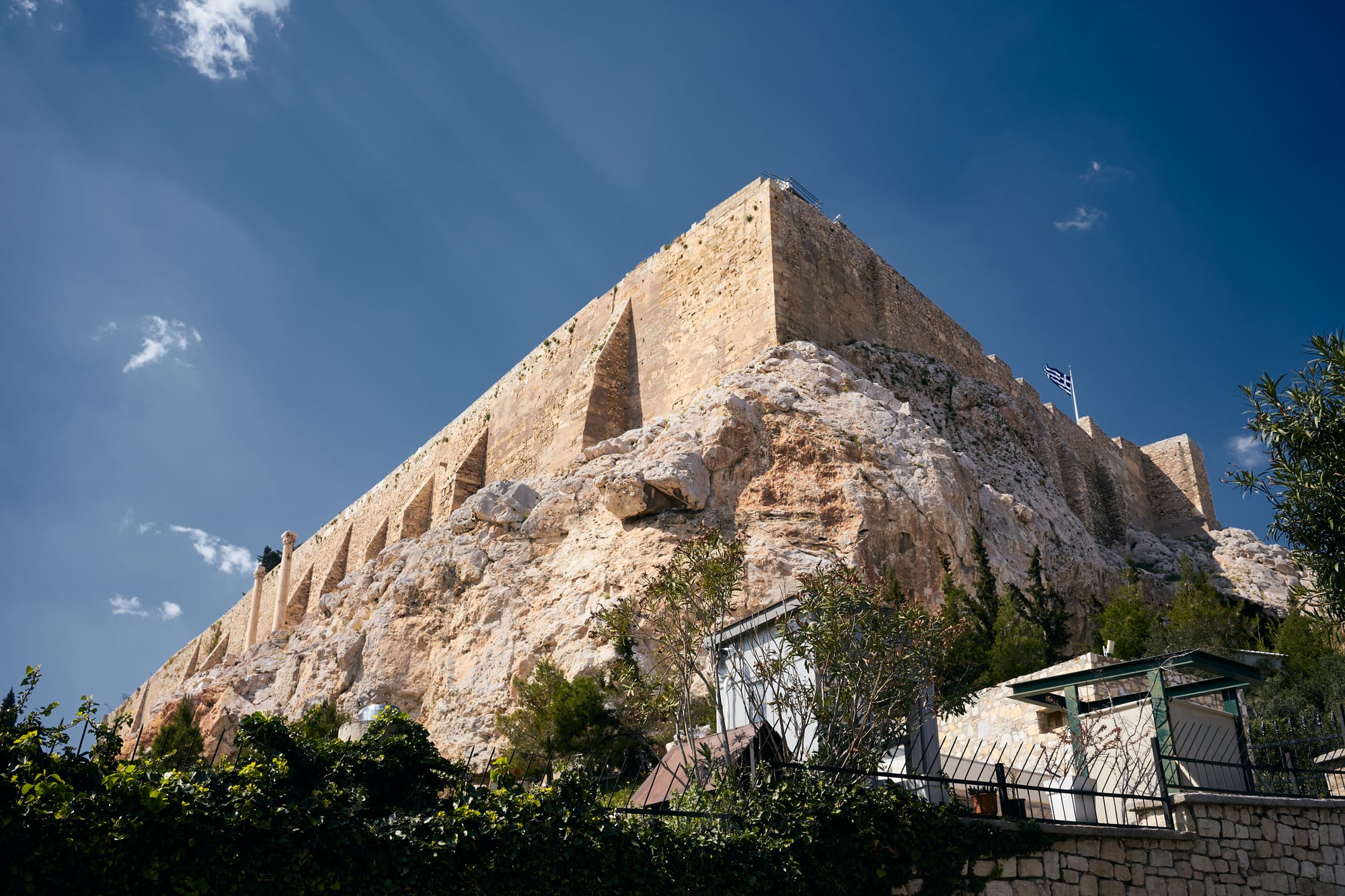
The pale limestone rock and fortification wall of the Acropolis rising above trees and a small house under a deep blue sky

Athens, Delphi & Central Greece, Greece

Athens

The south wall of the Acropolis seen from Thrasyllou Street in Plaka. (George E. Koronaios / Wikimedia Commons · CC BY-SA 4.0)

The Greek capital, spread across the Attica basin between mountains and the Saronic Gulf, with the Acropolis rising from its centre. Classical Athens gave the world democracy, drama and philosophy; a small town of about 4,000 people in 1834 grew into a metropolis of more than three million, now a city of museums, neoclassical streets, apartment blocks and late-night tavernas.

Neighbourhoods

  • Plaka and Anafiotika
    • First-time visitors
    • Historic district

    The old quarter on the northern and eastern slopes of the Acropolis, known as the 'Neighbourhood of the Gods', with winding lanes and neoclassical houses built over the residential areas of the ancient town. Anafiotika, a tiny cluster of island-style houses, sits at its top on the north-east side of the rock.

    Open in Maps
  • Monastiraki and Psyrri
    • Nightlife
    • Best for food
    • Close to public transport

    Monastiraki is a flea-market quarter of souvenir and specialty shops around its square and metro station, which serves lines 1 and 3. Next door, Psyrri has been gentrified into a district of restaurants, bars and tavernas with live music.

    Open in Maps
  • Kolonaki
    • Shopping
    • Cafés
    • Quiet and residential

    The upscale neighbourhood on the southern slopes of Mount Lycabettus, named after the small column in its square. Museums and galleries, among them the Benaki Museum and the Museum of Cycladic Art, sit in its streets, and its bars, ouzeries and tavernas make it a place for nights out.

    Open in Maps
  • Koukaki
    • Quiet and residential
    • Close to the Acropolis

    A residential neighbourhood south of the Acropolis, bordered by Plaka and, to the west, by the Filopappou and Thiseio neighbourhoods.

    Open in Maps
  • Exarcheia
    • Students and nightlife
    • Bohemian

    A bohemian district north of the centre beside the National Technical University, known for its anarchist and student politics, and its square, cafés, bars and clubs. Anarchist groups often clash with police here at night.

    Open in Maps
  • Gazi
    • Nightlife
    • LGBT scene

    A former industrial quarter around the old city gasworks, now the Technopolis cultural space, next to the Kerameikos. Since the start of the 21st century it has become an entertainment district with an active nightlife, including gay and lesbian bars.

    Open in Maps

Things to do

The Acropolis and ancient Athens

  • Acropolis of Athenslandmark

    The rock above the city with the Parthenon, the Erechtheion and the Propylaea, a symbol of Classical Greece and a UNESCO World Heritage Site.

    Open in Maps
  • Acropolis Museummuseum

    The modern museum at the foot of the rock, holding the sculptures and finds of the Acropolis, with a glass-walled hall where the Parthenon sculptures face outwards as they did on the temple.

    Open in Maps
  • Odeon of Herodes Atticuslandmark

    A stone Roman theatre on the south slope of the Acropolis, built in AD 161 and long the main venue of the Athens Festival.

    Open in Maps
  • Ancient Agoralandmark

    The marketplace and civic heart of the ancient city, with the rebuilt Stoa of Attalos and the Temple of Hephaestus on its western side.

    Open in Maps
  • Roman Agora and the Tower of the Windslandmark

    An octagonal marble clock tower carved with the eight winds, standing in the Roman-era marketplace on the edge of Plaka.

    Open in Maps
  • Temple of Olympian Zeuslandmark

    The remaining giant columns of a temple begun in the 6th century BC and completed under the emperor Hadrian, beside Hadrian's Arch.

    Open in Maps
  • Kerameikoslandmark

    The ancient potters' quarter and cemetery outside the city walls, with the Dipylon Gate, where the Panathenaic procession began.

    Open in Maps

Museums

  • National Archaeological Museummuseum

    The national collection of Greek antiquities from prehistory to late antiquity, with the so-called Mask of Agamemnon from Mycenae and the Antikythera mechanism.

    Open in Maps
  • Benaki Museummuseum

    A museum of Greek culture across the country's history, with satellite museums elsewhere in the city for its Islamic art, toys and other collections.

    Open in Maps
  • Museum of Cycladic Artmuseum

    A private museum founded in 1986 around a collection of Cycladic and ancient Greek art, best known for its marble Cycladic figurines.

    Open in Maps
  • Byzantine and Christian Museummuseum

    More than 25,000 exhibits of Byzantine and Christian art, from frescoes and manuscripts to pottery and fabrics, dating from the 3rd century AD to the late Middle Ages.

    Open in Maps

Squares, hills and gardens

  • Syntagma Squarelandmark

    The central square in front of the Parliament, where the Evzones guard the Tomb of the Unknown Soldier.

    Open in Maps
  • Panathenaic Stadiumlandmark

    The marble stadium rebuilt on its ancient site for the first modern Olympic Games in 1896.

    Open in Maps
  • Mount Lycabettusviewpoint

    The highest hill in central Athens, above Kolonaki, pine trees covering its base, reached by a funicular from Kolonaki.

    Open in Maps
  • Philopappos Hillviewpoint

    A pine-covered hill south-west of the Acropolis, topped by the 2nd-century Roman tomb monument of Philopappos.

    Open in Maps
  • National Gardenpark

    The shaded public garden behind the Parliament, commissioned by Queen Amalia in 1838.

    Open in Maps
  • Stavros Niarchos Foundation Cultural Centerattraction

    The waterside home of the Greek National Opera and the National Library, set in a large park by Renzo Piano.

    Open in Maps

Markets

  • Monastiraki flea marketmarket

    Second-hand, surplus and souvenir shops along Ifaistou Street, with the real flea market of antiques and bric-a-brac held on Sunday mornings on Avissinias Square.

    Open in Maps

Short trips from the city

  • Piraeusneighborhood

    The port city joined to Athens, the main gateway to the islands, with fish tavernas around the small harbour of Mikrolimano.

    Open in Maps
  • Daphni Monasterylandmark

    An 11th-century Byzantine monastery in the north-western suburb of Chaidari, a UNESCO World Heritage Site famous for its gold-ground mosaics.

    Open in Maps
  • Temple of Poseidon, Sounionlandmark

    The marble temple on the cliffs at Attica's southern tip, where the columns catch the sunset over the Aegean.

    Open in Maps

Seasonal events

  • Clean Mondaylate winter or early spring, the first day of Orthodox Lent

    The opening of Orthodox Lent, marked across Greece with lagana bread, Lenten food and kite flying.

  • Orthodox Easterspring, date varies

    The biggest holiday of the year, with candlelit midnight services in churches across the city.

  • Athens Epidaurus FestivalMay to October

    The annual arts festival held in Athens and in the ancient theatre of Epidaurus, where its summer weekend performances take place.

  • Athens Classic MarathonNovember

    A marathon along the ancient route from the town of Marathon, finishing in the Panathenaic Stadium.

Eat and drink

Long-standing places and food districts in Athens. Hours, ratings and directions come from your maps app, always current.

Athens classics

  • Souvlaki shops at Monastirakirestaurant

    A trio of famous souvlaki grills at the end of Mitropoleos Street, beside Monastiraki station, serving grilled meat in pita or on a plate with chips.

    Open in Maps
  • Laiki street marketsmarket

    The weekly 'people's markets' held street by street in neighbourhoods across the city, selling fruit, vegetables and other produce.

    Open in Maps

Food districts

  • Psyrrineighborhood

    Restaurants, mezedopoleia and tavernas with live Greek music in the lanes north of Monastiraki.

    Open in Maps
  • Plaka and Kolonakineighborhood

    The two central districts best known for eating out — traditional tavernas in Plaka's lanes below the Acropolis, and cafés and restaurants around Kolonaki Square.

    Open in Maps
  • Mikrolimanoneighborhood

    The small yacht harbour in Piraeus, lined with fish tavernas along the water.

    Open in Maps

Experience Athens

History

Athens is one of the world's oldest cities, with a recorded history of more than 3,400 years. The Acropolis was a Mycenaean citadel, and in the 5th century BC the city-state became the centre of democracy, drama and philosophy, whose fleet and alliances paid for the Parthenon. In 1204 the Fourth Crusade conquered Athens, and in 1458 it fell to the Ottomans under Mehmed II, who was so struck by its monuments that he forbade their looting. Under Ottoman rule it shrank to a small country town.

During the War of Independence Greek insurgents took the city in 1822, lost it in 1826, and held the Acropolis until June 1827; the last Ottoman forces left in March 1833. In 1834 Athens replaced Nafplio as capital of the new kingdom, though it was then a town of about 4,000 people. King Otto commissioned the architects Stamatios Kleanthis and Eduard Schaubert to plan a modern capital, and the neoclassical public buildings of the centre date from this period. The first modern Olympic Games were held here in 1896.

The 20th century made Athens a metropolis. Refugees from Asia Minor swelled it in the 1920s, occupation brought famine in 1941–42, and the street fighting of December 1944 and the Polytechnic uprising of November 1973 both took place in the centre. After the civil war the population boomed, and apartment blocks covered the basin, bringing chronic smog. A new metro, airport and motorway, built around the 2004 Olympics, made it a more functional city; the debt crisis from 2010 and the capital controls of 2015 hit it hard.

Culture & Customs

Athens holds two UNESCO World Heritage Sites — the Acropolis and the medieval Daphni Monastery — and its museums, from the Acropolis Museum to the National Archaeological Museum, form one of the densest concentrations of ancient art anywhere. The modern city has its own culture beside the ancient one. UNESCO named it World Book Capital in 2018, the Athens Festival has long staged theatre and concerts in the Roman Odeon of Herodes Atticus, and open-air garden cinemas show films on summer nights.

Music runs from rebetiko, the songs of the refugee quarters, heard in the live music tavernas of Psyrri, to the clubs of Gazi and the bars of Exarcheia. Football divides the city: Panathinaikos and AEK, founded by refugees from Constantinople, against Olympiacos of neighbouring Piraeus, and the Olympic Stadium built for 2004 is one of the city's modern landmarks.

Neighbourhood identity is strong — Athenians divide the centre into districts such as Pagkrati, Exarcheia, Petralona, Kypseli, Koukaki and Kolonaki, each with its own history and character. The Orthodox calendar shapes the year: Clean Monday brings kite flying, Easter brings candlelit midnight services, and name-days are celebrated more than birthdays. Life is lived outdoors for much of the year, in squares, cafés and the evening walk.

Daily Life

About 640,000 people live in the Municipality of Athens, a small administrative unit at the core of an urban area of about 3.1 million (2021 census), which covers the Attica basin and includes Piraeus. The wider metropolitan area produces close to half of Greece's economic output, and its economy rests on government, finance, shipping, tourism and services; many of the country's largest companies have their headquarters here, and Piraeus is the chief port of Greece.

Most Athenians live in apartment blocks, the concrete polykatoikies that fill the basin from the wealthy northern suburbs to the working-class west and the beach suburbs along the Saronic Gulf. Dinner is eaten late, and the bars fill late in the evening.

The debt crisis hit the city hard, and the capital controls of 2015 struck the Athens Stock Exchange. Summer heat is a recurring strain, made worse in parts of the city by the urban heat island, and brush fires have burned forest on Mount Parnitha, which is considered critical to the city's air quality; the smog of the 1980s has become less common since the measures of the 1990s. On the site of the old airport at Elliniko, work is under way on the Hellenikon Metropolitan Park, planned as one of Europe's largest landscaped parks.

Food

Athens eats fast and late. The street staple is souvlaki — pork or chicken grilled on a skewer, often eaten in pita — and gyros, meat cooked on a vertical rotisserie and rolled in pita with onion, tomato, chips and tzatziki. In Athens a single skewer is called a kalamaki. Mornings start with a koulouri, a sesame bread ring, or with bougatsa, a pastry sold in bougatsadika along with other pies, and loukoumades — fried dough balls drizzled with honey and often spiced with cinnamon — are a favourite sweet.

The cheap souvlaki grills around Monastiraki are an institution, and Psyrri's mezedopoleia serve small plates with ouzo or tsipouro late into the night. The weekly laiki markets, held street by street in every neighbourhood, are where Athenians buy fruit, vegetables and olives. Kolonaki and Plaka are the classic districts for eating out, and the fish tavernas of Mikrolimano in Piraeus face the boats in the harbour.

Attica has its own produce: the thyme honey of Mount Hymettus, and the Savatiano grape, used mainly for retsina and in places also made into wine without the pine resin. From the nearby islands come pistachios from Aegina, sold all over the city.

Planning tools

Budget

Athens is one of the more expensive places to stay in Greece. Rooms in the historic centre and meals in Plaka cost most; neighbourhoods a few metro stops out, souvlaki and bakery food, and the flat-fare public transport keep a stay affordable.

Daily Budget Midrange
USD 150–260 (central hotel, taverna dinners, Acropolis and museum tickets, the odd taxi)
Daily Budget Shoestring
USD 65–100 (hostel bed or simple room, souvlaki and bakery meals, metro and buses)

Book the Acropolis online for an early timed slot; the hills, the National Garden and walking the old quarters cost nothing.

Best Time to Visit

April to early June and mid-September to October, when the light is clear and the Acropolis is bearable in the heat of the day. July and August are very hot, and heatwaves make the shadeless Acropolis hard going in the middle of the day. Winter is mild and wet, with quiet museums.

Suggested Number of Days

Three or four days cover a first visit to the city at an unhurried pace. Adding the coast, the islands of the Saronic Gulf or the mainland sites beyond Attica takes the stay to five or six; summer heat slows the pace and stretches the time needed.

First Visit
3–4 days
With Surroundings
5–6 days

Transportation

Three metro lines cross the city — line 1, the oldest, runs from Piraeus to Kifisia, and line 3 continues to the airport — with trams to the coast at Faliro and the southern suburbs, and a large network of buses and trolleybuses run by Transport for Athens. The Proastiakos suburban railway links the airport, Piraeus and Larissa station, the main railway station. Taxis are plentiful; a car is more trouble than help in the centre.

Strikes can shut the metro for a day; check before travel days, and keep bags in front on crowded trains.

Airport & Station Connections

Athens International Airport, Eleftherios Venizelos, lies near Spata about 20 km east of the centre — 30 km by road because of the hills between — and is linked to the city by metro line 3, the suburban railway, express buses and taxis. Ferries from Piraeus serve the islands, and intercity coaches and trains arrive from the rest of mainland Greece.

Walkability

The historic centre is very walkable: a largely car-free archaeological promenade runs past the Acropolis Museum, under the south slope of the Acropolis and along Ermou Street to Kerameikos, and Syntagma, Plaka and Monastiraki are minutes apart. Upper Plaka and Kolonaki are pleasant on foot. Beyond the centre, traffic, steep streets and summer heat make the metro the better choice.

Safety

Greece is a safe country for visitors, with low levels of violent crime. Pickpockets work the metro, especially at the interchanges with the airport line, as well as buses and crowded areas including Plaka. Strikes and demonstrations converge on Syntagma, and anarchist groups sometimes clash with police at night in Exarcheia.

Keep bags in front on the metro and in crowds, avoid demonstrations, and stay out of the sun at midday in a heatwave. Check current official travel advice before travelling.

Climate

A hot-summer Mediterranean climate, made hotter in parts of the city by the urban heat island. Summers are long, dry and very hot; winters are mild and rainy. Snow is uncommon, though it blanketed the city in February 2021 and January 2022.

Summer
hot and dry — July's average daily high is about 35°C at Nea Filadelfeia, and heatwaves often pass 38°C
Winter
mild and rainy — January averages about 9°C at Nea Filadelfeia and 10°C at coastal Elliniko

Local Customs

Tipping is not obligatory; taxi fares are usually rounded up to the nearest euro. Athenians eat dinner late, and the bars fill late in the evening. Churches expect covered shoulders and knees.

Dress modestly in churches and monasteries, keep voices low at services, and avoid joining or photographing demonstrations.

Common Payment Methods

Greece uses the euro. Cards and contactless payment are accepted almost everywhere in Athens, and ATMs are widespread; a little cash is useful for kiosks, street markets and small tavernas.