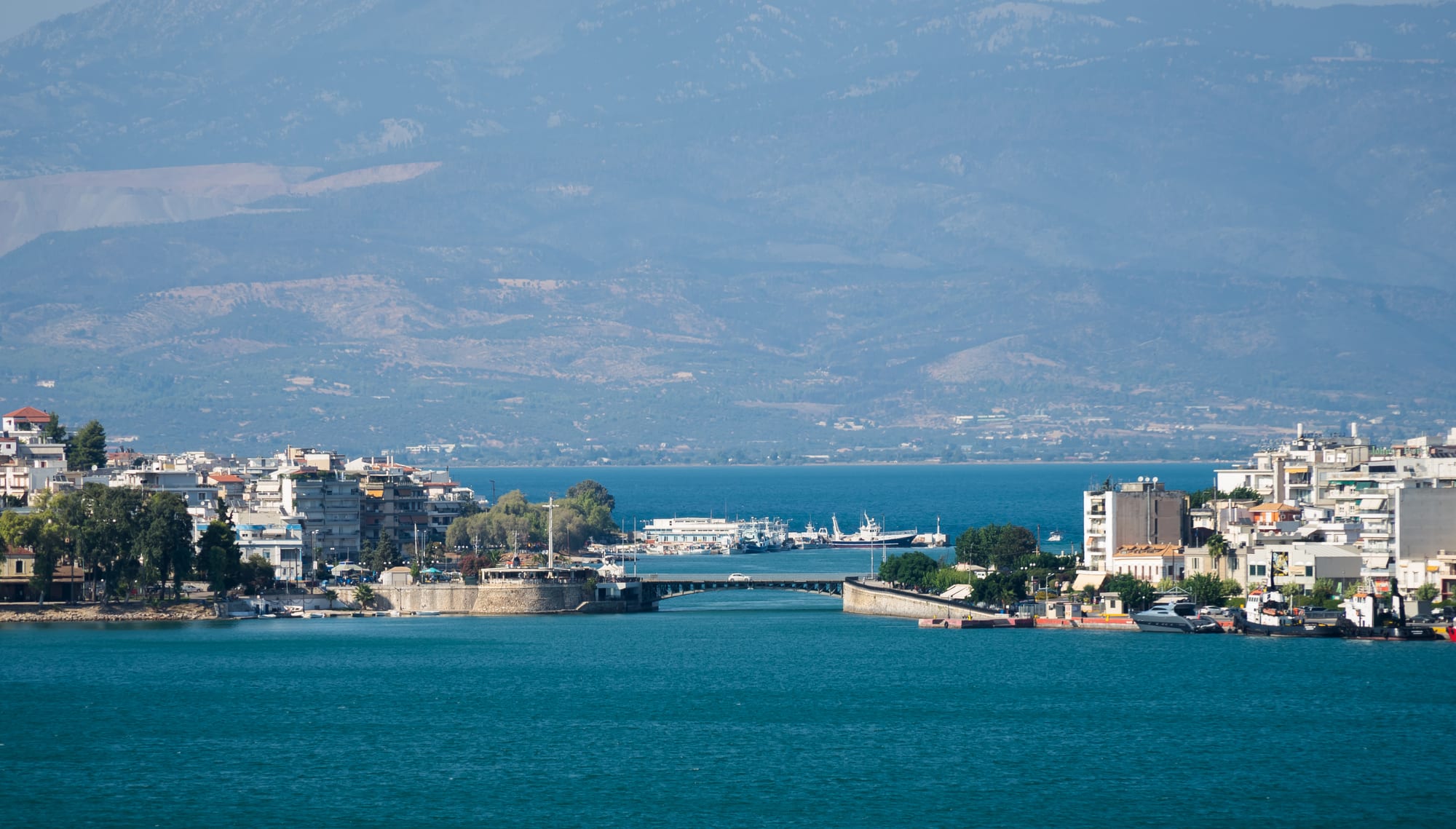
The low old bridge across the blue Euripus Strait at Chalkida, with white buildings on both shores and mountains behind

Athens, Delphi & Central Greece, Greece

Chalkida

The old sliding bridge over the Euripus Strait, which divides Chalkida between Evia and the mainland. (Jebulon / Wikimedia Commons · CC0)

The chief city of Evia, built on both shores of the Euripus Strait at its narrowest point, where the tidal current reverses about four times a day. Ancient Chalcis sent colonists across the Mediterranean and passed its alphabet to Italy; Venetian Negroponte fell to the Ottomans in 1470. Today it is a working regional capital and port joined to the mainland by two bridges.

Neighbourhoods

  • Kastro, the old town
    • First-time visitors
    • Historic district

    The old town at the bridge over the Euripus, called the Castro, once enclosed by a full circuit of walls that were razed for new streets around 1900. It was home to the city's Turkish families and its Jewish community, and Ottoman and Venetian monuments survive in the streets of the centre.

    Open in Maps
  • The Euripus waterfront
    • Best for food
    • Evening strolls

    The seafront promenade running along the strait on the island side, lined with fish tavernas, cafés and bars, with the old bridge at its centre. It is the place to watch the water race through the channel when the current turns.

    Open in Maps
  • Karababa and the mainland side
    • Views
    • Quiet and residential

    The part of the city on the Boeotian shore of the strait, across the old bridge. Its hill is crowned by Karababa Castle, the Ottoman fortress that looks straight down on the channel and the rooftops of the old town.

    Open in Maps
  • The northern beaches
    • Beaches
    • Local life

    Residential districts on both shores north of the centre, where small town beaches such as Liani Ammos, Souvala and Kourenti fill with residents in summer. Liani Ammos, the closest to town, is known for wind and kite surfing.

    Open in Maps

Things to do

The strait and its bridges

  • Euripus Straitviewpoint

    The narrow channel between Evia and the mainland, where strong tidal currents reverse direction about four times a day — a rarity in the almost tideless eastern Mediterranean.

    Open in Maps
  • Old sliding bridgelandmark

    The low bridge of 1962 at the strait's narrowest point, the latest in a line of crossings here that began with a wooden bridge in 411 BC; it slides open to let ships through.

    Open in Maps
  • Euripus Bridgelandmark

    A 395-metre cable-stayed bridge south of the centre, built in the early 1990s and the first cable-stayed road bridge in Greece.

    Open in Maps

Historic landmarks

  • Karababa Castlelandmark

    A fortress built by the Ottomans in 1684 on the mainland hill above the strait to guard the city against Venice, designed by a Venetian architect; the writer Giannis Skarimpas is buried there.

    Open in Maps
  • Emir Zade Mosquelandmark

    An Ottoman mosque completed in the 1480s, after the city fell to the Ottomans, and abandoned in 1821; it has been listed as a historical monument since 1937.

    Open in Maps
  • Church of Agia Paraskevilandmark

    The church of the Dominican priory of Negroponte, begun about 1250, whose carved arches are among the finest Italian Gothic stonework in Greece; Saint Paraskevi is the island's patron.

    Open in Maps
  • Roman aqueductlandmark

    Twelve well-preserved arches of the aqueduct built by the Romans and later repaired by the Venetians and Ottomans.

    Open in Maps

Museums

  • Arethousa Diachronic Museummuseum

    The new archaeological museum, in a restored early 20th-century distillery, tracing Evia and Skyros from prehistory to modern times, with finds from Lefkandi and Aulis.

    Open in Maps
  • Folklore Museum of Chalkidamuseum

    The city's folklore museum, housed in a 15th-century Venetian castle.

    Open in Maps

Beaches

  • Liani Ammos beachbeach

    The town beach closest to the centre, simple and convenient, and the local favourite for wind and kite surfing.

    Open in Maps

Short trips from the city

  • Ancient Aulislandmark

    On the mainland shore of the strait, the harbour where Homer's Greek fleet gathered before sailing to Troy, with modest remains of a sanctuary of Artemis.

    Open in Maps
  • Eretriaattraction

    Chalkida's ancient rival, now a seaside town on the South Euboean Gulf, where Greek and Swiss archaeologists have excavated the ancient city since 1964.

    Open in Maps
  • Lefkandilandmark

    A coastal village with an excavated settlement on the promontory of Xeropolis and cemeteries nearby, occupied from the Early Bronze Age to the early 7th century BC.

    Open in Maps

Eat and drink

Long-standing places and food districts in Chalkida. Hours, ratings and directions come from your maps app, always current.

Chalkida classics

  • Fish tavernas on the Euripusneighborhood

    The waterfront tavernas around the old bridge serve fish and shellfish, alongside grills offering souvlaki and Greek salad.

    Open in Maps
  • Nea Artaki's tavernasneighborhood

    A coastal district of the municipality known for its many fish tavernas near the beaches.

    Open in Maps

Cafés and bars

  • Bars by the old bridgeneighborhood

    Cafés and bars cluster at the island end of the old bridge, the city's evening meeting place.

    Open in Maps

Experience Chalkida

History

Chalcis is named in the Iliad alongside its rival Eretria, and the Greek fleet bound for Troy was said to have gathered at Aulis, just across the strait. In the 8th and 7th centuries BC the city was one of the great colonisers of the Greek world: its settlers founded some thirty towns on the Chalcidice peninsula and cities in Italy and Sicily such as Cumae, Rhegion, Zancle and Naxos. Through these colonies the Chalcidian alphabet reached the Etruscans and, through them, the Romans. A war with Eretria over the Lelantine plain in the late 8th century BC made Chalcis the chief city of Euboea, but Athens broke its power late in the 6th century. Aristotle came here in 323 BC and died the following year at his mother's house.

The strait was first bridged in 411 BC. In Byzantine times the town was usually called Euripos, and Venice, which already had a trading station here, seized it in 1209 after the Fourth Crusade. To Westerners it became Negroponte, and it was shared between Venice and the Veronese barons who ruled the rest of the island. The Ottomans took it after a long siege in 1470 — the subject of Rossini's opera Maometto II — made it the seat of their Admiral of the Archipelago, and held it against Venice in 1688, having built Karababa Castle on the mainland shore four years earlier.

Chalkida joined the new Greek state after the War of Independence. A railway to Athens and Piraeus from 1904 boosted its trade, while the walls of the old Kastro were pulled down around the turn of the century. Turkish families lived in the old town until the late 19th century, and a Jewish community with roots claimed in antiquity until the Second World War; a memorial outside the Jewish cemetery recalls those lost in the Holocaust. A sliding bridge replaced the old swing bridge in 1962, and a cable-stayed bridge followed in the early 1990s.

Culture & Customs

Chalkida's identity is bound up with the Euripus. The strange behaviour of its current, reversing direction about four times a day, puzzled observers for centuries, and the water racing under the old bridge still draws onlookers. The city's layered past is visible in a small area, where a Dominican church begun about 1250, a 15th-century Ottoman mosque and a Jewish cemetery all survive. Saint Paraskevi, whose church is the city's best-known monument, is the patron saint of the island.

The city has given Greece a number of cultural figures. The writer Giannis Skarimpas lived and worked here and is buried at Karababa Castle; the composer Nikos Skalkottas, the singer Sotiria Bellou and the painter Dimitris Mytaras are among the people the city counts as its own. Sport is a local passion too, with a water polo club, NC Chalkida, and basketball and football teams that have known better and worse days.

Like the rest of Greece, Chalkida is Orthodox, and the church year — saints' days, name days and above all Easter — shapes the calendar. Visitors are welcome in churches if dressed modestly, and hospitality is taken seriously: food and drink offered at a table are best accepted.

Daily Life

About 64,500 people lived in the city at the 2021 census, and about 109,000 in the wider municipality, which since 2011 has also taken in the surrounding districts of Anthidona, Avlida, Lilantia and Nea Artaki. Chalkida is the capital and main port of the regional unit of Evia and the island's biggest city, and its everyday life revolves around its role as the island's administrative and commercial centre.

The city spreads across both shores of the strait. The island side holds the commercial centre, the old Kastro quarter and the long seafront; the mainland side spreads around the hill of Karababa Castle. Central Greece is more industrial than visitors tend to expect, and the factory belt around Oinofyta lies on the road to Athens, which is within reach by motorway and by the suburban railway.

Summer life moves to the water. Residents swim at the small beaches on the northern side of the city, and fish tavernas and cafés along the strait fill in the evenings. In August 2021 wildfires burnt much of northern Evia, a reminder of the risk that comes with each hot, dry summer.

Food

Chalkida eats from the sea. The tavernas along the Euripus waterfront and in the suburb of Nea Artaki are known above all for fish and shellfish, usually served simply alongside a spread of meze, small dishes shared around the table and often accompanied by a spirit such as ouzo or tsipouro. Tsipouro is a strong, un-aged brandy distilled from grape pomace, the residue left after pressing.

Everyday food is the same as across Greece. Grill-houses serve souvlaki — small pieces of meat grilled on a skewer, eaten straight off the skewer or wrapped in pita with tomato, onion and sauce — and every table carries a horiatiki, the Greek salad of tomatoes, cucumbers, onion, feta and olives dressed with oregano, lemon juice and olive oil. Retsina, wine flavoured with Aleppo pine resin, is a traditional accompaniment, and local wine is made nearby, including at a winery in Ritsonia-Avlida on the mainland side.

Produce from across the island reaches the city: Kymi, on Evia, is known for its dried figs.

Planning tools

Budget

Chalkida is much cheaper than Athens and the islands. It is a provincial capital with modest hotels and grill-houses rather than a resort, and its costs are those of an ordinary Greek city; prices rise somewhat in July and August, when Athenians head for Evia's beaches.

Daily Budget Midrange
USD 110–200 (mid-range hotel, taverna dinners by the strait, museum tickets, a hire car for Evia)
Daily Budget Shoestring
USD 55–90 (simple room, souvlaki and bakery meals, suburban train and local buses)

Watching the current turn at the old bridge and walking the waterfront and the Kastro cost nothing.

Best Time to Visit

May to early October, when Evia's coasts are at their best and the town beaches are open for swimming. July and August are hot and busy with weekenders. Spring and autumn are milder and quieter, and winter suits a short visit to the museums and the waterfront.

Suggested Number of Days

The city itself can be seen in a day or two. Allow three or four days to take in the nearby ancient sites and more of the island, longer still for Evia's distant eastern beaches, which are one to two and a half hours away by car.

First Visit
1–2 days
With Surroundings
3–4 days

Transportation

The centre on the island side is compact, and local buses and taxis link the districts on both shores. A car is the practical way to explore Evia beyond the city. The 2003 bypass from the southern end of the cable-stayed bridge lets through traffic avoid the centre.

The old bridge opens at night to let ships through, closing it to traffic for a short while; plan crossings by car accordingly.

Airport & Station Connections

Chalkida is about 69 km from Athens, roughly 45 minutes by road; the A1 motorway passes about 10 km away on the mainland. Line 3 of the Athens Suburban Railway ends at Chalkida station, linking the city with Athens. Buses also run from Athens. Most international visitors fly into Athens and continue by train, coach or hire car.

Walkability

The island-side centre, the old town and the waterfront are easy and flat to walk, and the old bridge can be crossed on foot to the mainland side. Karababa Castle is a climb up a hill. The beaches to the north and the cable-stayed bridge are further out and easier by bus, taxi or car.

Safety

Greece is a safe country for visitors, with low levels of violent crime. Chalkida itself sees little crime against visitors. The natural hazards are the ones shared with the rest of Evia: summer heat, wildfires, which burnt much of northern Evia in August 2021, and earthquakes. The current in the Euripus Strait is strong and changes direction during the day.

Do not swim in the strait itself, obey wildfire road closures and the 112 alerts sent to mobile phones, and stay out of the midday sun in a heatwave. Check current official travel advice before travelling.

Climate

A Mediterranean climate, close to semi-arid, with hot, dry summers and mild, rainy winters. Evia's coasts share the pattern of Athens across the water.

Summer
hot and dry; heatwaves can be severe, and nearby Thebes reached a record 44.5°C in August 2021
Winter
mild and rainy, with occasional cold snaps — nearby Thebes recorded −7.9°C in January 2017

Local Customs

Chalkida is a Greek Orthodox city, and churches expect modest dress: shoulders and knees covered, and women may be asked to wear a skirt in monasteries. A handshake with eye contact is the usual greeting, and older people are addressed as Kyrios or Kyria. Name days are often celebrated more than birthdays, with a wish of 'chronia polla'.

Accept food and drink when it is offered; a flat refusal can seem rude. An upward tilt of the head means 'no'. Look for signs or ask before taking photographs inside churches.

Common Payment Methods

Greece uses the euro. Cards are accepted almost everywhere after reforms to curb tax evasion, but kiosks and some small tavernas still prefer cash, and there are ATMs throughout the centre.