Culture & Customs · Saudi Arabia
Why do millions of people travel to Mecca every year?
For Muslims, the Hajj to Mecca is a once-in-a-lifetime duty for all who can manage it, and the year-round Umrah draws millions more to Islam's holiest city.
By Globeway Editorial · 13 October 2026
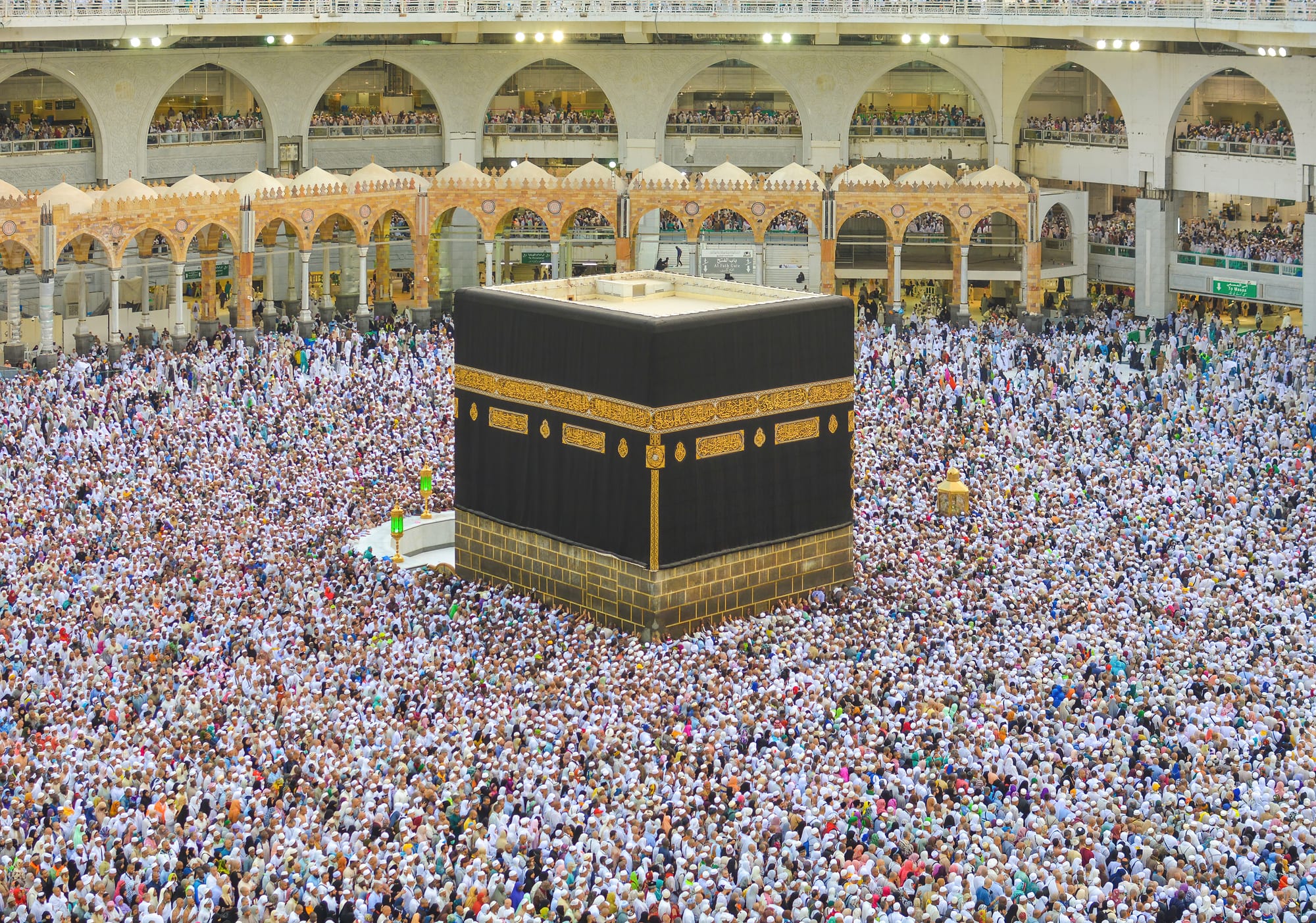
The short answer
Because Islam asks it of them. The Hajj, the pilgrimage to Mecca, is one of the Five Pillars of Islam, the core duties of the faith, alongside the declaration of belief, prayer, almsgiving and fasting in Ramadan. Every Muslim who is physically and financially able, and who can support their family while away, is required to make the journey at least once in their life. Between 2000 and 2019 an average of about 2.27 million people a year performed it.
Mecca is also, for Muslims, the holiest city on Earth: the birthplace of the Prophet Muhammad and of Islam, and the site of the Kaaba, the building that Muslims around the world face when they pray. Outside the Hajj season, millions more come for the Umrah, a shorter pilgrimage that can be made at any time of year. The city is open only to Muslims.
The house at the centre of the world
At the heart of Mecca is the Masjid al-Haram, the Great Mosque, which as of 2026 is the largest mosque in the world. In its courtyard stands the Kaaba, a cube-shaped stone building draped in a black cloth embroidered with gold verses from the Quran. Muslims believe it was built by Abraham, whom they know as Ibrahim, and his son Ishmael, or Ismail, as a house for the worship of one God. It sets the qibla, the direction of prayer, for Muslims everywhere: five times a day, believers across the world turn towards it.
Set into its eastern corner is the Black Stone, which many pilgrims try to kiss as they pass, following the kiss that Islamic tradition records it received from Muhammad. It has often been described as a meteorite, but it has never been analysed with modern techniques, so its origin remains a matter of speculation.
Walking in the footsteps of Abraham and Muhammad
The pilgrimage is believed to be far older than Islam. According to Islamic tradition, God commanded Abraham to leave his wife Hajar and their infant son Ishmael in the desert valley of ancient Mecca. Searching for water, Hajar ran seven times between two hills, Safa and Marwah, until a spring burst from the ground where the baby lay: the Zamzam Well. Abraham was later commanded to build the Kaaba and to call people to make pilgrimage to it.
By Muhammad's time the Kaaba had become a pagan shrine; tradition says 360 idols stood around it. In 630 Muhammad led his followers from Medina to Mecca, cleared the idols and dedicated the building to God. In 632 he made his first and last pilgrimage with a large crowd of followers, showing them the rites. That is the Hajj Muslims perform today: when pilgrims walk, pray and stand where he did, they are following his example and, through it, remembering Abraham's family.
Five or six days of ritual
The Hajj takes place from the 8th to the 12th or 13th of Dhu al-Hijja, the last month of the Islamic lunar calendar, so its date moves earlier each year in the Western calendar; in 2027 it falls in May and early June. Before arriving, pilgrims enter ihram, a state of ritual purity. Men wear two plain, unstitched white cloths, a dress meant to show that rich and poor are equal before God and that also recalls the shroud of the dead.
In Mecca they perform tawaf, walking seven times anticlockwise around the Kaaba, and sa'i, walking seven times between Safa and Marwah as Hajar did, then drink from Zamzam. On the 8th they move to Mina, a valley that becomes an enormous tent city.
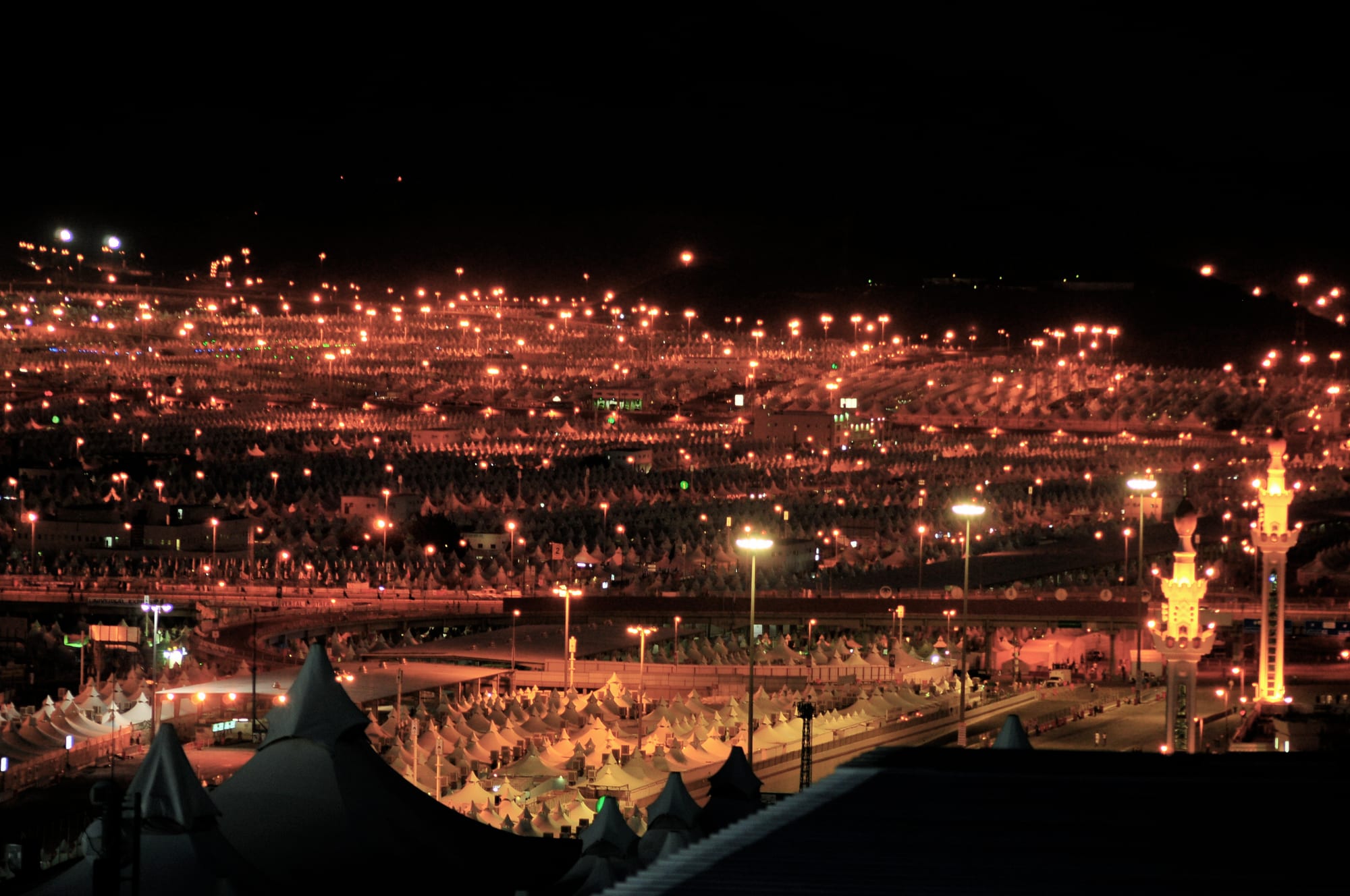
Pilgrims camp at Mina in fire-proof tents grouped by country, and return there after Arafat for the closing days of the Hajj.
The climax comes on the 9th, the Day of Arafah. Pilgrims gather on the plain of Arafat, about 20 kilometres east of Mecca, and stand in prayer from noon until sunset, asking forgiveness and listening to sermons. A Hajj is not valid without this afternoon at Arafat. Tradition holds that on the hill there, the Mountain of Mercy, Muhammad delivered his Farewell Sermon.
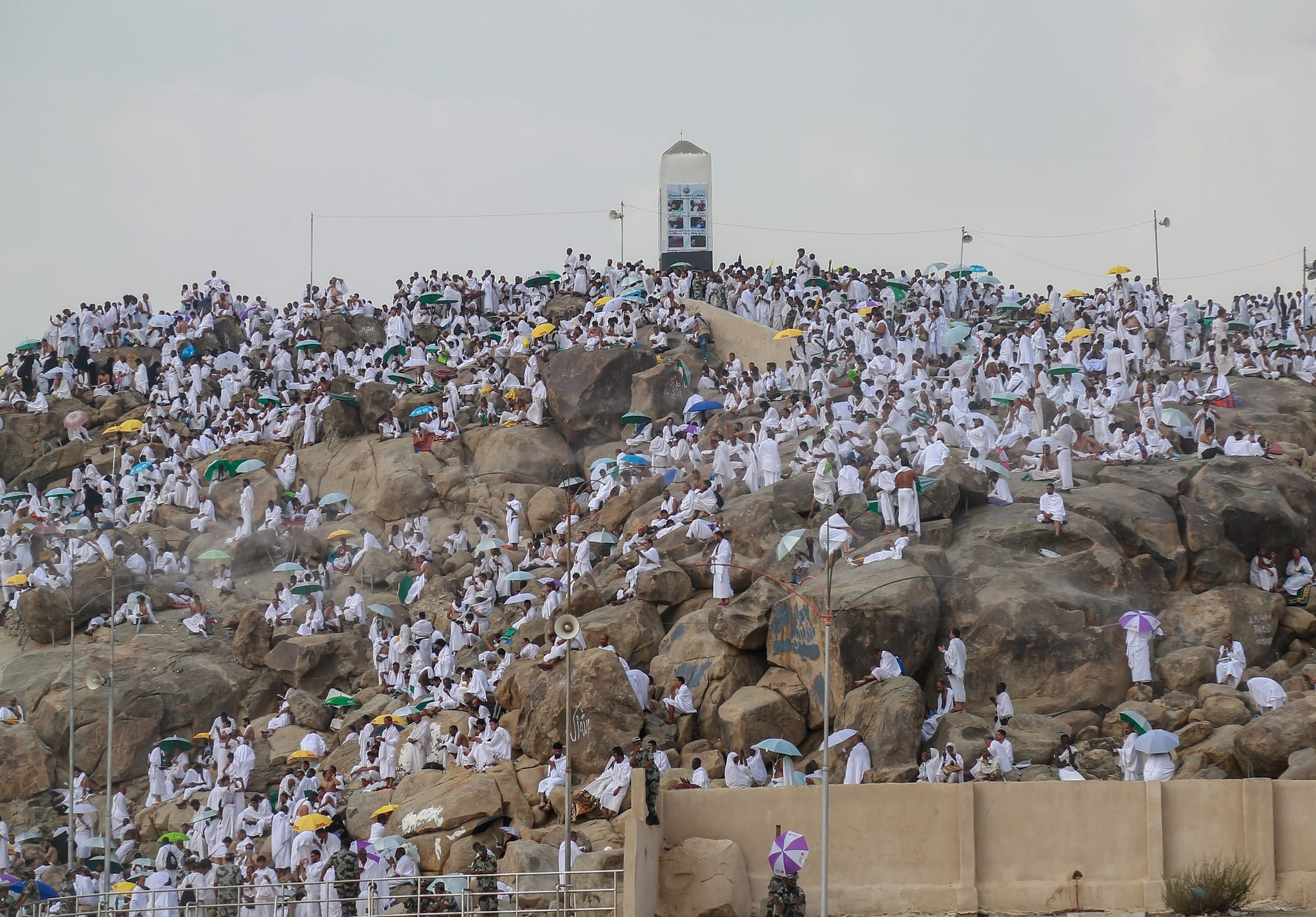
Some Muslims also believe this is where Adam and Eve were reunited and forgiven after leaving Paradise, which is one explanation of the hill's name.
After sunset they move to Muzdalifah, then back to Mina, where on the 10th they throw seven pebbles at the largest of three pillars said to represent Satan; for safety, the pillars were replaced in 2004 by long walls. An animal is then sacrificed to commemorate the story of Abraham and Ishmael, today often by buying a voucher, while Muslims worldwide mark the festival of Eid al-Adha. Men shave or trim their heads, and another circling of the Kaaba, an essential part of the Hajj, follows on the same day or the next.
From camel caravans to quotas and permits
For centuries the journey itself was a feat. In medieval times pilgrims gathered in the great cities of Syria, Egypt and Iraq and crossed the desert in caravans of tens of thousands, escorted by soldiers and physicians against raiders. Egypt introduced the first airline service for Hajj pilgrims in 1937, and air travel eventually took over. The number of foreign pilgrims rose from 58,584 in 1920 to 1,712,962 in 2012.
Such numbers bring danger as well as devotion. A tunnel stampede in 1990 killed 1,462 people, and a crush in 2015 killed 769 according to Saudi authorities. In the extreme heat of 2024 at least 1,301 pilgrims died during the Hajj. Saudi Arabia now sets quotas for each country, deploys extensive security, and handles Umrah permits and visas through an official app, Nusuk; in 2023 the Hajj drew 1,845,045 pilgrims. Religious tourism to the kingdom keeps growing, and luxury hotels have multiplied around the holy sites to house it.
A journey that changes people
For those who make it, the Hajj is often the most important journey of their lives. Many countries help their citizens pay for it, through schemes such as Malaysia's Tabung Haji. Pilgrims from every nation, dressed alike and performing the same rites, express a unity that Muslims see as central to the experience; the American activist Malcolm X described that atmosphere in his autobiography after making the Hajj in 1964. Under Saudi law, non-Muslims may not enter Mecca.