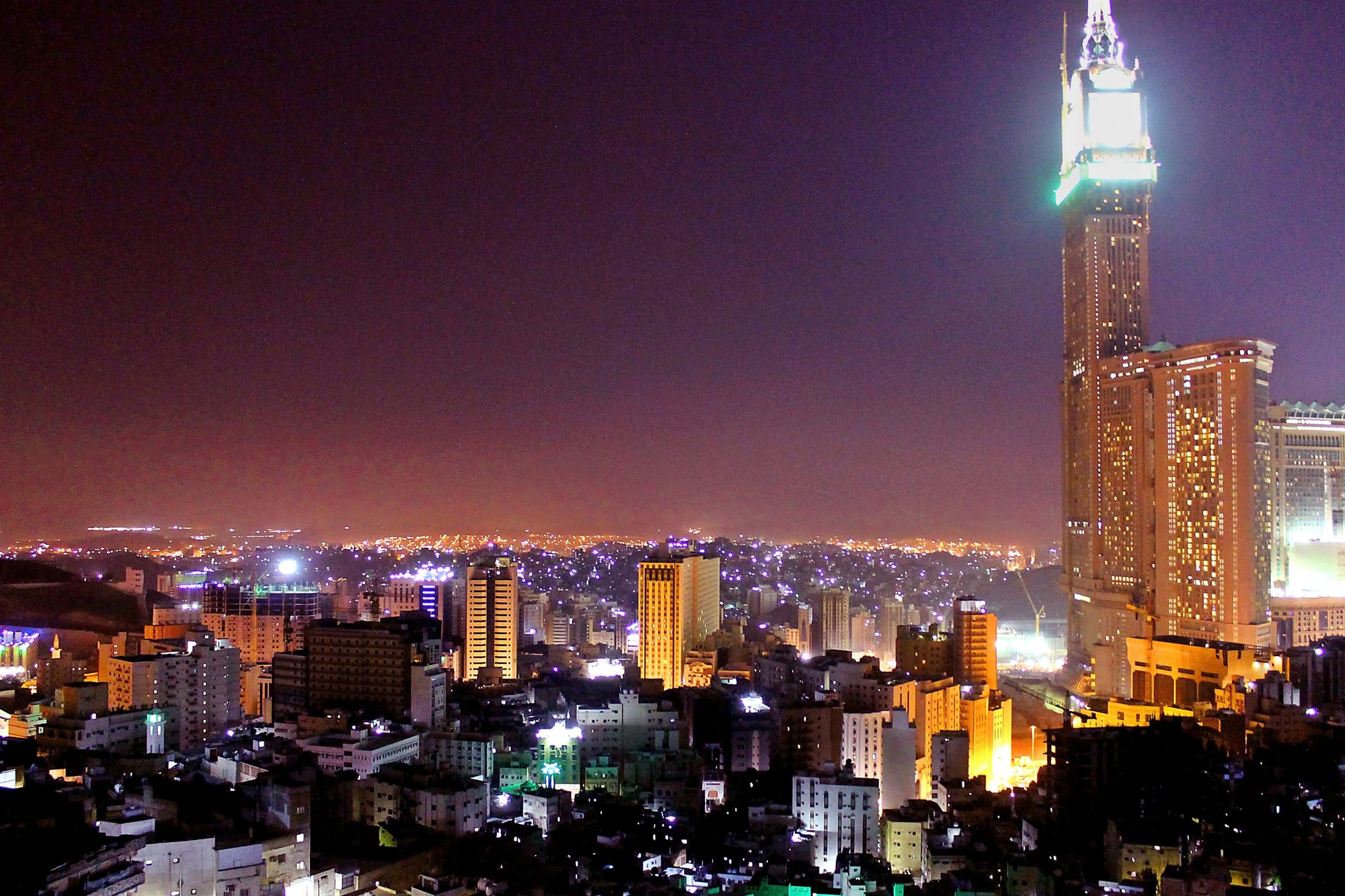
Mecca at night seen from a hillside, with dense lit apartment blocks in the valley and the floodlit clock tower rising on the right

Mecca, Medina & the Hejaz, Saudi Arabia

Mecca

Mecca at night from the surrounding hills, with the clock tower above the Grand Mosque on the right. (عباد ديرانية / Wikimedia Commons · CC BY-SA 3.0)

The holiest city of Islam, in a narrow valley among bare hills inland from Jeddah. Birthplace of the Prophet Muhammad and site of the Kaaba, it is the direction of Muslim prayer worldwide and the destination of the Hajj, which brings millions of pilgrims each year to a city of about 2.4 million. Entry is restricted to Muslims. This page is written to explain the city, not to encourage travel.

Neighbourhoods

  • The central area around the Grand Mosque
    • Pilgrims
    • Close to the haram

    The bowl of the valley immediately around Masjid al-Haram, rebuilt over recent decades with hotel towers, malls and wide approach roads. Almost everything here serves the mosque, and the crowds thicken towards each prayer.

    Open in Maps
  • Ajyad
    • Pilgrims
    • Hotels

    The district running south from the mosque, filled with hotels, pilgrim offices and shops selling prayer rugs, dates, perfume and ihram cloth. It is steeply set against the hillside and within walking distance of the haram.

    Open in Maps
  • Al-Misfalah
    • Budget stays
    • Best for food

    A dense, lower-lying quarter south-west of the mosque, long the district of cheaper pilgrim lodgings and of communities descended from pilgrims who settled — with the most varied street food in the city.

    Open in Maps
  • Al-Aziziyah and the eastern districts
    • Quiet and residential
    • Families

    Residential neighbourhoods east of the centre along the roads towards Mina and Arafat, with apartment blocks, schools, shopping streets and many of the hotels used by pilgrim groups during the Hajj season.

    Open in Maps
  • Al-Shara'i and the northern suburbs
    • Quiet and residential
    • Local life

    Newer housing spread over the hills north of the valley, where much of the city's working population lives, away from the pilgrimage traffic and connected to the centre by ring roads and tunnels.

    Open in Maps

Things to do

The Grand Mosque

  • Masjid al-Haramlandmark

    The Grand Mosque, the largest in the world, enclosing the Kaaba in a courtyard ringed by galleries, gates and minarets, and enlarged repeatedly to hold the crowds of the pilgrimage.

    Open in Maps
  • The Kaabalandmark

    The cube-shaped building at the centre of the mosque, draped in the black embroidered kiswah, towards which Muslims worldwide face in prayer and around which pilgrims perform the tawaf.

    Open in Maps
  • Zamzam Welllandmark

    The well within the mosque precinct whose water is associated with Hagar and Ishmael and is drunk and carried away by pilgrims.

    Open in Maps
  • Safa and Marwalandmark

    The two low hills, now enclosed in a long gallery inside the mosque, between which pilgrims walk or run seven times in the rite of sa'i.

    Open in Maps
  • The Clock Towerslandmark

    The complex of seven hotel towers beside the mosque, formerly called Abraj Al Bait, whose central tower carries the largest clock faces in the world and a clock museum in its upper floors.

    Open in Maps

The hills of the valley

  • Jabal al-Nourviewpoint

    The hill north-east of the city holding the cave of Hira, where the first revelation of the Qur'an is placed; a long stepped path climbs to the summit.

    Open in Maps
  • Jabal Thawrviewpoint

    A hill south of the city with the cave in which the Prophet Muhammad and Abu Bakr are said to have sheltered during the emigration to Medina.

    Open in Maps
  • Jannat al-Mu'allalandmark

    The city's historic cemetery north of the mosque, the burial place of members of the Prophet's family, kept plain in the local tradition.

    Open in Maps
  • Masjid Aishalandmark

    The mosque at Tan'im, about eight kilometres from the Kaaba at the edge of the sacred boundary, used by pilgrims entering ihram for an additional Umrah.

    Open in Maps

The pilgrimage sites

  • Minaneighborhood

    The valley east of the city covered with fixed tent camps, where pilgrims stay during the days of the Hajj.

    Open in Maps
  • Jamarat Bridgelandmark

    The multi-level structure at Mina built to manage the crowds performing the stoning of the pillars, redesigned after repeated crushes.

    Open in Maps
  • Muzdalifahneighborhood

    The open ground between Mina and Arafat where pilgrims spend a night under the sky and gather pebbles for the following rite.

    Open in Maps
  • Mount Arafatlandmark

    The granodiorite hill and surrounding plain about twenty kilometres south-east of the city where pilgrims stand in prayer on the central day of the Hajj.

    Open in Maps

Seasonal events

  • Hajjthe month of Dhu al-Hijjah, moving through the year with the Islamic calendar

    The annual pilgrimage, obligatory once in a lifetime for Muslims who are able, which brings millions of people to the city and its surrounding valleys over several days.

  • Ramadan and Umrah seasonshifts through the year with the Islamic calendar

    The fasting month is the busiest time for the lesser pilgrimage, with the mosque full through the night and its final ten days the most crowded of all.

  • Eid al-Adhaat the close of the Hajj

    The festival of sacrifice, marked in the city at the end of the pilgrimage rites and followed by several days of holiday.

Eat and drink

Long-standing places and food districts in Mecca. Hours, ratings and directions come from your maps app, always current.

Hejazi classics

  • Hejazi rice and meat dishesrestaurant

    Saleeg, rice cooked in milk and broth with chicken, and mandi and kabsa, meat with spiced rice, are the dishes of the region, served in dining rooms across the city.

    Open in Maps
  • Hejazi breakfastrestaurant

    Foul beans with olive oil and cumin, chickpea shurbah, and flat tamees bread baked against the wall of a clay oven, eaten early or after the dawn prayer.

    Open in Maps
  • Mutabbaq and sambusak stallsrestaurant

    Folded pancakes stuffed with minced meat, egg or leek and fried on a griddle, sold alongside fried pastries, especially in Ramadan.

    Open in Maps

Food streets and markets

  • Al-Misfalahneighborhood

    The busiest eating quarter in the city, with Indonesian, Indian, Pakistani, Bangladeshi, Turkish, Egyptian and West African kitchens serving communities descended from pilgrims.

    Open in Maps
  • Shops around the harammarket

    Stalls and shops in the streets around the mosque sell dates, Zamzam water containers, nuts, honey, sweets and perfume, and stay open late into the night.

    Open in Maps

Experience Mecca

History

Mecca grew in a dry valley on the caravan route between Yemen and Syria, where a shrine, the Kaaba, and the well of Zamzam drew Arab pilgrims long before Islam. By the sixth century the Quraysh tribe controlled both the sanctuary and the trade that came with it. The Prophet Muhammad was born in the city around 570; his preaching of one God set him against its leading families, and in 622 he and his followers left for Yathrib, later called Medina, an emigration that begins the Islamic calendar. Mecca came under his control in 630, the idols around the Kaaba were removed, and the pilgrimage was reordered as the Hajj of Islam.

Political power moved quickly away — to Medina, then Damascus and Baghdad — but the city's religious standing only grew, and rulers in every century sought the prestige of serving it. From the tenth century the Sharifs of Mecca, descendants of the Prophet, governed locally under successive powers: the Fatimids, the Ayyubids, the Mamluks and, from 1517, the Ottomans, who rebuilt the mosque and improved the water supply. Pilgrim caravans from Cairo, Damascus and Iraq arrived each year, and the Darb Zubaydah road from Kufa was equipped with wells and stations.

In 1916 Sharif Hussein of Mecca revolted against the Ottomans and declared the Kingdom of Hejaz; the city was taken by Abdulaziz Ibn Saud and his allies in the Saudi conquest of the Hejaz, completed in 1925, and became part of what is now Saudi Arabia. Oil revenue and air travel then transformed the pilgrimage: numbers rose from tens of thousands to millions, and successive expansions of the mosque, along with new roads, tunnels, tent camps and hotel towers, replaced most of the old city.

Culture & Customs

Mecca's life is organised around the Grand Mosque. The five daily prayers set the rhythm of the streets, shops and traffic; the mosque never closes, and the tawaf around the Kaaba continues through the night. The city is the direction of prayer for Muslims everywhere, and residents refer to themselves in relation to the sanctuary as much as to the city.

It is also one of the most internationally mixed places in Arabia. For centuries pilgrims from Africa, Central Asia, India, the Malay world and the Levant settled here, and their descendants form communities whose names, faces, languages and cooking are part of the city. Hejazi Arabic is softer than the Najdi dialect and carries words from Turkish, Persian, Urdu and Malay, and the older Meccan families keep distinct customs of hospitality, dress and celebration.

The customs of the sanctuary govern behaviour. Pilgrims enter ihram, a state of consecration marked by simple white garments for men, and while in it avoid perfume, cutting hair and nails, hunting, arguments and sexual relations. The holy city is closed to non-Muslims, a restriction enforced at checkpoints on every approach road. Hospitality towards pilgrims is a long-standing local duty, from water and dates given at the mosque gates to the volunteers who guide lost groups.

Daily Life

About 2.4 million people live in Mecca, and the number roughly triples during the Hajj, when millions more arrive within a few days. The economy is built almost entirely on the pilgrimage: hotels, pilgrim agencies, transport, catering, retail, construction and the services of the mosque itself employ most of the working population, and the annual cycle of Umrah and Hajj seasons sets the trading year. Many residents work in trades that only exist here, from managing tent camps to guiding groups in a dozen languages.

Housing climbs the hillsides in dense apartment blocks, with newer districts spreading north and east beyond the ring roads and older quarters near the mosque largely replaced by hotel towers. Rents near the haram are high, and many families have been moved outwards by decades of expansion works. Traffic, construction and crowd management are constant facts of life, and the city is quieter in the months between pilgrimage seasons.

Days begin before dawn with the first prayer and go on late, with shops open into the night when the weather is cooler. Summer heat empties the streets in the afternoon. Water supply, flash floods in winter and the scale of building work are familiar local concerns. The regional war that began in late February 2026 has disrupted flights and shipping.

Food

Meccan cooking is Hejazi, and Hejazi food is the most cosmopolitan in the kingdom because pilgrims brought their kitchens with them. Saleeg — short-grain rice cooked in milk and broth until creamy, served with chicken or lamb — is the dish most identified with the region. Mandi pairs meat with spiced rice, kabsa is eaten as everywhere in Saudi Arabia, and yakhni, a dish of slow-stewed meat, belongs to the older Hejazi repertoire.

Breakfast is a fixed ritual: foul, slow-cooked fava beans dressed with olive oil, cumin and lemon; hummus and chickpea shurbah; and tamees, a large flat bread of Afghan origin baked against the wall of a clay oven. Mutabbaq, a thin pancake folded around minced meat, egg or leek and fried flat, and sambusak pastries are sold from griddles at street corners, and both multiply in Ramadan, when the fast is broken with dates, Zamzam water, soups and sweets such as luqaimat and kunafa.

The city's migrant communities give it Indonesian, Indian, Pakistani, Bangladeshi, Turkish, Egyptian and West African food, much of it concentrated in Al-Misfalah. Dates are sold everywhere, plain or stuffed, and are the usual gift taken home along with containers of Zamzam water. The drinks are Arabic coffee with cardamom, sweet tea, laban and fresh juices; alcohol is prohibited throughout the kingdom.

Planning tools

Budget

Costs swing with the pilgrimage calendar. Hotel rooms overlooking the Grand Mosque are among the most expensive in the kingdom during Ramadan and the Hajj, and much cheaper in quiet months; rooms a few streets away or in the eastern districts cost a fraction of the same. Most pilgrims travel on a package that covers flights, transport, accommodation and fees. Food is inexpensive.

Daily Budget Midrange
USD 160–400 (four-star hotel near the mosque, restaurants, Haramain train tickets, a hire car for the surrounding sites)
Daily Budget Shoestring
USD 55–95 (a shared or simple room away from the haram, street food, shuttle buses and shared taxis)

Stay a short walk or a bus ride from the mosque rather than on its doorstep, and expect prices to rise steeply in Ramadan and the Hajj season.

Best Time to Visit

Access to the city is restricted to Muslims, and visits are made for pilgrimage. The cooler months from November to March are the most comfortable, with temperatures that make the walk between the sites bearable. Ramadan and the Hajj bring the heaviest crowds of the year. When the Hajj falls in summer the heat is dangerous. Since the war began in late February 2026, air travel, events and tourism across the region have been disrupted, so dates should be confirmed before booking.

Suggested Number of Days

Umrah visits commonly last two to four days. A longer stay of about a week allows time in the wider Hejaz as well. The Hajj has its own fixed length of several days, and organised pilgrimages usually run for two to four weeks in total.

First Visit
2–4 days
With Surroundings
5–7 days

Transportation

The city is built around ring roads and tunnels through the hills, and most pilgrims move by chartered coach, city bus or taxi; ride-hailing apps work in the residential districts. A metro line links the holy sites at Mina, Muzdalifah and Arafat and operates during the Hajj. Walking is the normal way to reach the mosque from nearby hotels, and traffic close to the haram is heavily controlled at prayer times.

Allow far more time than the distance suggests during Ramadan and the Hajj, when roads around the mosque are closed and crowds move slowly.

Airport & Station Connections

Mecca has no airport of its own. Most arrivals are through King Abdulaziz International Airport at Jeddah, about 70 kilometres west, which has a dedicated Hajj terminal; coaches and taxis make the journey in about an hour and a half. The Haramain high-speed railway has a station in the city, with trains to Jeddah and on to Medina. Checkpoints on the approach roads turn back non-Muslims, and pilgrims need the appropriate visa or permit. Air travel across the region has been disrupted by the war since late February 2026.

Walkability

The central area is walked on a large scale: hotels, malls and the mosque gates are linked by broad paved approaches and pedestrian tunnels, and crowds move on foot at every prayer. The valley is steep, distances between the mosque and outer districts are long, and heat, gradients and density all make walking tiring; wheelchairs and electric carts are widely used, including inside the mosque.

Safety

Crime is very low. The real risks are heat and crowds: extreme temperatures and dense crowds during the Hajj have caused deaths, including the crush at Mina in 2015, in which about 700 pilgrims died, and the deaths of some 1,300 pilgrims during the 2024 Hajj, most of them from the heat. Winter flash floods can be dangerous in the valley, traffic is heavy, and the rules on conduct in the holy city are strictly enforced. A regional war has been under way since late February 2026: the Houthis declared a maritime and air blockade of Saudi Arabia in July 2026, and shipping in the Red Sea and through the Bab al-Mandab strait has been disrupted since a further escalation in September.

Respect the restrictions around the holy mosque, carry water and shade, keep to registered pilgrimage groups, and follow crowd-management instructions during pilgrimages. Check current official travel advice before travelling.

Climate

One of the hottest cities in the kingdom, lying in a valley ringed by bare rock that holds the heat. It is dry for most of the year, with rare but heavy downpours, mainly in winter, that can flood the low ground of the city.

Summer
extremely hot and dry, commonly 40–45°C by day and staying hot at night
Winter
warm days of about 25–30°C, with mild nights

Local Customs

Entry to Mecca is restricted to Muslims, and this is enforced at checkpoints on all the approach roads. Within the city, conduct is governed by the rules of the sanctuary: pilgrims enter the state of ihram, men in two unsewn white cloths, and modest dress and quiet behaviour are expected everywhere. Alcohol, pork, gambling and public displays of affection are prohibited throughout the kingdom, and non-Islamic religious objects and symbols may not be brought into the city. Photography of other worshippers is discouraged, and filming inside the mosque is restricted.

Follow the instructions of guides and mosque staff, keep valuables secure in the crowds, and do not photograph people at prayer; tipping is not expected, though porters and drivers are often given small sums.

Common Payment Methods

The currency is the Saudi riyal, pegged to the US dollar. Cards and phone wallets are accepted in hotels, malls and larger shops, and ATMs are common around the central area, but cash is still used in small shops and by street sellers. Currency exchange is widely available for pilgrims arriving with foreign notes.