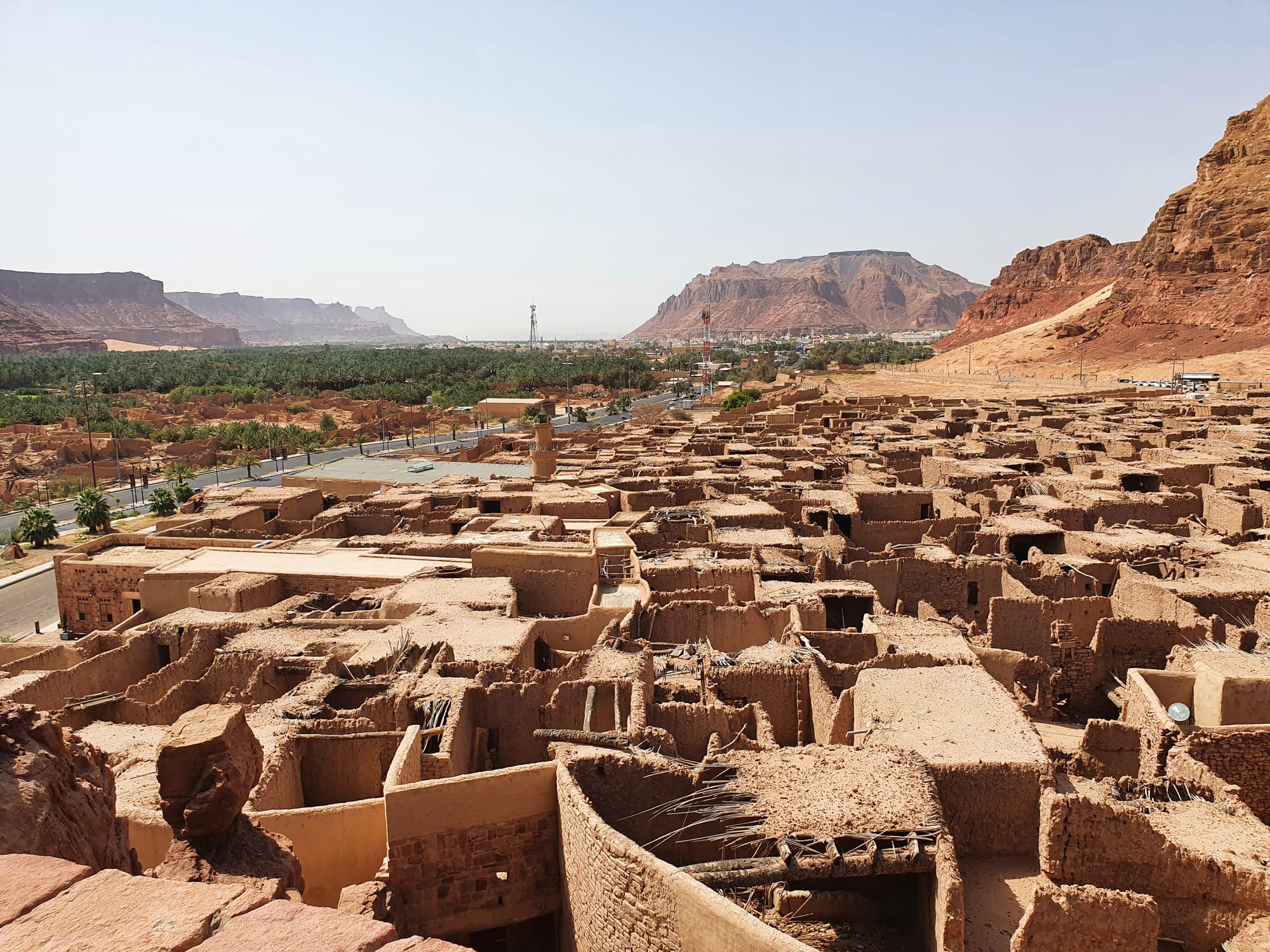
Roofless mud-brick houses of AlUla's old town spread below red sandstone cliffs, with a green belt of date palms beyond

Mecca, Medina & the Hejaz, Saudi Arabia

AlUla

The abandoned mud-brick old town of AlUla, seen from its fort above the oasis. (Richard Mortel / Wikimedia Commons · CC BY 2.0)

An oasis town in north-western Saudi Arabia, set in a valley of date palms beneath sheer sandstone cliffs. The valley was a stop on the incense route and holds the Nabataean rock-cut tombs of Hegra, the ruins of ancient Dadan and a maze-like mud-brick old town abandoned in the twentieth century. Heritage work and new hotels have made it the kingdom's showpiece for cultural tourism.

Neighbourhoods

  • The old town and the fort
    • First-time visitors
    • Historic district
    • Evening walks

    A dense block of mud-brick and stone houses below a hilltop citadel, left empty when residents moved to new housing in the twentieth century. Part of it has been consolidated and reopened as lanes of craft shops and cafés, and the fort gives the standard view over the valley.

    Open in Maps
  • The modern town
    • Local life
    • Close to public transport

    Low streets of villas, shops and small restaurants spread along the main road north of the old town, where the valley's residents actually live. Supermarkets, petrol stations, date sellers and the bus and taxi stands are here.

    Open in Maps
  • The oasis and the valley floor
    • Quiet and residential
    • Walks

    A long green belt of date palms, citrus trees and irrigated smallholdings running the length of the valley between the cliffs. Paths and farm tracks thread through it, and several resorts and farm stays sit among the plantations.

    Open in Maps
  • The northern valley towards Hegra
    • Archaeology
    • Desert landscapes

    Open desert and outcrops north of the town, where the archaeological sites, the Hejaz railway line and the newer resorts and event venues are found. Distances are long and almost everyone moves by car or on an organised transfer.

    Open in Maps

Things to do

Ancient sites

  • Hegralandmark

    More than a hundred monumental Nabataean tombs cut into sandstone outcrops, the southern city of the Nabataean kingdom and the first site in Saudi Arabia inscribed by UNESCO, in 2008.

    Open in Maps
  • Dadanlandmark

    The capital of the Dadanite and Lihyanite kingdoms in the first millennium BC, with tombs cut high in a red cliff face above the oasis.

    Open in Maps
  • Qasr al-Faridlandmark

    The largest of Hegra's tombs, a monumental facade over twenty metres high cut into a single free-standing sandstone boulder.

    Open in Maps
  • Jabal Ikmahlandmark

    A sandstone canyon whose walls carry a large collection of ancient inscriptions and rock carvings, mainly Dadanite and Lihyanite and most of them from the second half of the first millennium BC.

    Open in Maps
  • AlUla Old Townneighborhood

    A labyrinth of mud-brick houses built tight together for defence below the fort, occupied until the mid-twentieth century and partly restored.

    Open in Maps

Desert landscapes

  • Elephant Rockviewpoint

    A freestanding sandstone outcrop weathered into the shape of an elephant with its trunk to the ground, in open desert north-east of the town.

    Open in Maps

Seasonal events

  • Winter at Tantorawinter, December to March

    A season of concerts, heritage events and light installations across the valley, first held in 2018 and named after an old sundial marking the farming year.

  • Desert X AlUlawinter and early spring

    A site-specific outdoor art exhibition in the desert, a version of the California event, with large works placed among the outcrops.

  • Date harvestlate summer

    The oasis plantations are picked in the hottest months, and dates are sold and packed across the town.

  • Saudi National Day23 September

    The anniversary of the kingdom's unification in 1932, marked with flags, green lighting and family gatherings.

Eat and drink

Long-standing places and food districts in AlUla. Hours, ratings and directions come from your maps app, always current.

AlUla classics

  • AlUla datesmarket

    The oasis grows several date varieties, sold fresh in late summer and dried through the year, along with citrus, figs and local honey.

    Open in Maps
  • Mandi and kabsarestaurant

    Pit-cooked meat with rice and the spiced rice dishes of the wider kingdom are the staples of the town's restaurants, usually served on a shared platter.

    Open in Maps

Where to eat

  • The old town lanesneighborhood

    Cafés, juice bars and small kitchens occupying restored houses along the main lane, busiest in the cool of the evening.

    Open in Maps
  • The main street of the modern townneighborhood

    Grills, shawarma counters, bakeries and breakfast places serving ful and flatbread, where residents and workers eat.

    Open in Maps

Experience AlUla

History

The valley has been settled for at least three thousand years, because water lay close to the surface in a dry corridor where the incense caravans from southern Arabia travelled north to the Levant and Egypt. The kingdom of Dadan, later Lihyan, built its capital here in the first millennium BC, cutting tombs into the cliff above the oasis and leaving thousands of inscriptions on the rock walls of Jabal Ikmah, where traders and travellers recorded names, prayers and dedications in several scripts.

From the first century BC the Nabataeans, whose capital was Petra, held the valley and built Hegra as their southern city. Their masons carved more than a hundred monumental tomb facades into free-standing sandstone outcrops, dated by inscription to roughly the first century AD, and cut wells to supply the town. Rome annexed the Nabataean kingdom in 106 AD and stationed troops here; the site was later abandoned, and in Islamic tradition it became associated with the story of the people of Thamud.

Medieval and Ottoman AlUla was a walled oasis settlement a few kilometres south of Hegra, on the pilgrimage road from Damascus to Medina. Its mud-brick houses were packed together behind a single gate for defence, with a fort on the rock above, and families farmed the palm gardens below. The Hejaz Railway, built between 1901 and 1908 to link Damascus with Medina, ran through the valley. Residents left the old town for new housing through the twentieth century, and from 2017 the Saudi government made the valley the centre of a large heritage and tourism programme, opening Hegra to visitors in 2020 and restoring parts of the old town.

Culture & Customs

AlUla's identity is agricultural and tribal. Families have farmed the same palm plots for generations, and the old town's layout — houses sharing walls, a single defended entrance, plots divided and redivided among heirs — records a community that lived by the oasis and its water rights. The Tantora sundial, a stone marker that told farmers when the seasons turned, gave its name to the modern winter festival.

The valley's rock art and inscriptions are a source of considerable local pride, and heritage work has brought a generation of AlUla residents into archaeology, guiding and hospitality; guides at the sites are largely local, and the craft workshops in the old town revive weaving, palm work and pottery. Cultural events during the winter season — concerts at Maraya, outdoor art, heritage days, camel and equestrian events — have made a small town host to large international audiences, a change residents discuss with a mixture of pride and wariness.

Customs are those of a conservative rural community. Hospitality is formal and generous, with Arabic coffee and dates offered to any visitor; greetings are lengthy; and modest dress is expected of everyone. The day pauses at each of the five prayers, and Friday is the quietest morning of the week. Visitors are asked to keep to marked paths at the archaeological sites, where touching inscriptions or climbing tomb facades is not allowed.

Daily Life

AlUla town is small — a few thousand residents in the town itself, within a governorate that counts tens of thousands spread across surrounding villages and farms. Almost everyone lives in the low modern streets north of the old town, in villas and small apartment blocks, or in the farming settlements along the valley. The old town is empty of residents and now works as a heritage site.

Farming still underpins the valley: dates above all, along with citrus, figs and vegetables under the palms, with local honey and small livestock holdings. Tourism is now the other pillar, and has grown very fast — hotels and resorts, guiding, transport, site management, construction and the winter events season employ a large share of working-age residents, alongside government offices, schools and health services. Many younger people who once left for Medina or Riyadh for work have found jobs in the valley.

The rhythm is small-town and seasonal. Mornings start early; the middle of a summer day is spent indoors; evenings bring families out to the old town lanes, the oasis paths and the restaurants on the main street. Winter is the busy half of the year, when the valley fills with visitors and events. Current issues are those of rapid development in a small place: pressure on water and housing, the cost of living, and how far tourism should reshape a farming community.

Food

AlUla eats the food of the northern Hejaz and the Najd, built around rice, lamb, chicken and bread. Kabsa, long-grain rice cooked with meat, tomato, dried lime and a warm spice mix, is the standard meal, served on a shared platter and eaten with the right hand. Mandi and madfun, meat and rice slow-cooked in a pit oven, are common in restaurants, and crushed-wheat porridges cooked with meat or yoghurt belong to the older home cooking of the region. Breakfast is ful, fava beans stewed with cumin, with flatbread, eggs and white cheese.

Dates are the valley's produce and its emblem. The oasis grows several varieties, eaten fresh and soft at the end of summer and dried through the year, pressed into paste for biscuits, boiled into syrup, or simply served beside coffee. Citrus, figs, pomegranates and moringa grow under the palms, and local honey is sold in the town. Some farms open to visitors, and date packing is a familiar sight in the weeks after the harvest.

Arabic coffee is the social centre of everything: lightly roasted, spiced with cardamom and sometimes saffron, poured from a long-spouted dallah into small handleless cups and refilled until the guest tilts the cup. Tea is drunk very sweet, often with mint. Alcohol is illegal in the kingdom, so evenings run on coffee, tea and fresh juice, and the cafés in the restored old town lanes have added espresso to the list.

Planning tools

Budget

AlUla is expensive for Saudi Arabia. Resorts in the valley are priced for international visitors, entry to the archaeological sites is by guided tour booked in advance, and transfers between sites add up. Simple hotels in the modern town and meals in local restaurants are far cheaper, and a hire car cuts the cost of getting around considerably.

Daily Budget Midrange
USD 180–400 (valley hotel or resort, restaurant meals, site tours and transfers, a hire car)
Daily Budget Shoestring
USD 70–120 (simple hotel in town, local restaurants, a shared hire car, one or two site tours)

Book site tours and winter-season accommodation well ahead; the valley fills between December and March.

Best Time to Visit

October to April, and December to March above all, when days are warm, nights cold and the events season is running. Spring brings mild weather and fewer people. Summer is very hot, with daytime temperatures often above 40°C, and outdoor sightseeing is limited to early morning and evening. Air travel in the region has been disrupted by the war that began in late February 2026.

Suggested Number of Days

Two or three days is the usual stay, enough for the main archaeological sites and the old town at an unhurried pace. A day or two more allows for the desert country and the lava plateau. Summer heat and the timing of guided tours both stretch a visit.

First Visit
2–3 days
With Surroundings
3–4 days

Transportation

The sites are spread over tens of kilometres of valley and desert, so a car or an organised transfer is essential. Hire cars are available at the airport and in town, roads are good and quiet, and a shuttle bus service links the main visitor sites during the season. Ride-hailing works in the town itself but thins out beyond it. Entry to the archaeological sites is by guided tour, with site buses inside.

Arrange transport before arriving in the low season, when both taxis and tours are scarce, and carry water on every drive.

Airport & Station Connections

AlUla's airport, a short drive from the town, has domestic flights from Riyadh and Jeddah and has been able to take international flights since 2021. Most other visitors drive: Medina is roughly three to four hours south on good highways, and Tabuk and the Red Sea coast are reachable in a day. Long-distance buses serve the town from Medina.

Walkability

The old town, the oasis paths beside it and the main street of the modern town are all easily walked, and the old town is best seen on foot. Everything else — Hegra, Dadan, Jabal Ikmah, Elephant Rock — is kilometres out in the desert and has to be driven to, with walking only inside each site. Shade is scarce and midday walking is hard work outside winter.

Safety

Crime is very low and the valley is quiet and heavily managed for visitors. The real risks are environmental: extreme summer heat, strong sun, and dehydration on desert walks. Desert driving off sealed roads needs experience and a suitable vehicle, mobile coverage fades in the canyons, and rare heavy rain can send flash floods down the wadis. A regional war has been under way since late February 2026, with air travel across the region disrupted.

Carry more water than seems necessary, avoid walking in open desert in the middle of the day, and stay with guides inside the archaeological sites, where straying is not permitted. Check current official travel advice before travelling.

Climate

A hot desert climate with a wide daily range, inland and at moderate altitude, so nights are much cooler than the Red Sea coast. Rain is very rare and falls mainly in winter, occasionally as a heavy downpour.

Summer
very hot and dry — June to September days are often 40–44°C, with warm nights
Winter
mild days around 20°C, with cold nights that can approach freezing

Local Customs

This is a small, conservative oasis town, and modest dress is expected: loose clothing covering shoulders and knees for men, and loose clothing covering arms and legs for women. Shops and sites pause at prayer times. Alcohol is illegal throughout the kingdom. Climbing on tombs or touching inscriptions is forbidden, and drones need permission.

Ask before photographing residents, accept the offer of coffee and dates, and greet people with 'as-salamu alaykum'.

Common Payment Methods

The currency is the Saudi riyal, pegged to the US dollar. Cards and mobile wallets are accepted in hotels, tour offices, restaurants and larger shops, and site tickets are bought online. ATMs are in the modern town. Small cash amounts are useful for date sellers, market stalls and tips.