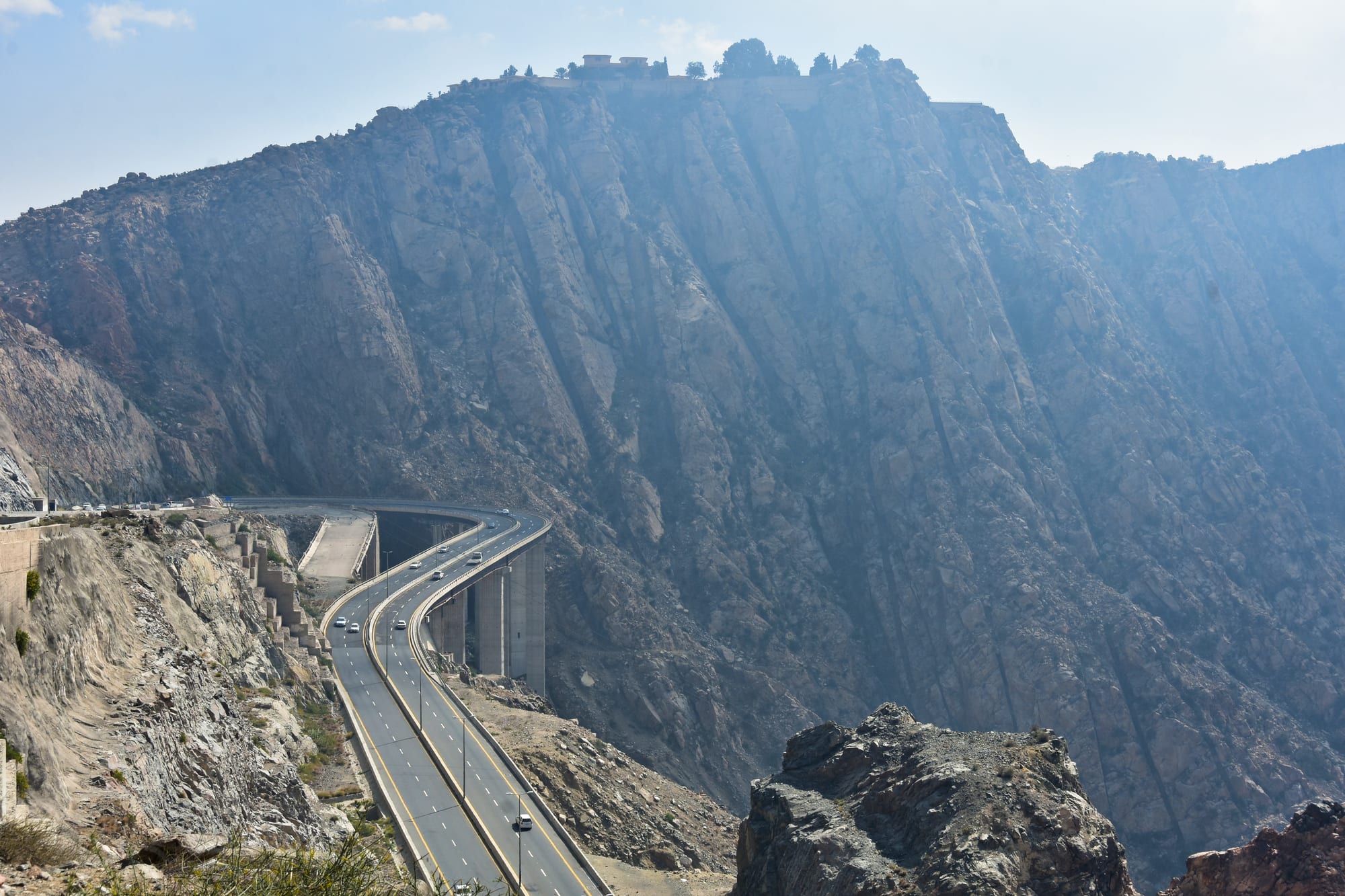
A curving motorway carried on piers across a steep grey mountainside on the Al-Hada escarpment below Taif

Mecca, Medina & the Hejaz, Saudi Arabia

Taif

The Al-Hada road climbing the escarpment to Taif. (Prof. Mortel / Wikimedia Commons · CC BY 2.0)

A highland city in western Saudi Arabia, set on a plateau in the Sarawat mountains above Mecca and reached up a switchback escarpment road. Its altitude gives it mild summers, and it has long been the summer retreat of the Hejaz, known for rose farms, fruit orchards and honey. Government offices moved here in the hot months for much of the twentieth century.

Neighbourhoods

  • The city centre
    • First-time visitors
    • Markets
    • Close to public transport

    The older core around the main souqs and the historic mosques, where the traditional markets sell roses, honey, dried fruit and household goods. Hotels, banks and bus stands are within a few streets, and the area is busiest in the evening.

    Open in Maps
  • Shubra and the museum quarter
    • Historic district
    • Architecture

    The streets around Shubra Palace, the early twentieth-century mansion of marble and carved wood that now houses the regional museum. Older stone and mud-brick houses survive nearby among newer blocks.

    Open in Maps
  • Al-Hada
    • Views
    • Cooler air
    • Families

    A resort area on the escarpment edge west of the city, above the hairpin road down to Mecca. Hotels, restaurants and viewpoints look out over the drop, and Saudi families come up for the cooler air and the views.

    Open in Maps
  • Al-Shafa
    • Orchards
    • Walks
    • Quiet and residential

    The high country south-west of the city, between about 2,200 and 2,500 metres up, with fruit orchards, rose farms, terraced fields and roadside stalls selling honey and produce. It is the coolest part of the area and the greenest.

    Open in Maps
  • The northern and eastern suburbs
    • Local life
    • Quiet and residential

    Newer districts of villas and apartment blocks spreading out across the plateau towards the airport and the Riyadh road, with neighbourhood shops, mosques and small restaurants. Residential rather than a place to sightsee.

    Open in Maps

Things to do

Landmarks and museums

  • Shubra Palacemuseum

    A four-storey house of white stone and carved wooden balconies built in the early twentieth century, later used by King Abdulaziz and King Faisal, and now the regional museum.

    Open in Maps
  • Abdullah ibn Abbas Mosquelandmark

    A mosque in the old centre that holds the tomb of Abdullah ibn Abbas, a cousin and companion of the Prophet Muhammad.

    Open in Maps

Mountains and viewpoints

  • Al-Hadaviewpoint

    The escarpment shoulder west of the city, where the road drops in tight hairpins towards Mecca and mountain hotels and viewpoints line the edge.

    Open in Maps

Gardens, markets and farms

  • Taif rose farmsattraction

    Farms in the hills around the city that grow damask roses and distil them into rose water and oil in the spring picking season.

    Open in Maps
  • Taif International Airporttransit hub

    The city's airport on the plateau north of the centre, with domestic and some regional flights.

    Open in Maps
  • The city souqsmarket

    Covered and open markets in the old centre selling rose products, honey, dried fruit, spices, silverwork and clothing.

    Open in Maps

Seasonal events

  • Rose seasonApril

    The damask roses are picked at dawn for a few weeks in spring and distilled the same day, and the farms and factories open to visitors.

  • Souq Okaz festivalsummer

    A heritage and poetry festival on the site of the pre-Islamic fair outside the city, revived in modern times with markets, performances and competitions.

  • Summer seasonJune to September

    Families from Jeddah, Mecca and Riyadh fill the city and the escarpment resorts to escape the heat of the lowlands, and hotel prices rise.

  • Saudi National Day23 September

    The anniversary of the kingdom's unification in 1932, marked with flags, green lighting and family outings.

Eat and drink

Long-standing places and food districts in Taif. Hours, ratings and directions come from your maps app, always current.

Taif classics

  • Taif honeymarket

    Mountain honey, including sidr honey from jujube trees, is a speciality of the highlands and is sold from dedicated shops in the city.

    Open in Maps
  • Saleegrestaurant

    Rice simmered in broth and milk until creamy and served with chicken, the dish most closely associated with Taif and the western highlands.

    Open in Maps
  • Rose water and rose sweetsmarket

    Distilled rose water flavours coffee, sweets and drinks across the Hejaz, and the factories sell it alongside rose oil and soaps.

    Open in Maps

Food districts and markets

  • The old souq districtneighborhood

    Grills, breakfast counters serving ful and flatbread, juice stands and sweet shops among the market lanes of the old centre.

    Open in Maps
  • Al-Hada and Al-Shafa roadside stallsneighborhood

    Stalls along the mountain roads selling pomegranates, figs, grapes, prickly pears and honey from the orchards behind them.

    Open in Maps

Experience Taif

History

Taif's advantage has always been its altitude. Sitting nearly 1,900 metres up on a plateau behind the escarpment, it grew as an agricultural oasis of walled gardens and orchards in a region of desert, and as a summer refuge for the people of the hot lowlands. Before Islam it was the home of the Thaqif tribe and a centre of the cult of the goddess Al-Lat, and the annual fair at Ukaz in the valley nearby was the great market and poetry contest of the Arabs, where tribes met under truce to trade and to hear their poets. The Prophet Muhammad came here in 619 seeking support and was rejected; the town accepted Islam a decade later.

Under the caliphates and the later empires Taif was a prosperous garden town and the summer seat of whoever governed the Hejaz, supplying Mecca with fruit, honey and rose water. The Ottomans fortified it; the Sharifs of Mecca kept summer residences here; and in the nineteenth and early twentieth centuries it changed hands repeatedly between Ottoman, Egyptian and local forces. Ibn Saud's army took the town in 1924, the first of the Hejazi cities to fall, and the Treaty of Taif in 1934 ended the war with Yemen.

In the modern kingdom Taif has kept a particular role. For decades the government moved here in summer, and the city has long hosted military academies and air force facilities. The 1989 talks that produced the Taif Agreement, which ended the Lebanese civil war, were held in the city. The escarpment roads were rebuilt to carry heavy traffic, the airport expanded, and the Souq Okaz festival revived on the site of the old fair.

Culture & Customs

Taif thinks of itself as a garden city, and the rose is its emblem. Damask roses have been grown in the surrounding hills for centuries; they are picked before dawn in April and distilled the same morning into rose water and rose oil, which is sold across the Muslim world and used by international perfume houses. Rose farms, distilleries and shops are part of the city's self-image in a way no other Saudi city has an equivalent for.

The highlands also carry an older cultural weight. The fair at Ukaz is remembered as the place where pre-Islamic Arabic poetry was judged and where the odes hung at Mecca were said to have been chosen, and the revived summer festival makes deliberate use of that memory with poetry competitions, calligraphy and craft markets. Local traditions include highland dances performed with sticks and swords at weddings and festivals, and the making of silver jewellery and woven goods sold in the souqs.

Socially, Taif is more conservative than Jeddah and more relaxed than the interior, with a strong tradition of hospitality shaped by generations of summer visitors. Extended families keep farms and second houses in Al-Shafa and the surrounding villages, and weekends in the warm months are spent in orchards and on picnic ground outside the city. Modest dress is expected in public, the day pauses for prayer, and coffee with dates opens every visit.

Daily Life

About 560,000 people live in Taif, making it one of the largest cities in the kingdom and the main centre of the mountains behind Mecca. Most live in low villas and apartment blocks spread across the plateau, and the population swells each summer with families who come up from the coast, so that shops, restaurants and hotels work to a strongly seasonal rhythm.

Agriculture remains real here in a way it is not in most of Saudi Arabia: roses, grapes, figs, pomegranates, prickly pears, almonds and honey come off the terraces and orchards of Al-Shafa and the surrounding valleys, and the produce is sold in the city's markets and along the mountain roads. Government offices, universities, hospitals, military installations and the summer tourism trade provide most other employment, and much of the working population commutes within the plateau by car.

Daily life is calmer and cooler than in the lowlands. Mornings are busy in the markets, the afternoon is quiet, and evenings fill the parks, the souqs and the escarpment viewpoints, where families sit out over the drop as the temperature falls. The weekend is Friday and Saturday. Current pressures include water supply for the farms, the spread of new housing over agricultural land, traffic on the escarpment roads, and the seasonal strain that summer visitors place on the city's services.

Food

Taif's kitchen is Hejazi with a highland accent. Saleeg, rice simmered slowly in meat broth and milk until it turns creamy and served with a whole chicken and a little clarified butter, is the dish most tightly linked to the city and its surroundings, and is a standard of family and restaurant tables alike. Kabsa, spiced rice with lamb or chicken, mandi cooked in a pit oven, and grilled meats fill out the menus, while breakfast is ful — fava beans stewed with cumin — with flatbread baked against the wall of a clay oven.

The produce is what sets Taif apart. Orchards in the hills yield pomegranates, figs, grapes, apricots and prickly pears, sold from roadside stalls in late summer and used in preserves and juices. Mountain honey is a serious business, with sidr honey from jujube blossom the most prized and sold by weight in specialist shops. Almonds, walnuts and dried fruit appear in sweets, and the markets sell spices for the whole region.

Rose water runs through everything sweet. It is stirred into Arabic coffee, which is lightly roasted, spiced with cardamom and poured from a long-spouted dallah into small cups with dates alongside; it flavours kunafa, basbousa, ma'amoul and milk puddings; and it is sold in bottles as a souvenir. Tea is drunk very sweet, often with mint. Alcohol is illegal in the kingdom, so the social evening is built around coffee houses, juice stands and long meals shared from a single platter.

Planning tools

Budget

Taif is cheaper than Jeddah or the holy cities for most of the year, with simple hotels in the centre and mid-range places on the escarpment. Prices rise sharply in the summer holidays, when Saudi families fill the city, and again during the rose season and the Souq Okaz festival. Food and markets are inexpensive; a hire car is the main extra cost.

Daily Budget Midrange
USD 160–400 (four-star hotel or an escarpment resort, restaurant meals, a hire car for Al-Hada and Al-Shafa)
Daily Budget Shoestring
USD 45–85 (budget hotel in the centre, local restaurants, buses and ride-hailing)

Avoid the peak summer weeks for lower prices, and note that the mountain resorts cost more than the city centre.

Best Time to Visit

March to May is the finest season, with mild weather and the rose harvest in April. Summer is warm rather than hot and is the traditional escape from the lowlands, but the city is crowded and accommodation is dearer. Autumn is quiet and clear; winter nights are cold, with mist on the escarpment. Air travel in the region has been disrupted by the war that began in late February 2026.

Suggested Number of Days

A day or two is enough for the city itself. Three or four allow for the escarpment, the high orchard country and the farms in the hills. The rose season and the summer holidays both add time, because roads and sites are busier.

First Visit
1–2 days
With Surroundings
3–4 days

Transportation

A car is the practical way to get about: the city is spread across a plateau and the mountain areas are tens of kilometres out along winding roads. Ride-hailing works well within the city and is cheap, though drivers are fewer in the outlying hills. City buses run on the main corridors, and taxis wait at the markets and hotels. Mountain roads are steep, with heavy lorry traffic on the descent to Mecca.

Drive the escarpment roads in daylight, watch for baboons and loose animals on the verges, and check the brakes on a hire car before the descent.

Airport & Station Connections

Taif International Airport, north of the city, has domestic flights and some regional services. Most arrivals are by road: Mecca is about ninety minutes down the escarpment, Jeddah roughly two and a half hours, and long-distance buses run from both. The nearest high-speed rail stations are in Mecca and Jeddah. Non-Muslim travellers must follow the signed bypass roads around Mecca.

Walkability

The old centre and its markets are walkable and pleasant in the cool of the evening, with short distances between the souqs, mosques and hotels. Beyond that the city is low, spread out and built for cars, with wide roads and few pavements, and the mountain areas are driving country with viewpoints rather than footpaths. The climate makes walking easier here than anywhere on the coast.

Safety

Crime is very low and the city is calm. The main risks are on the roads: the escarpment descent to Mecca is steep and busy with lorries, fog and rain can cut visibility, and brake failure is a known hazard. Baboons gather along the mountain roads and can become aggressive when fed. Nights are cold in winter. A regional war has been under way since late February 2026, with air travel across the region disrupted.

Do not feed or approach the baboons, drive the mountain roads slowly and in low gear, and carry warm clothing for winter evenings in the highlands. Check current official travel advice before travelling.

Climate

A hot desert climate strongly tempered by altitude, far cooler than the Hejaz coast because the city sits at about 1,880 metres. Days are warm and dry, nights cool all year, and most of the modest rainfall comes in spring, sometimes with thunderstorms over the escarpment.

Summer
warm to hot and dry — days usually in the low to mid 30s°C, with comfortable evenings
Winter
cool — days around 18–20°C, with nights near 5–10°C and occasional frost in the high orchards

Local Customs

Modest dress is expected: loose clothing covering shoulders and knees for men, and loose clothing covering arms and legs for women. Shops close at prayer times, and Friday mornings are quiet. Alcohol is illegal throughout the kingdom. Hospitality is formal — Arabic coffee and dates are offered to guests — and photographing people, especially women, requires permission.

Bargaining is normal in the souqs but done politely; tipping is not expected, though small amounts are appreciated.

Common Payment Methods

The currency is the Saudi riyal, pegged to the US dollar. Cards and mobile wallets are taken in hotels, restaurants and larger shops, and contactless payment is normal. Market stalls, roadside fruit and honey sellers and some taxis prefer cash, and ATMs are common in the city centre.