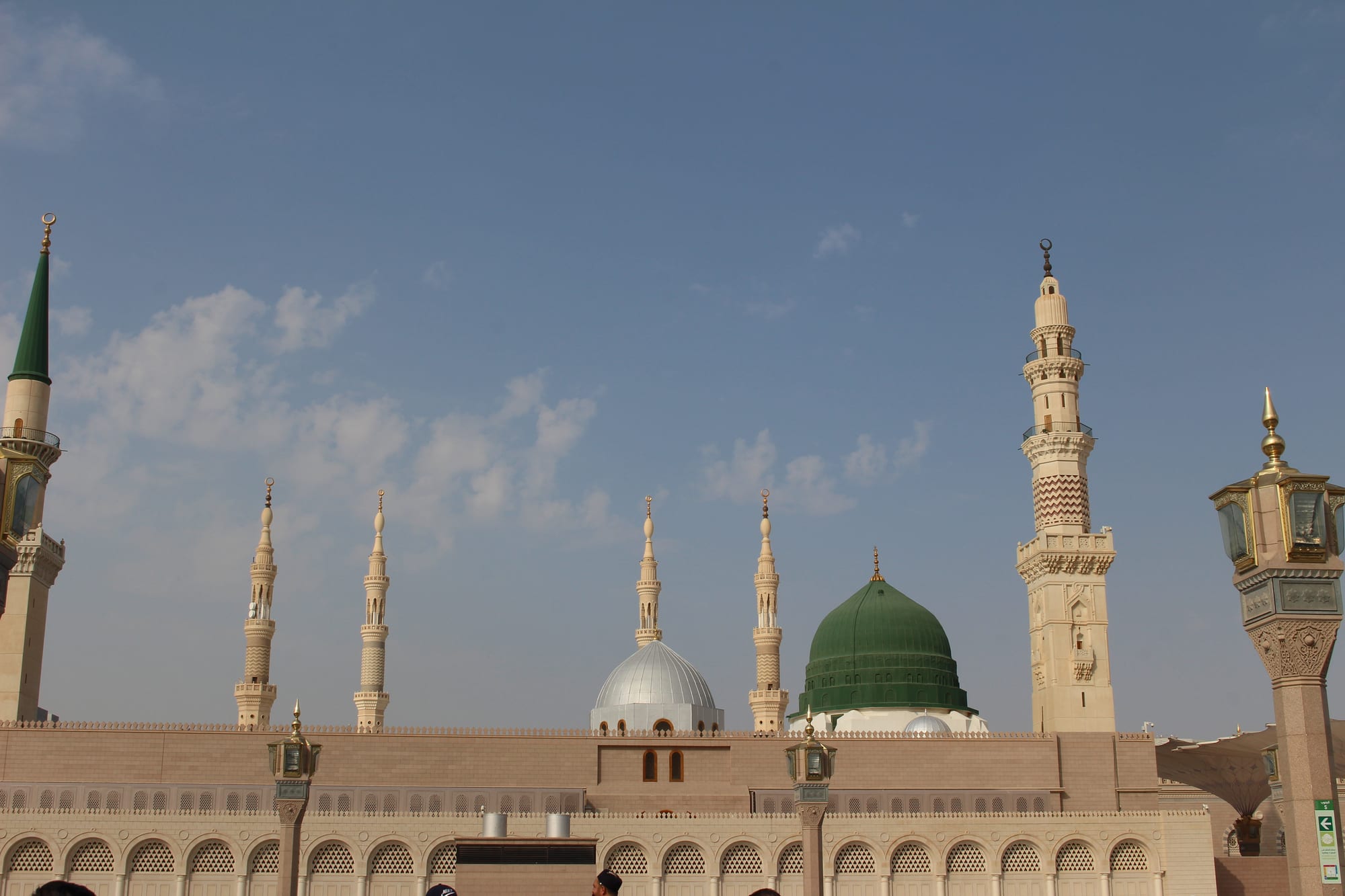
The green dome and tall pale minarets of the Prophet's Mosque in Medina under a blue sky with scattered clouds

Saudi Arabia

Mecca, Medina & the Hejaz

The Green Dome and minarets of the Prophet's Mosque in Medina, Islam's second-holiest site. (TheHadiRahim / Wikimedia Commons · CC0)

The western strip of Saudi Arabia between the Red Sea and the mountains — the Hejaz, home to Islam's two holiest cities, Mecca and Medina, to the old port of Jeddah that has welcomed pilgrims for centuries, and to the cool highland city of Taif, with a long, cosmopolitan history shaped by the pilgrimage.

Explore Mecca, Medina & the Hejaz

History

Mecca lay in a barren valley on the caravan routes between Yemen and Syria, its shrine, the Kaaba, drawing Arab pilgrims long before Islam. The Prophet Muhammad was born there around 570 into the Quraysh tribe; in 622 he and his followers emigrated to Yathrib, renamed Medina, an event that begins the Islamic calendar. Early battles at Badr and Uhud were fought near Medina, and Mecca surrendered in 630. Medina served as the capital of the first caliphs until the centre of power moved to Iraq and Damascus.

For most of the next thousand years the Hejaz was a province of distant empires, prized for the prestige of the holy cities. From the 10th century the Sharifs of Mecca, descendants of the Prophet, governed locally under the Fatimids, the Mamluks and, from 1517, the Ottomans. Jeddah grew as the port where pilgrims landed, and in 1908 the Hejaz Railway reached Medina from Damascus.

In 1916 Sharif Hussein launched the Arab Revolt against the Ottomans and declared the Kingdom of Hejaz, but in 1924–25 Ibn Saud's forces took Taif, Mecca, Medina and Jeddah. Jeddah remained the kingdom's diplomatic capital until embassies moved to Riyadh, and Taif served as a summer seat of government. Since then the state has repeatedly enlarged the holy mosques, replacing much of old Mecca with hotels and the clock-tower complex, and the Haramain railway opened in 2018.

Culture & Customs

The Hejaz has always been the most cosmopolitan part of Arabia. Pilgrims who stayed on — from Indonesia, India, Central Asia, Africa and the Levant — left their mark in family names, faces and food, and Hejazi Arabic, softer than the Najdi dialect, absorbed words from Turkish, Persian and beyond. Jeddah in particular sees itself as more relaxed and outward-looking than Riyadh, a reputation reinforced by the Red Sea International Film Festival and the Formula One race on its Corniche circuit, both launched in 2021.

Religion shapes the rhythm of Mecca and Medina entirely. The Hajj in the month of Dhu al-Hijjah and the Umrah, especially in Ramadan, set the calendar, and generations of local families have made their living guiding and housing pilgrims. Non-Muslims may not enter Mecca.

Hejazi traditions include the mizmar, a dance with long sticks to drums; the roshan, the carved wooden balcony screen of Jeddah's houses; and the rose culture of Taif, where rosewater and rose oil are distilled. Ramadan evenings in Al-Balad, with food stalls and lanterns, are a local institution.

Daily Life

Jeddah, with about four million people, is the kingdom's commercial port and second city; Mecca has over two million residents and Medina around one and a half million, both swelling enormously during pilgrimage seasons. Taif, Yanbu and Rabigh are the other main towns.

The economy rests on the pilgrimage — hotels, transport, catering and services for millions of Hajj and Umrah visitors a year — and on trade through Jeddah Islamic Port, one of the busiest on the Red Sea. Yanbu has oil refineries and petrochemical plants, and new projects such as King Abdullah Economic City near Rabigh add to the coast's industry.

Jeddah life runs late: families walk the Corniche after sunset, cafés and restaurants fill until after midnight, and the weekend means the beach clubs of Obhur. In Mecca and Medina the day is ordered by the five prayers at the holy mosques. Current issues include the large-scale demolition of older and informal neighbourhoods in Jeddah for redevelopment, and the pressure of growing pilgrim numbers on the holy cities.

Food

Hejazi cooking reflects the pilgrim trade. Saleeg, rice simmered in broth and milk until creamy and served with chicken, is linked to Taif and the west; mandi, meat and rice cooked in a pit oven, came with Yemeni settlers; and sayadiya, fish with spiced rice and caramelised onion, is the coast's dish. Breakfast is ful, stewed fava beans, eaten with tamees, a large round flatbread of Afghan origin baked in clay ovens.

Street food is where the Hejaz stands out: mutabbaq, a thin pastry folded around egg, minced meat and leek and fried on a griddle; balila, boiled chickpeas with cumin; and sambusak pastries at Ramadan. Sobia, a fermented drink of bread or barley, sweetened and spiced, is drunk in Ramadan.

Medina is famous for its dates, above all ajwa, a small dark variety tied to the Prophet's tradition, and pilgrims carry home Zamzam water from Mecca's well. Taif grows pomegranates, figs, grapes and honey, and its roses flavour sweets and drinks. Desserts include kunafa and basbousa.

Attractions & Natural Wonders

Mecca is open only to Muslims. At its centre the Masjid al-Haram encloses the Kaaba and the Zamzam well, overlooked by the Abraj Al Bait clock tower, and the Hajj rites lead out to Mina, Muzdalifah and the plain of Mount Arafat; Jabal al-Nour holds the cave of Hira, where the first revelation is placed.

Medina centres on the Prophet's Mosque, with the tomb of Muhammad beneath the Green Dome. Around it are the Quba Mosque, the first built in Islam, the Qiblatayn Mosque, Mount Uhud and the old Hejaz Railway station, now a museum. Access for non-Muslims to the sacred core around the mosque is restricted.

Jeddah's Al-Balad, a UNESCO World Heritage Site, is a maze of coral-stone houses with roshan balconies, souqs and old mosques, with Nasseef House as its best-known merchant home. The Corniche runs north past King Fahd's Fountain, among the tallest in the world, and the mosque built out over the water, to the creek of Obhur.

Inland, Taif sits in the Sarawat mountains, reached up the hairpin road of Al Hada; its sights are the rose farms, the Shubra Palace, the fruit orchards of Al Shafa and the revived Souq Okaz fair site. Along the Red Sea coast, coral reefs off Jeddah and Yanbu draw divers.

Cities in Mecca, Medina & the Hejaz

Planning basics

Budget

Prices here swing with the pilgrimage calendar. Hotels next to the holy mosques in Mecca and Medina are among the most expensive in the kingdom during Ramadan and Hajj and much cheaper at other times, while Jeddah has a wide range from budget hotels to Corniche towers. Taif is cheaper outside the summer holidays, when Saudi families fill it.

Daily Budget Midrange
USD 160–400 (four-star hotel, restaurants, Haramain train tickets, a hire car for Taif and the coast)
Daily Budget Shoestring
USD 55–95 (budget hotel away from the haram, local restaurants, buses and ride-hailing)

Avoid Ramadan and the Hajj weeks unless on pilgrimage, and stay a short walk from the mosques rather than on their doorstep to save money.

Safety

Crime is very low. The risks come from heat and crowds: during the Hajj, extreme temperatures and dense crowds have caused deaths, including the Mina crush of 2015 and many heat-related deaths in 2024. Jeddah's traffic is aggressive, winter flash floods can be deadly, as in 2009, and the rules on conduct in the holy cities are strictly enforced.

Respect the restrictions around the holy mosques, carry water and shade, avoid driving in heavy rain, and follow crowd-management instructions during pilgrimages. Check current official travel advice before travelling.

Climate

The Hejaz has three climates. Jeddah and the coast are hot and humid for most of the year; Mecca, in a ring of bare hills, is among the hottest cities in the kingdom, often above 40°C in summer; Medina is hot and dry with cooler winter nights. Taif, high in the mountains, is the escape — warm summers and chilly winters. Rare winter downpours cause flash floods in Jeddah and Mecca.

Summer
Mecca 40–48°C and dry; Jeddah 35–40°C and humid; Taif around 30–33°C
Winter
Jeddah and Mecca 20–30°C; Medina nights around 10–15°C; Taif cool, with nights near 5–10°C

Transportation

Jeddah's King Abdulaziz International Airport handles most pilgrims and visitors, and Medina and Taif have their own airports. The Haramain high-speed railway links Jeddah, Mecca and Medina, Medina being about two hours from Mecca. Highways run along the coast and up to Taif, and ride-hailing is easy in the cities. Checkpoints on the approach roads divert non-Muslims around Mecca.

Non-Muslims should follow the signed bypass roads around Mecca; the train is the easiest way between Jeddah and Medina.

Best Time to Visit

November to March is the most comfortable season for Jeddah, Al-Balad and the coast. Taif is pleasant in spring and is a summer retreat from the heat. Ramadan and the Hajj season, which move through the year with the Islamic calendar, bring huge crowds to Mecca, Medina and Jeddah's airport.