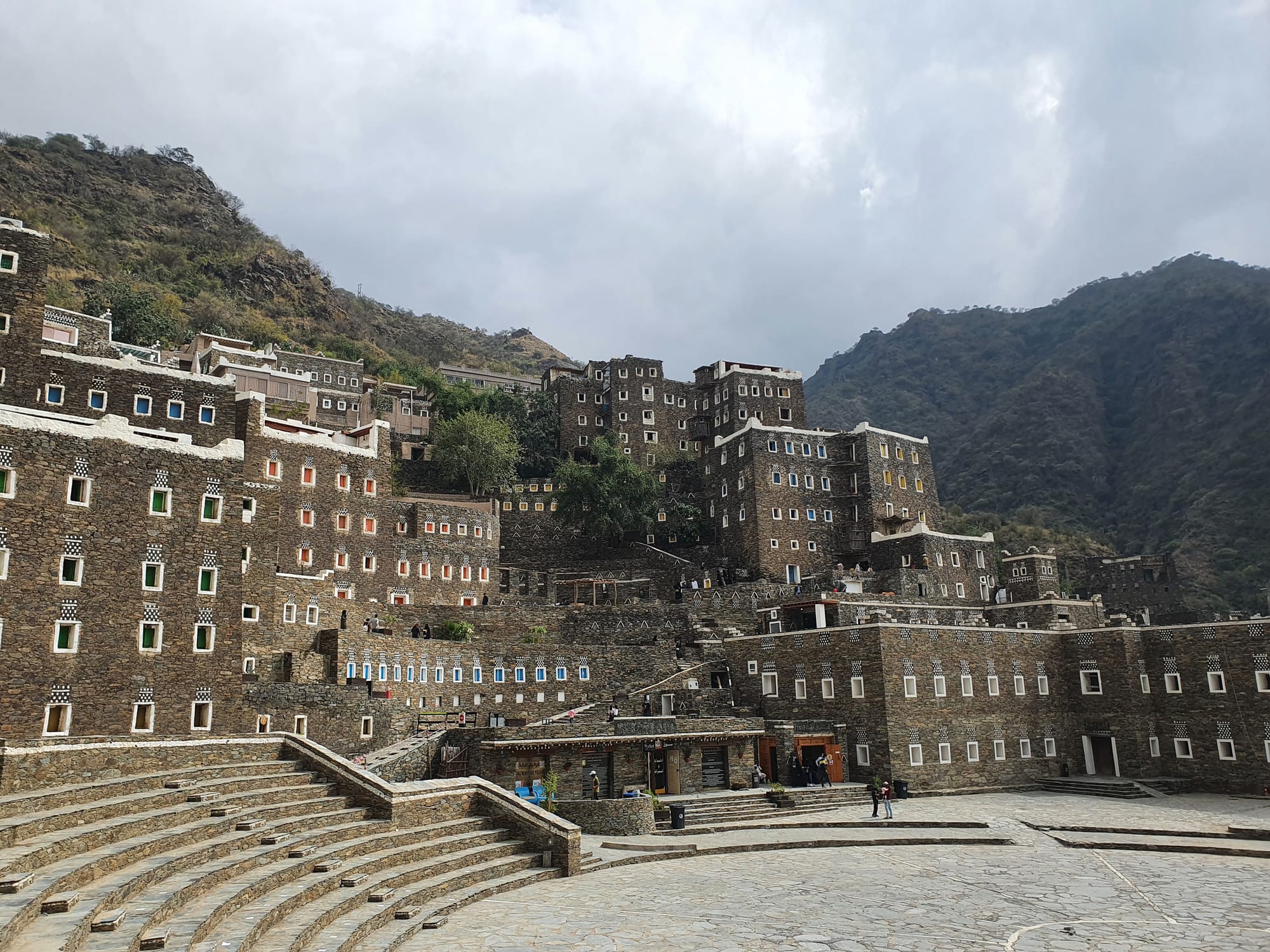
Tall stone tower-houses with white-framed windows stacked up a hillside below green mountains under a cloudy sky

Saudi Arabia

Asir & the South

The stone tower-houses of Rijal Almaa, in the mountains west of Abha. (Richard Mortel / Wikimedia Commons · CC BY 2.0)

Saudi Arabia's green south-west, where the Sarawat mountains of Asir and Al Bahah rise above the hot Tihama coastal plain of Jazan and the Red Sea's Farasan Islands, with the old oasis city of Najran to the east — a region of terraced fields, stone tower-houses and cultural ties to neighbouring Yemen.

Explore Asir & the South

History

The south lay on the incense road north from Yemen, and Najran was one of its great oases. By the 6th century it had a large Christian community, which was massacred around 523 by the Himyarite king Dhu Nuwas; the ruins of the old city at Al-Ukhdood are linked by tradition to the "People of the Ditch" in the Qur'an. The highlands of Asir and Al Bahah were home to settled farming tribes who terraced the mountain slopes and built fortified stone and mud villages.

For centuries the region was contested between Yemen's rulers, the Sharifs of Mecca, the Ottomans and local chiefs. In the early 20th century Muhammad al-Idrisi founded an emirate based at Sabya in the Tihama, while the Saudis extended their rule over highland Asir in the 1920s. The Idrisi state accepted Saudi protection in 1926 and was absorbed soon after, and a short war with Yemen ended in the Treaty of Taif of 1934, which left Asir, Jazan and Najran in Saudi hands. The border was finally fixed in the Treaty of Jeddah in 2000.

Development came late, with roads, airports and the city of Khamis Mushait growing around a major air base. Since 2015 the war in Yemen has made the southern border a front line, with cross-border fighting and Houthi attacks on its towns.

Culture & Customs

The south differs from the rest of the kingdom in its landscape, dress and traditions, and it shares much with Yemen across the border. Mountain tribes such as the Shahran, Ghamid and Zahran keep strong tribal identities, and the original people of Habala were known as "flower men" for the garlands of herbs and flowers worn on their heads.

The region's best-known art is Al-Qatt Al-Asiri, the bold, geometric wall painting done by women inside Asiri homes, recognised by UNESCO as intangible heritage. Stone tower-houses, carved wooden doors and colourful interiors mark the villages of Rijal Almaa and Al Bahah. Folk dances with drums, such as those performed at weddings in Asir and Jazan, are energetic and communal.

Najran has its own identity: its mud-brick tower-houses, a strong tribal culture, and a large Ismaili community, a minority within Shia Islam. In Jazan, the farming of Khawlani coffee on the mountain terraces is recognised by UNESCO as intangible heritage, and on Farasan the Hareed festival celebrates the seasonal catch of parrotfish.

Daily Life

Asir is the most populous part of the south. Khamis Mushait, its largest city, and the provincial capital Abha form a growing urban area on the plateau, while Jazan, Najran and Al Bahah are smaller provincial capitals. Many villages cling to the mountains and slopes of the Tihama.

The economy mixes government jobs and the military with farming, tourism and trade. The highlands grow fruit, grain and honey on terraces; Jazan's coastal plain produces mangoes, papayas and other tropical fruit, and its mountains grow coffee. Summer tourism to Abha and the mountains is expanding.

Life in the mountains is cooler and slower than in the rest of the kingdom. Families picnic in the parks and forests, and cafés fill in the evenings. In Jazan and Najran, the war across the border has shaped daily life, with cross-border shelling that has at times closed schools and the airport in Najran.

Food

Southern cooking has much in common with Yemen. Haneeth, lamb slow-roasted until tender and served over rice, and mathbi, meat grilled on hot stones, are festive dishes, and mandi is popular everywhere. The Asiri speciality is areeka, a dense bread dough kneaded with ghee and honey.

Honey is the region's pride: the mountains of Asir and Al Bahah produce highly prized honey, sold at markets and festivals. Jazan grows mangoes, papayas and bananas, and the Tihama's markets are full of fruit in season.

Coffee is the drink, and Jazan's Khawlani beans are grown on steep mountain terraces. Qishr, a drink brewed from coffee husks with ginger, is common in the Tihama. On the coast and on Farasan, fresh fish is grilled or cooked with rice, and the parrotfish of the Hareed season is a local delicacy.

Attractions & Natural Wonders

Abha, the capital of Asir, sits among the Asir mountains, with a restored old quarter, parks and a cable car. Nearby, Jabal Sawda is officially the highest peak in the kingdom, at about 3,000 metres, with juniper forests and wide views over the escarpment. Al Soudah and the forests of Asir National Park draw walkers in summer.

West of Abha, a steep road descends to Rijal Almaa, a village of stone tower-houses with a heritage museum in one of its buildings. Habala, the "hanging village", sits on a ledge of a sheer cliff, once reached only by rope ladders and now by a cable car. In Al Bahah, the stone village of Dhee Ain stands on a white rocky hilltop above banana and lemon groves.

On the coast, Jazan has the hilltop Dosariyah fort overlooking the town and sea, and ferries run to the Farasan Islands, a protected area of coral reefs, mangroves, beaches and Farasan gazelles, with historic stucco-decorated houses and an Ottoman castle. Najran, in the east, has the ruins of Al-Ukhdood, the Emara Palace and mud-brick tower-houses among palm groves.

Cities in Asir & the South

Planning basics

Budget

The south is one of the cheaper parts of the kingdom. Abha has a good choice of mid-range hotels and furnished apartments, although prices climb in the summer season when Saudi families escape the heat. Jazan and Najran have modest business hotels and inexpensive restaurants, and Farasan's accommodation is limited and simple.

Daily Budget Midrange
USD 130–290 (mid-range hotel, restaurants, a hire car for the mountain roads, cable-car tickets)
Daily Budget Shoestring
USD 50–85 (budget hotel or apartment, local restaurants, a shared ferry and taxis)

Visit Abha outside the peak summer weeks for lower hotel prices, and hire a car to reach the villages.

Safety

The towns are generally calm and crime is low, but this is a border region. Many governments advise against travel to the areas along the Yemeni border, which runs through Jazan, Asir and Najran, because of the war in Yemen: Houthi forces have shelled Najran, repeatedly hit Abha airport with missiles and drones, and struck the Jazan refinery as recently as July 2026. Mountain roads, fog and flash floods are the other hazards.

Stay out of the border zone, keep to the main roads, and avoid mountain driving in fog. Check current official travel advice before travelling.

Climate

The south has two climates. The Asir and Al Bahah highlands, at around 2,000 metres and above, are the coolest part of the kingdom, with mild summers, cold winter nights, fog and rain in summer and winter. The Tihama plain and the Jazan coast are hot and humid most of the year, and Najran, inland, is dry and hot in summer.

Summer
Abha and the highlands 20–30°C with afternoon storms; Jazan and the Tihama 35–40°C and very humid
Winter
cold in the highlands, near freezing at night; warm on the coast, 25–30°C

Transportation

Abha, Jazan, Najran and Al Bahah all have airports with flights from Riyadh and Jeddah. There is no railway. A car is needed for the mountain villages, and the switchback roads down to Rijal Almaa and the Tihama are steep and often foggy. Ferries carry passengers and cars from Jazan port to the Farasan Islands, and Habala is reached by cable car.

Drive the mountain escarpment roads in daylight, and book the Farasan ferry a day ahead.

Best Time to Visit

The highlands are Saudi Arabia's summer resort, pleasant from May to September, when the Abha summer season fills the city. The coast, Jazan and Farasan are best from November to March, when the heat eases; the Hareed fishing festival on Farasan falls in spring. Spring and autumn suit both the mountains and Najran.