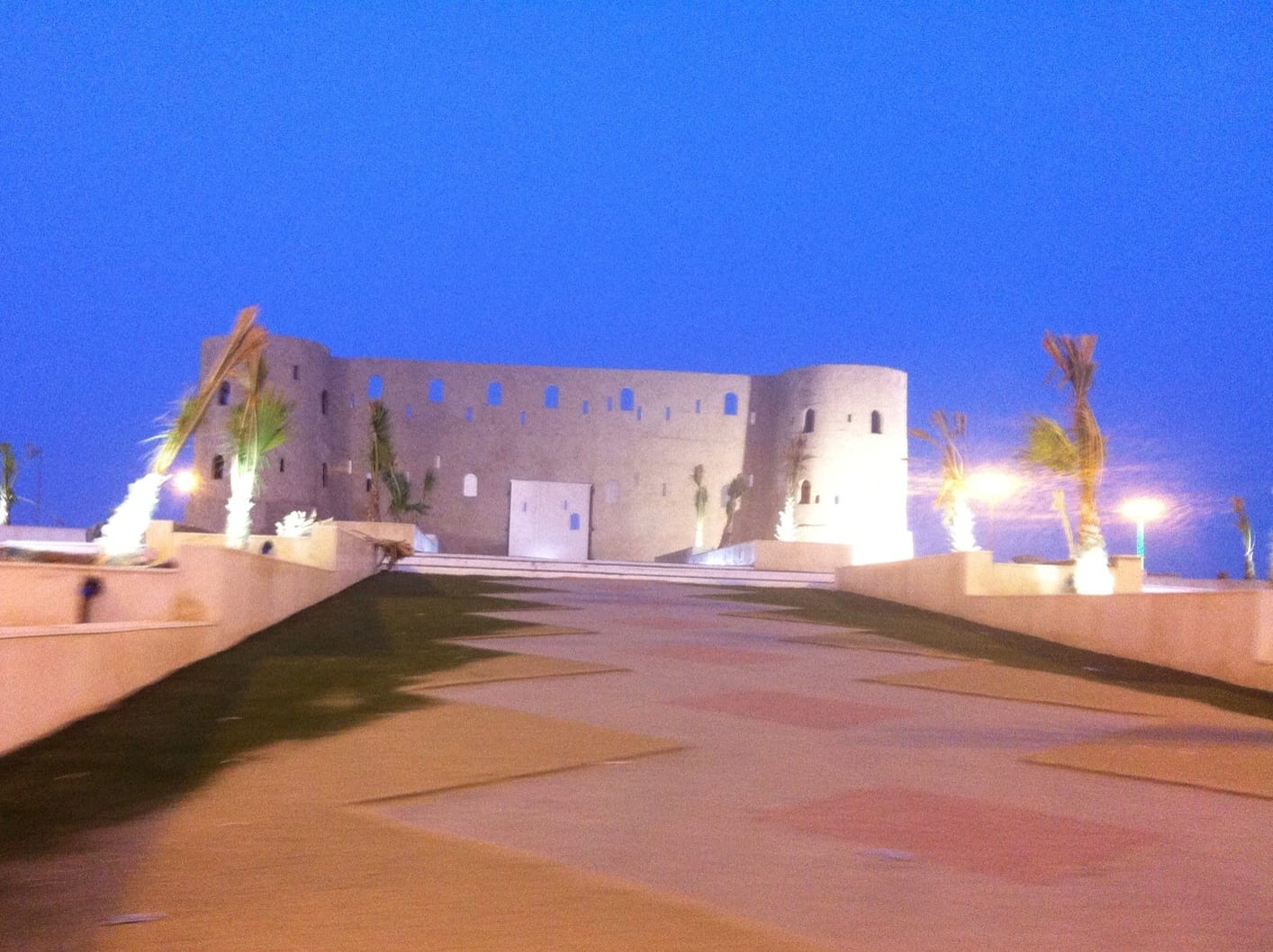
A long stone fort floodlit at dusk above a broad paved square lined with palms under a deep blue sky

Asir & the South, Saudi Arabia

Jizan

The fort above Castle Square in Jizan. (MrJoker07 / Wikimedia Commons · CC BY-SA 4.0)

The capital of Jazan Province, a Red Sea port on the hot, humid Tihama plain in the far south-west of Saudi Arabia, close to the Yemeni border. Long a fishing and trading harbour under Ottoman and Idrisi rule, it is now a working port and university city, the ferry gateway to the Farasan Islands and the base for trips into the Fifa mountains.

Neighbourhoods

  • The Corniche
    • First-time visitors
    • Evenings out
    • Seafront

    The seafront road along the Red Sea, with lawns, walkways, play areas and fish restaurants. Families come out after sunset when the day's heat eases, and the water and the port cranes are in view along most of its length.

    Open in Maps
  • The city centre and the fort hill
    • Historic district
    • Markets
    • Local life

    The older core rises towards the hill crowned by the fort, with the main souq streets, gold and cloth shops and small cafés below it. Traffic is heavy by day and the shops reopen in the cool of the evening.

    Open in Maps
  • The port and ferry terminal
    • Farasan ferry
    • Working waterfront

    South-west of the centre, the commercial harbour handles cargo and fishing boats, and the ferries to the Farasan Islands load cars and passengers here. It is a working area rather than a place to linger, but it is where most visits to the islands begin.

    Open in Maps
  • The northern suburbs and Jazan Economic City
    • Quiet and residential
    • Newer hotels

    New housing districts spread north along the coastal road towards the university and the industrial city, with wide streets, malls and modern hotels. Distances are long and almost everyone drives.

    Open in Maps

Things to do

In the city

  • The hilltop fortlandmark

    A restored stone fort on the rise above the centre, floodlit at night above the square named after it.

    Open in Maps
  • Jizan Cornicheattraction

    The seafront promenade along the Red Sea, the city's main evening gathering place, with gardens, walkways and fish restaurants.

    Open in Maps
  • Jazan Universityattraction

    The province's public university, founded in 2006 and its only one, whose campus north of the city brought thousands of students to the region.

    Open in Maps

The Red Sea

  • Farasan Islandsattraction

    A coral archipelago reached by car ferry from Jizan, protected for its reefs, mangroves and beaches and home to the Arabian gazelle, with decorated stucco buildings such as Al-Rifa'i House and Al-Najdi Mosque and an Ottoman castle.

    Open in Maps

Short trips inland

  • Fifa Mountainsviewpoint

    A cluster of steep peaks north-east of the city, their slopes covered in agricultural terraces planted with coffee and maize, reached by a spiralling mountain road.

    Open in Maps
  • Abu Arishattraction

    An old market town on the plain inland from Jizan, once a seat of local rulers, with a historic fort at its centre.

    Open in Maps
  • Sabyaattraction

    The Tihama town that was the capital of the Idrisi emirate in the early 20th century, now a farming and market centre.

    Open in Maps

Seasonal events

  • Hareed Festivalspring, usually April

    A festival on the Farasan Islands marking the yearly arrival of shoals of hareed, or parrotfish, in the shallows, with a communal catch and boat races.

  • Mango and tropical fruit harvestsummer

    The Jazan plain's mango, papaya and banana crop comes in through the hot months, sold from roadside stalls and celebrated at local fruit festivals.

Eat and drink

Long-standing places and food districts in Jizan. Hours, ratings and directions come from your maps app, always current.

Jizan classics

  • Corniche fish grillsneighborhood

    Restaurants along the seafront grill Red Sea fish whole or bake it in a clay oven, served with rice, chilli relish and flatbread.

    Open in Maps
  • The fish marketmarket

    The morning catch is landed and auctioned near the harbour, and some stalls will have a fish cleaned and cooked on the spot.

    Open in Maps

Markets and cafés

  • The central souqmarket

    Stalls of mangoes, papaya, bananas and dates alongside spices, honey and coffee husks from the mountains behind the city.

    Open in Maps
  • Coffee housesneighborhood

    Cafés serve both modern speciality coffee and qishr, the local drink brewed from coffee husks with ginger; Khawlani beans grown on the Jazan mountain terraces are the region's pride.

    Open in Maps

Experience Jizan

History

Jizan grew where the Tihama plain meets the Red Sea, a shallow anchorage used for fishing and coastal trade between the Arabian coast and the African shore. For centuries the surrounding plain and the mountains behind it were contested between Yemen's rulers, the Sharifs of Mecca, local tribal chiefs and, from the 16th century, the Ottomans, who held the coast in order to control the southern Red Sea.

In the early 20th century Muhammad al-Idrisi founded an emirate in the Tihama with its capital at Sabya, inland from Jizan, and the port became its outlet to the sea. The Idrisi state came under Saudi mandate by the Treaty of Mecca in 1926, and after the treaty broke down the last Idrisi ruler ceded his rule in 1930, making Jazan the last region of the peninsula to join Saudi Arabia; a short war with Yemen ended in the Treaty of Taif of 1934, which left Jazan, Asir and Najran in Saudi hands, and the border was finally fixed by the Treaty of Jeddah in 2000.

Modern Jizan is largely a creation of the decades after oil. Roads, a deep-water port, an airport and a provincial administration turned a fishing town into the capital of Jazan Province; Jazan University opened in 2006, and a large industrial and refinery complex was built up the coast to the north. Since 2015 the war across the border in Yemen has shaped life in the province, with cross-border attacks on southern towns, a period of relative calm, and renewed fighting from July 2026.

Culture & Customs

The far south feels different from the rest of the kingdom, and much of that difference is visible in Jizan. The Tihama shares dress, dialect, music and food with the Yemeni coast a short distance away: lighter clothing, wrapped skirts worn by men in the villages, and a drumming tradition that is faster and more percussive than the music of central Arabia. Wedding dances in the plain and the mountains are communal and loud, performed in lines with drums and, in some districts, with the jambiya dagger worn at the waist.

Coffee is central. The Khawlani coffee of the Jazan mountains, grown on narrow terraces behind the city, has been recognised by UNESCO as intangible cultural heritage, and the knowledge of planting, harvesting and roasting it is passed down within families. Honey from the same mountains is prized across the kingdom. Al-Qatt Al-Asiri, the geometric wall painting done by women in the highlands to the north, is also part of the region's visual identity.

Manners follow the general Saudi pattern, with a strong local emphasis on hospitality: coffee and dates are offered before any business, and refusing outright is impolite. The city has a large population of migrant workers, mostly from South Asia and other Arab countries, who run much of the retail and catering trade, so Urdu, Hindi and Malayalam are heard alongside Arabic in the souq.

Daily Life

About 200,000 people lived in the Jizan governorate at the 2022 census, and some 1.4 million in Jazan Province as a whole, which has the highest population density of any province in the kingdom. The city is a provincial capital: government offices, the university, hospitals, the port and the fishing fleet provide most of the work, alongside farming on the plain and an industrial and refinery complex up the coast that has drawn workers from across the kingdom.

Days begin early and end late. The heat pushes errands into the morning, brings a long midday pause, and empties the streets until the evening, when the souq, the malls and the Corniche fill up and families picnic on the grass by the sea. Prayer times structure the working day. Most households own a car, and the city's low, spread-out districts of villas and apartment blocks are linked by wide roads rather than by public transport.

The province's agriculture — mangoes, papayas, bananas, sorghum and coffee — is unusual in Saudi Arabia and supplies markets far beyond the south. The border with Yemen, and the fighting there, is the other constant of life in the province: it has brought military installations, displaced families, and periods when schools and the airport have closed.

Food

Jizan eats from the sea and from the tropical plain behind it. Red Sea fish — grouper, emperor, snapper and sardine among them — is grilled over charcoal or baked whole in a clay mofa oven, then rubbed with spice and served on rice with flatbread and a fiery chilli and tomato relish. Prawns and squid appear on the same menus, and on the Farasan Islands the spring catch of hareed, the parrotfish that gives the local festival its name, is a seasonal delicacy.

The wider southern kitchen is shared with Yemen. Haneeth, lamb slow-cooked until it falls from the bone and served over rice, and mathbi, meat grilled on hot stones, are festive dishes; mandi, rice and meat cooked together in a pit oven, is everywhere. Breads are baked against the walls of clay ovens, and masoub, mashed ripe banana with crumbled bread, cream and honey, is a favourite sweet dish in the south.

Fruit defines the summer. Jazan's mangoes are the best known in the kingdom, and papayas, bananas and guavas grow on the same plain, sold from roadside stalls through the hot months. Mountain honey is sold in the souq at high prices, and the drink of the Tihama is qishr, brewed from coffee husks with ginger and sometimes cinnamon, alongside the Khawlani coffee grown on the terraces above the city.

Planning tools

Budget

Jizan is inexpensive by Saudi standards. Hotels are mostly plain business places in the centre and along the coastal road, restaurants are cheap, and the main extra costs are a hire car and the ferry to the Farasan Islands, where accommodation is limited and simple. Rooms are in demand during the summer fruit season and around public holidays.

Daily Budget Midrange
USD 110–220 (business hotel, restaurant meals, a hire car for the coast and the mountains)
Daily Budget Shoestring
USD 45–80 (budget hotel or furnished apartment, local restaurants, shared taxis and the ferry)

A hire car makes the mountains and the inland towns reachable, and the Farasan ferry is worth arranging a day ahead.

Best Time to Visit

November to March, when the coastal heat and humidity ease and the sea is pleasant; the Hareed festival on Farasan falls in spring. From May to September the plain is very hot and humid and activity moves to the early morning and the evening. The fighting with Yemen's Houthis escalated in July 2026, with missile and drone attacks on Jizan and other southern cities in September, so plans should be checked against current advice.

Suggested Number of Days

One or two days are enough for the city itself. Three or four suit a longer stay, since the islands off the coast involve a ferry crossing and an overnight, and the mountain roads inland are slow.

First Visit
1–2 days
With Surroundings
3–4 days

Transportation

The city is spread out along the coast and almost everyone drives. Taxis and ride-hailing work in the built-up area, and intercity buses run north to Jeddah and inland to Abha. A hire car is needed for the mountain roads, which are steep, winding and often foggy near the top. Car and passenger ferries cross to the Farasan Islands from the port.

Drive the escarpment roads in daylight and allow far longer than the distance suggests; fill up before heading into the mountains.

Airport & Station Connections

King Abdullah bin Abdulaziz International Airport, also known as Jizan airport, serves the city with flights from Riyadh and Jeddah, though airports in the south have been affected during the fighting with Yemen's Houthis and flights can be disrupted. By road, Jeddah is a long drive north on the Red Sea highway and Abha is a few hours inland and uphill. There is no railway.

Walkability

The Corniche is made for walking, and the older centre around the souq can be covered on foot, but the rest of the city is built for cars, with wide roads and long blocks. Heat and humidity limit walking to the early morning and after dark for much of the year.

Safety

The city itself is calm and ordinary crime is low, but this is a border region. Many governments advise against travel to the areas along the Yemeni border, which runs south and east of Jizan, because of the fighting in Yemen, which resumed in July 2026 after about four years of relative calm. Houthi forces struck Jizan along with Abha, Khamis Mushait and Najran on 8 September 2026, hitting civilian and economic sites and wounding more than seventy people, and air-raid alerts were sounded in the region on 10 September. Heat, fast traffic and flash floods in the wadis after rain are the other hazards.

Stay out of the border zone, keep to the main roads, and avoid wadi beds when rain is forecast. Check current official travel advice before travelling.

Climate

Hot and humid for most of the year on the Tihama coastal plain, with a short, warm winter. Rain is scarce and usually falls in brief storms that can flood wadis and roads; the mountains behind the city are several degrees cooler.

Summer
very hot and humid — daytime temperatures around 35–40°C with heavy humidity off the sea
Winter
warm and much more comfortable — around 25–30°C by day, cooler at night

Local Customs

Saudi Arabia is a conservative Muslim country and the south is more traditional than the big cities. Modest dress covering shoulders and knees is expected for everyone, and many women wear an abaya, which is no longer legally required of foreign visitors. Prayer times punctuate the day and some shops close briefly for them. Alcohol is illegal. Greetings are unhurried, the right hand is used for eating and giving, and hospitality with coffee and dates is offered readily.

Ask before photographing people, especially women, and do not photograph the port, military sites or the border area. Tipping is not expected but small amounts are appreciated.

Common Payment Methods

The currency is the Saudi riyal. Cards and mobile payment are accepted in hotels, malls and larger restaurants, and ATMs are common in the city, but small souq stalls, the fish market and the islands often work in cash, so it is worth carrying some.