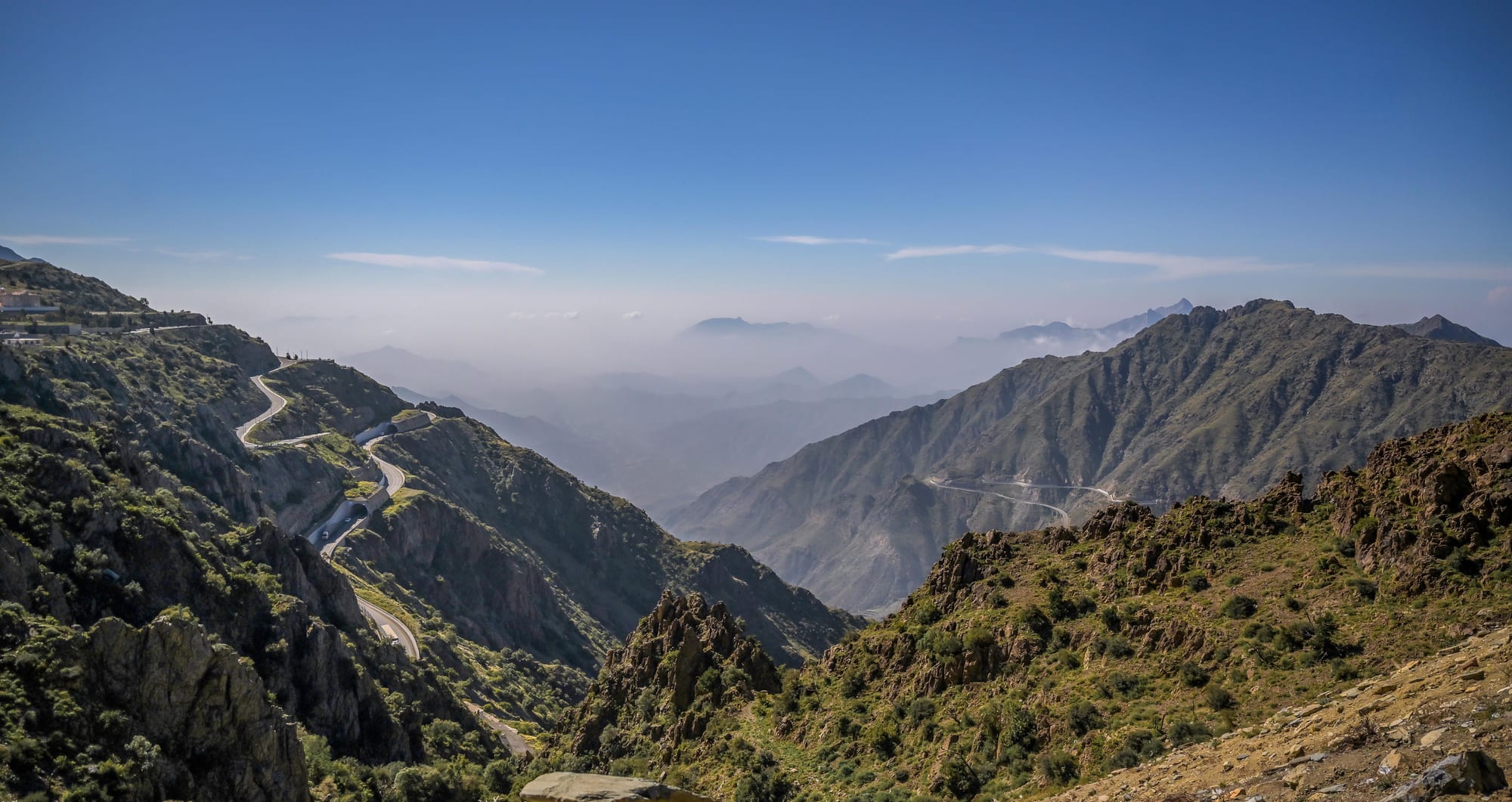
A switchback road descending green rocky mountain ridges into a hazy valley below, under a clear blue sky

Asir & the South, Saudi Arabia

Al Bahah

A switchback road through the mountains of the Al Bahah highlands. (Saudi Press Agency (SPA) / Wikimedia Commons · CC BY-SA 4.0)

A highland town about 2,000 metres up in the Sarawat mountains, capital of the smallest of Saudi Arabia's provinces and one of the country's coolest summer retreats. Juniper forests, terraced fields, stone tower-houses and watchtowers surround it, and steep escarpment roads drop from its edge towards the Tihama plain and the Red Sea.

Neighbourhoods

  • The town centre
    • First-time visitors
    • Markets
    • Close to services

    The compact core around the main streets and the souq, with shops, cafés, government offices and most of the town's hotels. It is the one part of Al Bahah where walking between places makes sense, and it fills in the evening rather than in the heat of the afternoon.

    Open in Maps
  • Raghadan and the forest parks
    • Picnics
    • Families
    • Walks

    Wooded parkland on the edge of town where juniper stands survive on the plateau. Saudi families come to picnic and barbecue through the summer, and the area holds the town's larger open spaces rather than its shops.

    Open in Maps
  • The escarpment edge
    • Viewpoints
    • Photography
    • Cool air

    Where the plateau breaks away towards the Tihama, with viewpoints and cafés looking out over layered ridges and, in summer, cloud that boils up the cliff in the afternoon. The road down to the coastal plain begins here.

    Open in Maps
  • The Baljurashi road
    • Quiet and residential
    • Villages
    • Terraced farmland

    South of town the plateau carries villages, terraced fields and old stone houses along the road to Baljurashi. Newer villas and rest houses are spread among them, and almost everyone drives.

    Open in Maps

Things to do

In and around the town

  • Raghadan Forestpark

    Woodland on the edge of Al Bahah, the town's main picnic ground and the easiest place to see the highland forest, long known too for the Sunday market held there.

    Open in Maps

Markets

  • The town souqmarket

    The central market for honey, dried fruit, spices, silver and mountain produce brought in from the surrounding villages.

    Open in Maps

Viewpoints

  • Al Bahah escarpment viewpointsviewpoint

    Lookouts along the plateau rim where the mountains fall away towards the coastal plain, often with cloud rolling up the cliff face in summer.

    Open in Maps

Villages and short trips

  • Dhee Ayn marble villagelandmark

    An abandoned village of stone tower-houses built on a white marble outcrop above palm and banana gardens, on the escarpment below the town.

    Open in Maps
  • Baljurashiattraction

    A highland town south of Al Bahah, the largest in the province, long a stop on the old trade routes through the mountains.

    Open in Maps
  • Al Mandaqattraction

    A highland town north-west of Al Bahah, the second largest in the province, among terraced slopes and old stone villages at the head of the descent to the lowlands.

    Open in Maps
  • Al Makhwahattraction

    The market town on the Tihama plain at the foot of the escarpment, hot and tropical in feel compared with the highlands above it.

    Open in Maps

Seasonal events

  • Al Bahah summer seasonJune to August

    The town's busiest months, when Saudi families escape the heat of the lowlands for the mountains and parks, cafés and rest houses fill.

  • The honey seasonlate summer or autumn

    The selling season for the region's beekeepers, whose sidr and other mountain honeys are among the most expensive in the kingdom.

Eat and drink

Long-standing places and food districts in Al Bahah. Hours, ratings and directions come from your maps app, always current.

Al Bahah classics

  • Highland grill housesneighborhood

    Restaurants in and around the centre serve mandi and haneeth — lamb or chicken cooked slowly with rice — alongside grilled meat and salads.

    Open in Maps
  • The honey stallsmarket

    Shops and market stalls sell combs and jars from the surrounding mountains, graded by the flowering tree the bees worked.

    Open in Maps

Markets and cafés

  • The central souqmarket

    Local produce, dried fruit, spices, silver jewellery and daggers, busiest in the cooler part of the day.

    Open in Maps
  • Mountain cafésneighborhood

    Cafés on the plateau edge serve Saudi coffee with dates and modern speciality coffee, many built for the view over the escarpment.

    Open in Maps

Experience Al Bahah

History

The mountains around Al Bahah have been farmed for thousands of years by the Ghamid and Zahran tribes, who cut terraces into the slopes, dug channels to catch the rain and built stone houses and watchtowers to defend their fields and grain stores. The routes through these peaks linked Yemen with the Hijaz, and caravans carrying incense, coffee and goods from the Red Sea ports climbed the escarpment along paths that are still traceable beside the modern road.

For centuries the highlands were governed locally, with tribal councils and fortified villages, while wider control shifted between the rulers of Yemen, the Sharifs of Mecca and the Ottomans. The area came under Saudi rule in the 1920s as the kingdom took in Asir and the south-west, and the province of Al Bahah was established as a separate administrative region, the smallest in the country, with the town as its capital.

Al Bahah itself was a modest market and administrative centre until roads reached the plateau in the second half of the 20th century. Paved highways to Taif and Jeddah, the escarpment descents to the Tihama, a domestic airport and government investment turned it into a provincial capital and a summer resort for Saudis escaping the heat. Many of the old stone villages around it were left empty as families moved into new concrete houses, and some are now being restored as heritage sites.

Culture & Customs

Al Bahah's identity is tribal and agricultural. The Ghamid and Zahran confederations dominate the province, and family and tribal ties still organise much of social life, from weddings to disputes. Older men in the villages may still wear a wreath of herbs or flowers on the head in the tradition shared with the mountains of Asir further south, and the jambiya dagger appears at celebrations rather than in daily wear.

Building is the region's most visible art. Houses and towers are made of flat stones laid without mortar, with projecting slabs to throw off the rain and small windows against the cold, and the same stone is used for the terrace walls that step down the mountainsides. Interiors were decorated with painted geometric patterns, a tradition related to Al-Qatt Al-Asiri, the wall painting done by women in the highlands that UNESCO recognises as intangible heritage.

Music and dance at weddings are communal and rhythmic, performed in lines to drums, and poetry competitions remain popular. Honey is more than a product here: beekeeping families are respected, and giving honey is a mark of regard. Hospitality follows the wider Saudi pattern — coffee poured from a dallah, dates, and an insistence that a guest eats — but with a mountain reserve that visitors often notice as formality.

Daily Life

About 90,000 people lived in the town at the 2022 census, in a province of some 339,000 that is the smallest in Saudi Arabia by both area and population. Government employment dominates: the regional administration, schools, the university and the hospital are the largest employers, alongside small businesses, construction and the summer tourist trade. Farming continues on the terraces, though at a fraction of its old scale, and many families keep bees.

The rhythm of the year matters more here than in most Saudi towns. In summer the population swells with visitors from Jeddah, Riyadh and the lowlands, hotels fill, the parks are busy every evening and roadside stalls sell honey, fruit and grilled corn. Out of season the town is quiet, cold at night, and shrouded in mist for days at a time.

Young people leave for Jeddah, Taif and Riyadh to study and work, and many households have members away, returning for holidays and Eid. The province has seen steady investment in roads and tourism, including work on the escarpment routes and on restoring abandoned stone villages, and the debate over how to bring income without losing the forests and the old buildings is a live one locally.

Food

Mountain cooking here is plain, slow and built around grain, meat and honey. The regional speciality is areeka, a dense bread dough kneaded with ghee and topped generously with honey, eaten from a communal dish. Local breads are baked in clay ovens or on hot stones, and porridge-like dishes of wheat with meat and ghee appear on festive tables.

Rice and meat dishes shared with the rest of the south dominate restaurant menus: mandi, meat and rice cooked together over a pit oven; haneeth, lamb slow-roasted until it falls from the bone; and mathbi, meat grilled on hot stones. Grills of chicken and lamb, salads, hummus and flatbread are the everyday alternative, often eaten in the open at a picnic rather than at a table.

Honey is the region's signature. Hives are kept in the juniper and acacia woods and along the wadis below the escarpment, and the sidr and talh honeys of the south-west fetch high prices across the kingdom. The lower slopes and the plain below produce bananas, pomegranates, grapes and figs, sold along the mountain roads in season. Coffee, roasted light and spiced with cardamom in the Saudi way, is served constantly, and qishr, brewed from coffee husks with ginger, is drunk in the warmer country below the mountains.

Planning tools

Budget

Al Bahah is one of the cheaper places to stay in Saudi Arabia, with plain hotels, furnished apartments and rest houses rather than international chains. Prices rise through the summer, when families from the lowlands fill the town. Food is inexpensive; the main extra cost is a hire car, which is effectively necessary for the villages and the escarpment roads.

Daily Budget Midrange
USD 110–220 (mid-range hotel, restaurant meals, a hire car for the mountain roads)
Daily Budget Shoestring
USD 45–80 (budget hotel or furnished apartment, local restaurants, shared taxis)

Avoid the peak summer weeks for lower room prices, and hire a car — the villages and viewpoints are scattered along the plateau.

Best Time to Visit

The highlands are at their most pleasant from May to September, when the rest of the kingdom is baking and Al Bahah is mild, green and busy with Saudi visitors. Spring and autumn are quieter and still comfortable, with clear air after rain. Winter nights are cold. The fighting with Yemen's Houthis escalated in July 2026, with missile and drone attacks on southern cities in September, so plans for the south should be checked against current advice.

Suggested Number of Days

One or two days cover the town, its parks and the nearest viewpoints. Three or four suit a wider trip, because the stone villages and the descents to the lowlands are spread out and the mountain roads are slow.

First Visit
1–2 days
With Surroundings
3–4 days

Transportation

A car is needed. The town itself is small, but the villages, forests and viewpoints lie along the plateau and down the escarpment, and public transport between them is minimal. Intercity buses connect Al Bahah with Taif, Jeddah and Abha. The switchback roads to the coastal plain are steep, narrow in places and often wrapped in fog in the afternoon.

Drive the escarpment roads in daylight, use low gears on the descents, and watch for baboons, livestock and sudden fog.

Airport & Station Connections

The province is served by King Saud Domestic Airport at Al-Aqiq, out of town to the north, which handles domestic flights only; for international connections people use Taif, Abha or Jeddah, and flights in the south can be disrupted during the fighting with Yemen's Houthis. Most visitors drive: Taif and Jeddah are a few hours north and north-west on mountain and desert highways, and Abha is several hours south along the escarpment. There is no railway.

Walkability

The centre is small enough to walk, and the parks and rim paths are made for it, but the town spreads along ridge roads and the distances between districts are long. Pavements are patchy outside the core. The altitude keeps walking comfortable even in summer, and evenings are cool.

Safety

Al Bahah is calm and crime is low. The real hazards are on the roads: steep escarpment descents, fog that can close in within minutes, and flash floods that fill wadis after storms. Cliff edges at viewpoints are often unfenced, and troops of baboons along the roads should not be fed or approached. The province lies well north of the Yemeni border, but the wider south has been affected by the fighting that resumed in July 2026.

Keep to the main roads in fog, stay back from unfenced edges, and avoid wadi beds when rain is forecast. Check current official travel advice before travelling.

Climate

A highland climate, cool for Saudi Arabia because of the altitude. Cloud and mist push up the escarpment from the coastal plain, rain falls in spring and summer storms, and the air is noticeably thinner and fresher than in the lowlands a short drive away.

Summer
mild for the kingdom — daytime temperatures around 20–30°C, with afternoon cloud and storms
Winter
cold by Saudi standards — around 10–18°C by day and nights that can approach freezing on the plateau

Local Customs

This is a conservative, tribal part of the kingdom, more traditional than the big cities. Modest dress covering shoulders and knees is expected of everyone, and many women wear an abaya, which is no longer legally required of foreign visitors. Alcohol is illegal. Prayer times shape the day and some shops close for them. Hospitality is strong: coffee, dates and honey are offered readily, and the right hand is used for eating and giving.

Ask before photographing people, especially women, and before entering or photographing old village houses, which are usually family property.

Common Payment Methods

The currency is the Saudi riyal. Cards and mobile payment work in hotels, petrol stations and larger shops, and there are ATMs in the town, but village stalls, honey sellers and small cafés often prefer cash, so it is worth carrying some.