History
This corner of Arabia sat on the incense road that carried frankincense and myrrh from the south to the Mediterranean. The oasis of Dadan, at AlUla, was the capital of the Dadanite and then the Lihyanite kingdoms in the first millennium BC, and their inscriptions cover the rock face of Jabal Ikmah. Tayma, to the north, was an important oasis in the same era; the Babylonian king Nabonidus lived there for about ten years in the 6th century BC. In Al Jawf, Dumat al-Jandal — the Adummatu of Assyrian records — was a stronghold of Arab queens.
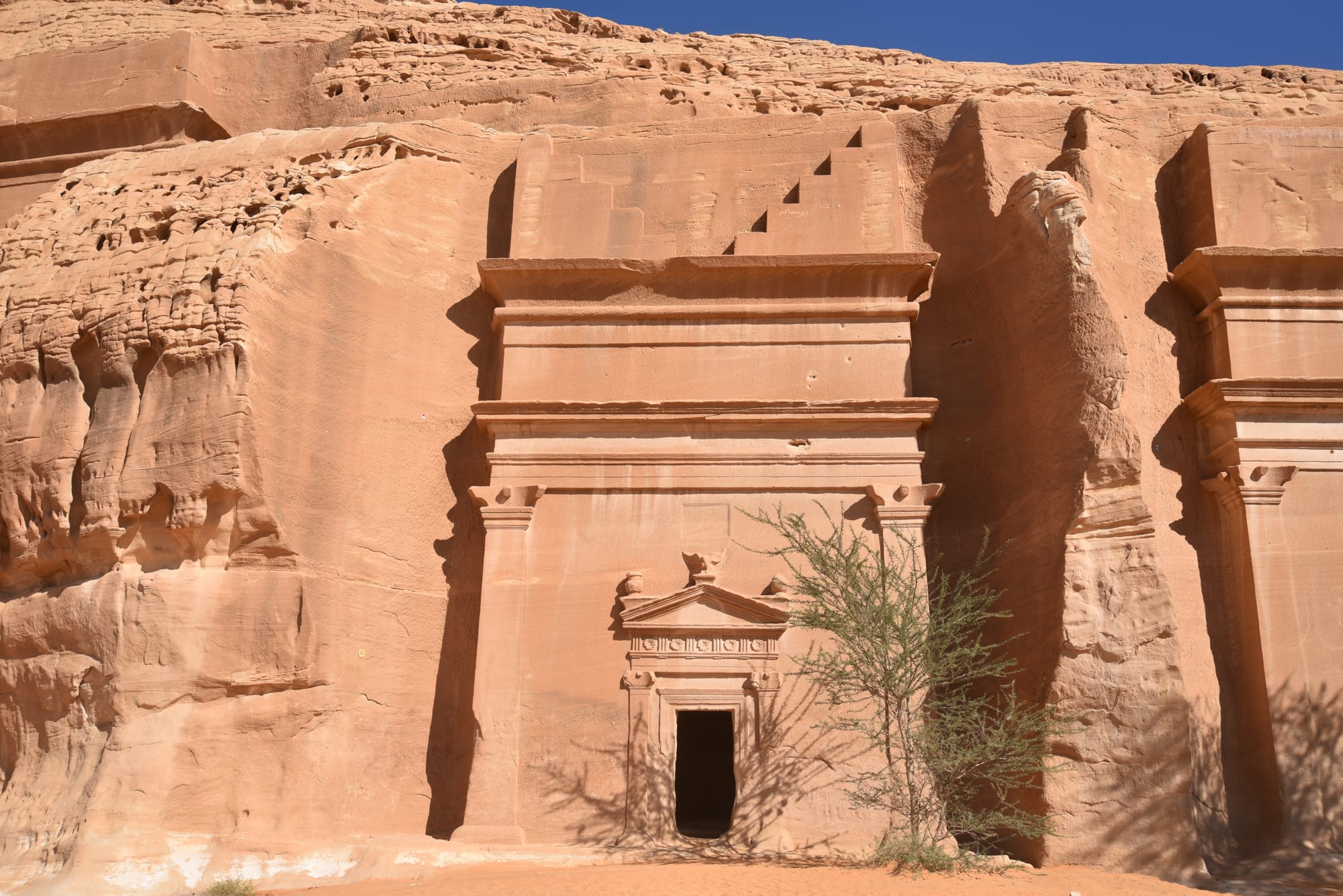
The Nabataeans, whose capital was Petra, made Hegra their great southern city in the 1st century AD and carved many of its tombs before Rome annexed their kingdom in 106 AD. Islamic tradition links the site to the people of Thamud, and it was long avoided as a cursed place. In 630 the Prophet Muhammad led an expedition to Tabuk, and the pilgrim road from Damascus to Medina passed through the region for centuries, guarded by Ottoman forts.
The Hejaz Railway, opened through Tabuk and Hegra in the 1900s, was repeatedly sabotaged during the Arab Revolt of 1916–18 and never reopened. The region became part of the Saudi state in the early 20th century. From the late 1940s the Trans-Arabian Pipeline brought pumping stations that grew into Arar, Rafha and Turaif. Since 2017 the state has made the north-west the centre of its tourism plans, with the Royal Commission for AlUla, the Red Sea resorts and NEOM.