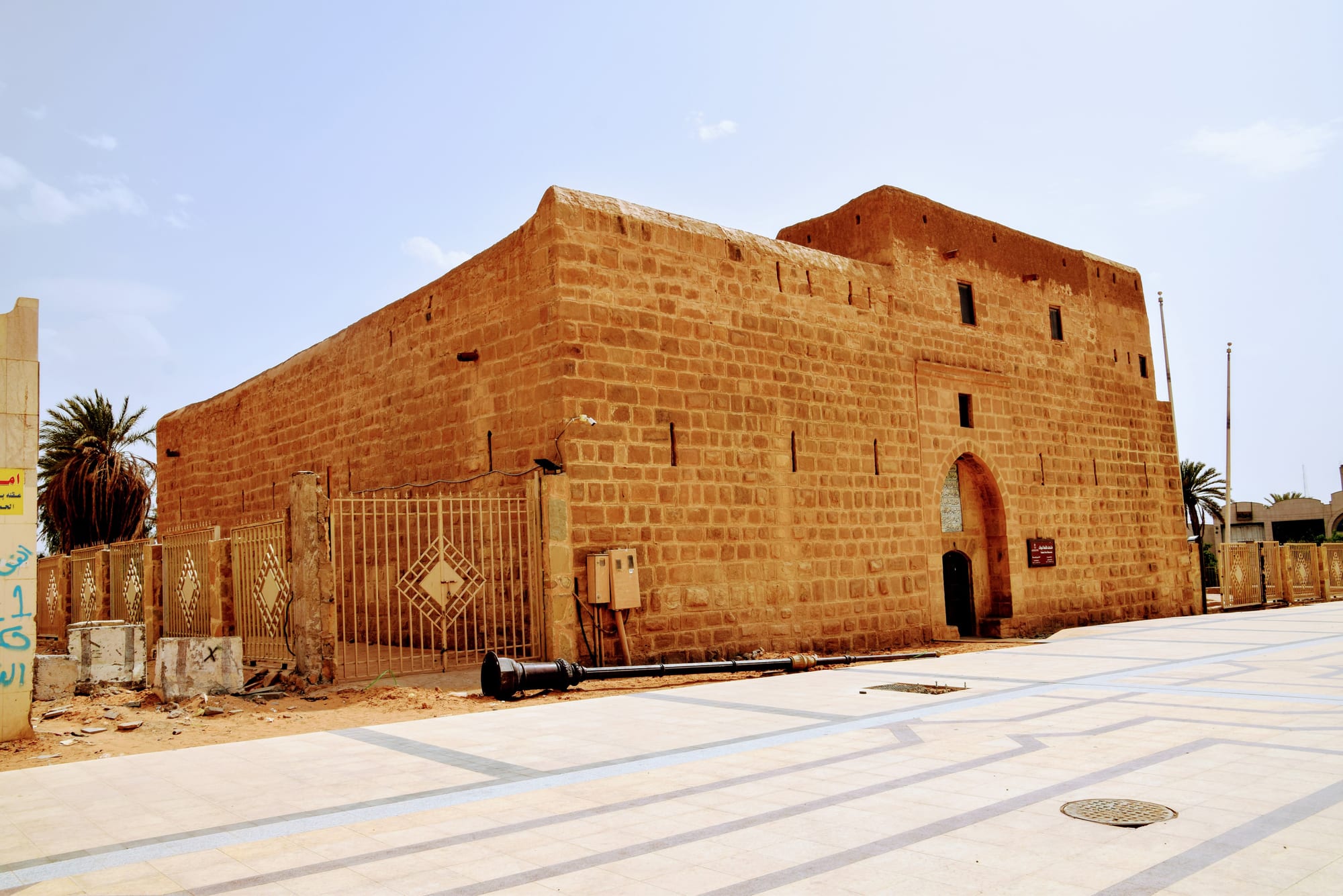
A square sandstone fort with crenellated walls and an arched doorway, palms to one side and a paved plaza in front

AlUla, Tabuk & the Northwest, Saudi Arabia

Tabuk

The Ottoman-era castle in the centre of Tabuk. (Heritage Commission / Wikimedia Commons · CC BY-SA 4.0)

The largest city of Saudi Arabia's north-west, an oasis on the old pilgrim road from Damascus that grew around an Ottoman-era fort and a station of the Hejaz Railway. Irrigated farms, an air base and a university made the modern city, and it is now the road and air gateway to the canyons, mountains and Red Sea coast of Tabuk Province. This page is written to explain the city, not to encourage travel.

Neighbourhoods

  • The old centre around the castle
    • First-time visitors
    • Historic district

    The heart of the original oasis settlement, where the castle, the old mosque and the Hejaz Railway grounds stand within a short walk of each other. Around them are older low-rise streets, small shops and the city's traditional market area.

    Open in Maps
  • Prince Fahd bin Sultan Road and the commercial strip
    • Best for food
    • Shopping

    The long main avenue that carries much of the city's commerce, lined with grill and mandi restaurants, cafés, car showrooms and shopping centres. Most of the hotels used by visitors sit on or near it.

    Open in Maps
  • The northern and western districts
    • Quiet and residential
    • Families

    Newer grid-planned quarters of villas and low apartment blocks spreading towards the edge of the plain, with neighbourhood mosques, schools and small parades of shops. They are residential rather than sightseeing areas.

    Open in Maps
  • The university and hospital quarter
    • Students
    • Quiet and residential

    The area shaped by the University of Tabuk and the city's main hospitals, with student housing, bookshops and cafés. It is a younger, busier part of the city during term time.

    Open in Maps
  • The airport and military district
    • Close to transport

    The eastern approach to the city, where the regional airport and the long-established air base occupy a large area. Photography of military installations is prohibited, and this side of the city is used mostly for arriving and leaving.

    Open in Maps

Things to do

Landmarks in the city

  • Tabuk Castlelandmark

    A small fort in the city centre, dating in its present form to 1559 in the Ottoman period, built as a station on the pilgrim road from Damascus; it has two storeys around a courtyard, contains a mosque, and has been restored as a museum.

    Open in Maps
  • Hejaz Railway stationlandmark

    The stone station buildings, water tower and workshops of the railway that ran from Damascus towards Medina in the 1900s, restored as a heritage site on the eastern side of the old centre.

    Open in Maps

Markets and city life

  • The central souqmarket

    The older market streets near the castle, where dates, spices, coffee, cloth and household goods are sold in small shops rather than in a single hall.

    Open in Maps
  • University of Tabukattraction

    The public university, established in 2006, whose campus and student population have reshaped the western side of the city.

    Open in Maps

Short trips from the city

  • Jabal al-Lawzviewpoint

    One of the highest mountains in north-western Arabia, west of the city near the Jordanian border, where snow occasionally falls in winter.

    Open in Maps
  • Wadi Al Disahtrail

    A valley in the mountains of the south-western part of Tabuk Province, well watered and thick with palms below high sandstone cliffs, reached on rough tracks and usually visited with a guide or in a 4x4.

    Open in Maps

Eat and drink

Long-standing places and food districts in Tabuk. Hours, ratings and directions come from your maps app, always current.

Tabuk classics

  • Mandi and kabsa housesrestaurant

    Plain, busy dining rooms serving lamb or chicken over spiced rice, eaten from a shared tray, with the northern cracked-wheat dish jareesh often on the menu in winter.

    Open in Maps
  • Grills and shawarma standsrestaurant

    Charcoal grills and late-opening shawarma counters along the main commercial roads, a staple of the evening in the cooler months.

    Open in Maps

Markets and cafés

  • The central produce and date marketmarket

    Stalls of dates, olives, citrus and vegetables from the farms of the surrounding plain, with desert truffles appearing in late winter after good rains.

    Open in Maps
  • Coffee houses in the centrecafe

    Arabic coffee with cardamom and dates alongside espresso in modern cafés, which double as the city's main meeting places for younger residents.

    Open in Maps

Experience Tabuk

History

Tabuk grew from a well-watered oasis on the desert road between Syria and the Hejaz, a stopping place for caravans long before Islam. It is remembered above all for the expedition of 630 AD, when the Prophet Muhammad led a large force north to Tabuk and, finding no battle, made agreements with local leaders before returning; the campaign gave the settlement a lasting place in early Islamic history and its name is used for the event itself.

For centuries afterwards the oasis served the annual pilgrim caravan from Damascus to Medina. The Ottomans, who controlled the route, maintained a fort here to guard the wells and shelter pilgrims, and the castle that stands in the city centre today is the descendant of those works, rebuilt and repaired over generations. In the first decade of the 20th century the Hejaz Railway was pushed south through Tabuk, and a station, water tower and workshops were built beside the old town. The line was attacked repeatedly during the Arab Revolt of 1916–18 and was effectively abandoned by 1920.

The region became part of the Saudi state in the 20th century, and Tabuk was made the capital of the province that carries its name. An air base, a large garrison and government offices brought population and money; from the 1970s deep wells and centre-pivot irrigation turned the surrounding plain into one of the kingdom's agricultural districts, growing wheat, fruit and flowers. The University of Tabuk followed in the 2000s, and since the late 2010s the city has been repositioned as the gateway to the province's tourism and construction projects.

Culture & Customs

Tabuk is a tribal city in a tribal province. Bedouin descent matters socially, with families tracing themselves to the great northern tribes whose grazing grounds once crossed what are now the borders with Jordan, and tribal courtesy shapes daily manners: long greetings, careful hospitality and the serving of Arabic coffee from a brass pot in small handleless cups, poured for a guest before anything else is discussed.

Nabati poetry, recited and sung in the local dialect, is the region's strongest artistic tradition, along with camel breeding and the sword and stick dances performed at weddings and national holidays. Winter camping is the great seasonal pleasure: families drive out to the desert and the wadis with tents, firewood and coffee pots, and stay for days at a time. Falconry and hunting trips follow the same season.

Religious observance is public and structured. Shops close for each of the five daily prayers, Ramadan reshapes the working day and the evening, and the two Eid holidays empty the offices and fill the streets at night. Dress is conservative in the markets and the older districts, and the sexes mix less freely in social settings than in Riyadh or Jeddah, although the rapid social changes of recent years — women driving, mixed cafés, public concerts elsewhere in the kingdom — are visible here too, particularly among students.

Daily Life

About 600,000 people live in Tabuk, making it the largest city in the north-west. The population is overwhelmingly Saudi by the standards of the kingdom's big cities, with communities of Egyptian, Sudanese, Yemeni, Pakistani and Filipino workers in the shops, restaurants, farms and hospitals.

The economy rests on four things: the armed forces, whose base and garrison have been part of the city for decades; government administration as the provincial capital; agriculture, with dairy, poultry, wheat, fruit and cut flowers produced on the irrigated plain and trucked or flown to the rest of the country; and services, including the university and the regional hospitals. Construction projects in the wider province have added jobs and raised expectations, and younger residents increasingly work in tourism, logistics and retail rather than following their parents into government or farming.

The daily rhythm is shaped by heat and prayer. Business is done in the morning, much of the city rests in the afternoon, and shops, restaurants and parks fill again after sunset, later still in summer and during Ramadan. Weekends belong to family visits and, in the cooler months, to driving out of town. The pressures residents talk about are the cost of housing, water use on the farms, and whether the province's new developments will bring work that lasts.

Food

Tabuk eats the food of northern Arabia. Kabsa — rice cooked with meat, tomato, onion and a mix of spices including dried lime — is the everyday feast dish, and mandi, meat slow-cooked over a pit or in an oven and served over rice, is the other standard. Jareesh, coarsely cracked wheat cooked with meat or yoghurt to a thick porridge, is a winter dish of the north, and so is qursan, thin dry flatbreads layered and softened in broth. Bread is central: round loaves from neighbourhood bakeries and flatbread baked against the wall of a clay oven.

After good winter rains the desert produces faqa, the pale desert truffles that appear in the markets in late winter and spring and are cooked with meat or rice or simply grilled. Dates are eaten daily and offered to every guest, and the farms of the plain supply the city with milk, laban, yoghurt, eggs, citrus and vegetables. Grilled chicken, shawarma and a strong Levantine influence in salads, hummus and fattoush reflect the old road to Syria as well as the Syrian and Egyptian cooks in many kitchens.

Drinks are non-alcoholic everywhere, since alcohol is illegal in the kingdom. Arabic coffee, pale and bitter with cardamom, is served with dates; sweet black tea with mint or sage follows meals; and camel's milk is still drunk. Speciality coffee shops have multiplied in recent years, and fresh fruit juice stands are a fixture of summer evenings.

Planning tools

Budget

Tabuk is an ordinary provincial city and one of the cheaper bases in the north-west. Hotels are modest business and chain properties rather than resorts, and local restaurants are inexpensive. The comparison is stark with AlUla, where the regional midrange figure of USD 210–530 reflects limited, upmarket accommodation; staying in Tabuk costs far less. The main expense here is a hire car, since the sights of the province lie hours apart.

Daily Budget Midrange
USD 120–230 (business hotel, restaurants, a hire car and fuel for desert drives)
Daily Budget Shoestring
USD 55–95 (budget hotel, local restaurants, shared taxis and ride-hailing)

Use Tabuk as a low-cost base for the province rather than sleeping near the sights, and book a car with the hotel or at the airport.

Best Time to Visit

October to March. The city stands high on a plain and winter days are mild and clear, which suits walking in the centre and driving out to the canyons and mountains, though nights fall near freezing. Summer is hot and dry and outdoor sightseeing is uncomfortable. The war that began in late February 2026 has disrupted air travel and events across the region, so dates should be confirmed before booking.

Suggested Number of Days

The city itself is quickly seen and suits a night or two. Most visitors stay longer because Tabuk is a base for the wider province, where driving distances are long; how many days are needed depends on how far into the desert and towards the coast a trip goes.

First Visit
1–2 days
With Surroundings
4–6 days

Transportation

The city is spread out and built for driving. Ride-hailing apps work well and are the usual way for visitors to move about; taxis and a limited bus service also run. There is no urban rail. Almost everyone exploring the province hires a car, and some routes into the canyons need a four-wheel drive.

Fill the tank before long drives, keep water in the car, and avoid driving at night when camels stray onto desert roads.

Airport & Station Connections

Prince Sultan bin Abdulaziz Airport, usually called Tabuk Airport, is a joint civil and military field on the edge of the city, a short drive from the centre, with domestic flights from Riyadh and Jeddah and some regional services. Long-distance buses connect Tabuk with Jeddah, Medina and the north, and good highways run south towards AlUla and west to the Red Sea coast, journeys of several hours. Flights across the region have been disrupted by the war since late February 2026.

Walkability

The old centre around the castle, the railway grounds and the market streets can be covered on foot in an hour or two. Beyond that the city is low-density, with wide roads, long blocks and few shaded pavements, so walking between districts is impractical; residents drive even short distances, and summer heat rules out walking in the middle of the day.

Safety

Tabuk is a quiet city and crime against visitors is rare. The practical hazards are fast highway driving, heat and dehydration in summer, cold nights in winter, flash floods in wadis after rare storms, and the emptiness of the desert roads. Military and security sites in and near the city must not be photographed. A regional war involving Iran and the Gulf states has been under way since late February 2026, and air travel and tourism across the region have been disrupted.

Drive in daylight, carry water and fuel, avoid wadis when rain is forecast, and never photograph military or security installations. Check current official travel advice before travelling.

Climate

Desert climate, tempered by an elevation of some 750 metres. Rain is slight and falls mainly in winter, skies are clear for most of the year, and the daily swing between afternoon and night is large.

Summer
hot and dry, with afternoons commonly 35–40°C and low humidity
Winter
mild days of about 15–20°C, with nights near or below freezing and occasional frost

Local Customs

This is a conservative provincial city and dress is modest for everyone: shoulders and knees covered, loose clothing, and many women wear an abaya in public, though it is not required of foreign visitors. Greetings are unhurried and right-handed, coffee and dates are offered to guests and should be accepted, and non-Muslims do not enter mosques. Alcohol is illegal throughout the kingdom, and so is bringing it in. Shops and offices close for prayer times through the day, and much of the city eats late.

Ask before photographing people, never photograph military sites, and dress modestly in the markets and the old centre.

Common Payment Methods

The currency is the Saudi riyal, pegged to the US dollar. Cards and contactless payment are taken almost everywhere, including small restaurants, and ATMs are widespread. A little cash is useful for market stalls and small purchases. Visitors normally need a visa arranged before arrival or online.