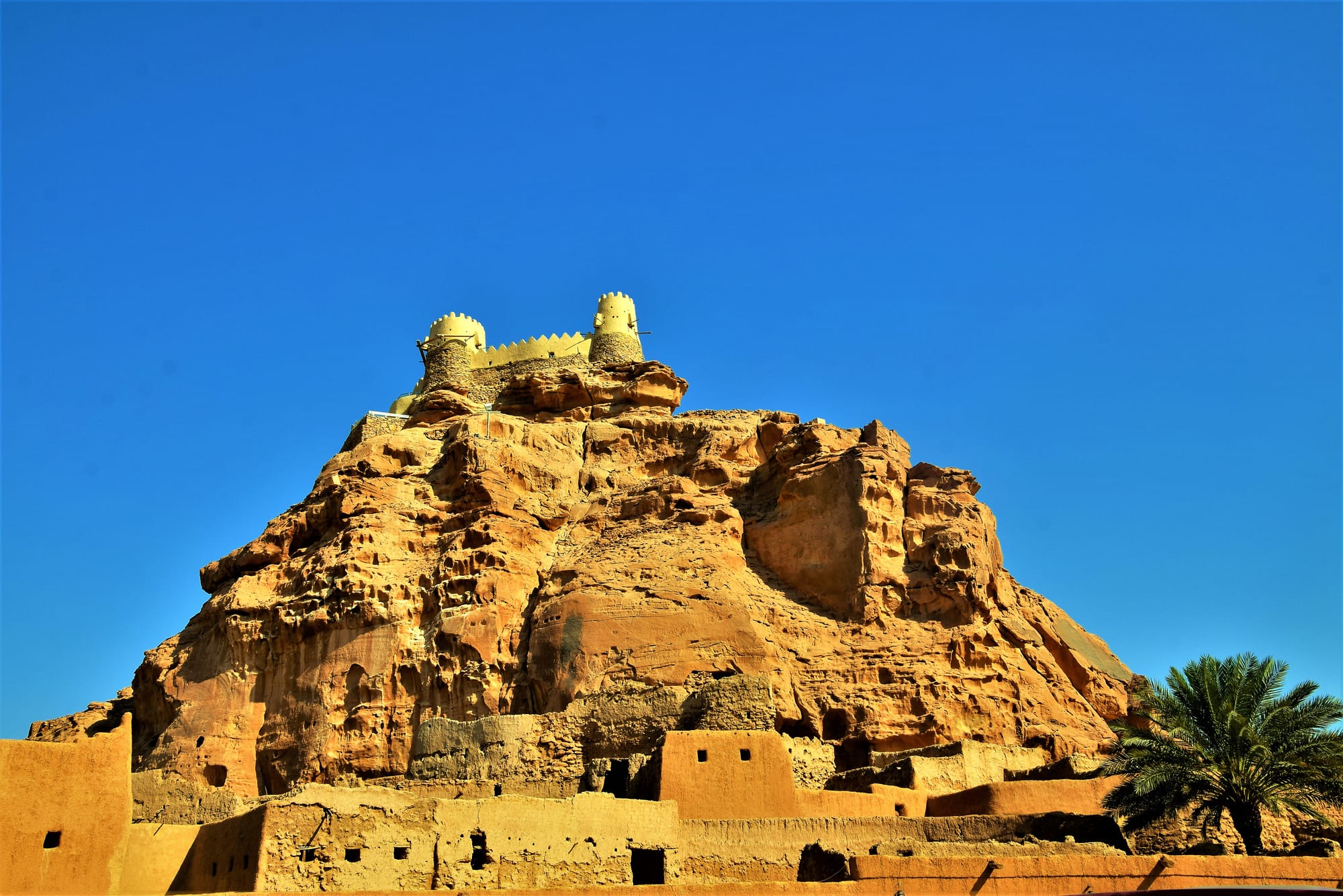
A stone fort with round towers on top of a weathered sandstone outcrop, mud-brick ruins and a palm below against a deep blue sky

AlUla, Tabuk & the Northwest, Saudi Arabia

Sakaka

Zabal castle on its rock above the old quarter of Sakaka. (Heritage Commission / Wikimedia Commons · CC BY-SA 4.0)

The capital of Al Jawf province in the far north of Saudi Arabia, an oasis town of palm gardens and olive groves under a sandstone outcrop crowned by the old Zabal fort. Settled for thousands of years on the route between Arabia and Mesopotamia, it is now a quiet provincial and farming centre near some of the country's oldest monuments. This page is written to explain the city, not to encourage travel.

Neighbourhoods

  • The old quarter below the castle
    • First-time visitors
    • Historic district

    The original settlement at the foot of the Zabal outcrop, with remains of mud-brick houses, old wells and narrow lanes. It is the most atmospheric part of the town and where its history is most visible.

    Open in Maps
  • The central market streets
    • Best for food
    • Shopping

    The commercial heart around the main roads, with shops selling dates, olives and household goods, restaurants, bakeries and most of the town's hotels within a short drive.

    Open in Maps
  • The palm and olive gardens
    • Local life
    • Quiet

    Irrigated farmland wrapping the built-up area, where date palms, olive groves and vegetable plots run up to the houses. Family farms here supply the province and the rest of the kingdom.

    Open in Maps
  • The university and government district
    • Students
    • Quiet and residential

    The newer eastern and southern edges built around Al Jouf University, provincial offices and hospitals, with wide roads, villas and student housing.

    Open in Maps
  • Dumat al-Jandal
    • Historic district
    • Day trips

    A separate oasis town about 37 kilometres to the south-west, with a stone castle above an old quarter of low houses and one of the oldest mosques in the country. It is treated locally as part of the same oasis world as Sakaka.

    Open in Maps

Things to do

Landmarks in the town

  • Zabal Castlelandmark

    A fort on a hilltop at the north-western edge of the town, its outer wall of stone and clay with four corner towers, probably raised on older, Nabataean-era remains, with the rock-cut Sisira Well beside it and views across the oasis.

    Open in Maps
  • The old quarter and wellsneighborhood

    Mud-brick ruins, cisterns and rock-cut wells below the castle, the remains of the settlement that farmed this oasis before the modern town spread around it.

    Open in Maps

Ancient sites

  • Rajajil standing stoneslandmark

    Fifty-four groups of upright stone pillars, the tallest about three metres, standing on a sandy plain south-east of the town and dated to the fourth millennium BC; they carry Thamudic inscriptions, and are thought to have been small temples or sanctuaries.

    Open in Maps
  • Dumat al-Jandallandmark

    An ancient oasis town south-west of Sakaka, known to the Neo-Assyrians as Adummatu and ruled at times by Arab queens, with an old stone and mud-brick quarter below its fortress.

    Open in Maps
  • Marid Castlelandmark

    The fortress standing over Dumat al-Jandal, dated to the first century AD, with a lower storey of stone, an upper storey of mud brick and four conical towers added at different periods; Zenobia's troops are said to have failed to take it.

    Open in Maps
  • Umar Mosquelandmark

    An early mosque in Dumat al-Jandal, built in the 640s and among the oldest in the kingdom, with a tall stone minaret at the corner of the prayer hall; the traditional link to the caliph Umar is doubted.

    Open in Maps

The oasis and everyday town

  • The date and olive farmsattraction

    Groves and pivot-irrigated fields surrounding the town, harvested for dates in late summer and for olives pressed into oil in autumn.

    Open in Maps
  • The produce marketmarket

    Stalls of dates, olives, olive oil, citrus and vegetables from the province's farms, busiest in the morning.

    Open in Maps

Seasonal events

  • The olive harvestautumn

    The province's signature crop is picked in the autumn, and the new oil and the table olives from its farms fill the shops and roadside stalls.

  • Ramadan and the two EidsRamadan and the following month, moving through the year

    The fasting month turns life to the night and the Eid holidays bring family visiting, new clothes and large shared meals; many shops keep short daytime hours.

Eat and drink

Long-standing places and food districts in Sakaka. Hours, ratings and directions come from your maps app, always current.

Al Jawf classics

  • Kabsa and mandi housesrestaurant

    Lamb or chicken over spiced rice eaten from a shared tray, the standard meal for families and groups, with jareesh and qursan appearing in the cold months.

    Open in Maps
  • Olive oil, dates and olivesmarket

    The province is known across the kingdom for its olives and oil as well as its dates, sold in shops and roadside stalls around the town.

    Open in Maps

Markets and cafés

  • The central produce marketmarket

    Local fruit, vegetables and dates, with desert truffles in late winter and spring after good rains.

    Open in Maps
  • Coffee houses in the centrecafe

    Arabic coffee with cardamom served with dates, alongside espresso and karak-style tea in modern cafés popular with students.

    Open in Maps

Experience Sakaka

History

The Al Jawf depression has been inhabited for a very long time. The standing stones at Rajajil, south of the modern town, were raised in the fourth millennium BC, making them among the oldest monuments in Arabia, and the springs and shallow water table of the oasis supported settlement continuously afterwards. Sakaka sits in a basin where sandstone outcrops rise from farmland, and its earliest inhabitants cut wells, cisterns and rooms into that soft rock.

The oasis lay on the route between Arabia and Mesopotamia and was therefore fought over. Dumat al-Jandal, the larger ancient centre nearby, appears in Assyrian records as Adummatu, a stronghold of Arab queens raided in the seventh century BC; it later fell within the orbit of Nabataean, Roman-client and Byzantine-allied powers before coming into the early Islamic state, when the oasis was the object of expeditions from Medina. Sakaka grew alongside it as a farming settlement, guarded by the fort on the Zabal rock, whose present stone and mud-brick form dates from later centuries though the site is far older.

For much of the modern period the oasis was contested between tribal confederations and neighbouring powers, including the Al Rashid of Ha'il and the Al Saud, before it was secured within the Saudi state in the 1920s. Sakaka was made the capital of Al Jawf province, which brought government offices, schools and hospitals. Deep wells and mechanised irrigation from the later 20th century turned the surrounding plain into one of the kingdom's agricultural districts, and Al Jouf University was founded here in 2005; large solar and wind projects have since been built in the province.

Culture & Customs

Al Jawf is a northern, tribal province with ties running across the desert to Iraq, Jordan and Syria, and Sakaka's social life reflects that. Families identify strongly with tribe and lineage, hospitality is close to an obligation, and the ritual of Arabic coffee — poured from a long-spouted pot into small cups and refilled until the guest shakes it — opens every visit. Nabati poetry, recited in the local dialect, is the prestige art form, performed at weddings and gatherings along with drumming and sword dances.

Farming shapes the calendar as much as religion does. The date harvest in late summer and the olive picking in autumn are social events as well as economic ones, with families working the groves and the province's oil sold and compared; Al Jawf's olives are a point of local pride, unusual in a country better known for dates. Winter brings camping in the desert, hunting and falconry, and long evenings around a fire.

Religious observance is public and structured: shops close for each prayer, Ramadan reverses the day, and the Eid holidays fill the streets at night. Dress is conservative and social mixing between unrelated men and women is more limited than in the big cities, although the national changes of recent years are visible among students at the university and in the cafés they fill in the evenings. Visitors are a novelty here rather than an industry, and curiosity is usually met with an invitation.

Daily Life

Sakaka had a population of 204,174 at the 2022 census and is the largest settlement in Al Jawf, with Dumat al-Jandal and Qurayyat as the other main centres of the province. Most residents are Saudi, with Egyptian, Sudanese, Syrian, Yemeni and South Asian workers in agriculture, shops, construction and health care.

The economy rests on agriculture, government and services. Wheat, fodder, dates, citrus and above all olives are grown on irrigated land around the town and processed locally; provincial administration, Al Jouf University, schools and hospitals provide most salaried employment; and shops, contractors and transport firms serve the province and the traffic heading for the Jordanian and Iraqi borders. Renewable energy projects in the province have added a newer kind of industrial employment.

Life follows the heat and the prayers: business in the morning, a long quiet afternoon, and the markets, cafés and parks filling after sunset. Weekends go to family visits, farms and, in the cool months, desert camping. Housing is mostly detached villas with walled yards, and nearly every household depends on a car. The issues residents discuss are water use in a province that irrigates heavily, jobs for graduates, and the distance from the country's economic centres.

Food

Northern Arabian cooking dominates. Kabsa — rice cooked with meat, onion, tomato and spices including dried lime — and mandi, meat cooked slowly and served over rice, are the dishes of any gathering, brought to a shared tray and eaten with the right hand. Winter brings jareesh, coarsely cracked wheat simmered with meat or yoghurt to a thick porridge, and qursan, thin dry flatbreads layered and softened in broth with meat and vegetables — both dishes of the north rather than the coast.

The oasis supplies the rest. Dates are eaten daily, offered to every guest and sold by variety; olives and locally pressed olive oil are the province's signature product, used in cooking and eaten with bread at breakfast; and the farms provide citrus, tomatoes, wheat and dairy. After good winter rains, faqa, the pale desert truffles of the northern deserts, appear in the market in late winter and spring and are cooked with meat or rice.

Drinks are non-alcoholic, alcohol being illegal in the kingdom. Arabic coffee, pale, lightly roasted and heavy with cardamom, is the ceremonial one; sweet black tea, often with mint or sage, follows meals; camel's and goat's milk and laban are drunk in farming households. Speciality coffee shops and karak tea stands have multiplied around the university, and evening bakeries sell semolina cakes and syrup-soaked pastries.

Planning tools

Budget

Sakaka is one of the cheapest bases in the north-west. Hotels are simple business properties, restaurants are inexpensive, and the main costs are a hire car and fuel for the long drives between sites. The regional midrange figure of USD 210–530 reflects AlUla's limited upmarket rooms and the Red Sea resorts; Al Jawf costs far less than that.

Daily Budget Midrange
USD 110–210 (business hotel, restaurants, a hire car and fuel)
Daily Budget Shoestring
USD 45–85 (budget hotel, local restaurants, shared taxis)

Hire a car for the province — Rajajil and Dumat al-Jandal are hard to reach otherwise — and buy olive oil and dates directly from farm shops.

Best Time to Visit

October to April. Autumn brings the olive harvest and mild days; winter is clear and cold, with nights near or below freezing, which suits walking among the ruins and standing stones. Spring can bring desert truffles after rain. Summer is very hot and dry and outdoor sightseeing is uncomfortable. The war that began in late February 2026 has disrupted air travel and events across the region, so dates should be confirmed before booking.

Suggested Number of Days

The town and the sites around it can be seen in a day or two with a car. Longer is worth it for the wider province and the farms, and travellers combining Al Jawf with Tabuk or the northern border towns should allow for several hours of driving between them.

First Visit
1–2 days
With Surroundings
2–3 days

Transportation

Everything here runs on cars. Ride-hailing works within the town and taxis can be hired by the half-day, but there is no useful public transport, and the sites outside the built-up area need a vehicle. Roads across the province are good, straight and lightly used.

Fill up before leaving town, drive in daylight where possible, and watch for camels and drifting sand on the desert roads.

Airport & Station Connections

Al-Jouf International Airport, a joint civil and military field, lies a short drive from the centre and has domestic flights as well as some services to other cities in the Middle East. The northern railway line reaches the province, and long-distance buses run to Riyadh, Tabuk, Ha'il and the border towns; by road it is a long day's drive from Riyadh and several hours from Tabuk. Flights across the region have been disrupted by the war since late February 2026.

Walkability

The old quarter and the castle hill make a good short walk, and the central market streets can be covered on foot. Beyond that the town is low-density and built around wide roads, with long distances between districts and little shade, so a car is needed; summer heat and winter cold both shorten what is comfortable on foot.

Safety

Sakaka is quiet and crime against visitors is rare. The practical hazards are long empty drives, summer heat, freezing winter nights, dust storms, and flash floods in low ground after rare storms. Some governments advise against travel close to the Iraqi border, which lies north-east of the province. A regional war involving Iran and the Gulf states has been under way since late February 2026, and air travel and tourism across the region have been disrupted.

Drive in daylight, carry water and fuel, keep well away from the Iraqi border, and do not photograph military or security sites. Check current official travel advice before travelling.

Climate

A dry continental desert climate with the widest seasonal range in the kingdom. Rain is slight and falls mostly between November and April, and the difference between day and night is large all year.

Summer
very hot and dry, with afternoons often 38–44°C
Winter
cool days of about 12–18°C, with frequent frost and nights at or below 0°C

Local Customs

This is a conservative provincial town where tribal and family ties are strong. Dress modestly, with shoulders and knees covered and loose clothing; many women wear an abaya in public, though it is not required of foreign visitors. Greetings are unhurried and right-handed, coffee and dates are pressed on guests and should be accepted, and non-Muslims do not enter mosques. Alcohol is illegal throughout the kingdom. Shops close for each of the five daily prayers.

Ask before photographing people, dress modestly at the old quarter and in the markets, and avoid photographing military or border installations.

Common Payment Methods

The currency is the Saudi riyal, pegged to the US dollar. Cards are widely accepted in hotels, restaurants and filling stations, and ATMs are easy to find in the centre, but small cash amounts help at farm shops and market stalls. Visitors normally need a visa arranged before arrival or online.