Attractions & Natural Wonders · Tanzania
Why do more than a million wildebeest circle the Serengeti every year?
The herds, some 1.3 to 1.7 million wildebeest plus zebras and gazelles, follow the rain and the grass in a vast clockwise loop between Tanzania and Kenya.
By Globeway Editorial · 13 October 2026
The short answer
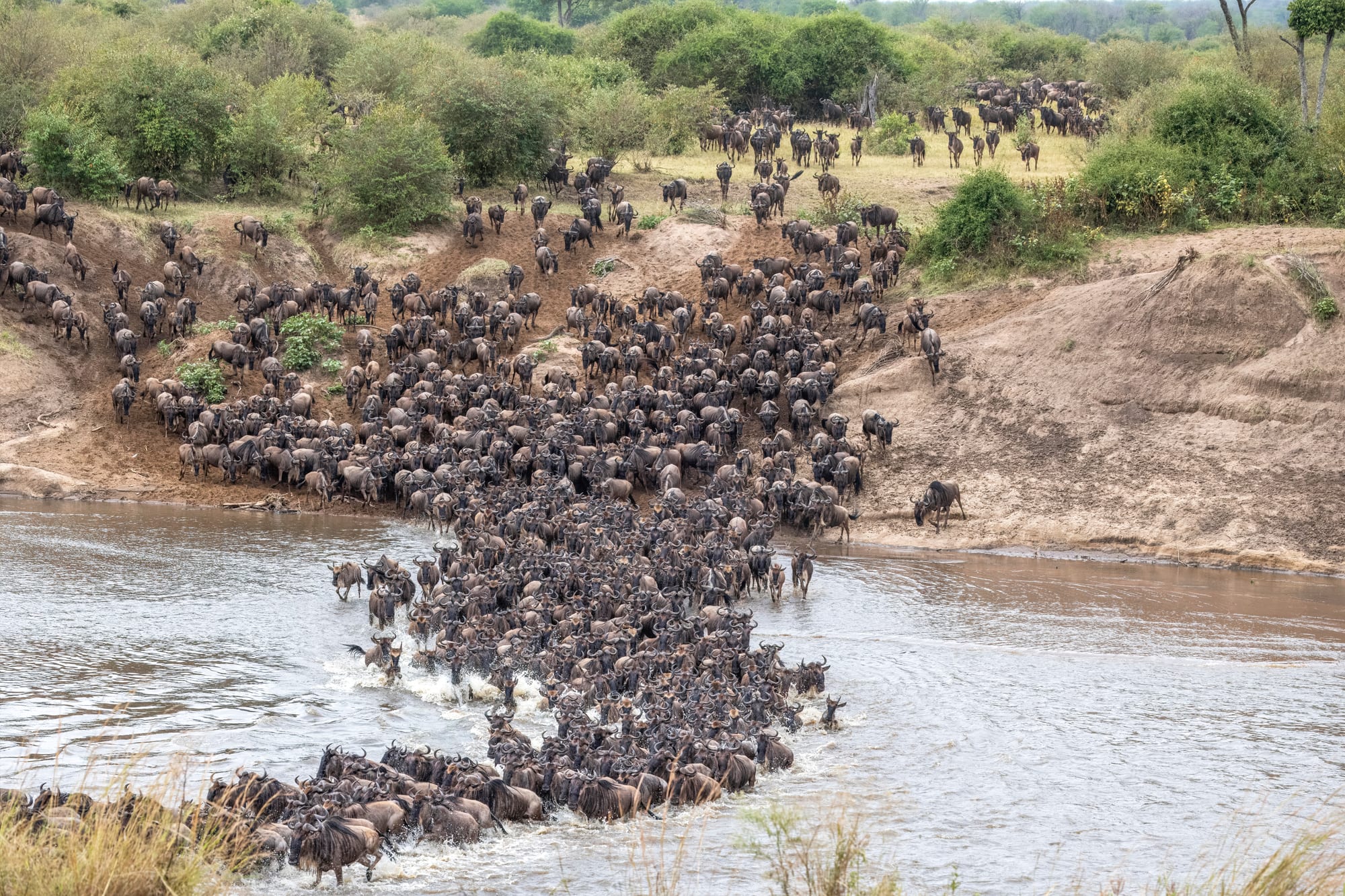
They are following the grass. The Serengeti has two rainy seasons, a long one from March to May and a shorter one in October and November, and rain falls very unevenly across it. The wildebeest spend the wet months on the short-grass plains of the south-east, where the grass is rich enough to feed mothers and newborn calves, and then, as the plains dry out, move north-west and north towards the wetter country around Lake Victoria and Kenya's Maasai Mara, where grass and water last through the dry season. When the short rains return, they head south again. The whole loop runs clockwise for around 800 kilometres.
The number in the question is a little high. Estimates of the wildebeest themselves range from about 1.3 million to 1.7 million. What does pass two million is the whole moving crowd: the wildebeest travel with around 250,000 to 260,000 zebras and several hundred thousand gazelles, along with eland and other plains animals.
A year on the move
The journey has a rough calendar, although the timing shifts with the rain from year to year. In February the herds are on the short-grass plains in the south-east of the ecosystem, around the Ngorongoro Conservation Area, giving birth to roughly 500,000 calves in the space of two or three weeks. As the rains end in May they start moving north-west into the Western Corridor, the stretch of the park drained by the Grumeti and Mbalageti rivers, and usually stay around the Grumeti until late June.
From July they push north across the Grumeti and then the Mara, reaching Kenya in late July or August. They spend the rest of the dry season in the Mara country, around the only river in the ecosystem that flows all year. In early November, with the short rains, they turn south again and usually arrive back on the southern plains in December, in good time for calving.
- December: herds arrive back on the south-eastern short-grass plains
- February: about 500,000 calves are born in two or three weeks
- May: rains end and the herds move north-west towards the Western Corridor
- Late June: herds gather around the Grumeti River
- July: crossings of the Grumeti and Mara rivers begin
- Late July to August: herds arrive in Kenya's Maasai Mara for the rest of the dry season
- Early November: the short rains start and the herds head south again
Why the southern plains matter
The almost treeless plains of the southern Serengeti grow on volcanic ash. The eruption of the now-extinct Kerimasi volcano about 150,000 years ago dumped huge amounts of fine whitish-grey ash here, and later eruptions of Ol Doinyo Lengai deepened it. Over time the ash hardened into layers of calcareous tuff and a calcium-rich hardpan, a hard crust beneath the soil. The result is a grassland of short grasses on light, alkaline soils, exactly the kind of grazing the blue wildebeest prefers. Its broad mouth is built for eating large amounts of short grass.
Wildebeest migrations are timed to the pattern of rain and grass growth on plains like these, where the animals find the nutrient-rich food that mothers need to produce milk and calves need to grow. But rain is spread very unevenly. It varies from as little as 508 millimetres a year in the lee of the Ngorongoro highlands, at the south-eastern edge, to 1,200 millimetres on the shores of Lake Victoria in the west. At the end of the rainy season the herds leave for their dry-season range because drinking water runs short. The far north-west, with the highest rainfall in the system, becomes the herds' refuge at the end of the dry season. Wildebeest need water often, ideally drinking twice a day, so they cannot simply sit out the drought where they are.
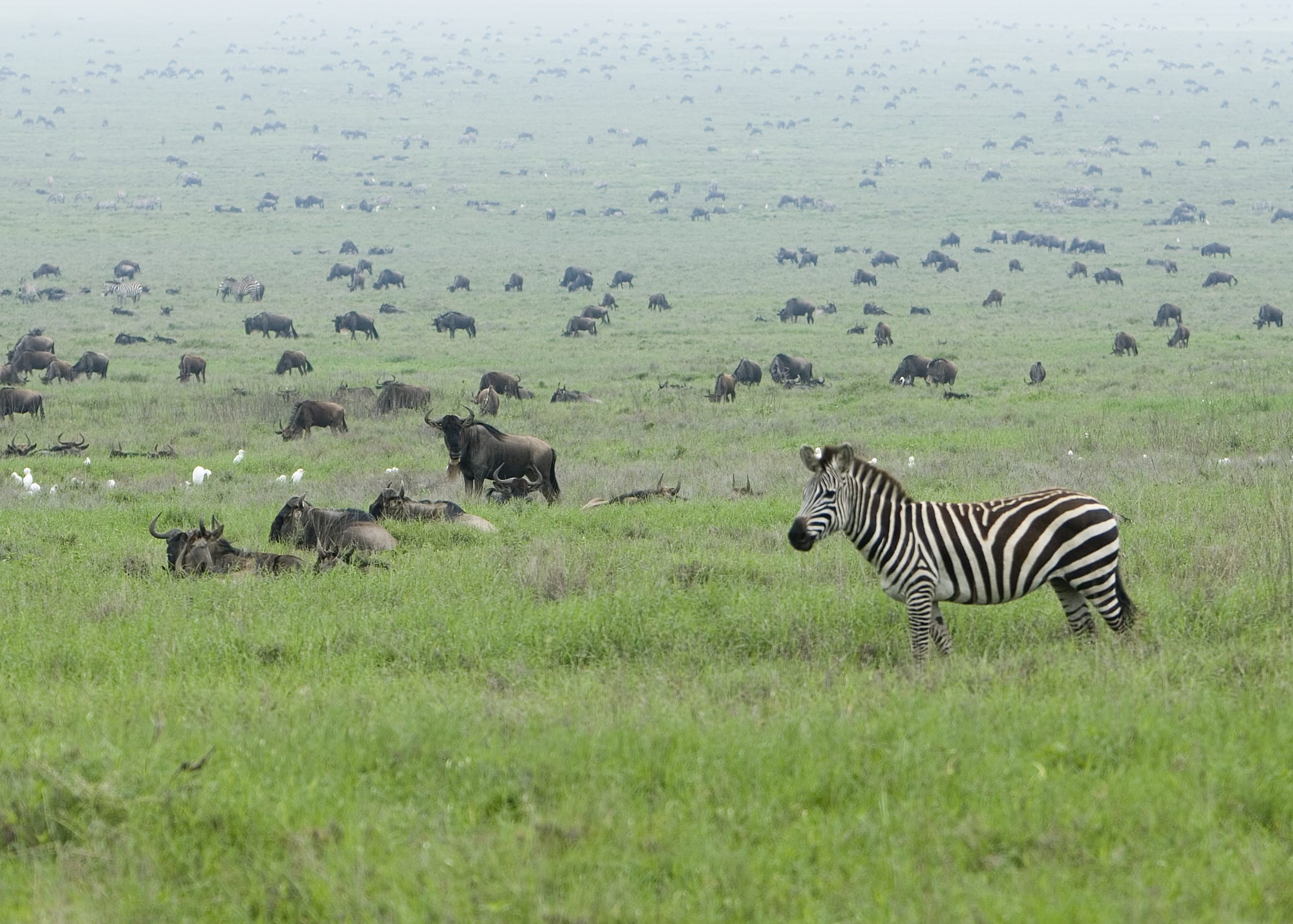
Zebras and wildebeest travel together for a reason. The zebras usually go first and eat the taller, less nutritious upper layer of grass, exposing the lower, greener growth that wildebeest prefer. Thomson's and Grant's gazelles take part too, though in the dry season they move only east and west rather than making the long trip north.
Safety in numbers
Calving is the key to the whole pattern. Between 80 and 90 per cent of calves are born within a three-week window, and mothers give birth in the middle of the herd, usually around midday, so that the newborn, which can stand within minutes, is steady on its feet before nightfall when predators are most active. In large herds about 80 per cent of calves survive their first month, against about 50 per cent in small herds. The few calves born early rarely survive at all: mixed in among the previous year's young, they are easier for predators to pick out.
Moving also lets the population grow far larger than it could by staying put. Access to rich grazing for breeding means that migratory wildebeest populations reach much bigger numbers than resident ones. Many such migrations existed a century ago, but all except three, in the Serengeti, at Tarangire in Tanzania and in Zambia's Kafue, have since been disrupted or lost.
The river crossings and their cost
The crossings are the most dramatic part of the journey, and among the most dangerous. Around 3,000 crocodiles wait in the Grumeti and Mara rivers, but they are not the main killer: for every wildebeest caught by a crocodile, around 50 drown. Each year about 250,000 wildebeest die along the way from drowning, predation, exhaustion, thirst or disease.
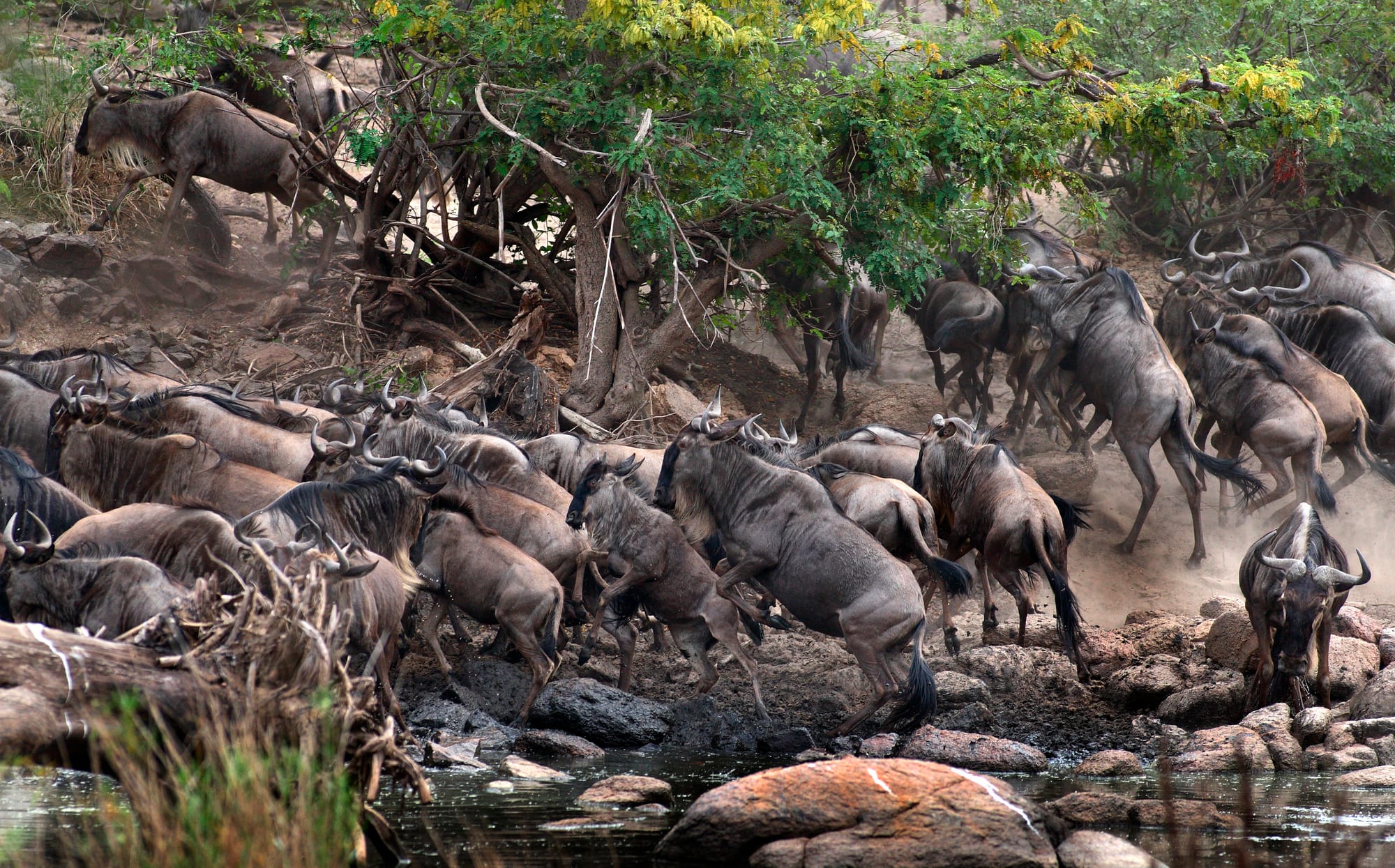
The herds are also hunted all the way. The Serengeti ecosystem holds more than 3,000 lions, around 1,000 leopards and thousands of spotted hyenas, and vultures follow the migration closely to feed on the carcasses it leaves behind.
Why the herds are so big today
The size of the migration is partly a story of disease. Rinderpest, a viral cattle plague that also infected wildebeest, swept through eastern and southern Africa in the 1890s and killed an estimated 80 to 90 per cent of all cattle. With its wildebeest gone, the Serengeti burned in intense annual wildfires. By the mid-1970s wildebeest and buffalo numbers had recovered, and their grazing left less grass to fuel fires, allowing acacia trees to return. Rinderpest was declared eradicated worldwide in June 2011.
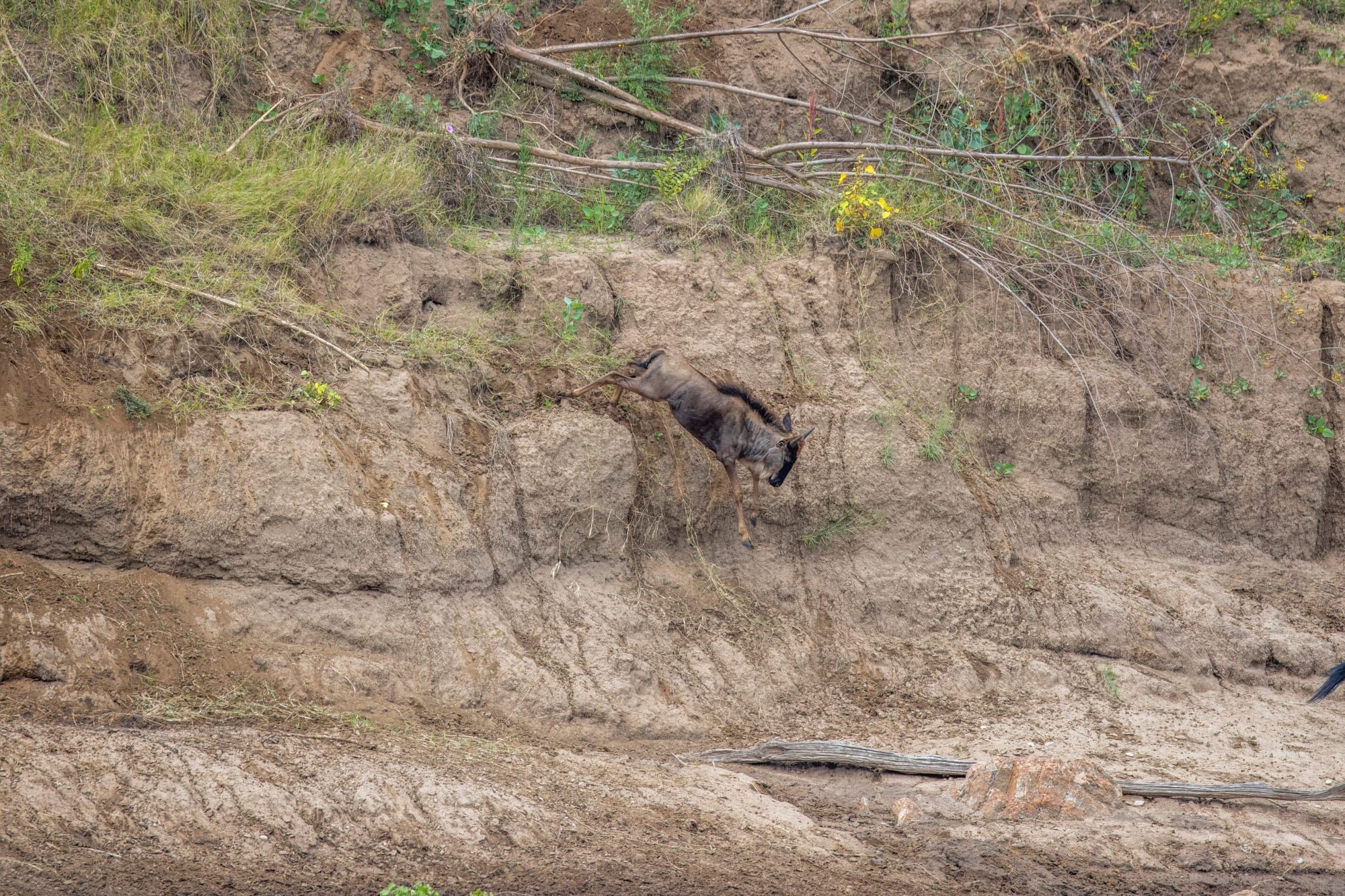
The migration depends on the whole loop staying open. Tanzania and Kenya protect more than 80 per cent of the Serengeti, yet the ecosystem has shrunk to about 60 per cent of its original size. Deforestation in the Mau Forest has changed the flow of the Mara River, and a proposed 452-kilometre highway across the park, revived in 2024, has alarmed conservationists who fear it would disrupt the migration.
For visitors the calendar is the guide: the southern plains around calving time from January to March, the Western Corridor from May to July, and the river crossings in the north and the Maasai Mara from July, when they are a major safari attraction.