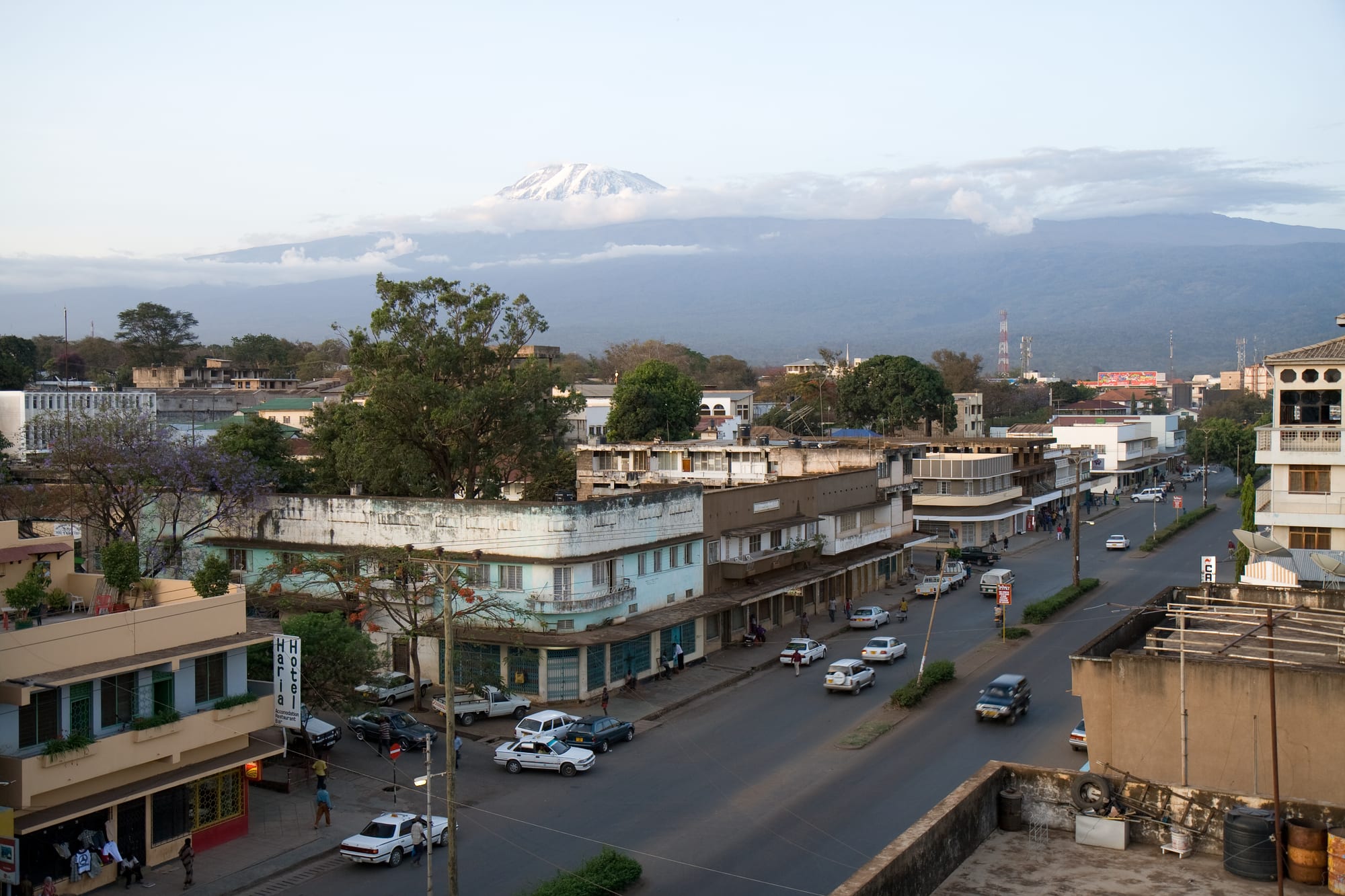
A street of low buildings in Moshi with trees in the foreground and the snow-capped summit of Kilimanjaro above the clouds

Tanzania

Arusha, Kilimanjaro & the Northern Safari Circuit

Kilimanjaro's snow-capped summit rising above the town of Moshi. (Stig Nygaard / Wikimedia Commons · CC BY 2.0)

The north-eastern highlands and Rift Valley country of Arusha, Kilimanjaro and Manyara regions — Tanzania's tourism heartland, running from Mount Kilimanjaro and Moshi past Arusha to the Ngorongoro Crater, the southern Serengeti plains, Lake Manyara and Tarangire, and home to the Chagga, Maasai, Arusha, Meru and Iraqw peoples.

Explore Arusha, Kilimanjaro & the Northern Safari Circuit

History

Few places have told more about human origins. At Olduvai Gorge, in the Ngorongoro Conservation Area, Mary and Louis Leakey's discoveries — above all the robust skull found in 1959 — made the name famous, and at nearby Laetoli footprints left by early hominins in volcanic ash about 3.6 million years ago were found in 1976. In later millennia Cushitic-speaking herders, Bantu farmers and, later, the Maa-speaking Maasai moved into the highlands and the Rift Valley.

On Kilimanjaro's slopes the Chagga built dozens of small chiefdoms, each under a mangi, irrigating banana and millet gardens with furrows. The missionary Johannes Rebmann reported the mountain's snow in 1848, to disbelief in Europe, and in 1889 Hans Meyer and Ludwig Purtscheller made the first recorded ascent. German rule followed from the 1880s, and Chagga resistance was put down harshly, with Mangi Meli of Moshi hanged in 1900. Missionaries introduced coffee, and in 1930 the Kilimanjaro Native Co-operative Union, now Tanzania's oldest co-operative, was founded to market their coffee.

Arusha grew from a German fort into the region's hub. In 1967 Nyerere launched Ujamaa there with the Arusha Declaration, and the city later hosted the talks that produced the 1993 Arusha Accords for Rwanda, the UN tribunal for the Rwandan genocide and the headquarters of the East African Community. The Serengeti became a national park in 1951, and in 1959 the Ngorongoro Conservation Area was created as a place where Maasai herding and wildlife would share the land.

Culture & Customs

The region is a patchwork. The Chagga of Kilimanjaro are known across Tanzania for their work ethic and their long tradition of trade. Around Arusha live the Arusha and Meru, farming peoples with close ties to the Maasai, and to the south-west the Iraqw of the Mbulu highlands speak a Cushitic language unlike any of their neighbours'. The Nilotic Datooga live in Karatu and the south-west of Manyara Region, and near Lake Eyasi small groups of Hadza still live largely by hunting and gathering and speak a click language unrelated to any other.

The Maasai, whose red shukas, beadwork and jumping dances of young warriors have become images of Tanzania itself, remain pastoralists at heart, measuring wealth in cattle and organising life around age-sets and ceremonies. Their relationship with conservation is fraught. Since 2021 the government has been moving families out of the Ngorongoro Conservation Area to Msomera, a village some 600 kilometres away, in a programme it describes as voluntary and which Human Rights Watch says has been coercive; in Loliondo, a dispute in 2022 over land set aside for wildlife turned violent, and the United Nations reported large numbers of Maasai displaced from Loliondo and Ngorongoro.

Christianity is the majority faith, Protestant and Catholic on the mountain slopes, with Muslim communities in the towns.

Daily Life

Arusha, with around 600,000 people, is the region's commercial centre and one of Tanzania's busiest cities, crowded with safari vehicles, conference delegates and international organisations. Moshi, with roughly 220,000, is smaller and calmer, an orderly town of coffee-trade buildings and climbing outfitters; Babati, the capital of Manyara Region, is a modest market town.

Tourism is the region's great earner, employing guides, drivers, cooks, porters and lodge staff by the tens of thousands, and its dependence on visitors was laid bare when travel stopped in 2020. Farming still matters: coffee, bananas and vegetables on the mountain slopes, wheat and beans on the highland plains, and flowers and seeds grown for export around Arusha. At Mirerani, in Manyara Region, the world's only known deposits of tanzanite are mined, the gem discovered there in 1967.

Days begin early, with commuters packed into dala-dalas and porters gathering at the park gates. Current issues include the land disputes around Ngorongoro and Loliondo, pressure on farmland from a growing population, water shortages in Arusha, and the political tension that followed the October 2025 election, when protests also reached Arusha.

Food

The food of the Kilimanjaro slopes is built on the banana. Mtori is a thick stew of mashed green bananas and meat, often given to new mothers because it is soft and nourishing. The Chagga's great drink is mbege, a mildly alcoholic drink of fermented bananas and finger millet, made largely by hand. Bananas also turn up roasted over charcoal by the roadside.

The Maasai diet is traditionally based on milk and meat from their herds; roasted goat and sheep are the centre of their feasts, and nyama choma — grilled meat eaten with kachumbari and salt — is the social meal of Arusha's bars and roadside grills. In the towns everyday meals are ugali or rice with beans, greens and stew, and Arusha's central market is piled with highland vegetables, avocados and fruit.

Coffee is the region's signature crop. Arabica from the slopes of Kilimanjaro and Meru and from the Karatu highlands is sold across the world, and farms around Moshi and Karatu show visitors the process from cherry to cup.

Attractions & Natural Wonders

Mount Kilimanjaro, rising alone from the plains to 5,895 metres at Uhuru Peak, is climbed on routes such as Marangu, Machame and Lemosho over several days, through farmland, rainforest, heath and alpine desert to the glaciers of the summit. Moshi is the base, with coffee farms and the Materuni waterfalls on the lower slopes, and the crater lake of Lake Chala lies on the Kenyan border to the east. Arusha, the other gateway, sits below Mount Meru, the centrepiece of Arusha National Park with its Momella lakes and Ngurdoto Crater.

West of Arusha the road climbs the Rift Valley wall. Lake Manyara National Park lies at its foot, beyond the market town of Mto wa Mbu, and Tarangire to the south is known for elephants and baobabs in the dry season. Karatu's farms lead up to the Ngorongoro Conservation Area, a UNESCO World Heritage Site: the crater itself, packed with game; the Empakaai crater; Olduvai Gorge and its museum; and, to the west, the southern Serengeti plains around Ndutu, where the wildebeest herds calve from around January to March. The main body of Serengeti National Park lies beyond, in the Mara and Simiyu regions.

Further afield are Lake Natron, a caustic soda lake where lesser flamingos breed, beneath Ol Doinyo Lengai, the Maasai's sacred active volcano; Lake Eyasi, with its Hadza and Datooga communities; and, in Manyara Region, the volcanic cone of Mount Hanang.

Cities in Arusha, Kilimanjaro & the Northern Safari Circuit

Planning basics

Budget

This is the most expensive part of Tanzania. Park and conservation fees are charged per person per day, the Ngorongoro Crater adds a separate vehicle fee, and a safari needs a 4x4 and a driver-guide. A Kilimanjaro climb, with its compulsory guides, porters and park fees, costs well into four figures in US dollars. Away from the parks, Arusha and Moshi have cheap guesthouses and local restaurants.

Daily Budget Midrange
USD 260–680 per day on a guided safari (vehicle, guide, park fees, lodge or tented camp)
Daily Budget Shoestring
USD 35–65 in Arusha or Moshi, off-safari (guesthouse, local food, dala-dalas)

Compare several licensed operators in Arusha or Moshi, share a vehicle to split costs, and check exactly which park fees a quote includes.

Safety

The region is generally safe and well used to visitors. The main risks are petty theft and occasional muggings in Arusha and Moshi after dark, touts at the bus stations, road accidents on the highways, altitude sickness on Kilimanjaro and Mount Meru, and wild animals in the parks. Relations between the authorities and Maasai communities in Ngorongoro and Loliondo are tense.

Climb with a licensed operator and ascend slowly, stay in the vehicle unless a guide says otherwise, and use taxis at night. Check current official travel advice before travelling.

Climate

Altitude sets the climate. Moshi, at the foot of Kilimanjaro, is warm; Arusha, higher up, is mild all year; the Ngorongoro crater rim, well above 2,000 metres, is cold at night and often in cloud; and Kilimanjaro's summit is below freezing. The long rains fall from roughly March to May and the short rains around November.

Summer
December to March is warm, around 27–32°C in Moshi and the parks and mid-20s in Arusha
Winter
June to August is the cool season, with chilly nights around 10–14°C in Arusha and near freezing on the crater rim

Transportation

Kilimanjaro International Airport lies between Moshi and Arusha, and Arusha Airport handles light aircraft to the park airstrips. Buses link Arusha to Moshi in about an hour and a half, to Nairobi across the Kenyan border, and to Dar es Salaam in a long day. The drive from Arusha to the Ngorongoro rim takes about three to four hours on tarmac, and beyond it tracks lead onto the Serengeti plains. Safaris run by 4x4.

Fly into Kilimanjaro rather than Dar es Salaam for a northern safari, and ask how long each driving day will be before booking.

Best Time to Visit

June to October is the dry peak for game viewing in Tarangire, Manyara and the crater, and the most popular window for Kilimanjaro. January to March is the calving season on the southern Serengeti plains around Ndutu and a second good climbing window. The long rains of April and May bring low prices, green landscapes and muddy tracks, and some camps close.