Attractions & Natural Wonders · Tanzania
Why does Kilimanjaro have snow on the equator?
Its summit stands nearly six kilometres up, where the air is far below freezing all year, but the ice it carries is now vanishing fast.
By Globeway Editorial · 13 October 2026
The short answer
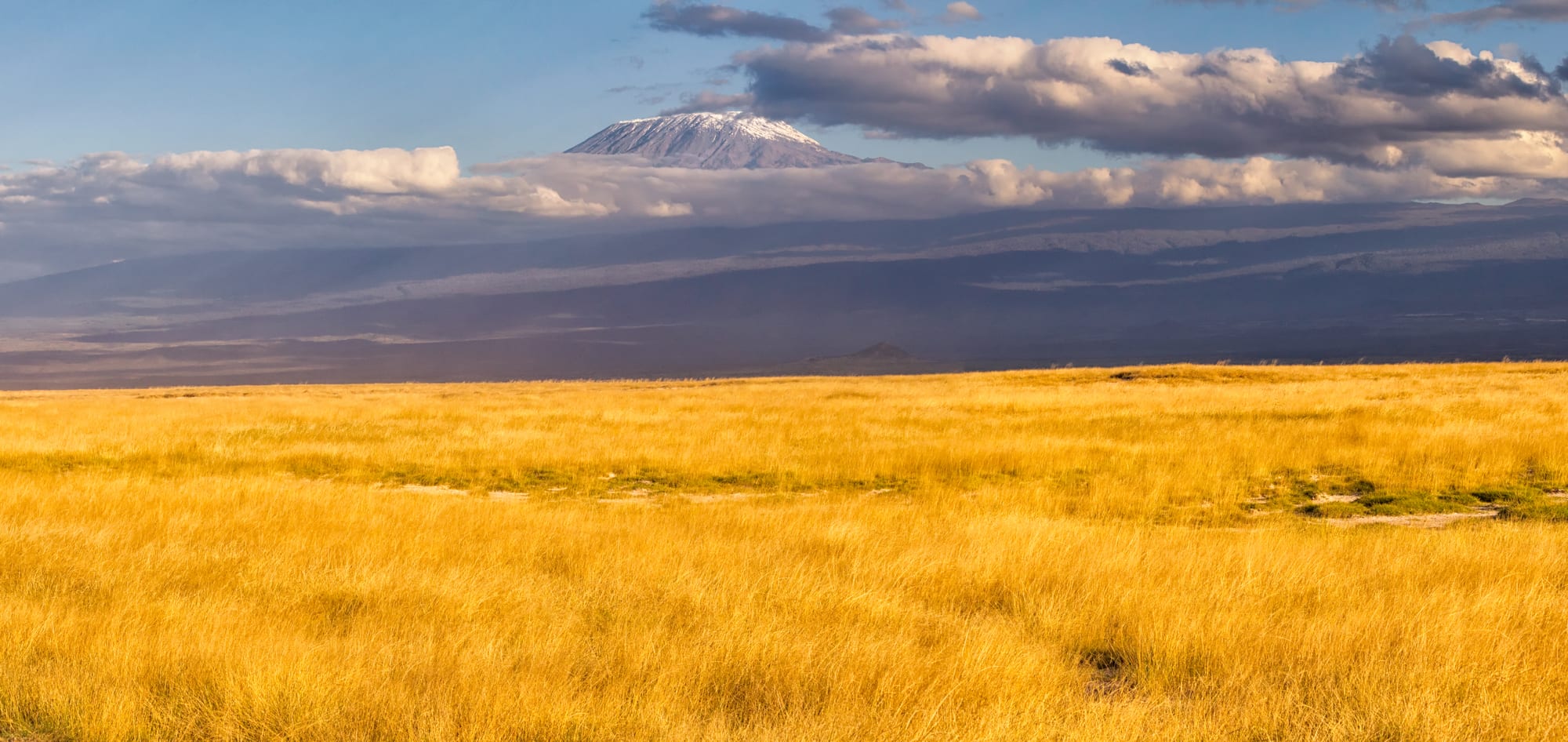
Kilimanjaro is cold at the top for the same reason every high mountain is: air gets colder with height. Its highest point, Uhuru Peak, stands 5,895 metres (19,341 feet) above sea level, so high that the average temperature in the summit area is about −7 °C. Near the equator the line above which snow and ice can last, the snow line, typically sits at around 4,500 metres. Kilimanjaro reaches well above it, and it is one of only three places in Africa, with Mount Kenya and the Rwenzori Mountains, that still hold glaciers.
Strictly speaking, the mountain is not on the equator but about 340 kilometres south of it, close enough that its climate is equatorial, with little change between seasons. Its "snow" is mostly glacier ice, the remnant of a much larger ice cap. That ice has been shrinking for more than a century, and scientists expect it to be gone within a few decades.
Colder with every kilometre
Air that rises expands and cools. In the standard model of the atmosphere used by aviation, the temperature falls by about 6.5 °C for every kilometre of height. Climbing nearly six kilometres from sea level to the top of Kilimanjaro is therefore, in temperature terms, like travelling from the tropics to the poles.
The mountain shows this in its bands of vegetation. Bushland and farms on the lower slopes give way to rainforest between about 1,800 and 2,800 metres, then heather and moorland, then alpine desert from 4,000 metres, and finally an arctic zone above 5,000 metres. Nights on the summit ice fields fall to −9 °C on average, and on the clearest nights to as low as −27 °C. Days are only a little warmer, with average highs around −4 °C.
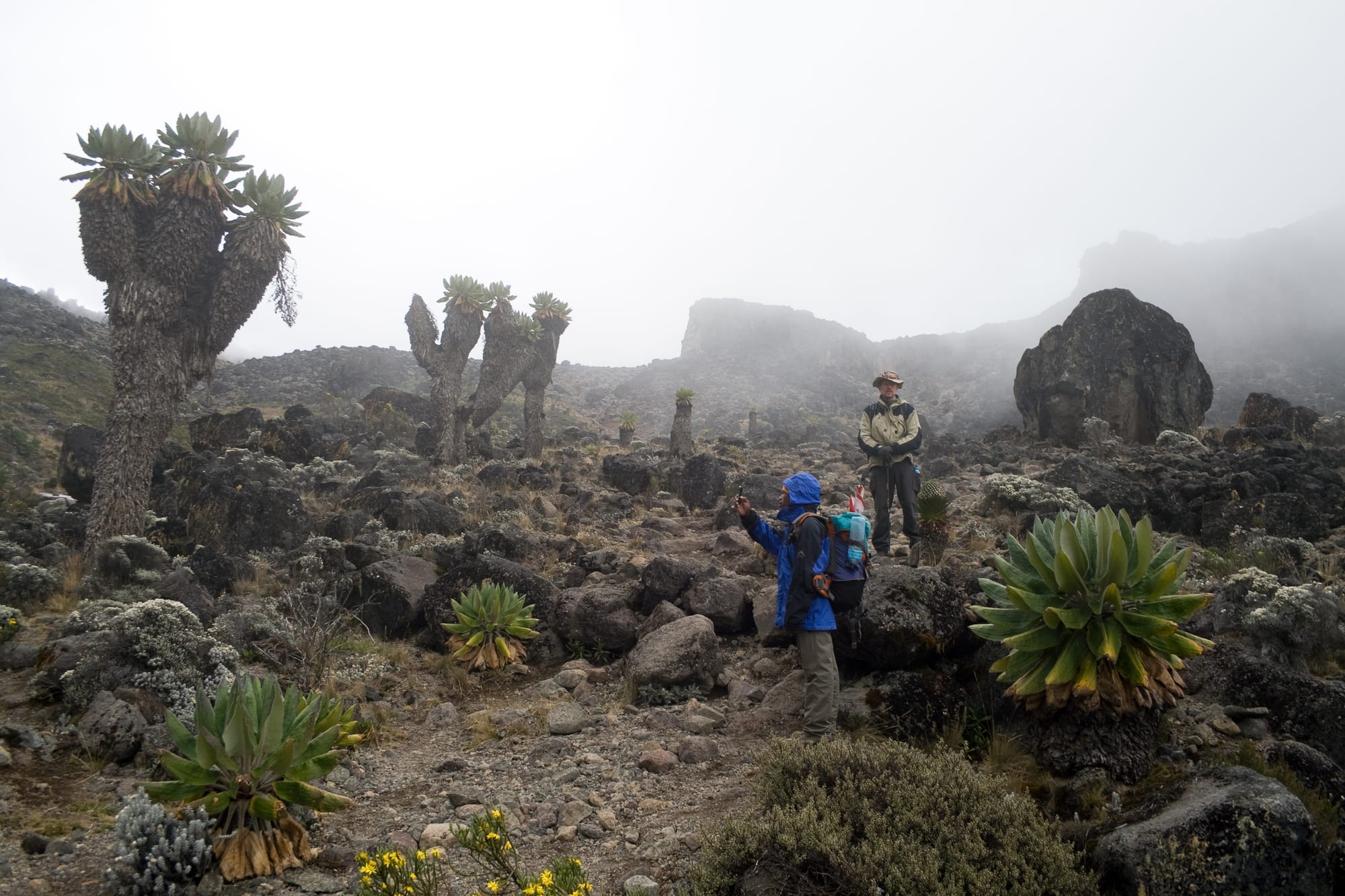
Each band of altitude on Kilimanjaro has its own climate and plant life, from farmland and rainforest to moorland, alpine desert and ice.
Being close to the equator helps in one way: the summit has an ice-cap climate with little seasonal change, and temperatures that are mild for such a height. On nearby Mount Kenya, which shares this kind of equatorial mountain climate, one researcher summed it up as "winter every night and summer every day".
Why a mountain this high still has so little ice
Height alone is not the whole story. Precipitation on the summit falls mainly as snow and graupel, small pellets of soft hail, but only 250 to 500 millimetres a year, and it disappears within days or years. The rainy seasons run from March to May and around November, and the summit lies in an alpine zone where annual precipitation drops to around 200 millimetres. Kilimanjaro also stands alone, rising 4,900 metres above its plateau base, far from the sea. Mountains like this have larger daily temperature swings and less moisture, which pushes the snow line higher. That is one reason the neighbouring Mount Meru has no glacier today.
In the dry, thin air of the summit, sunlight matters more than air temperature. The ice on the crater plateau ends in sheer vertical walls, a feature unique to these summit glaciers. The air around them stays below freezing, but the sun shining on those walls melts them, and much of the ice also turns straight into water vapour, a process called sublimation. Studies suggest that falling humidity, rather than rising temperature, drove the shrinking of the ice on the slopes from the late 19th century, and that no clear warming trend occurred at the height of those glaciers between 1948 and 2005.
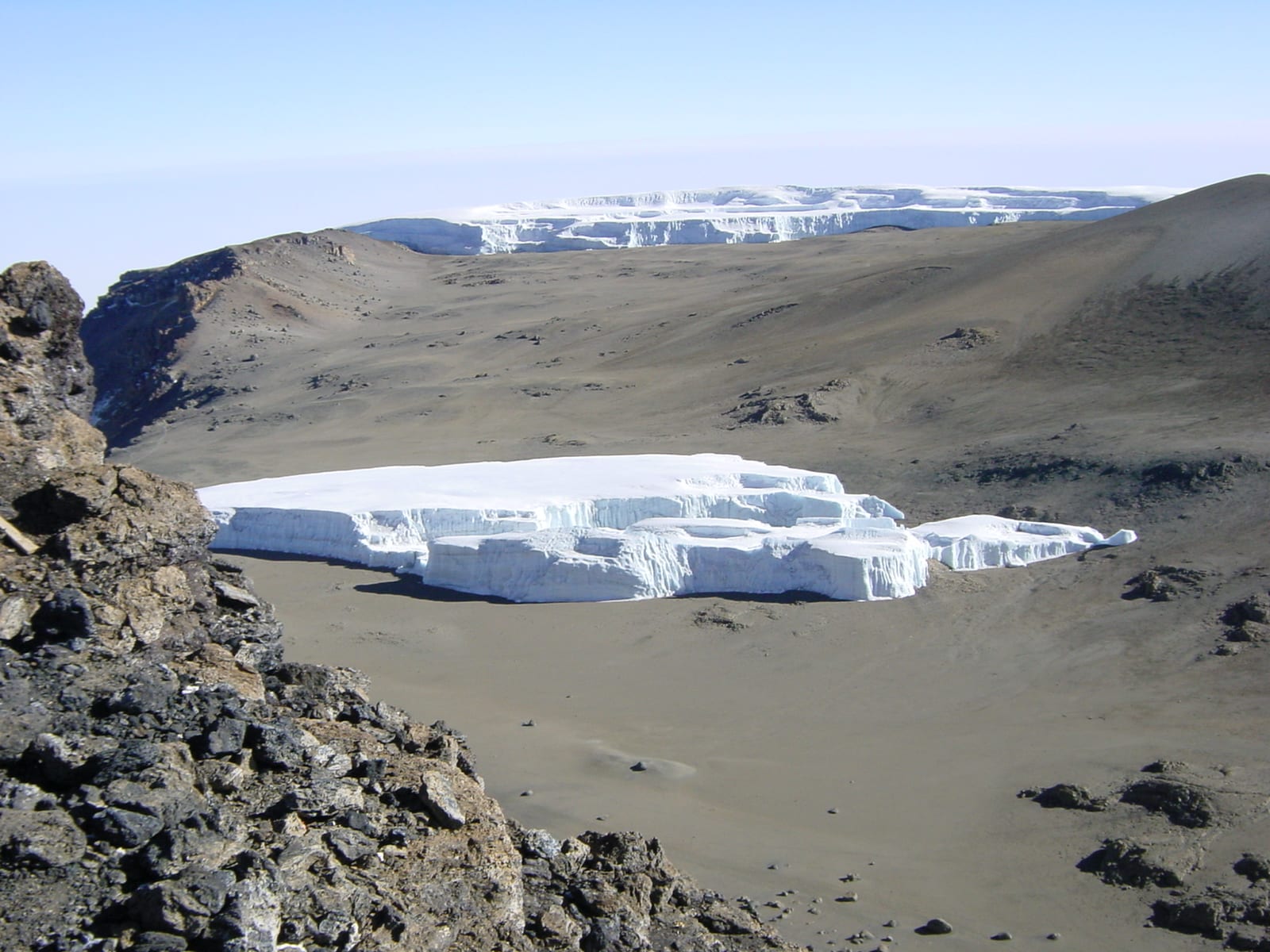
The vertical ice walls of Kilimanjaro's glaciers are where most of their shrinking takes place.
The snow that Europe refused to believe
When the German missionary Johannes Rebmann saw the mountain on 11 May 1848, he noticed a dazzling white cap. His guide called it simply "baridi", cold, and Rebmann concluded that it could only be snow. His report was published in 1849 and dismissed for the next twelve years. The Geographical Society of London held that snow could not exist, let alone last, so close to the equator, and put the story down to the hallucination of a missionary sick with malaria.
Later expeditions proved Rebmann right. In August 1871 the missionary Charles New reached the snow at slightly more than 4,000 metres, and in 1889 the German geographer Hans Meyer and the Austrian mountaineer Ludwig Purtscheller reached the highest summit. At that time the top of Kibo, the highest of Kilimanjaro's three volcanic cones, was entirely covered by an ice cap of about 20 square kilometres, with glaciers spilling down its western and southern slopes.
Kilimanjaro's shrinking ice
- 1848
Johannes Rebmann reports snow on the summit; experts in London dismiss it.
- 1889
Hans Meyer and Ludwig Purtscheller reach the summit, then wrapped in an ice cap of about 20 square kilometres.
- 1912
Ice covers 11.40 square kilometres.
- 1912–1953
The glaciers on the slopes retreat rapidly; total ice cover shrinks by about 1.1 per cent a year.
- 1989–2007
The yearly loss speeds up to 2.5 per cent.
- 2011
Less than 1 square kilometre of ice remains, almost 85 per cent less than in 1912.
A summit losing its ice
The modern retreat is steep. Ice covered 11.40 square kilometres in 1912 and less than 1 square kilometre in 2011. Of the ice still present in 2000, almost 40 per cent had gone by 2011. The glaciers are thinning as well as shrinking, and none has an area where new snow builds up faster than ice is lost. A 2013 estimate concluded that, at the current rate of global warming, most of the ice will disappear by 2040, and that "it is highly unlikely that any ice body will remain after 2060".
The ice has come and gone before. During the last ice age a continuous cap of about 400 square kilometres reached down to 3,200 metres, and the ice fields may have vanished entirely around 11,500 years ago, in a long dry spell, before wetter conditions let them form again. But the present shrinking appears to be unique in the almost 12,000-year history of today's ice, and it is happening at the same time as glaciers retreat across the tropics and mid-latitudes. When the ice goes, the loss for water supplies will be small: the forests far below the summit are the real reservoirs for the people living around the mountain.
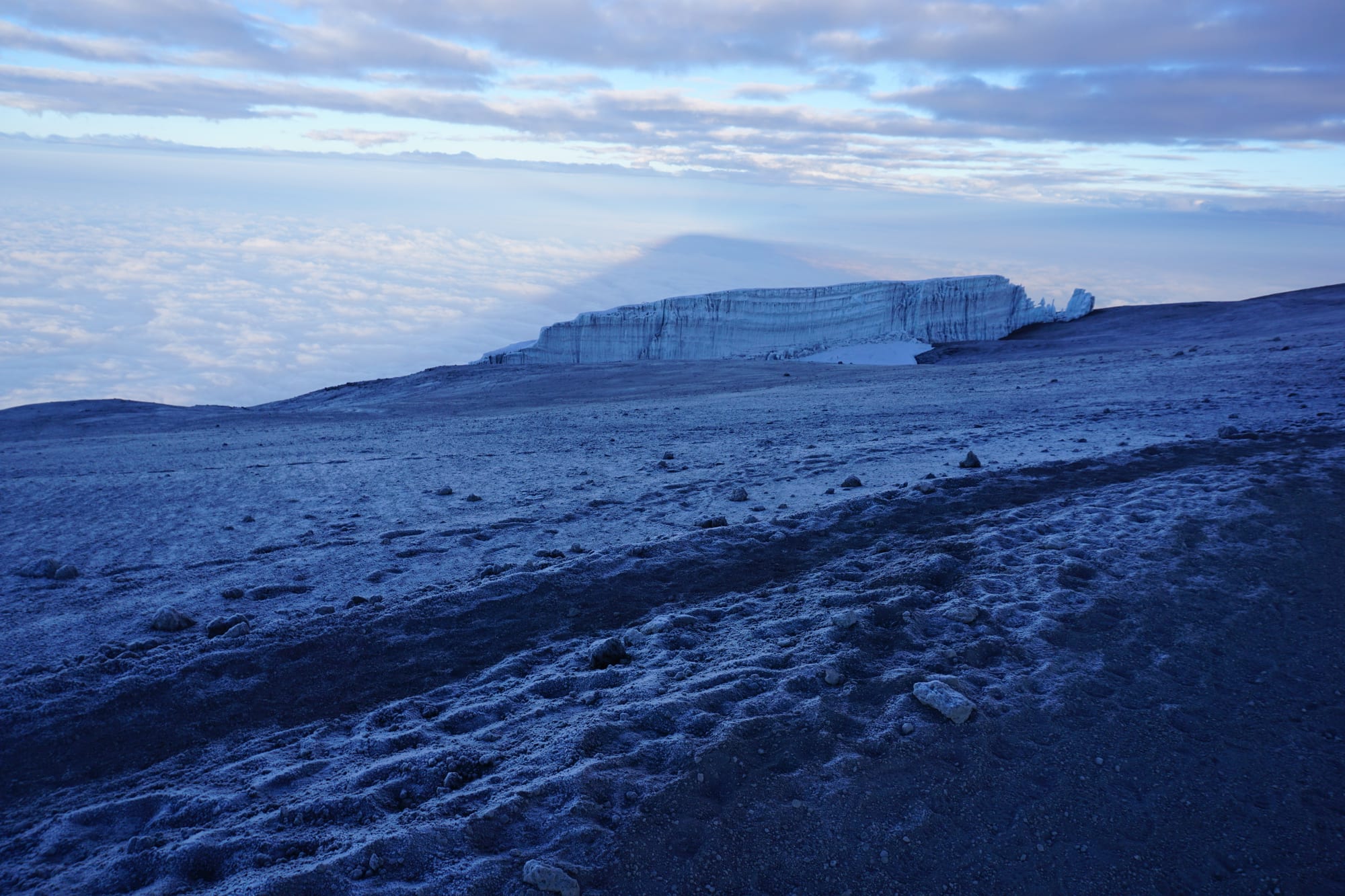
Snow can fall on Kilimanjaro at any time of year, mostly in the two rainy seasons, but the old glaciers beneath it are no longer being replenished.
Seeing the ice today
The summit lies in Kilimanjaro National Park, and the ice can still be seen by those who climb to the crater rim by one of the seven established routes to Uhuru Peak; routes such as the Machame and Lemosho take six days or more. The mountain is not technically difficult, but its height makes altitude sickness a serious risk, and acclimatising slowly matters. From the plains below, the white cap of Kibo can still be seen on clear days, though it is far smaller than the one Rebmann described.