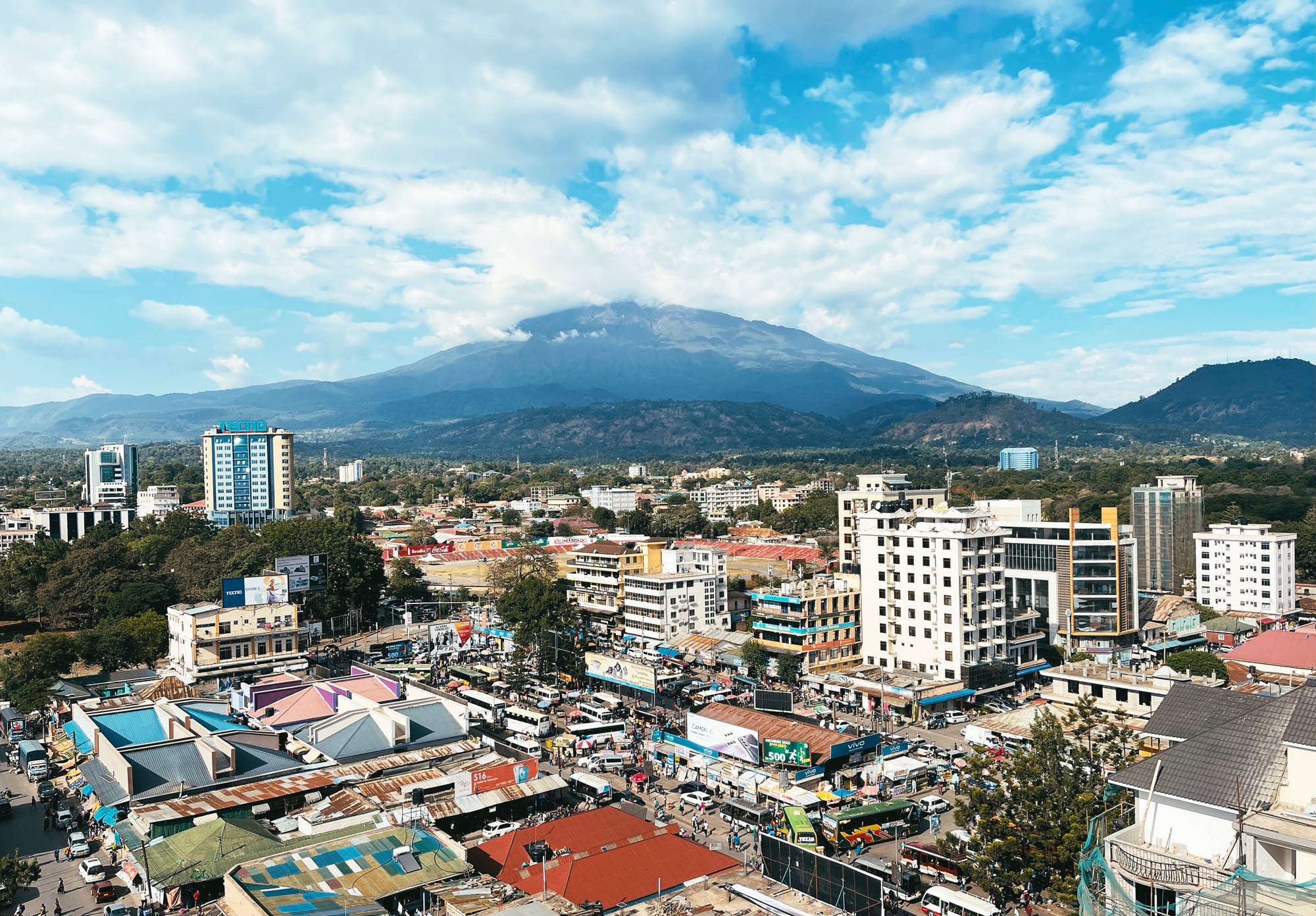
A city of low buildings and market roofs seen from above, with the broad volcanic cone of Mount Meru rising behind under cloud

Arusha, Kilimanjaro & the Northern Safari Circuit, Tanzania

Arusha

Arusha below the cone of Mount Meru. (Halidtz / Wikimedia Commons · CC BY-SA 4.0)

A highland city in northern Tanzania, spread below the volcanic cone of Mount Meru at around 1,400 metres. It grew from a German fort into the country's safari capital, the place where almost every trip to the Serengeti, Ngorongoro and Kilimanjaro is arranged, and it is also a diplomatic centre, home to the East African Community and a busy conference trade.

Neighbourhoods

  • The city centre
    • First-time visitors
    • Close to public transport
    • Markets

    The grid of streets around the clock tower and Boma Road, holding the safari operators, banks, cafés, craft shops and most of the central hotels. The markets and the main bus stand are a short walk west, and traffic and touts are heaviest here.

    Open in Maps
  • Kijenge and the eastern suburbs
    • Quiet and residential
    • Restaurants

    The greener ground east of the Themi river, with embassies, offices, schools and a spread of restaurants and guesthouses along the Old Moshi and Njiro roads. It is quieter than the centre and a common base for people staying more than a night or two.

    Open in Maps
  • Njiro
    • Quiet and residential
    • Nightlife
    • Best for food

    A residential district on higher ground south-east of the centre, built up over the last two decades with apartments, shopping centres, bars and grill restaurants. It is where much of the city's middle-class evening life happens.

    Open in Maps
  • Sakina and Unga Limited
    • Local life
    • Close to public transport

    The busy western and northern approaches along the Nairobi and Dodoma roads, around the old flour mill that gives Unga Limited its name — workshops, transport yards, guesthouses and dense local housing, with dala-dalas running constantly into the centre.

    Open in Maps
  • Usa River
    • Quiet and residential
    • Gardens
    • Close to the national park

    A small town about 20 km east of the centre on the Moshi road, set among coffee and flower farms on the lower slopes of Meru. Its garden lodges are a calmer alternative to the city and the closest base to the Arusha National Park gates.

    Open in Maps

Things to do

Landmarks in the city

  • Arusha clock towerlandmark

    The small clock tower at the central roundabout, long described locally as marking the midpoint of the old route between Cairo and Cape Town, and the point from which the city is usually navigated.

    Open in Maps
  • Arusha International Conference Centrelandmark

    The large complex on the edge of the centre that hosts the region's conferences and housed the United Nations tribunal for the Rwandan genocide, which sat in Arusha from 1995.

    Open in Maps
  • Uhuru Torch monumentlandmark

    The independence torch monument beside the Arusha Declaration Museum, marking the Uhuru Torch first lit on the summit of Kilimanjaro in December 1961.

    Open in Maps

Museums

  • Arusha Declaration Museummuseum

    A museum on the city's political history and the 1967 Arusha Declaration, in which Nyerere set out the policy of Ujamaa and self-reliance.

    Open in Maps
  • Natural History Museummuseum

    A museum in the old German administrative building near the clock tower, opened to the public in 1987, with exhibits on early humans, the plants and animals of the region and the history of the city.

    Open in Maps
  • Cultural Heritage Centreattraction

    A large privately run craft and art complex on the western side of the city, selling carvings, paintings, textiles and tanzanite, its gallery housed in a striking building that draws on the forms of a drum, a spear and a shield.

    Open in Maps

Markets and streets

  • Maasai marketmarket

    The open craft market where Maasai beadwork, blankets, carvings and paintings are sold and hard bargaining is expected.

    Open in Maps
  • Arusha Central Marketmarket

    The city's main produce market, crowded with highland vegetables, fruit, spices, grain, fish and household goods from the surrounding farms.

    Open in Maps

Green space and sport

  • Sheikh Amri Abeid Memorial Stadiumattraction

    The city's main stadium, holding about 20,000 and used mostly for football as the home ground of Arusha FC, named after the Tanzanian politician and cleric Kaluta Amri Abeid.

    Open in Maps
  • Themi river valleypark

    The wooded strip that cuts through the city, carrying cold water down from Meru past gardens, small farms and footbridges.

    Open in Maps

Short trips from the city

  • Arusha National Parkpark

    A compact park about 25 km east of the city taking in Mount Meru, the Momella lakes with their flamingos, the Ngurdoto Crater and forest with colobus monkeys and giraffes.

    Open in Maps
  • Mount Meruviewpoint

    The 4,562-metre volcano above the city, climbed over three or four days by the Momella route on its eastern side, through forest and along a high crater rim.

    Open in Maps
  • Lake Dulutipark

    A small crater lake about 14 km east of the city, near Tengeru, ringed by forest and walked on a path around the rim, with birds, monitor lizards and views to Meru.

    Open in Maps
  • The tanzanite mines at Mereraniattraction

    The mining town about 40 km south-east of Arusha beside the only known deposits of tanzanite, the blue-violet gem first identified there in 1967.

    Open in Maps
  • Tarangire National Parkpark

    A park roughly 110 km south of the city, under two hours away by paved road, known for large elephant herds and ancient baobabs along the Tarangire river in the dry season.

    Open in Maps

Eat and drink

Long-standing places and food districts in Arusha. Hours, ratings and directions come from your maps app, always current.

Arusha eating

  • Arusha Central Marketmarket

    Highland vegetables, avocados, bananas, beans and spices from the farms around Meru, with stalls of fried snacks, chapati and tea around the edges.

    Open in Maps
  • Kilombero marketmarket

    A crowded produce and general market west of the centre, where much of the city shops for food, second-hand clothes and household goods.

    Open in Maps
  • The nyama choma grills of Njironeighborhood

    Charcoal grills and bars in the south-eastern suburbs where goat and beef are roasted, cut up and eaten with kachumbari and ugali — the city's standard evening out.

    Open in Maps
  • Cafés and coffee houses around the clock towerneighborhood

    The centre's cafés serve arabica grown on the slopes of Meru and Kilimanjaro, and are where safari plans are settled over a pot of it.

    Open in Maps
  • Indian restaurants on the Sokoine and Old Moshi roadsneighborhood

    A legacy of the city's long-established South Asian community — curries, biryani, samosas and tandoori cooking, some of the oldest restaurant trade in Arusha.

    Open in Maps

Experience Arusha

History

Arusha is young by Tanzanian standards. The Arusha people, farmers related to the Maasai, settled the southern slopes of Mount Meru in the nineteenth century, growing bananas and maize on well-watered ground and trading with the pastoral Maasai of the plains below. Germany pushed into the area in the 1890s, met resistance from the Arusha and Meru, and built a fort — the boma that still stands near the clock tower — around 1900, laying out a small administrative station beside it.

Under British rule after the First World War the town became a centre for settler farming of coffee, wheat and sisal on the mountain slopes, and a staging post for the first tourists heading to the Serengeti and Ngorongoro. It also gained an Asian merchant community whose shops lined the central streets. Its political moment came in 1967, when Julius Nyerere chose Arusha to announce the Arusha Declaration, the statement of socialism and self-reliance that shaped Tanzania for a generation.

From the 1990s the city took on an international role. It hosted the negotiations that produced the 1993 Arusha Accords for Rwanda; the United Nations tribunal for the Rwandan genocide sat here from 1995, bringing lawyers, translators and journalists for nearly two decades; and the revived East African Community placed its headquarters in the city in 2000. Tourism grew alongside, and by the 2020s Arusha had spread far up the slopes of Meru, with a population several times what it was at independence and city status since 2012.

Culture & Customs

Arusha is a meeting point rather than a place with one culture. The Arusha and Meru of the mountain slopes, the Chagga from Kilimanjaro, the Maasai of the plains and people from every region of Tanzania live in the same streets, along with a long-established South Asian business community and a large number of foreign residents working for the East African Community, the courts, conservation organisations and the safari trade. Kiswahili is the common language, and English is heard constantly in the centre.

The Maasai presence is the most visible: red shukas in the markets, beadwork sold on the pavements, and herders bringing cattle along the roads on the edge of the city. That visibility cuts both ways, since Maasai imagery sells the safari industry while relations between Maasai communities and the authorities over land at Ngorongoro and Loliondo remain tense, and the subject is a live one in the city's newspapers and bars.

Everyday manners are Tanzanian: long greetings, respect for elders, shikamoo and its reply marahaba, modest dress and an unhurried pace summed up by pole pole. Christian churches and mosques both fill on their days, football is followed closely, and the bars of Njiro and Kijenge carry Bongo Flava and the fast singeli beats that came out of Dar es Salaam. Craft markets, art galleries and Tingatinga painting all trade heavily on the tourist flow.

Daily Life

About 600,000 people lived in Arusha at the 2022 census, making it one of the larger cities in Tanzania and one of the fastest growing. Tourism underpins much of the economy: safari operators, drivers, guides, cooks, porters, lodges, craft sellers and the garages that keep several thousand Land Cruisers on the road. Conferences and the international institutions add hotels, restaurants and services, and the tanzanite trade and gem cutting employ a further slice of the city.

Around it, farming remains substantial — coffee estates and smallholdings on the slopes of Meru, flower and vegetable seed farms grown for export, and maize, beans and bananas on the higher ground. The city centre is where all of it is traded, at the produce markets, the small factories on the Dodoma road and the banks around the clock tower.

The day starts early, with dala-dalas full before seven, porters and drivers gathering outside operators' offices and the markets already busy. Evenings belong to the grills and bars. The city's long-standing problems are water supply and pressure on the Themi and other streams coming off Meru, traffic on roads laid out for a much smaller town, informal housing spreading onto farmland, and the exposure of a tourism economy to anything that stops travel, as the halt in 2020 showed. Political tension following the October 2025 election reached Arusha as well as the larger cities.

Food

Arusha eats like the highlands around it. Ugali, the stiff maize porridge, comes with beans, greens and a meat or bean stew, and rice, chapati and boiled or roasted bananas fill out the everyday menu. Bananas matter more here than in most of Tanzania: mtori, a thick soup of mashed green bananas cooked with meat, is a dish of the Meru and Chagga slopes, traditionally given to new mothers and to the sick.

The city's social meal is nyama choma — goat or beef roasted over charcoal, cut into pieces and eaten with the hands with kachumbari, a fresh salad of tomato, onion and chilli, and either ugali or chips. Grills of this kind stand across Njiro, Kijenge and the roadsides out of town, and they are where football is watched and evenings are spent. Mishkaki, marinated beef skewers, and chipsi mayai, chips cooked into an omelette, are the cheap standbys, and street tea with mandazi or chapati is breakfast.

Two local products are worth seeking out. Arabica coffee grown on Meru and Kilimanjaro is roasted and served in the cafés of the centre, and the farms around the city sell it directly. Mbege, the mildly alcoholic Chagga drink of fermented bananas and finger millet, is made in the villages on the slopes rather than in city bars. Indian restaurants, some of them long-established, provide the other main alternative, alongside the avocados, plums and vegetables that come down daily from the mountain farms.

Planning tools

Budget

Arusha itself is inexpensive: guesthouses, local restaurants and dala-dalas cost little, and the city has hotels at every level for the safari trade. The expense is what people come for. A guided safari with a 4x4, a driver-guide, park fees and a lodge is charged per person per day and dwarfs everything else, and a Kilimanjaro or Meru climb runs to four figures in US dollars.

Daily Budget Midrange
USD 110–220 in the city (mid-range hotel, restaurant meals, taxis, a day trip), against USD 260–680 a day on a guided safari
Daily Budget Shoestring
USD 35–65 in the city, off-safari (guesthouse, local food, dala-dalas)

Compare several licensed operators before booking, check exactly which park fees and transfers a quote includes, and join an existing group to share the cost of a vehicle.

Best Time to Visit

June to October is dry, clear and cool, the peak for game viewing and for climbing, and the busiest time in the city. January to March is warmer and mostly dry, and the calving season on the southern Serengeti plains. The long rains of April and May bring low prices and green hills but muddy park tracks and closed camps.

Suggested Number of Days

The city itself takes a day or two, and most visitors use it as the arrival and departure point around a longer trip. Five to eight days covers a northern-circuit safari based here; a climb on Meru or Kilimanjaro adds several more.

First Visit
1–2 days
With Surroundings
5–8 days

Transportation

Dala-dala minibuses run set routes across the city for a few hundred shillings, and bajaji three-wheelers and taxis cover shorter hops; there is no metered fare, so the price is agreed first. Ride-hailing apps work in the city. Long-distance buses leave from the central bus stand for Moshi, Dar es Salaam and Nairobi, and safari vehicles collect from hotels.

Agree a taxi or bajaji fare before getting in, and expect the roads in and out of the centre to be slow at the start and end of the working day.

Airport & Station Connections

Kilimanjaro International Airport lies east of the city on the Moshi road, roughly halfway to Moshi and about an hour away by shuttle or taxi, and handles most intercontinental and regional arrivals. Arusha Airport, on the western side of the city, takes light aircraft to the park airstrips and Zanzibar. Buses run from Nairobi in about five to six hours across the Namanga border, from Moshi in about an hour and a half, and from Dar es Salaam in a long day.

Walkability

The central grid around the clock tower, the markets and Boma Road is easily walked, and the ground is fairly flat. Beyond it the suburbs are spread out and separated by main roads with broken or missing pavements, so most journeys are by dala-dala, bajaji or taxi. Walking in the centre draws persistent approaches from safari and craft touts, and is best kept to daylight.

Safety

Arusha is used to visitors and generally safe by day, but it has a reputation for street crime: bag-snatching, pickpocketing around the markets and bus stand, and occasional muggings after dark, including on quiet stretches between the centre and the suburbs. Touts and 'flycatchers' selling safaris on the street are a persistent nuisance and sometimes a fraud. Altitude and wildlife are the risks outside the city.

Climb with a licensed operator and ascend slowly, stay in the vehicle unless a guide says otherwise, and use taxis at night. Book safaris through a registered office rather than with someone met in the street, and carry little of value around the markets. Check current official travel advice before travelling.

Climate

Altitude makes the climate mild all year: warm days, cool nights and far less humidity than the coast. The long rains fall from about March to May and the short rains around November, and cloud often hides Meru in the middle of the day.

Summer
December to March is the warmest time, around 26–29°C by day with nights in the mid-teens
Winter
June to August is the cool season, around 22–25°C by day with chilly nights near 10–14°C

Local Customs

Greetings come before business, shikamoo is used to elders, and a handshake and a few words of Kiswahili go a long way. Dress is modest by local standards, and beachwear is out of place in the city. Maasai in town often expect payment for a photograph, and it is asked for first; photographing government buildings, the airport and police is not allowed. Tipping is customary for safari guides, drivers, cooks and porters, and operators usually suggest a daily rate.

Ask and agree a price before photographing anyone, particularly Maasai in traditional dress, keep bargaining in the craft markets good-humoured, and dress modestly away from lodges.

Common Payment Methods

The currency is the Tanzanian shilling. Arusha has plenty of banks and ATMs, and cards are taken by hotels, lodges, tour operators and larger restaurants, usually with a fee. US dollars in clean notes issued recently are accepted for safaris, park fees and lodges. Markets, dala-dalas, bajajis and small shops are cash only, and mobile money is used everywhere.