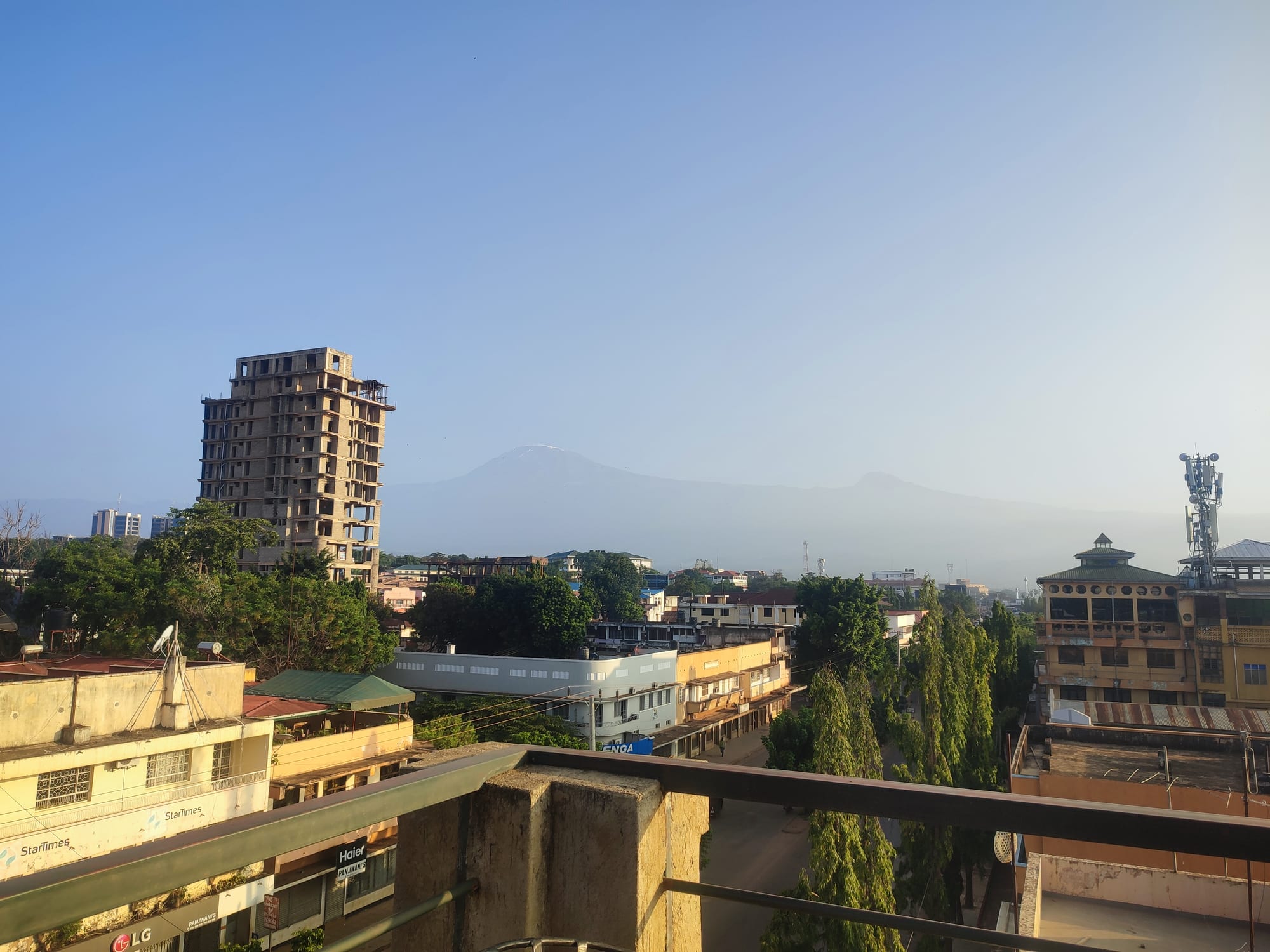
Low shops and a tall unfinished tower block among trees in Moshi, with the broad snow-capped dome of Kilimanjaro behind

Arusha, Kilimanjaro & the Northern Safari Circuit, Tanzania

Moshi

Moshi's town centre, with the summit of Kilimanjaro rising behind it. (Lebu Ayiga / Wikimedia Commons · CC BY 4.0)

A town in northern Tanzania at the southern foot of Mount Kilimanjaro, about 800 metres above sea level among Chagga coffee and banana farms. German rule made it a railway and administrative centre, and the coffee co-operatives followed; today it is the calmer of the region's two gateways, a base for climbing the mountain and for the plantations on its lower slopes.

Neighbourhoods

  • Town centre
    • First-time visitors
    • Close to public transport
    • Best for food

    A compact grid of low colonial-era and mid-century buildings around the main junction, holding the banks, tour offices, cafés and the main market. Almost everything a short visit needs is within a few minutes' walk, and the bus stand for Arusha and Dar es Salaam is on its edge.

    Open in Maps
  • Shanty Town
    • Quiet and residential
    • Gardens and shade

    Despite the name, the leafy residential quarter laid out north-west of the centre, with large plots, mature trees and old bungalows. Many guesthouses and long-stay houses for volunteers and climbing companies are here, a short walk or dala-dala ride from town.

    Open in Maps
  • Rau and the southern edge
    • Quiet and residential
    • Local life

    Residential wards spreading south of the centre towards the plains, with a forest reserve, small farms and schools among the housing. Life is quieter and cheaper than in town, and the roads run on to the sugar estates and the Dar es Salaam highway.

    Open in Maps
  • Kiboriloni and the eastern wards
    • Markets
    • Local life

    The busy eastern side of the town, known across the region for its large clothes and produce market. The streets fill on market days with traders from the mountain villages, and the road continues uphill towards Marangu.

    Open in Maps

Things to do

Kilimanjaro and its gates

  • Mount Kilimanjarolandmark

    Africa's highest mountain at 5,895 metres, a free-standing volcano whose snow-capped dome is visible from the town on clear mornings.

    Open in Maps
  • Kilimanjaro National Parkpark

    The park covering the mountain above the farmed slopes, listed as a UNESCO World Heritage Site in 1987, entered on foot at gates including Machame and Marangu.

    Open in Maps
  • Machameneighborhood

    A Chagga district on the south-western slopes above Moshi, once one of the mountain's chiefdoms, which gives its name to one of Kilimanjaro's busiest climbing routes and its park gate.

    Open in Maps
  • Maranguneighborhood

    A town of waterfalls and banana groves east of Moshi, one of the main access points for climbing Kilimanjaro and the site of the national park headquarters, with a long association with Chagga guides and porters.

    Open in Maps

In the town

  • Kilimanjaro Native Co-operative Unionlandmark

    The farmers' coffee union founded in 1930 and the oldest co-operative in the country, with its offices in the centre of Moshi and some ninety primary societies buying coffee on the mountain.

    Open in Maps
  • Kiboriloni marketmarket

    A large open market in the ward of the same name on the eastern side of town, trading clothing and produce brought down from the mountain villages.

    Open in Maps

Short trips from the town

  • Lake Chalaattraction

    A crater lake in a steep-walled caldera on the Kenyan border east of Moshi, formed about 250,000 years ago and fed mostly by groundwater off Kilimanjaro.

    Open in Maps
  • Arushaneighborhood

    The larger safari capital of the north, about an hour and a half west by road beneath Mount Meru.

    Open in Maps
  • Kilimanjaro International Airporttransit hub

    The region's international gateway, on the plain between Moshi and Arusha, used by climbers and safari visitors alike.

    Open in Maps

Seasonal events

  • Kilimanjaro Marathonlate February or March

    A road race starting and finishing in Moshi, held every year since 2002 and the largest sporting event in Tanzania, with a marathon, half marathon and shorter run drawing several thousand entrants in sight of the mountain.

  • Nane Nane farmers' day8 August

    The national agricultural day, marked in the region with shows of crops, livestock and machinery, and a natural fit for a coffee-growing district.

  • Coffee harvestroughly July to December

    The season when cherries come down from the Chagga farms to the co-operative pulperies and the auction trade, and farm visits are at their busiest.

Eat and drink

Long-standing places and food districts in Moshi. Hours, ratings and directions come from your maps app, always current.

Moshi markets and food streets

  • Moshi central marketmarket

    The town's main produce market, piled with bananas, avocados, tomatoes, beans and spices brought down from the mountain, with cheap cooked food at its edges.

    Open in Maps
  • Town-centre nyama choma grillsneighborhood

    Charcoal grills and bars around the centre serving goat and beef roasted and cut up on the board, eaten with kachumbari salad and salt.

    Open in Maps

Coffee and cafés

  • Town-centre coffee housescafe

    Cafés in and around the centre serve arabica grown on the slopes above the town, several of them run by or buying directly from farmer co-operatives.

    Open in Maps

Chagga dishes

  • Mbegeneighborhood

    The Chagga drink of fermented banana and finger millet, mildly alcoholic and cloudy, made by hand and sold in village bars around the town.

    Open in Maps
  • Mtorineighborhood

    A thick stew of mashed green bananas cooked with meat, the everyday dish of the Kilimanjaro slopes and often given to new mothers.

    Open in Maps

Experience Moshi

History

The town's name is said to refer to the smoke that rises from the mountain above it, and its site was a settlement on the trading paths between the mountain chiefdoms and the caravan routes crossing the plains below. On the slopes above, dozens of small Chagga chiefdoms, each under a mangi, farmed irrigated gardens of banana and millet. German forces established a station here in the 1890s during the conquest of the mountain country, and the suppression of Chagga resistance included the hanging of Mangi Meli of Moshi in 1900.

Moshi became the administrative centre of the Kilimanjaro district and, more lastingly, a railway town: the line from the coast at Tanga reached it in 1912, giving the mountain farms their first cheap route to the sea and making the town the collecting point for their crops. Missionaries had introduced coffee to the slopes, and Chagga smallholders took it up on a scale that transformed the district. In 1930 the Kilimanjaro Native Co-operative Union was founded to market their coffee, and it remains Tanzania's oldest co-operative; its buildings and auction trade shaped the centre of the town.

After independence in 1961 Moshi kept its role as a regional capital and coffee town, and added a second trade. As climbing Kilimanjaro grew from an expedition into an industry, the town filled with outfitters, guides and porters, and later with volunteers and language students. Sugar growing on the plains below and a large referral hospital and several colleges gave it a further base, leaving a town whose prosperity still rests on the mountain above it.

Culture & Customs

Moshi is a Chagga town, and the Chagga are known across Tanzania for enterprise, schooling and a long tradition of trade — a reputation built on the coffee co-operatives, the mission schools of the mountain slopes and a dense network of family businesses. Christianity is the majority faith, Lutheran and Catholic churches standing prominently in the centre, with Muslim and Indian communities long established in the commercial streets and a Hindu Mandal among them.

The mountain shapes daily identity as much as the economy. Guiding and portering are respected trades passed through families and villages, and the work of porters — their pay, loads and equipment — is a live public issue in the town. The Kilimanjaro Marathon each year fills the streets with runners from across Tanzania and abroad, and the town keeps the unhurried manner summed up in the Swahili phrase pole pole, slowly slowly, which is also the standard advice for walking uphill at altitude.

Swahili is the language of the street, with Kichagga spoken in the villages above and English common in the tourism trade. Manners follow the national pattern: greetings before business, shikamoo to elders, modest dress in town and in churches, and a certain formality in public that visitors are expected to match. Mbege, the banana beer of the Chagga, still marks weddings, funerals and village gatherings on the slopes.

Daily Life

About 220,000 people live in Moshi's urban area, making it a good deal smaller and quieter than Arusha along the road. Its economy rests on three things: coffee, brought down from the smallholdings above and traded through co-operatives and auction; tourism, which supports guides, porters, cooks, drivers, outfitters and guesthouses in large numbers; and services for the wider region, including a major referral hospital, colleges and the offices of Kilimanjaro Region. Sugar estates on the plains south of town are another significant employer.

Life follows an early rhythm. Dala-dalas fill before dawn with commuters and traders coming down from Marangu, Machame and the other mountain wards; porters gather to be weighed in and allocated to climbing parties; and the markets are busiest in the morning, with Kiboriloni drawing crowds from far up the slopes. Most residents live in the wards spreading south and east of the small centre, where plots are large enough for bananas, maize and a few animals.

Pressure on land is the persistent issue: the mountain farms are subdivided between generations until plots are very small, pushing young people into town work or migration. Water supply, dependent on the mountain's streams and glaciers, and the fortunes of the coffee price are watched closely, and the dependence on visitors was felt sharply when travel stopped in 2020. Politics returned to the streets in the unrest that followed the October 2025 election.

Food

The food of Moshi is the food of the Kilimanjaro slopes, and it begins with the banana. Mtori is a thick stew of green bananas mashed with meat and broth, soft and filling, traditionally fed to new mothers and to anyone recovering. Green bananas also appear boiled with beans, or cooked with meat in the dish generally called ndizi nyama, and ripe ones are roasted over charcoal at roadside stalls.

Away from the Chagga kitchen the standards are national: ugali, the stiff maize porridge, eaten with beans, greens such as mchicha, or a stew; rice and chapati; and nyama choma, goat or beef grilled over charcoal, cut up on a board and eaten with kachumbari, the chopped tomato and onion relish. Samosas, mandazi and chips mayai, the chip omelette, are the standard cheap snacks, and sugarcane juice and spiced chai are drunk all day.

Two drinks belong to the district. Mbege, brewed from fermented bananas and finger millet, is the Chagga ceremonial drink, cloudy and mildly alcoholic, made in the villages rather than in factories. The other is coffee: arabica grown on the slopes above the town, sold worldwide through the co-operatives, and served in the cafés of the centre, where farm tours end with a cup roasted and ground by hand.

Planning tools

Budget

Moshi itself is inexpensive: guesthouses, local restaurants and dala-dalas cost little, and the town is a cheaper base than Arusha. The money goes on what is arranged from it. A Kilimanjaro climb, with compulsory guides, porters, park fees and equipment, runs well into four figures in US dollars for a week, and safaris in the northern parks are charged per person per day for vehicle, guide and park entry.

Daily Budget Midrange
USD 260–680 per day on a guided safari (vehicle, guide, park fees, lodge or tented camp); far less on days spent in Moshi itself
Daily Budget Shoestring
USD 35–65 (guesthouse, local food, dala-dalas, a coffee-farm walk)

Compare several licensed operators before committing to a climb or safari, ask exactly which park fees and porter wages a quote includes, and share a vehicle to split costs.

Best Time to Visit

June to October is the dry season and the main climbing window, with the clearest mountain views early in the morning. January to March is warmer and also good for climbing, and coincides with the calving season on the Serengeti plains. The long rains of April and May bring cloud, mud on the routes and lower prices.

Suggested Number of Days

A day or two covers the town, its market and a coffee farm on the slopes above it. Three or four allow for the lower mountain, a crater lake or hot springs, and rest before or after a climb. A Kilimanjaro ascent itself adds five to nine days on the mountain.

First Visit
1–2 days
With Surroundings
3–4 days

Transportation

The centre is walkable and everything else runs on shared minibuses, the dala-dalas, which leave from the stands in town for Marangu, Machame and the surrounding villages. Bajaji three-wheelers and motorcycle taxis cover short hops, taxis are easy to find in the centre, and tour companies collect climbers and safari clients from their accommodation. Long-distance buses link Moshi with Arusha, Dar es Salaam and the Kenyan border.

Agree a taxi or bajaji fare before setting off, and allow extra time on market days, when the eastern roads into town are slow.

Airport & Station Connections

Kilimanjaro International Airport lies on the plain roughly 40 kilometres west of the town, about three-quarters of an hour by road, with flights from Europe, the Gulf and other African cities as well as domestic services. Arusha is about an hour and a half away by bus, Dar es Salaam a long day, and buses also cross the border to Nairobi. Most climbers and safari clients are met at the airport by their operator.

Walkability

The town centre is small, flat and easily walked, with the market, banks and tour offices within a few blocks of each other. Beyond it, pavements give out and the residential wards are spread wide, so a dala-dala or bajaji is usual. Walking in the centre after dark is not advised, and heat in the middle of the day is tiring.

Safety

Moshi is a calm town, and the tourism trade is long established and well regulated. The usual risks are bag-snatching and pickpocketing around the bus stand and market, touts pressing climbing and safari deals on new arrivals, road accidents on the highways, and, on the mountain itself, altitude sickness, which is the serious hazard of a Kilimanjaro climb. Malaria is present in the lowlands around the town.

Climb with a licensed operator and ascend slowly, stay in the vehicle unless a guide says otherwise, and use taxis at night. Take malaria precautions, book through a company with an office rather than a street agent, and avoid political gatherings. Check current official travel advice before travelling.

Climate

Warm all year at about 800 metres, hotter than Arusha on its higher ground and cooler than the coast. Two rainy seasons divide the year: the long rains from roughly March to May and shorter rains around November. The southern-hemisphere summer falls in December to February.

Summer
December to March is the warm season, with days often around 28–32°C and hazy afternoons
Winter
June to August is cooler and dry, with days in the mid-20s °C and nights around 14–16°C

Local Customs

Greetings come first, and shikamoo is the respectful greeting to an elder. Dress is modest in town, with shoulders and knees covered away from lodges. Tipping is customary in restaurants at around ten per cent, and tips for climbing crews — guides, cooks and porters — are a significant part of their income and are usually pooled at the end of a trek.

Ask before photographing people, farm workers or market traders; dress modestly in churches and mosques; and treat porters' loads and working conditions as a fair question to ask an operator about.

Common Payment Methods

The currency is the Tanzanian shilling, and cash is used for markets, dala-dalas and small shops. US dollars are accepted for climbs, safaris, park fees and hotels, and notes should be recent and undamaged. ATMs are plentiful in the town centre, and cards work in hotels and larger tour offices but rarely elsewhere.