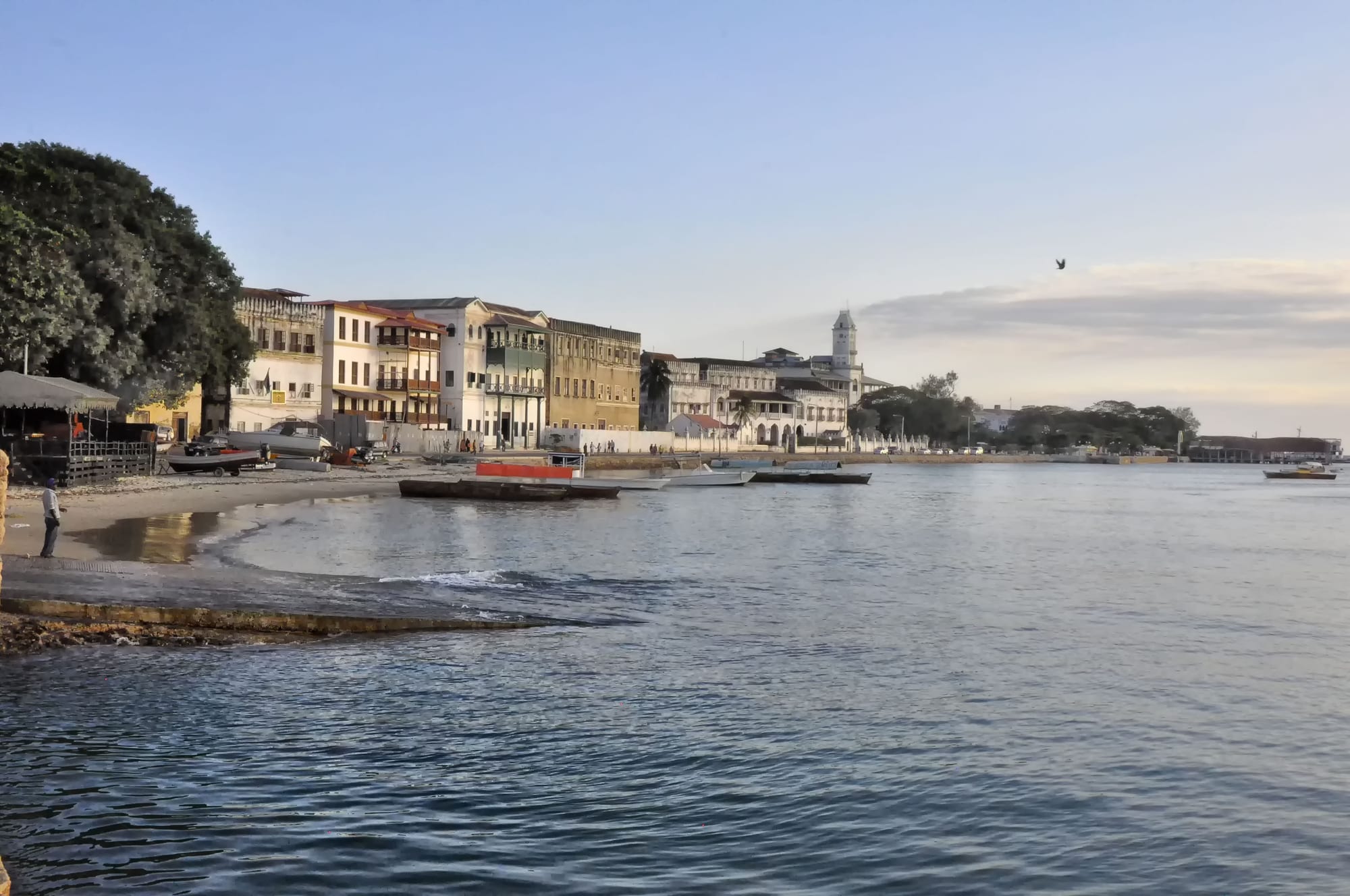
Calm blue water and a sandy shore with moored boats, in front of a row of old multi-storey buildings and a white tower

Tanzania

Zanzibar & Pemba

The seafront of Stone Town, the historic centre of Zanzibar City on Unguja. (Rod Waddington / Wikimedia Commons · CC BY-SA 2.0)

The Zanzibar archipelago off Tanzania's coast — the main island of Unguja with the old city of Stone Town, and greener, quieter Pemba to the north — a semi-autonomous part of the union with its own president and parliament, a mostly Muslim Swahili culture, a history as the seat of an Omani sultanate, and an economy of cloves, seaweed and tourism.

Explore Zanzibar & Pemba

History

Traders from Arabia, Persia and India visited these islands for many centuries, and a Swahili town flourished at Unguja Ukuu in the first millennium. The mosque at Kizimkazi carries an inscription dated 1107, one of the oldest in East Africa, and ruins on Pemba at Ras Mkumbuu and Pujini recall the medieval trading towns. The Portuguese held sway in the 16th century until Omani Arabs drove them out.

In the 19th century Sultan Seyyid Said moved his court from Muscat to Zanzibar, and the island became the capital of an Omani sultanate and the hub of East Africa's trade. Clove plantations worked by enslaved people spread over Unguja and Pemba, and Stone Town's market sold captives brought from the mainland until Britain pressed the sultan to close it in 1873. Zanzibar became a British protectorate in 1890, and in 1896 a British bombardment ended the Anglo-Zanzibar War in well under an hour — often called the shortest war on record.

The islands became independent in December 1963 under the sultan, but on 12 January 1964 a revolution overthrew him; many Arabs and South Asians were killed, with estimates of the dead from several hundred to 20,000, and the Afro-Shirazi Party under Abeid Karume took power. In April 1964 Zanzibar united with Tanganyika to form Tanzania, keeping its own president, government and House of Representatives. Karume was assassinated in 1972. Multiparty elections since 1995 have been bitterly contested, and protests in 2001 were met with deadly force. A power-sharing government was agreed in 2010 and later restored, but the balance between the islands and the union remains a live political question.

Culture & Customs

Zanzibar is almost entirely Muslim and thoroughly Swahili. The Kiunguja dialect of Stone Town became the basis of standard Swahili, and the islands' culture mixes African, Arab, Persian and Indian strands, seen in the carved wooden doors, the Omani-style houses with their inner courtyards, and the Indian merchants' shops with balconies. Women typically wear the buibui or kanga and headscarf, and men the kanzu and embroidered kofia cap.

Taarab, orchestral sung poetry blending Arab and Swahili traditions, has its home here; the singer Siti binti Saad made it popular in the early 20th century, and music clubs keep it alive in Stone Town. The Sauti za Busara festival in February brings musicians from across Africa, and the Zanzibar International Film Festival is held every year. At Makunduchi the Mwaka Kogwa festival marks the old Persian-influenced new year with mock fights and a hut burning, and Pemba keeps a tradition of village bullfights.

Manners are conservative. Greetings are long, elders are addressed with respect, and dress that covers shoulders and knees is expected in towns and villages. During Ramadan eating and drinking in public by day is frowned on. Freddie Mercury, born in Stone Town in 1946, is the islands' most famous son abroad.

Daily Life

About 1.9 million people live in the archipelago, most of them on Unguja, where Zanzibar City, including Stone Town and its sprawling suburbs, holds a large share of the population. Pemba's towns — Chake Chake, Wete and Mkoani — are small, and the island is more rural and poorer than Unguja.

Tourism is now the islands' largest industry, employing guides, drivers, cooks and hotel staff, and hotels line much of Unguja's north and east coasts. Cloves remain a state-supported export, grown above all on Pemba, and seaweed farming, largely done by women on the tidal flats of the east coast, gives many villages a cash income. Fishing and small farming fill the rest.

The day turns on the five calls to prayer, with markets busiest in the morning and Stone Town's squares and the Forodhani waterfront filling up at dusk. Current issues include rapid hotel building, pressure on water supplies, waste and plastic, the effect of warming seas on seaweed farms, and politics: the October 2025 elections, held for Zanzibar and the union together, were criticised by the opposition and foreign observers.

Food

Zanzibar's cooking draws on its spice gardens and its trading past. Pilau and biryani are the festive dishes, fragrant with cloves, cardamom and cinnamon; octopus curry, mchuzi wa pweza, is a coastal favourite; and rice cooked in coconut milk accompanies most meals. Breakfast is chai with mandazi or vitumbua, small rice-and-coconut pancakes.

Street food is at its best at the Forodhani night market on the Stone Town waterfront, where stalls grill seafood skewers and sell samosas, cassava and sweet potatoes. Urojo, the "Zanzibar mix", is a spiced sauce served with fried street snacks. Tiny cups of bitter kahawa coffee are poured from brass pots on street corners, often with kashata, a sweet of coconut or peanuts.

The sweet tooth shows in halua, a dense Omani-style sweet flavoured with cardamom, and in fresh sugarcane juice pressed with ginger and lime. The spice farms supply cloves, nutmeg, cinnamon, black pepper, vanilla and lemongrass, and tropical fruits fill the Darajani market.

Attractions & Natural Wonders

Stone Town, a UNESCO World Heritage Site, is best explored on foot through its maze of lanes: the Old Fort, the House of Wonders (under restoration since parts of it collapsed) and the Palace Museum on the waterfront, the Anglican cathedral built on the site of the slave market with its memorial, the Darajani market, the old Persian-style Hamamni baths and the hundreds of carved doors. Boats run to Changuu Island, with its giant tortoises, and to the Chumbe Island coral reserve.

North of the city lie the spice farms, where tours show how the islands' spices grow, and at the far north Nungwi and neighbouring Kendwa have white-sand beaches, dhow builders and boat trips to the reefs around Mnemba Island. On the east coast, Paje and Jambiani have wide lagoons, seaweed farms and kitesurfing, and Jozani forest, part of Jozani-Chwaka Bay National Park, shelters the Zanzibar red colobus on boardwalk trails through forest and mangroves. Kizimkazi in the south has its ancient mosque and dolphin trips.

Pemba, hilly and green, draws divers to the steep reef walls of the Pemba Channel and the protected reefs around Misali Island, and has the Ngezi forest, clove plantations and the ruins of Ras Mkumbuu.

Cities in Zanzibar & Pemba

Planning basics

Budget

Zanzibar is pricier than the mainland outside the safari parks. Beach hotels on the north and east coasts range from simple guesthouses to expensive resorts, and Stone Town has hotels at every level. Local food, dala-dalas and the Forodhani night market keep daily costs down, while diving, boat trips and resort stays push them up. Pemba has fewer, costlier lodges and very basic guesthouses in its towns.

Daily Budget Midrange
USD 110–260 (mid-range beach hotel, restaurant meals, taxis, a spice tour or snorkelling trip)
Daily Budget Shoestring
USD 40–70 (guesthouse, street food, dala-dalas)

Stay in Stone Town guesthouses and use shared transport to the beaches; arrange the compulsory travel insurance before flying or sailing in.

Safety

The islands are generally safe, but muggings and bag-snatching happen in Stone Town's dark alleys and on quiet beaches at night, and theft from hotel rooms and beaches is common. Zanzibar's elections have repeatedly been disputed. Sea urchins, strong currents off some beaches and poorly equipped boats are the practical hazards.

Walk in Stone Town after dark in company or take a taxi, dress modestly away from the beaches, and use reputable boat and dive operators. Check current official travel advice before travelling.

Climate

The islands are hot and humid all year, cooled by sea breezes. The long rains fall from about March to May, when some beach hotels close, and the short rains around November. Pemba is greener and wetter than Unguja. The trade winds that carried the old dhow traffic still blow, the kaskazi from the north-east around December to March and the kusi from the south-east around June to September.

Summer
December to March is the hottest period, around 31–33°C, humid, with calmer seas
Winter
June to October is drier and slightly cooler, around 28–30°C, with breezier seas on the east coast

Transportation

Fast ferries link Dar es Salaam with Stone Town in about two hours, and Zanzibar's airport has domestic and international flights. On Unguja, dala-dalas and minibuses run from Stone Town to Nungwi, Paje and the other beach villages in about an hour or more, and taxis are easy to hire. Pemba is reached by short flight or by ferry from Unguja, and boats also cross from Tanga. Getting around Pemba means minibuses or a hired car.

Book ferries through the official offices or the operators themselves, not touts at the port, and agree taxi fares before setting off.

Best Time to Visit

June to October and December to February are the main seasons, with dry weather and good diving; the Sauti za Busara music festival is held in February, and the Zanzibar International Film Festival is held every year. April and May are wet and quiet. During Ramadan many restaurants close in daytime outside the tourist areas, and modest behaviour matters even more.