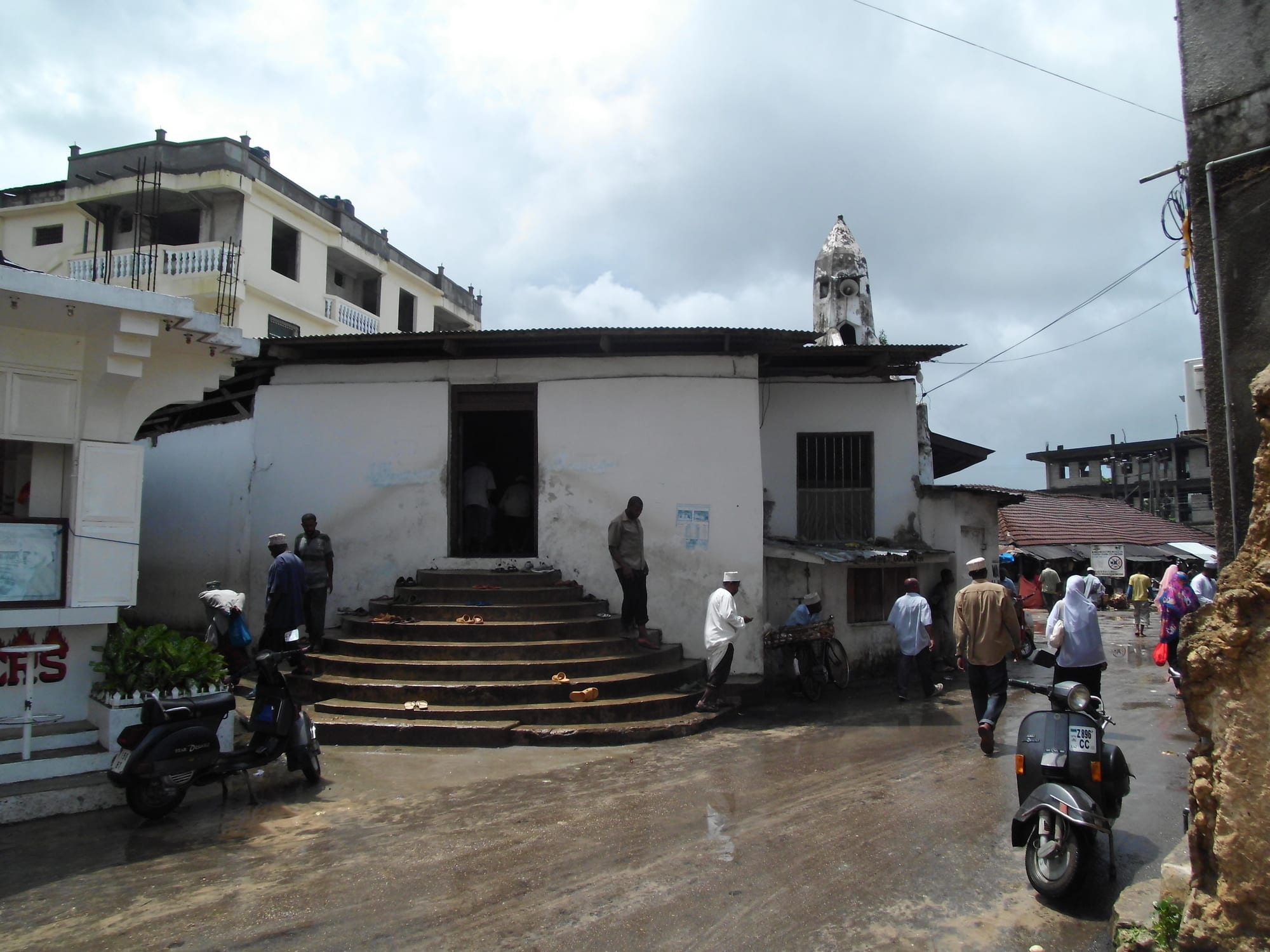
A whitewashed mosque with broad steps and a short minaret on a wet street corner, with shops and people passing on either side

Zanzibar & Pemba, Tanzania

Chake-Chake

An old mosque on a street in the centre of Chake-Chake, the main town of Pemba. (Pemba.mpimaji / Wikimedia Commons · CC BY-SA 3.0)

The main town of Pemba, the northern island of the Zanzibar archipelago, standing above Chake-Chake Bay, a deep indentation in the island's west coast. It is the island's administrative and market centre, surrounded by clove plantations and hills, and the usual base for diving the reefs of the Pemba Channel and for the medieval ruins along the coast.

Neighbourhoods

  • The town centre
    • First-time visitors
    • Markets
    • Close to public transport

    The ridge-top streets around the market, the bank, the hospital and the government offices, where the minibuses gather and most of the island's business is done. It is small enough to cross in a few minutes on foot and busiest in the morning.

    Open in Maps
  • The creek and the old port
    • Walks and viewpoints
    • Local life

    The ground falling away west of the centre towards the tidal creek and its mangroves, where boats come up on the tide. The view from the ridge over the water and the palms is the best in the town.

    Open in Maps
  • The plantation edges
    • Quiet and residential
    • Local life

    Houses spread outward from the centre into clove and coconut plantations and small farms, thinning into villages along the roads north to Wete and south to Mkoani. This is where most families live and where the drying cloves are spread on mats in season.

    Open in Maps

Things to do

In the town

  • Pemba Museummuseum

    The island's museum in the town centre, holding objects and displays on Pemba's history and cultural heritage.

    Open in Maps
  • Chake-Chake marketmarket

    The island's main market, selling fish, cassava, bananas, fruit and spices, with cloves traded through the state system rather than on the open stalls.

    Open in Maps
  • Pemba Airporttransit hub

    The island's only airport, about 7 km south-east of the town, with short flights to Zanzibar and the mainland.

    Open in Maps

Ruins and the reefs

  • Pujini ruinslandmark

    The walls of a fortified palace at Pujini village east of the town, associated in island tradition with a fifteenth-century ruler remembered as Mkame Ndume, and the only known early fortification on the Swahili coast.

    Open in Maps
  • Ras Mkumbuulandmark

    The ruins of a medieval Swahili town at the end of a long peninsula north-west of Chake-Chake, among them a large mosque, reached by boat across the bay.

    Open in Maps
  • Misali Islandattraction

    A small forested island about 10 km west of the town inside a protected marine area, its reefs holding more than 300 fish species and its beaches used by nesting green and hawksbill turtles.

    Open in Maps

Short trips from the town

  • Ngezi Forest Reservepark

    A reserve of mostly primary forest at the island's north-western tip, home to the Pemba flying fox, a fruit bat found nowhere else.

    Open in Maps
  • Weteneighborhood

    The island's northern town and the capital of Pemba North Region, whose harbour was long the main point of entry to Pemba.

    Open in Maps
  • Mkoanineighborhood

    The southern town with the busiest harbour on Pemba, where most ferries from Zanzibar and the mainland arrive.

    Open in Maps

Seasonal events

  • Eid al-Fitrvaries with the Islamic calendar

    The end of Ramadan is the island's main celebration, with new clothes, visiting between families and crowded streets after a month of daytime fasting.

  • Eid al-Adhavaries with the Islamic calendar

    The festival of sacrifice, marked with prayers, shared meat and gatherings in the villages around the town.

  • The clove harvestvaries with the crop, mainly in the drier months

    The island's defining season, when unopened flower buds are picked from the trees and spread to dry on mats and roadsides until they turn brown.

Eat and drink

Long-standing places and food districts in Chake-Chake. Hours, ratings and directions come from your maps app, always current.

Markets and eating houses

  • Chake-Chake marketmarket

    Fish landed on the creek, cassava, breadfruit, jackfruit, bananas and island spices, with fried snacks sold at the edges through the morning.

    Open in Maps
  • The town-centre eating housesneighborhood

    Plain restaurants near the market serving rice with coconut fish stew, ugali, beans, chapati, pilau and biryani, at prices well below Unguja's beach strips.

    Open in Maps
  • Street snacks and chaicafe

    Stalls sell mandazi, vitumbua, samosas and fried cassava with spiced tea in the morning, and grilled mishkaki skewers as the evening cools.

    Open in Maps

Experience Chake-Chake

History

Pemba was settled and trading long before the town on this ridge amounted to anything. Swahili towns grew on the island's creeks and headlands from the ninth century onward, and the ruins at Ras Mkumbuu, with its large mosque, and the walled site at Pujini east of Chake-Chake belong to that world of merchants shipping mangrove poles, rice and ivory across the Indian Ocean. Pujini, dated to the fifteenth century, is remembered in island tradition as the stronghold of a ruler known as Mkame Ndume.

Chake-Chake itself grew as a defensible market on the high ground above the creek, first occupied between about 1500 and 1600, and it took on its present role during the nineteenth century when Pemba became the most productive clove island of the sultanate's empire. Plantations worked by enslaved labourers covered the interior, and the island's harvest — then as now, larger than Unguja's — was shipped through the creeks to Zanzibar. The town became the administrative centre of the island under the sultans and then under the British protectorate.

The revolution of 1964 and the union with Tanganyika brought the plantations under state control, and cloves have remained a state-supported export ever since. Pemba became a stronghold of opposition politics in the multiparty era, and its elections have been repeatedly disputed, which has left the island both politically distinct and economically neglected compared with Unguja. Diving tourism, focused on the channel reefs, arrived from the 1990s but remains small.

Culture & Customs

Pemba is Swahili, Muslim and markedly more conservative than the beach districts of Unguja. Mosques are the fixed points of every village, the week turns on Friday prayers, and Ramadan is observed strictly. Kiswahili is spoken with a distinct Pemban accent that islanders identify instantly, and long, formal greetings are expected before any conversation begins.

The island is known throughout East Africa for traditional medicine and divination, and people travel from the mainland and beyond to consult healers here — a reputation that outsiders often sensationalise and that residents treat as an ordinary part of life. Another local tradition is the village bullfight, in which a bull is teased and turned by men with cloths in a ring of spectators before being led away unharmed; it was introduced by the Portuguese, is known as mchezo wa ng'ombe, and is staged in the villages.

Music and dance follow the Swahili coast — taarab, drumming at weddings, and recitation at religious festivals — and weddings are the great village occasions. Visitors are rare enough outside the dive lodges to attract friendly curiosity, and the manners that matter are simple: cover up, greet first, ask before taking photographs, and accept that things happen at the island's pace.

Daily Life

Chake-Chake is a small town serving an island of around half a million people, most of whom live in villages among the clove and coconut plantations. The town holds the island's main hospital, the regional offices, the secondary schools, the banks and the market, so business from all over Pemba comes up the ridge in the morning and goes home in the afternoon.

Cloves remain the backbone of the rural economy, bought through the state trading system, and the harvest seasons dictate the year: buds picked by hand from tall trees, dried on mats along every roadside, and the smell of them everywhere. Fishing, seaweed farming on the east coast, rice, cassava and fruit fill the rest, and money sent home from relatives working in Unguja, Dar es Salaam and the Gulf matters to many households.

Pemba is poorer than Unguja, with thinner infrastructure, an electricity supply dependent on a submarine cable, and fewer of the tourism jobs that have reshaped the larger island. Its politics are a live issue rather than a historical one, and many islanders feel the archipelago's investment stops at the channel. Daily life is quiet and regulated by prayer times, the market, the school day and the tide.

Food

Pemba eats the Swahili food of the archipelago with more of it grown at home. Fish, octopus and squid from the creeks and the channel are cooked in mchuzi wa nazi, a coconut curry, or grilled over charcoal, and served with wali wa nazi, rice cooked in coconut milk. Ugali, boiled cassava, breadfruit and green bananas cooked as a vegetable are the everyday starches, and beans and greens fill out the plate.

Spice is the island's identity. Cloves are its crop, and cinnamon, nutmeg, black pepper and cardamom grow alongside them, going into pilau and biryani for weddings and Eid and into the strong, sweet chai drunk all day. Breakfast is that tea with mandazi, vitumbua — small rice-and-coconut pancakes — or fried cassava with chilli salt, and mishkaki skewers are grilled at the roadside in the evening.

Fruit is abundant on such a wet, green island: jackfruit, breadfruit, mangoes, custard apples, pineapples and coconuts drunk green. Sweets follow the Omani and Indian inheritance, with halua, kashata made of coconut or peanuts, and sugarcane juice pressed with lime and ginger. Alcohol is served only at the handful of lodges, and eating out in the town means the plain, good, cheap restaurants around the market rather than anything designed for visitors.

Planning tools

Budget

Pemba is the cheap end of the archipelago for everyday costs and the expensive end for what most people come to do. Guesthouses in the town and market food cost very little, but the island has few hotels, diving is the main activity and is priced accordingly, and boat trips to Misali or Ras Mkumbuu have to be arranged rather than joined.

Daily Budget Midrange
USD 110–260 (a hotel or small lodge, restaurant meals, a hired car or taxi, a boat or dive trip)
Daily Budget Shoestring
USD 40–70 (guesthouse, market food, minibuses)

Arrange diving and boat trips before arriving, since operators are few, and carry enough cash for several days.

Best Time to Visit

June to October and December to February are dry and the best months for diving, when visibility in the Pemba Channel is at its best. The long rains from about March to May are heavy, and some lodges close. The clove harvest fills the roads and villages with drying buds in its seasons.

Suggested Number of Days

Two days cover the town and the nearest sites. Four to six suit divers and anyone wanting the ruins, the forest in the north and the smaller ports, since roads are slow and boats depend on the tide. Pemba rewards an unhurried stay more than a short one.

First Visit
2 days
With Surroundings
4–6 days

Transportation

The town is walked. Dala-dala minibuses and shared taxis run north to Wete and south to Mkoani and to the villages, though they thin out in the afternoon and stop early. Hired cars with drivers and motorcycle taxis are the practical way to reach the ruins, the forest and the coast, and boats for Misali and Ras Mkumbuu are hired at the creek or through a lodge.

Set out early for anywhere outside the town, as public transport dries up in the afternoon, and agree boat and taxi prices in advance.

Airport & Station Connections

Pemba Airport, about 7 km south-east of the town, has short flights from Zanzibar and the mainland, the quickest way in. Ferries from Zanzibar and the mainland dock at Mkoani in the south of the island, and smaller boats also cross from Tanga. Crossings take several hours and can be rough outside the calmer months.

Walkability

The centre is small and easily walked, though it sits on a ridge, so the streets down towards the creek are steep in places. Pavements are patchy and the roads are shared with minibuses and motorcycles. Anything outside the town — the ruins, the plantations, the coast — needs transport.

Safety

Pemba is quiet and crime against visitors is uncommon, with petty theft around the market and the ports the main everyday risk. Elections here have repeatedly been disputed, and politics turned violent around the general election of October 2025, when protests in Dar es Salaam and other cities were met with lethal force, a curfew was imposed and internet access was cut for several days; political gatherings are best avoided. Boats vary greatly in condition, currents in the channel are strong, and medical facilities on the island are limited.

Walk in Stone Town after dark in company or take a taxi, dress modestly away from the beaches, and use reputable boat and dive operators. Take malaria precautions, which the country advice recommends nationwide including Zanzibar, and note that serious medical cases are flown to Zanzibar or Dar es Salaam. Check current official travel advice before travelling.

Climate

Hot and humid all year, and hillier, greener and more fertile than Unguja. The long rains fall from about March to May, with shorter rains around November, and the rest of the year is mostly dry with sea breezes.

Summer
December to March is hottest, around 31–33°C, humid, with calmer seas
Winter
June to October is drier and slightly cooler, around 28–30°C, with breezier conditions in the channel

Local Customs

Pemba is more conservative than Unguja and sees far fewer visitors, so dress and behaviour matter more. Shoulders and knees covered is the norm for men and women alike in the town, greetings are long and come before any request, and alcohol is barely sold outside the few lodges. The island also has a long-standing reputation across East Africa for traditional healing, a subject treated seriously rather than as a curiosity.

Ask before photographing people, mosques or markets, cover up throughout the town, and keep clear of political meetings and election-period gatherings.

Common Payment Methods

Tanzanian shillings are used for everything, with US dollars accepted at lodges and for dive packages. There are banks and a small number of ATMs in Chake-Chake and Mkoani, but they are unreliable and cards are of little use outside the lodges, so it is worth arriving with enough cash for the whole stay.