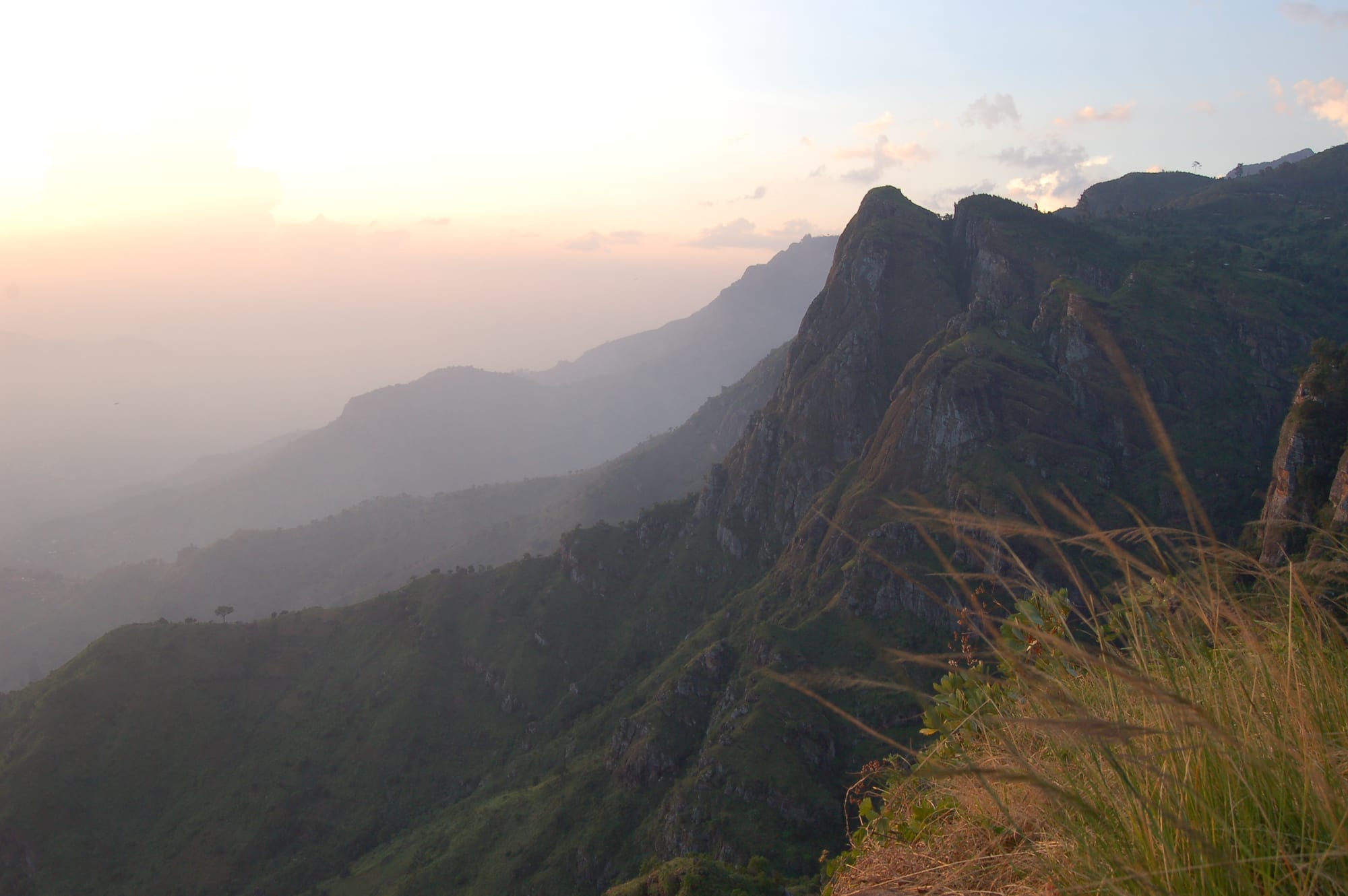
Steep green ridges and rocky cliffs of the Usambara Mountains fading into a hazy evening sky, with tall grass in front

Tanzania

Dar es Salaam & the Swahili Coast

Evening over the Usambara Mountains in Tanga Region. (Joachim Huber / Wikimedia Commons · CC BY-SA 2.0)

The mainland's Indian Ocean shore from the Kenyan border south to the Rufiji, taking in Dar es Salaam, the country's largest city and commercial capital, the old caravan port of Bagamoyo, Tanga and Pangani, the cool Usambara Mountains inland and Mafia Island offshore — the region where Swahili trade, German rule and modern Tanzania's economy all centred.

Explore Dar es Salaam & the Swahili Coast

History

The coast was part of the Indian Ocean trading world for many centuries before Europeans arrived. Swahili towns grew up at Kaole near Bagamoyo, where mosques and pillar tombs date from around the 13th century, at Tongoni south of Tanga and at Kua on Juani Island off Mafia, trading ivory, gold and mangrove poles for cloth, beads and porcelain. The Portuguese raided the shore in the 16th century, and Omani Arabs later drew it into the orbit of Zanzibar.

In the 19th century Bagamoyo became the mainland terminus of the caravan routes from Lake Tanganyika, through which ivory and enslaved people passed on their way to Zanzibar. Explorers set out from here too, and in 1874 Livingstone's body was carried to Bagamoyo before being shipped home. In the 1860s Sultan Majid of Zanzibar founded a new town at the fishing village of Mzizima and named it Dar es Salaam, "haven of peace".

The Germans arrived in the 1880s and met fierce resistance in the Abushiri revolt, which broke out around Pangani in 1888. They made Dar es Salaam the capital of German East Africa in 1891, built a railway inland from Tanga, and turned the Tanga hinterland into a sisal-growing region. In 1914 German troops repelled a British landing at the Battle of Tanga. Under British rule Dar es Salaam grew into the centre of the independence movement, and it remained the seat of government long after the move of the capital to Dodoma was announced in 1974.

Culture & Customs

This is the mainland heartland of Swahili culture. Along the shore the language is spoken in its coastal forms, Islam is the majority faith, and dress follows the coastal pattern of kanga wraps for women and the long white kanzu for men at Friday prayers. Inland the peoples change: the Zaramo around Dar es Salaam, the Zigua and Bondei behind Tanga, and the Shambaa of the Usambara Mountains, whose villages have long been Christian and Muslim side by side.

Dar es Salaam is the country's cultural engine. Bongo Flava, Tanzania's hip-hop and R&B, grew up here in the 1990s, and newer street styles such as singeli, fast and dance-driven, came out of its poorer neighbourhoods. Tingatinga painting, the bright, flat-coloured animal pictures now sold across East Africa, began in the city in the 1960s, and Makonde carvers work at the craft markets. Football divides the city between Simba and Young Africans, whose derby brings Dar es Salaam to a standstill.

Bagamoyo keeps an artistic role of its own as the home of the national arts college, which hosts an annual festival of music, dance and theatre. Across the region, greetings are long and respectful, elders are addressed formally, and modest dress is expected away from the beaches.

Daily Life

Dar es Salaam, with about 5.4 million people in its region at the 2022 census, is one of Africa's fastest-growing cities and the country's commercial, media and banking centre. Its port handles trade not only for Tanzania but for landlocked neighbours such as Zambia, Rwanda and Burundi, and the government, though formally moved to Dodoma, still keeps a large presence here. Tanga, with roughly 400,000 people, is the second port on this coast; Bagamoyo, Kibaha and Lushoto are much smaller.

Outside the city, life depends on fishing, coconuts, cashews and cassava along the shore, sisal around Tanga, and vegetables and fruit in the cool Usambaras, which supply the markets of Dar es Salaam. Mafia's economy rests on fishing, seaweed farming and a small tourism trade.

The city's day starts before dawn with long commutes by dala-dala minibus, bajaji tuk-tuk and the rapid-transit buses, and ends in evening traffic that can take hours. Current issues include flooding in low-lying neighbourhoods, housing pressure and the aftermath of the unrest that followed the October 2025 election, when protests in Dar es Salaam were met with curfews, an internet shutdown and deadly force whose toll remains disputed.

Food

Coastal cooking is built on coconut, rice and fish. Food here is spicier than inland: rice and fish are often cooked in coconut milk, and seafood appears in coconut curries all along the shore. Pilau, rice cooked with a mix of spices, and biriyani are the festive dishes, and Dar es Salaam's long-settled Indian community adds its own cooking.

The streets of Dar es Salaam feed the city. Chipsi mayai, chips cooked into an omelette, is the classic cheap meal; mishkaki, marinated beef skewers, and nyama choma grill on charcoal in the evenings; and breakfast is chai with mandazi, lightly sweet fried dough, or vitumbua, small rice cakes. The Kivukoni fish market by the harbour sells the morning catch, which can be fried on the spot.

Inland the food shifts. In the Usambara Mountains, ugali and bananas are eaten with beans and greens from the terraced fields, and the cool slopes grow vegetables and fruit rarely seen on the coast. Drinks run from fresh coconut water and sugarcane juice to strong spiced chai and, in the city's bars, cold local lager.

Attractions & Natural Wonders

Dar es Salaam repays a day or two. The National Museum has the country's key historical and fossil collections, the Village Museum shows traditional houses from across Tanzania, and the Kariakoo market is a vast, crowded trading quarter. The old German waterfront, the Askari Monument and the Kivukoni fish market lie close together, and boats run from Msasani to the uninhabited islands of Mbudya and Bongoyo for swimming and snorkelling.

North along the coast, Bagamoyo has crumbling Arab and German buildings, the old German boma and customs house, and the Catholic mission with its museum of the caravan and slave trade; the Kaole ruins lie just to the south. Saadani National Park beyond is one of the few places in East Africa where elephants, giraffes and lions share a park with an ocean beach.

Further north, Pangani is a sleepy Swahili town at the mouth of the Pangani River, with river trips and empty beaches, and Tanga has a colonial centre, the Amboni Caves in limestone to the north and the Tongoni ruins to the south. Inland rise the Usambara Mountains: Lushoto and the Irente viewpoint in the west, where the escarpment drops away to the plains, and the rainforests of the Amani Nature Reserve in the east, known for rare birds, chameleons and the wild African violet.

Offshore to the south, Mafia Island has the Mafia Island Marine Park, with reefs, turtles and whale sharks, and the ruins on Chole and Juani islands.

Cities in Dar es Salaam & the Swahili Coast

Planning basics

Budget

The coast is the cheapest part of Tanzania to travel independently. Dar es Salaam has hotels at every level and street food for very little, and the guesthouses of Tanga, Pangani and Lushoto are modest. Costs rise on Mafia Island, where most lodges are small and upmarket and the flight out adds up, and in Saadani, where park fees and a vehicle are needed.

Daily Budget Midrange
USD 95–230 (mid-range hotel, restaurant meals, taxis, a guided walk or dive)
Daily Budget Shoestring
USD 40–70 (guesthouse, street food, buses and dala-dalas)

Eat at the local stalls and ride the city's rapid-transit buses in Dar es Salaam; save the splurge for a few nights on Mafia or in Saadani.

Safety

Most of the region is calm, but Dar es Salaam has frequent street crime, with bag-snatching from passing motorbikes, muggings on quiet beaches and pickpocketing in Kariakoo. The city was the centre of the protests and security crackdown around the October 2025 election. Road accidents on the main highways are the other serious risk.

Take registered taxis or ride-hailing cars after dark, carry little of value, avoid demonstrations and walk beaches only in company and in daylight. Check current official travel advice before travelling.

Climate

The coast is hot and humid all year, with the long rains from about March to May and the short rains around November. The Usambara Mountains, much of them above 1,000 metres, are markedly cooler and greener, with misty mornings and chilly nights in the middle of the year.

Summer
December to March is the hottest time, around 30–33°C on the coast and very humid
Winter
June to September is cooler and drier, around 26–29°C by day on the coast; nights in Lushoto can drop near 10°C

Transportation

Dar es Salaam is the country's main air and sea gateway, with fast ferries to Zanzibar and the new standard-gauge railway heading west to Morogoro and Dodoma. Buses run north to Bagamoyo in about two hours and to Tanga in roughly five or six, with connections up to Lushoto. Mafia is reached by a short flight from Dar es Salaam or by boat from the mainland, and Saadani by road or light aircraft.

Allow plenty of time to cross Dar es Salaam, whose traffic is severe; leave for the north early in the morning.

Best Time to Visit

June to October brings the most comfortable weather on the coast, clear days in the Usambaras and good game viewing in Saadani. Mafia's whale sharks and reefs draw divers and snorkellers, and the hottest months still suit the beaches. April and May are the wettest months, when some coastal lodges close and mountain paths turn to mud.