Attractions & Natural Wonders · South Africa
Why does a tablecloth of cloud spill over Cape Town's Table Mountain?
The summer south-easter forces moist air up a kilometre-high wall of rock; it cools into cloud on top and melts away as it pours down towards the city.
By Globeway Editorial · 13 October 2026
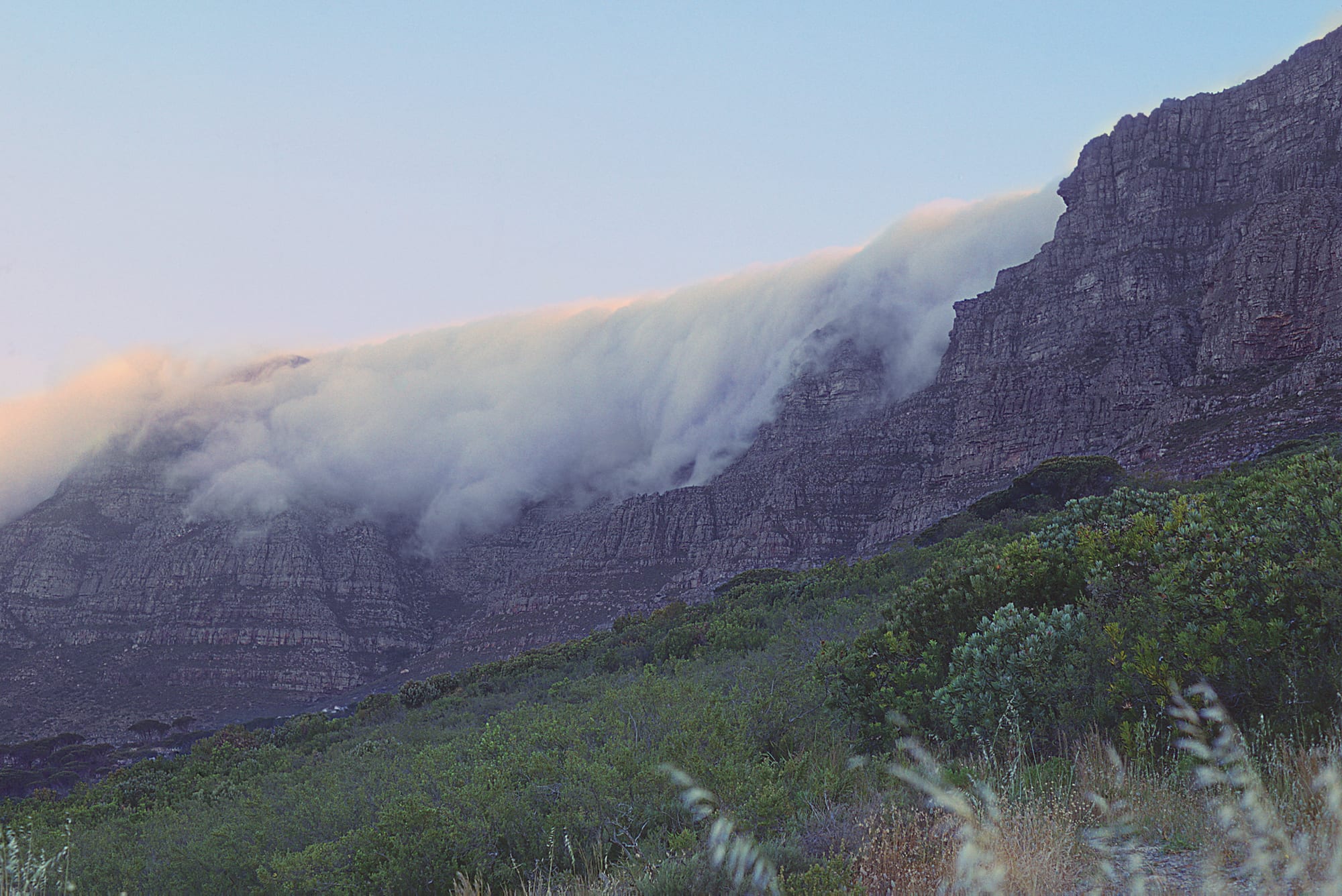
The short answer
The tablecloth is made by the wind. In spring and summer a strong, steady wind from the south-east, which Capetonians call the south-easter or the Cape Doctor, drives moist air against the back of Table Mountain. The only way for that air to go is up, and as it climbs the slopes it cools. Cool air can hold less water vapour than warm air, so near the top the invisible moisture condenses into tiny droplets, and a flat sheet of cloud settles over the summit plateau.
The wind keeps pushing, so the cloud is shoved over the edge of the cliffs on the city side. As it tumbles down that face the air sinks, warms up again and the droplets turn back into vapour. The cloud seems to pour over the rim like a cloth draped over a table, yet it never reaches the streets below: it is being made on one side of the summit and unmade on the other.
A table made for clouds
Table Mountain rises about 1,000 metres (3,300 feet) straight above Cape Town. Its main feature is a level plateau roughly three kilometres from side to side, edged by sheer cliffs and flanked by Devil's Peak to the east and Lion's Head to the west. The highest point, Maclear's Beacon, a stone cairn built for a survey in 1865, stands 1,086 metres above sea level.
That shape is what makes the tablecloth so tidy. The flat top exists because the mountain is made of extremely hard quartzitic sandstone, laid down roughly 450 to 510 million years ago, which resisted the erosion that stripped away softer layers above and around it. Geologists call it a syncline mountain: its summit was once the floor of a valley, and everything higher has worn away. The result is a long, level lid of rock, so the cloud that forms on it is long and level too. The Portuguese navigator António de Saldanha, who made the first recorded ascent in 1503, named it Taboa do Cabo, the Table of the Cape.
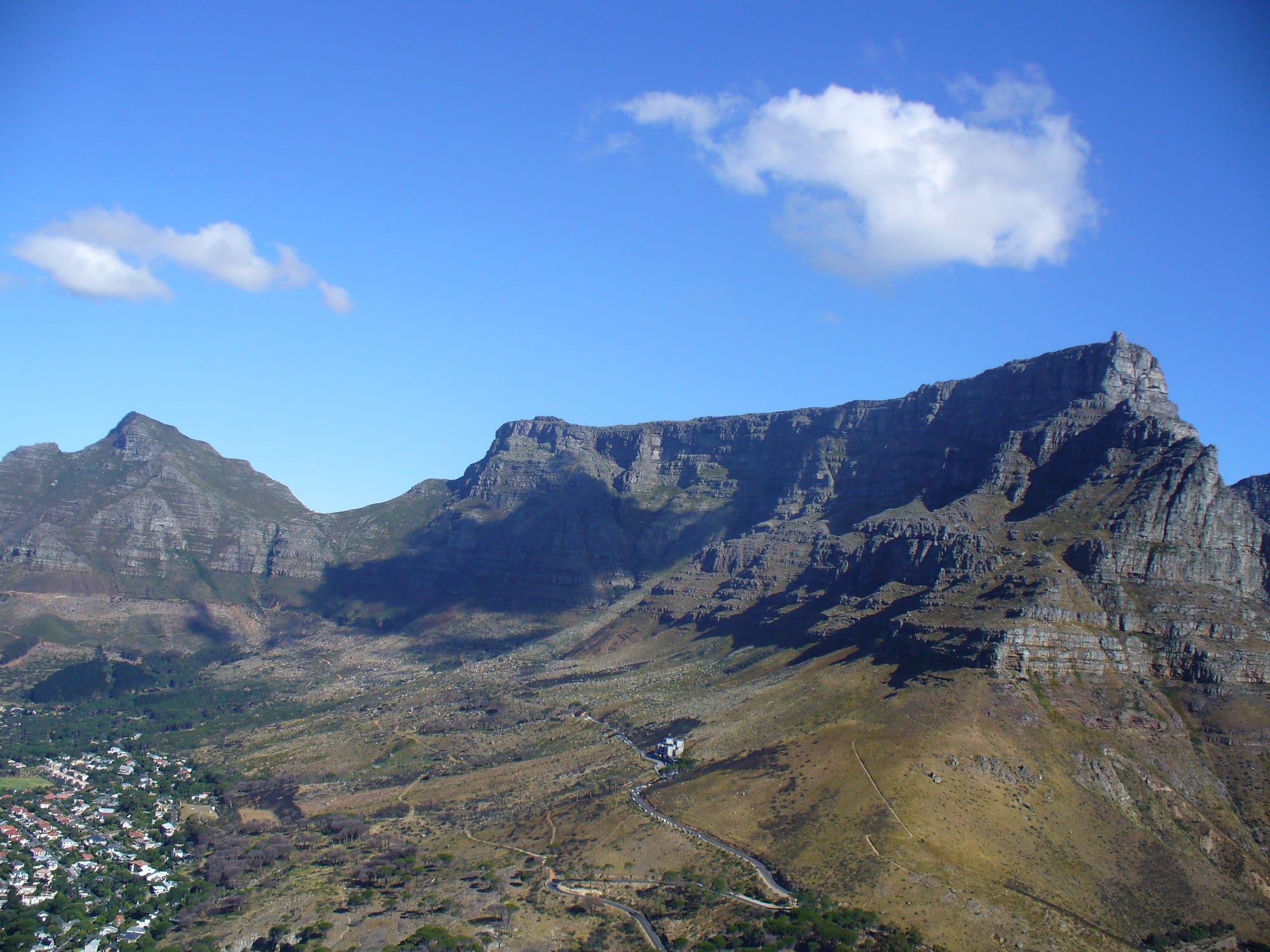
The table itself never changes. What makes the cloud appear is a strong, moist wind forcing air up and over the top, which is why the tablecloth comes and goes with the south-easter.
The wind called the Cape Doctor
The south-easter blows mainly from September to March, the southern hemisphere's spring and summer. It is driven by the South Atlantic High, a large, persistent area of high pressure over the ocean to the west of Cape Town that shifts north and south with the seasons, following the sun. The wind is strong, often persistent and usually comes with fair weather, and it is notorious on the Cape Peninsula, where it can be unpleasantly forceful. On its way to the mountain it crosses False Bay, the wide bay south-east of the city, where in summer it whips up lines of breaking waves along the northern shore.
Its nickname comes from a local belief that it clears Cape Town of pollution and "pestilence". Meteorological records suggest the reputation is a little unfair to winter: the north-westerly winds that bring the city's winter rain can be far stronger, but because they come with days of rain they never earned a flattering name. Cape Town has a Mediterranean climate, with dry, warm summers and wetter winters, so the tablecloth is above all a fine-weather cloud of the summer half of the year.
Cooling on the way up, warming on the way down
Meteorologists call the process orographic lift: an air mass forced from a low elevation to a higher one as it moves over rising ground. Rising air expands because the pressure around it falls, and expanding air cools, a change known as adiabatic cooling because no heat is exchanged with the surroundings. Dry air cools by about 9.8 °C for every kilometre it rises. Once it has cooled to its dew point, the temperature at which its relative humidity reaches 100 per cent, the vapour begins to condense into cloud.
On Table Mountain that point is reached close to the summit, which is why the cloud sits on the plateau rather than higher in the sky. The same physics then works in reverse. As the air descends the lee side of a mountain, the side sheltered from the wind, it is compressed, warms and dries, which is the mechanism behind rain shadows and the warm, dry foehn winds of mountain valleys. Over Cape Town that descent happens down the cliffs above the City Bowl, the amphitheatre of streets between the mountain and the harbour, and the cloud evaporates part-way down.
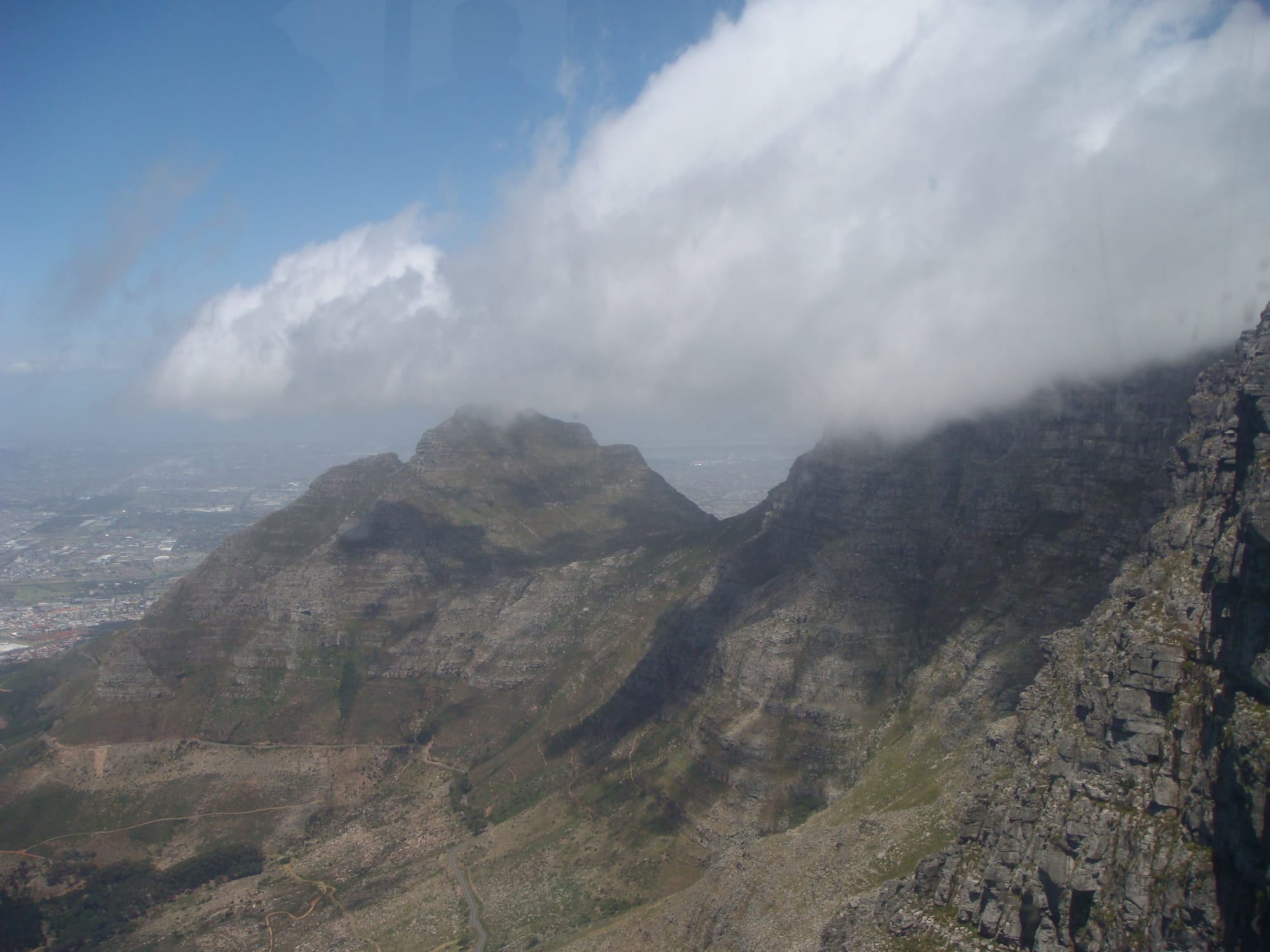
From above, the cloud can be seen streaming across the range while the city below stays in sunshine. The cloud looks still, but the air inside it is moving fast.
The Devil's smoke
Long before anyone talked about lapse rates and dew points, Cape Town had its own explanation. The folk tale tells of Jan van Hunks, a Dutchman and a prodigious pipe smoker who is said to have lived at the foot of the mountain around 1700. His wife made him leave the house whenever he smoked, so he took his pipe up the slopes of the peak beside Table Mountain. One day he met a mysterious stranger who also smoked, the two boasted about how much they could get through, and a smoking contest began. The stranger turned out to be the Devil. Van Hunks won in the end, but not before their smoke had covered the mountain and formed the tablecloth. Whenever the cloud is seen, it is said to stand for the contest.
The story is often given as the reason the eastern summit is called Devil's Peak, a 19th-century English translation of the Dutch Duivels Kop, but that is far from certain. One suggestion is that the name is a corruption of the Dutch for "Dove's Peak"; another links it to Fra Mauro's 15th-century world map, which labelled the tip of Africa Cabo de Diab, the Devil's Cape. Before any of these, the peak was known as Windberg or Charles Mountain.
Watching the cloth being laid
The best months to see the tablecloth are the south-easter months from September to March, and the best views are from below, where the whole sheet of cloud can be seen sliding over the cliffs: from the city centre, from the Victoria and Alfred Waterfront on Table Bay, or from the slopes near the lower cableway station.
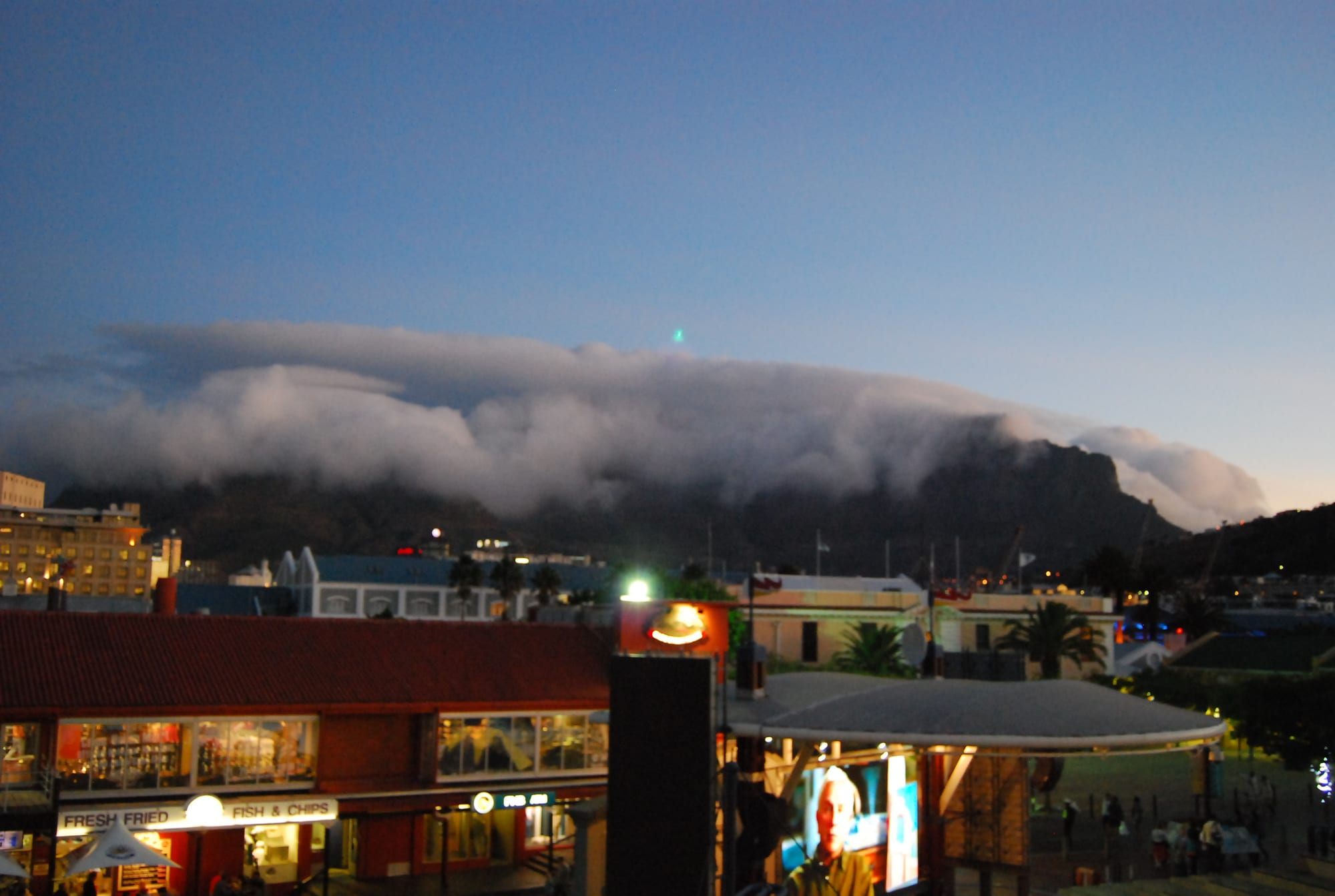
The south-easter is not always gentle. When it arrives together with a cut-off low, a kind of low-pressure system, it can bring heavy rain to the Western Cape instead of fair skies; locals call this a Black South-Easter, and one caused the Laingsburg flood of January 1981.
The cableway to the summit opened on 4 October 1929. Its modern cars carry 65 passengers, turn through a full circle on the way up, and run on a double cable that keeps them steadier in high winds. Riding up while the cloth is being laid means arriving inside it: the plateau, normally a place of wide views over the city and the ocean, disappears into white. The mountain is the centrepiece of Table Mountain National Park, the most visited national park in South Africa, and in 2011 it was named one of the New7Wonders of Nature.