History · Syria
Why does Damascus claim to be the oldest city in the world?
A river oasis at a desert crossroads has kept Damascus inhabited and important for thousands of years, though Jericho, Byblos and Aleppo have rival claims.
By Globeway Editorial · 13 October 2026
The short answer
Damascus makes the claim because people have lived on and around its site for thousands of years without the city ever being abandoned, and because written records name it unusually early: Egyptian lists of the 15th century BC already mention it. It has also been a capital again and again, of an Aramaean kingdom around 3,000 years ago, of the Umayyad Caliphate in the 7th and 8th centuries, and of modern Syria, which is why it is often called the oldest capital city in the world.
The claim is real but not unique. Damascus is best described as one of the oldest continuously inhabited cities on Earth. Jericho has settlement going back about 11,000 years, Byblos in Lebanon has been continuously inhabited since about 5000 BC, and Aleppo, Syria's other great city, may have been inhabited since the sixth millennium BC. Which of them wins depends on how "city" and "continuous" are defined, and the evidence for every candidate is disputed.
An oasis at the edge of the desert
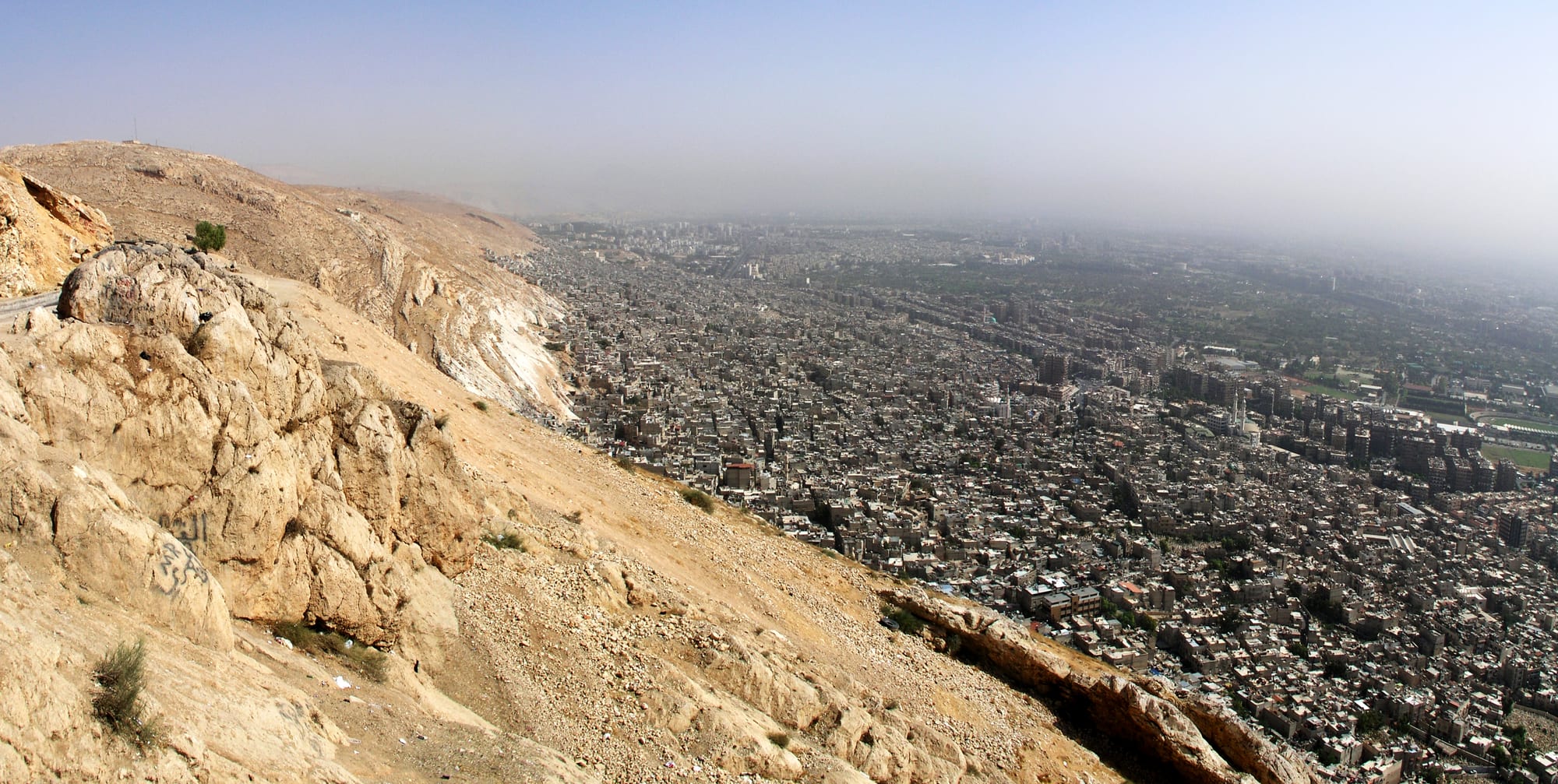
Damascus exists because of water. The city sits on a plateau 680 metres (2,230 feet) above sea level, about 80 kilometres inland from the Mediterranean, in the rain shadow of the Anti-Lebanon mountains. Rain is scarce, but the Barada River, fed by melting snow in the mountains, flows down into the plain and once spread through seven branches to water the Ghouta, an oasis of fields and orchards whose name is simply the Arabic word for garden. Vegetables, cereals and fruit have been grown there since ancient times.
The site also sat on a crossroads. One trade route ran north to south, linking Egypt with Asia Minor; another crossed the desert east to west, linking Lebanon with the Euphrates. A place with reliable water, good farmland and passing trade had every reason to keep being lived in, whoever happened to rule it.
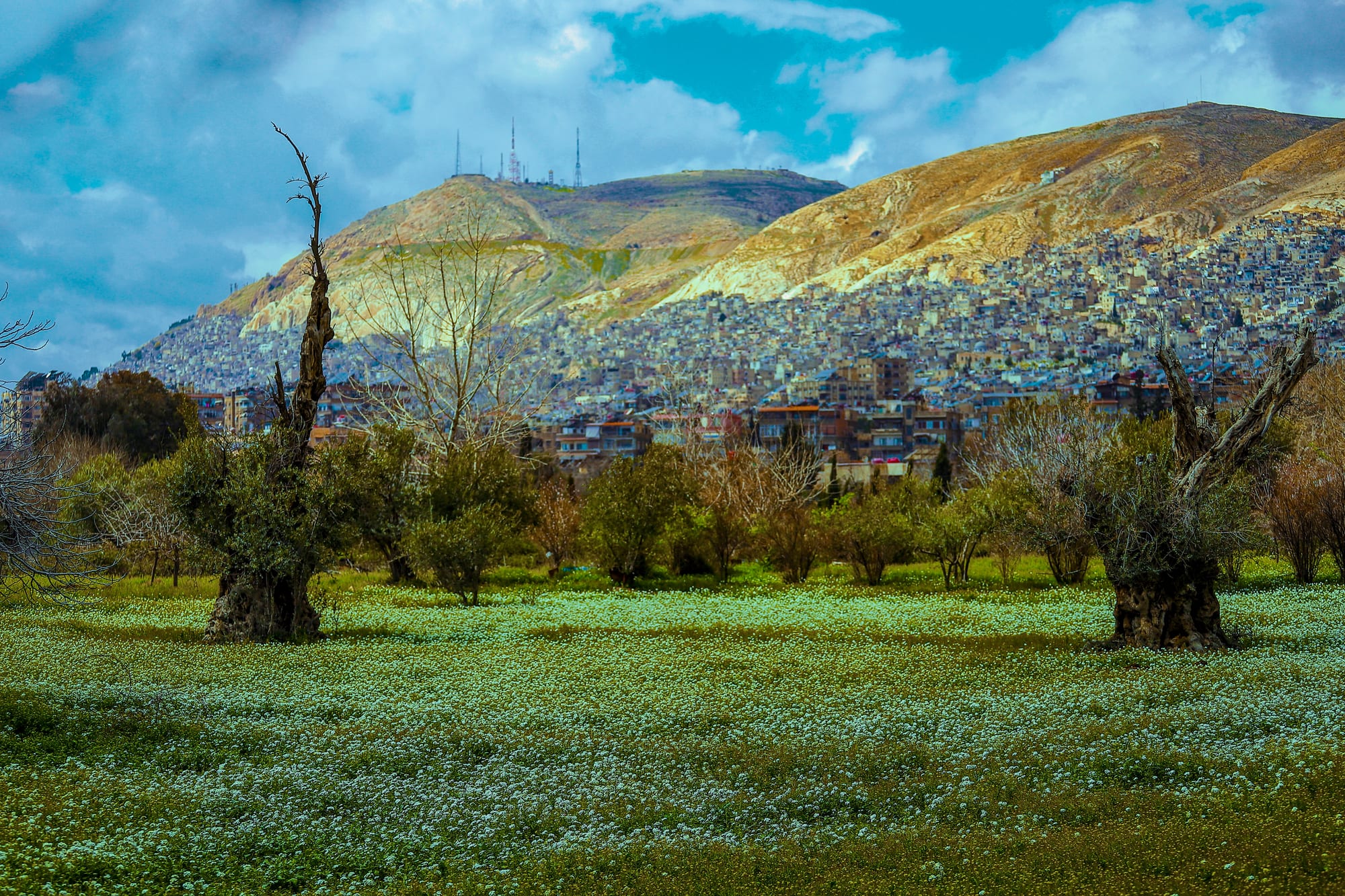
The Ghouta's green belt still surrounds the city on its eastern and southern sides, although the Barada itself has been almost drained dry by the rapid growth of housing and industry.
What the evidence actually shows
The earliest traces lie just outside the city. Carbon dating at Tell Ramad, a Neolithic village mound about 20 kilometres south-west of Damascus, suggests it may have been occupied from around 6300 BC, and there is evidence of settlement in the wider Barada basin as far back as 9000 BC. Inside the later city walls, however, there was no large-scale settlement until the second millennium BC.
Then the written record begins. The name appears as tjmsqw in a list of places compiled for the Egyptian pharaoh Thutmose III in the 15th century BC, and in the Amarna letters, diplomatic tablets of around 1350 BC, as Dimasqu, ruled by a local prince named Biryawaza. The meaning of the name itself is uncertain.
The decisive change came with the Aramaeans, a Semitic people who settled in the area by the 11th century BC. They dug canals and tunnels to make the most of the Barada, and in 965 BC a ruler named Ezron seized the town and founded the kingdom of Aram-Damascus. From then on Damascus was a capital, fighting the kingdom of Israel, leading a coalition against the Assyrians at the Battle of Qarqar in 853 BC, and falling to Assyria in the 8th century BC.
- c. 6300 BC: Tell Ramad, near Damascus, may already be occupied
- 15th century BC: Damascus is named in a list of Thutmose III of Egypt
- c. 1350 BC: The Amarna letters mention Damascus and its ruler
- 965 BC: Ezron founds the Aramaean kingdom of Aram-Damascus
- 64 BC: The Romans take Damascus
- 391: The Temple of Jupiter becomes a Christian cathedral
- 706–715: The Umayyad Mosque is built on the same site
- 1979: The Old City is listed as a UNESCO World Heritage Site
A city built on top of itself
What makes Damascus feel so old is that each new ruler built on the same ground rather than moving elsewhere. Greek planners gave it a grid, including the 1,500-metre street the Romans made their main east–west road; it is the Street Called Straight where, according to the Acts of the Apostles, Saint Paul stayed after his conversion. The Romans enclosed the city in a wall, and the ruins of earlier periods now lie up to 2.4 metres below the modern streets, so deeply buried under later building that most can never be excavated.
The clearest example is a single plot of land in the Old City. The Aramaeans built a temple there to Hadad, their god of rain and storms. Under the Seleucid Greeks it was dedicated to Zeus, and after the Romans took Damascus in 64 BC it became a great Temple of Jupiter. In 391 the Christian emperor Theodosius I turned it into a cathedral, and between 706 and 715 the Umayyad caliph al-Walid built the Great Mosque on the site, reusing columns and arcades from the church. The mosque's walls are the inner walls of the Roman temple.
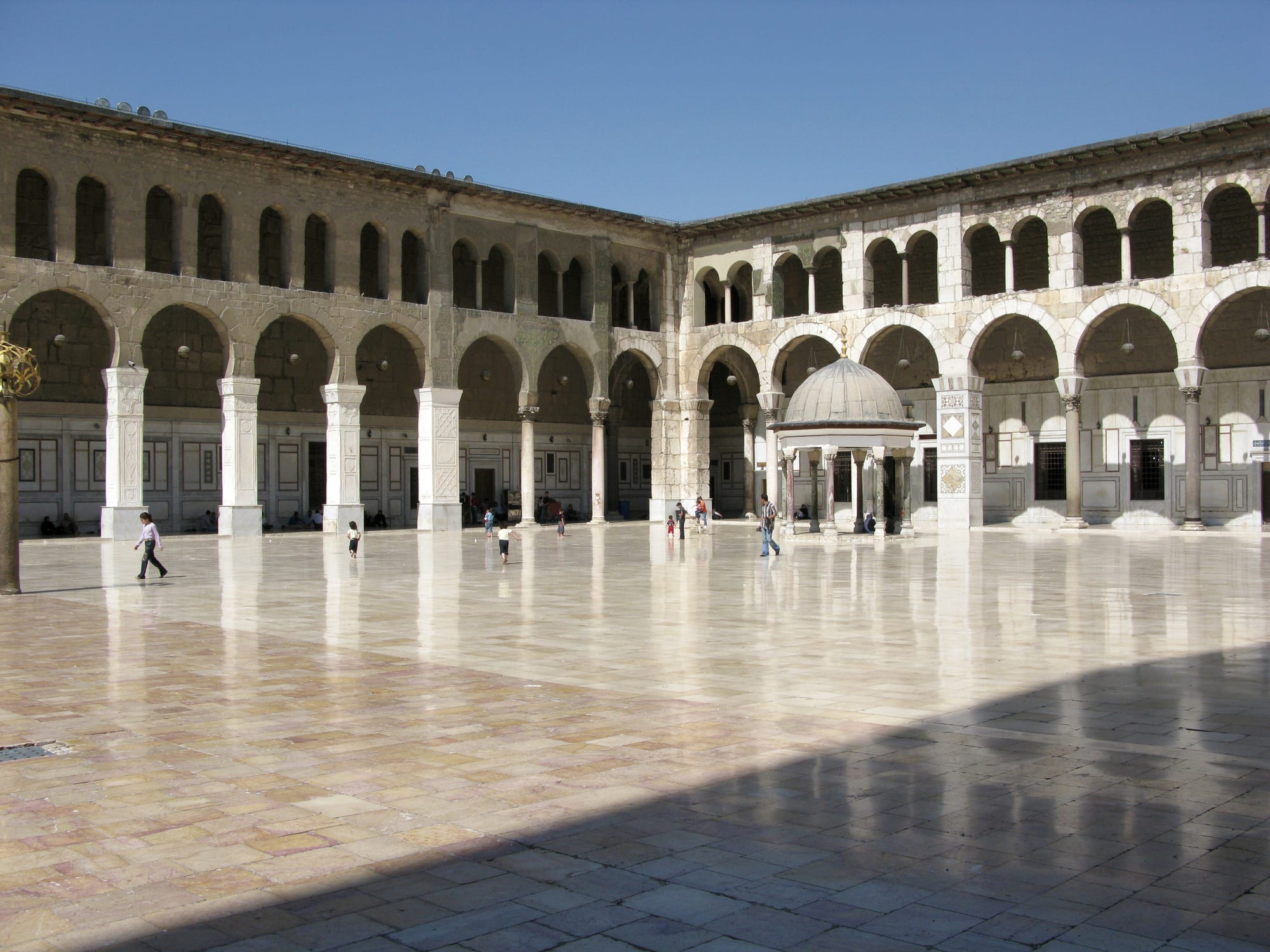
Christian and Muslim tradition both hold that the head of John the Baptist is buried here, a belief that goes back to the 6th century, and a shrine inside the mosque honours him.
The mosque is considered the oldest still in use in its original form, and it was built when Damascus was the capital of the Umayyad Caliphate, from 661 to 750, the seat of an empire. That long chain of capitals, from Aram to the caliphs to modern Syria, is what lies behind the title "oldest capital city in the world".
The rivals and the fine print
Other cities can make stronger claims on some measures. At Jericho, archaeologists have found more than 20 successive settlements, the first dating back to about 9000 BC, and UNESCO described its ancient mound as the oldest fortified city in the world when it listed the site in 2023. Byblos, on the Lebanese coast, was first settled between 8800 and 7000 BC and has been continuously inhabited since about 5000 BC. Aleppo appears in the Ebla tablets of the third millennium BC.
The arguments turn on definitions. Is a Neolithic farming village a city? Does a gap of a few centuries break continuity? Must the settlement sit on exactly the same spot? Lists of the world's oldest cities warn that nearly all their claims are disputed for exactly these reasons. Damascus's case rests less on having the very earliest date than on the combination: thousands of years of habitation, early written records and an almost unbroken run as a capital.
The old city today
The walled Old City, about 1.5 kilometres long, was declared a UNESCO World Heritage Site in 1979 and placed on the List of World Heritage in Danger in 2013 because of the civil war. After rebels entered Damascus in December 2024 and the Assad government collapsed, Syria began a fragile transition, and most governments still advise against all or all but essential travel to the country.