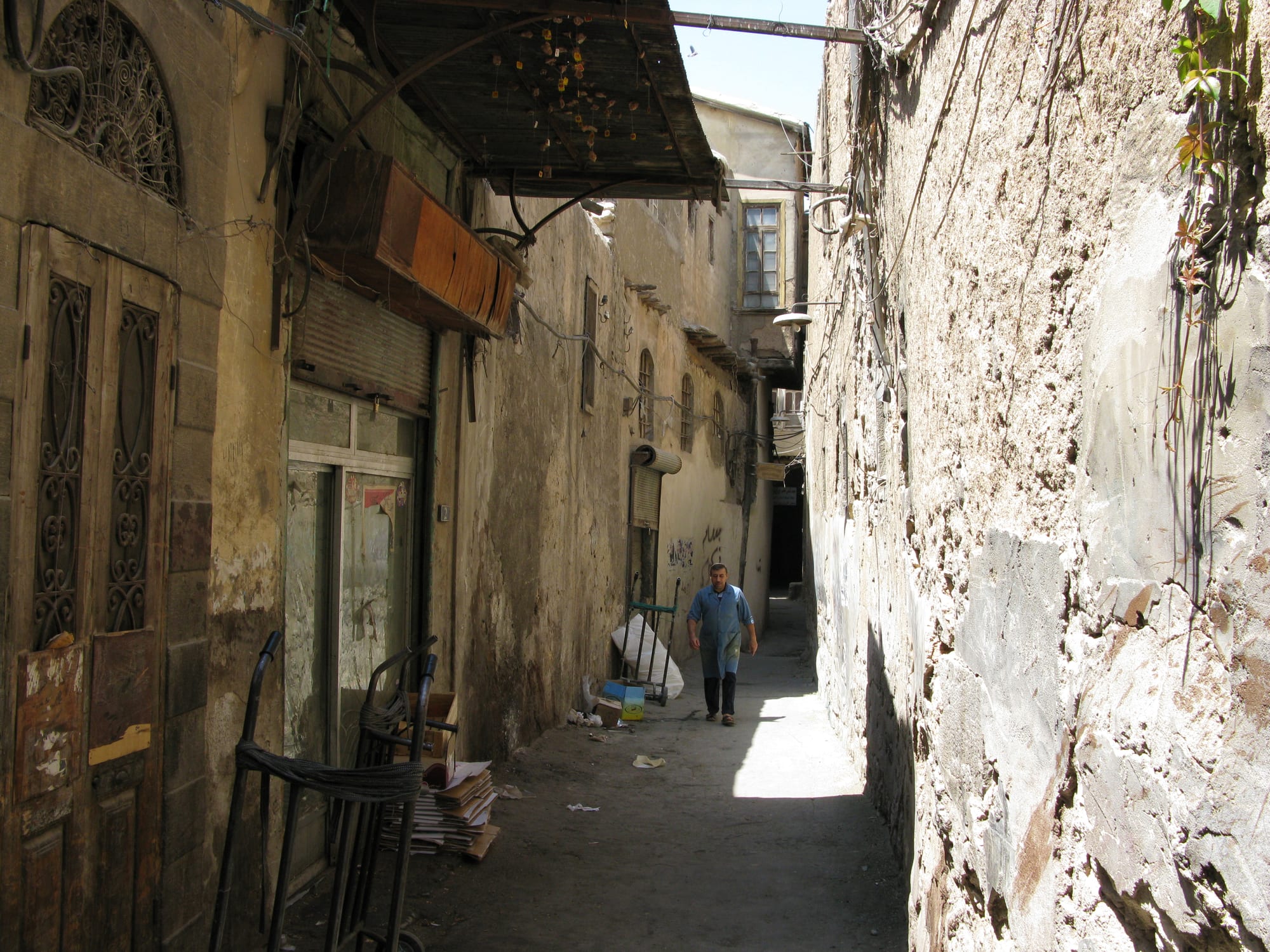
A narrow sunlit alley in old Damascus between tall stone and plaster walls, with a man walking towards the camera

Damascus & the South, Syria

Damascus

An alley in the walled old city of Damascus. (Vyacheslav Argenberg / Wikimedia Commons · CC BY 4.0)

Syria's capital, set where the Barada river leaves the mountains and waters the Ghouta oasis, and one of the longest continuously inhabited cities in the world. Capital of the Umayyad Caliphate in the 7th and 8th centuries, it keeps a walled old city of souks, courtyard houses and churches around the Umayyad Mosque. This page is written to explain the city, not to encourage travel.

Neighbourhoods

  • The Old City
    • First-time visitors
    • Historic district
    • Best for food

    The walled city, a UNESCO World Heritage Site, laid out on a Roman grid and entered through medieval gates. The Umayyad Mosque, the covered Hamidiyah souk, the Azem Palace and streets of courtyard houses are all inside it, and almost everything a visitor would come for is within a short walk.

    Open in Maps
  • Bab Touma and the Christian quarter
    • Historic district
    • Cafés and bars
    • Churches

    The north-eastern corner of the old city, named after its gate, with churches of several rites, narrow lanes of old houses and a concentration of cafés and restaurants in converted courtyards. The Chapel of Ananias lies below street level nearby.

    Open in Maps
  • Midan
    • Best for food
    • Local life

    A long quarter running south-west from the old city along the historic pilgrim road to Mecca, known across Syria for its sweet shops, grain merchants and grills. It is densely residential and was heavily affected by the war.

    Open in Maps
  • Salihiyah and the slopes of Qasioun
    • Historic district
    • Viewpoints

    A quarter on the lower slopes of Mount Qasioun north-west of the walled city, with medieval madrasas and tombs among busy shopping streets. The ground rises steeply towards the viewpoints over the city.

    Open in Maps
  • Abu Rummaneh and Malki
    • Quiet and residential
    • Embassies

    Early 20th-century planned districts north-west of the centre, with wide tree-lined streets, apartment blocks, embassies and the more expensive shops and restaurants. This is the modern, administrative face of the capital rather than the historic one.

    Open in Maps
  • Sayyida Zaynab
    • Pilgrimage
    • Local life

    A suburb south of the city built up around a major Shia shrine, which drew pilgrims from Iran, Iraq and Lebanon in large numbers before 2011. The area around the mosque is crowded with hostels, shops and religious bookstalls.

    Open in Maps

Things to do

Famous landmarks

  • Umayyad Mosquelandmark

    The great mosque built by the caliph al-Walid in the early 8th century on the site of a Roman temple and a Christian basilica, with gold mosaics of rivers and palaces and a shrine said to hold the head of John the Baptist.

    Open in Maps
  • Tomb of Saladinlandmark

    The mausoleum of the sultan Saladin, who died in Damascus in 1193, in a small garden on the north side of the Umayyad Mosque.

    Open in Maps
  • Khan As'ad Pashalandmark

    The largest caravanserai in the old city, built in 1751–52 for the governor As'ad Pasha al-Azm, its arcaded courtyard roofed with eight domes around a large central opening.

    Open in Maps
  • Straight Streetlandmark

    The Roman decumanus crossing the old city from west to east, named in the Acts of the Apostles and still lined with shops and workshops.

    Open in Maps
  • Bab Sharqilandmark

    The eastern gate of the old city, the only one to keep its Roman form, marking the end of Straight Street in the Christian quarter.

    Open in Maps
  • Damascus Citadellandmark

    A large medieval fortress at the north-western corner of the walled city, rebuilt by the Ayyubids in the early 13th century, unusual for standing on flat ground rather than a hill.

    Open in Maps
  • Takiyya al-Sulaymaniyyalandmark

    An Ottoman mosque and pilgrim hostel complex beside the Barada, designed by the imperial architect Sinan in the 1550s for caravans bound for Mecca.

    Open in Maps

Museums and churches

  • National Museum of Damascusmuseum

    Syria's national and largest museum, reopened in January 2025, holding finds from Ugarit, Mari, Ebla, Palmyra and Dura-Europos, including the reconstructed synagogue of Dura-Europos and a Palmyrene tomb chamber.

    Open in Maps
  • Mariamite Cathedrallandmark

    The Greek Orthodox cathedral of Damascus, seat of the Patriarch of Antioch, on an ancient church site in the old city.

    Open in Maps
  • Sayyida Ruqayya Mosquelandmark

    A shrine mosque north of the Umayyad Mosque, built around the mausoleum in 1985 in a modern Iranian style of mirror and gold work, and a focus for Shia pilgrimage.

    Open in Maps

Souks and streets

  • Al-Hamidiyah Souqmarket

    The largest souk in Syria, a long street under a high arched iron roof running from beside the citadel to the Umayyad Mosque.

    Open in Maps
  • Bab al-Saghirlandmark

    A southern gate of Roman origin beside an old cemetery that holds tombs venerated by Shia pilgrims.

    Open in Maps

Views and green space

  • Mount Qasiounviewpoint

    The bare ridge rising behind the city, whose road and terraces give the standard view over the whole of Damascus and the Ghouta.

    Open in Maps
  • Tishreen Parkpark

    The largest public park in Damascus, in the north-west of the city, long used for family outings and an annual flower show.

    Open in Maps
  • Barada Riverattraction

    The river that made the city possible, running from the Anti-Lebanon mountains through the centre and out into the orchards of the Ghouta.

    Open in Maps

Short trips from the city

  • Maaloulaattraction

    A cliffside village about 56 km north-east, one of the last places where a Western Aramaic dialect is spoken, with the convent of Saint Thecla and the monastery of Saints Sergius and Bacchus.

    Open in Maps
  • Saydnayaattraction

    A hill town north of Damascus whose Greek Orthodox convent of Our Lady, held by tradition to have been founded in the sixth century, has long drawn Christian and Muslim pilgrims.

    Open in Maps
  • Zabadaniattraction

    A mountain town near the Lebanese border, long a summer resort for Damascenes escaping the heat, and heavily damaged during the war.

    Open in Maps

Seasonal events

  • Ramadan nightsthe lunar month of Ramadan

    The old city's cafés, sweet shops and souks stay open late through the month, and families gather for iftar after sunset.

  • Eid al-Fitrat the end of Ramadan

    Days of family visiting, new clothes and sweets, with crowds around the Umayyad Mosque.

  • Eid al-Adhaduring the month of Dhu al-Hijjah

    The feast of sacrifice, marked with meat shared among relatives and neighbours and the year's busiest travel within the country.

  • Feast of the CrossSeptember

    Marked on 14 September by churches following the Gregorian calendar, in the Christian quarters and in the villages north of the city.

Eat and drink

Long-standing places and food districts in Damascus. Hours, ratings and directions come from your maps app, always current.

Damascus classics

  • Bakdashcafe

    An ice-cream parlour in the Hamidiyah souk, established in 1885, where booza, a mastic frozen dairy dessert, is pounded by hand with wooden mallets and rolled in pistachio.

    Open in Maps
  • Al-Nofara Cafécafe

    A coffee house in an alley behind the Umayyad Mosque, reckoned the oldest in the city, long known for tea, water pipes and a hakawati reading serialised folk epics aloud.

    Open in Maps

Food districts and markets

  • Midan sweet shopsneighborhood

    The quarter Damascenes go to for barazek sesame biscuits, baklava and other pastries, alongside grills and bakeries on its main street.

    Open in Maps
  • Straight Street covered marketmarket

    Spices, dried fruit, nuts, coffee and pickles sold under the roofed Ottoman market that covers the western half of Straight Street.

    Open in Maps
  • Bab Touma cafésneighborhood

    Restaurants and cafés in restored courtyard houses in the Christian quarter, where arak and wine are served alongside mezze.

    Open in Maps

Experience Damascus

History

Damascus grew where the Barada river leaves the Anti-Lebanon mountains and spreads into the Ghouta, an oasis of orchards on the edge of the desert, and it is counted among the oldest continuously inhabited cities in the world. It was the seat of an Aramaean kingdom in the early first millennium BC, then passed to the Assyrians, Babylonians and Persians. Under Rome it became a wealthy provincial city whose main east–west avenue, the Via Recta, is still the line of Straight Street, and the temple of Jupiter at its heart became a Christian basilica dedicated to John the Baptist.

The Arab armies took the city in 634, and from 661 to 750 Damascus was the capital of the Umayyad Caliphate, ruling from Spain to Central Asia. The caliph al-Walid replaced the basilica with the Umayyad Mosque, whose mosaics and plan influenced mosque architecture far beyond Syria. The Abbasids moved the capital to Iraq, and Damascus was fought over by Fatimids, Seljuks and Crusaders. Nur al-Din and then Saladin made it a base against the Crusader states, and Saladin was buried beside the mosque in 1193. Timur sacked the city in 1401, carrying its craftsmen to Samarkand.

From 1516 Damascus was an Ottoman city and the assembly point for the annual pilgrim caravan to Mecca, which shaped the Midan quarter and paid for its khans and mosques. French rule followed the First World War and was resisted in the Great Syrian Revolt, which reached Damascus in 1925 and which the French suppressed by bombing and shelling the city. Independence came in 1946, and Damascus has been the seat of government ever since, including the Assad family's from 1970 until December 2024. The old city, listed by UNESCO in 1979, came through the war largely intact, while outer suburbs were heavily damaged.

Culture & Customs

Damascus thinks of itself as a city of manners. The Damascene accent has long been the standard voice of Syrian television drama, exported across the Arab world, and the historical series filmed here — above all the long-running Bab al-Hara, set in a walled-city quarter under the French — fixed an image of old Damascus in millions of homes. The city's writers, singers and dramatists have been central to modern Arabic culture, and the poet Nizar Qabbani, born and raised in the old city, is its best-known literary son.

The courtyard house is the city's defining institution: closed and plain towards the street, opening inward on a paved court with a fountain, citrus trees and a liwan, the open room that catches the evening air. Many have been restored as restaurants and hotels in the old city, which is where visitors most easily see the architecture. The old coffee house is the other, with tea, water pipes and, at al-Nofara behind the Umayyad Mosque, a hakawati reading folk epics aloud.

Religious life runs along several tracks in a small area. The Umayyad Mosque is a major Sunni monument and also draws Shia pilgrims to its shrine commemorating Husayn; Sayyida Zaynab and Sayyida Ruqayya are Shia pilgrimage centres; and the Christian quarter around Bab Touma holds Greek Orthodox, Greek Catholic, Syriac, Armenian and Maronite congregations whose bells and Easter processions are part of the city's year. Crafts survive in the souks: inlaid wood, brocade, copper and the mouth-blown glass that Damascus has made for centuries.

Daily Life

The city itself counted about 1.5 million people at the 2004 census, at the centre of a metropolitan area usually estimated at several million, swollen and then reshaped by years of displacement. Damascus was Syria's seat of government, banking, trade and universities before 2011, and the state payroll, the University of Damascus and small commerce still employ much of the city. Salaries in the pound are worth little, so households rely on second jobs, small trade and money sent by relatives abroad.

Life is unevenly distributed across the city. The old city and the western districts such as Abu Rummaneh and Malki came through the war comparatively well, while the eastern Ghouta and the southern suburbs, including the Palestinian camp at Yarmouk, were devastated; returning families there live among ruins and slow reconstruction. Electricity and water cuts structure the day, generators and batteries are normal household equipment, and fuel queues can be long.

The rhythm begins early, with bread queues, school runs and traffic on the ring roads, slows through the hot afternoon, and picks up again after sunset, when families walk in Tishreen Park, sit in the old city's cafés or gather on rooftops. Friday is the day off, with midday prayers, visiting and long lunches; Sunday adds church for Christian families. The return of displaced people, the cost of living and how the new authorities will govern are the everyday conversations.

Food

Damascus is the home of refined urban Levantine cooking, built on mezze: hummus and msabbaha (warm chickpeas with tahini), moutabal of smoked aubergine, tabbouleh heavy with parsley, fattoush with fried bread, and sheets of flatbread to lift them. Breakfast is foul (stewed fava beans with oil and lemon) or fatteh, layers of bread, chickpeas and yoghurt topped with fried nuts, bought hot from shops that sell nothing else. Kibbeh appears in a dozen shapes, from fried stuffed ovals to trays baked with pine nuts; shakriyeh is lamb simmered in yoghurt, and yabraq are vine leaves rolled around rice and meat.

Street food means shawarma carved from the spit, falafel, and manakish flatbreads baked with thyme and oil or with cheese. The Midan quarter is the city's sweet district and the likely birthplace of barazek, thin sesame biscuits studded with pistachio; baklava, halawet el-jibn and semolina cakes come from the same streets. Bakdash in the Hamidiyah souk pounds booza, a stretchy mastic ice cream, with wooden mallets and rolls it in crushed pistachio.

The Ghouta orchards supply apricots, pressed into sheets of qamar al-din that dissolve into a Ramadan drink, along with figs, walnuts and the Damask rose, whose petals become rose water and jam and which UNESCO listed in 2019 as Syrian intangible heritage. Street sellers pour tamar hindi (tamarind) and jallab, a syrup of carob, dates and grape molasses served with pine nuts, from brass jugs carried on the back. Coffee is bitter, strong and scented with cardamom; tea is drunk very sweet; and arak, the aniseed spirit, is served with mezze where alcohol is sold.

Planning tools

Budget

Damascus has more working hotels, restaurants and transport than anywhere else in Syria, and prices in dollar terms are low, but almost everything depends on cash carried in, a volatile exchange rate and the cost of fuel and a trusted driver. Figures are indicative only and change quickly.

Daily Budget Midrange
USD 90–180 (boutique courtyard hotel, restaurant meals, private car and driver) — indicative only
Daily Budget Shoestring
USD 30–50 (simple old-city guesthouse, street food, shared taxis) — indicative only

Bring money as clean US dollar notes and change it through trusted channels; cards and cash machines cannot be relied on.

Best Time to Visit

Historically April–May and September–October, when the city is warm but not scorching. Ramadan evenings once filled the old city's streets and sweet shops. International flights have served Damascus again since January 2025, but security conditions, not the season, decide whether any visit is possible.

Suggested Number of Days

The walled old city and the museum occupy two or three days at an unhurried pace. Adding the Qalamoun villages and the Hauran to the south takes four or five. Checkpoints, closures and the time needed to arrange a driver make every plan slower than the distances suggest.

First Visit
2–3 days
With Surroundings
4–5 days

Transportation

Damascus International Airport and the overland road from Lebanon are the main ways in, with the Jordanian crossing at Nasib used at times. Within the city, yellow taxis and crowded minibuses do most of the work, and shared taxis link the capital with the Qalamoun, Daraa and Suwayda. Roads are damaged, checkpoints are frequent and fuel can run short.

Travel only in daylight, with a local driver who knows current conditions, and expect routes to change at short notice.

Airport & Station Connections

Damascus International Airport lies about 30 km south-east of the centre and has handled international flights again since January 2025, though the number of airlines serving it is small. Many arrivals still come overland from Beirut, a road journey of a few hours through the Anti-Lebanon mountains, and the southern crossing to Jordan at Nasib is used at times.

Walkability

The walled old city is the most walkable part: about 1.5 km from end to end, largely closed to cars in the souks, and flat. Surfaces are uneven, some lanes are very narrow, and quarters damaged during the war have rubble and unsafe buildings. Beyond the walls the modern city is spread out, traffic is heavy and crossing the main avenues on foot is difficult.

Safety

Most governments advise against all or all-but-essential travel to Syria, and the capital is no exception. Former front lines around the city, in the Ghouta and in the southern suburbs, are contaminated with mines and unexploded ordnance and many buildings are unstable. Crime has risen with poverty, and consular help is minimal or absent.

Do not travel for leisure; anyone who must go should use an experienced local fixer, keep away from the Golan line, military sites, crowds and damaged buildings, and never touch debris. Check current official travel advice before travelling.

Climate

Damascus sits at about 680 metres on the dry, landward side of the Anti-Lebanon mountains, giving it a semi-arid climate: hot, dry summers, cool winters with most of the year's modest rainfall, and a wide gap between day and night temperatures all year.

Summer
hot and dry, often above 33°C by day in July and August, with noticeably cooler evenings
Winter
cool to cold, with January days around 12°C, frost at night and occasional snow

Local Customs

Damascus is a conservative but cosmopolitan city with a strong sense of manners. Greetings are unhurried, hospitality is pressed on guests, and refusing an offer of coffee or food once before accepting is normal. Modest dress covering shoulders and knees is expected, and women cover their hair to enter the Umayyad Mosque, where visitors also remove their shoes. Alcohol is sold in Christian quarters and in some restaurants but is not drunk in public.

Ask before photographing people, and do not photograph soldiers, checkpoints, government buildings or damaged districts.

Common Payment Methods

The currency is the Syrian pound, redenominated during 2026 with two zeros removed. In practice the economy runs on cash, with US dollars widely used for hotels and drivers. Foreign cards and cash machines cannot be relied on, so money is brought in as clean dollar notes and changed through trusted channels.