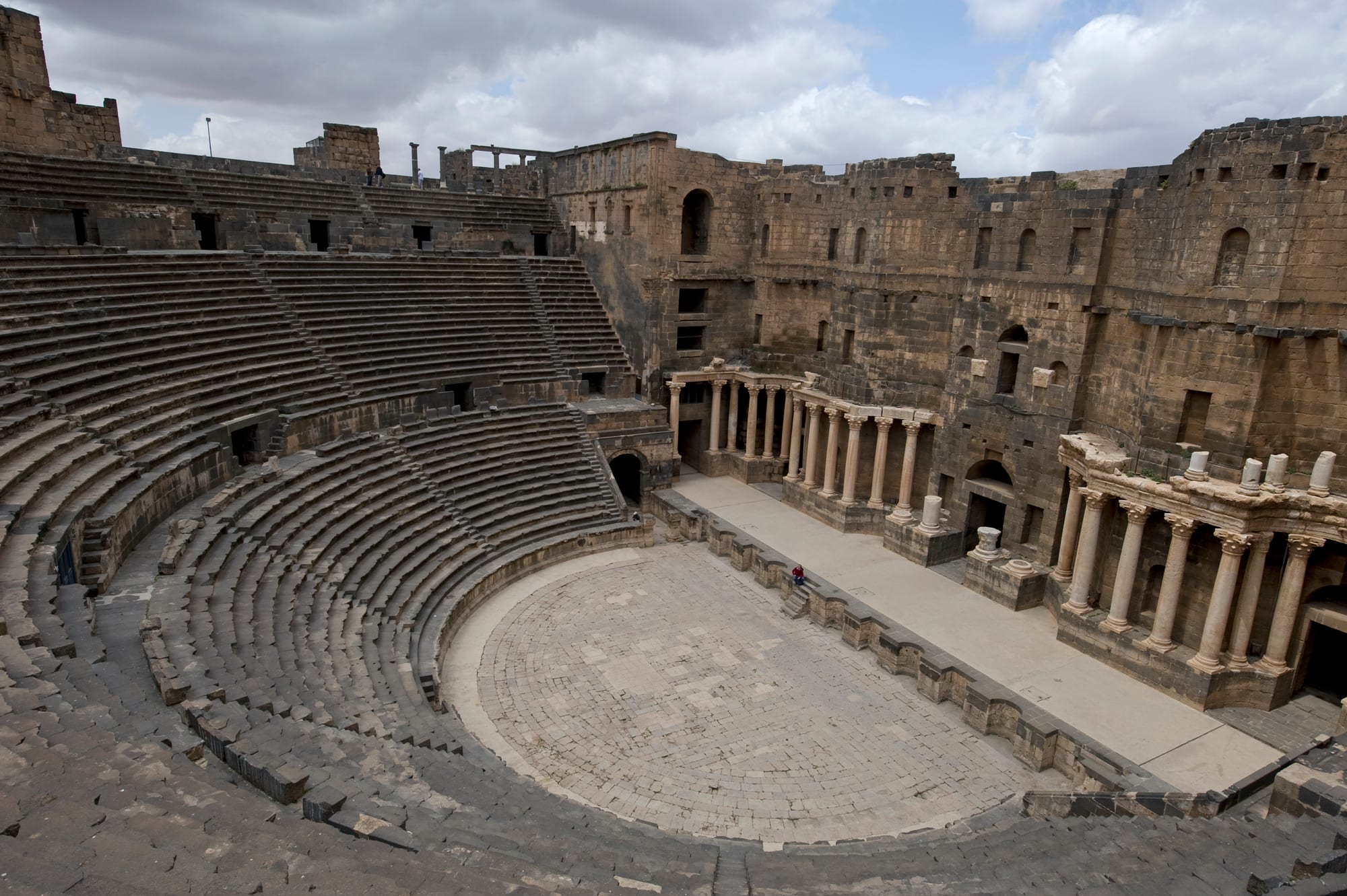
The steep stone seating of the Roman theatre at Bosra curving around a paved orchestra, with a colonnaded stage building to the right

Damascus & the South, Syria

Bosra

The second-century Roman theatre at Bosra, enclosed by the walls of the later citadel. (Dosseman / Wikimedia Commons · CC BY-SA 4.0)

A small town on the black basalt plain of the Hauran in southern Syria, built in and around the remains of a Roman city that was capital of the province of Arabia. Its second-century theatre survives almost complete inside a medieval citadel, and the ancient streets are still lived in. This page is written to explain the town, not to encourage travel.

Neighbourhoods

  • The ancient town
    • First-time visitors
    • Historic district
    • Walking

    The archaeological core, a UNESCO World Heritage Site, laid out on the Roman grid around a colonnaded main street with baths, gates, churches and an early mosque. Families live among the ruins in houses built from the same black basalt, so it is a working town rather than a fenced site.

    Open in Maps
  • The citadel quarter
    • Historic district
    • Viewpoints

    The southern edge of the town, dominated by the fortress that medieval rulers built around the Roman theatre. The ground rises here, and the ramparts look out over the basalt plain towards the Druze mountains.

    Open in Maps
  • The modern town
    • Local life
    • Markets

    The newer streets spreading north and east from the ruins, with shops, bakeries, the bus stand and most of the population. Plain concrete and basalt houses stand among orchards and grain fields at the edges.

    Open in Maps

Things to do

The Roman city

  • Roman theatre of Bosralandmark

    A theatre of the second century AD built of black basalt, seating about 17,000 people, preserved because it was turned into a fortress in 1068 and ringed with eight great towers by the Ayyubids between 1202 and 1253, whose vaulted passages are entered on the way in.

    Open in Maps
  • Al-Omari Mosquelandmark

    One of the oldest standing mosques anywhere, founded in the time of the caliph Umar and completed in 721 under Yazid II, a plain hypostyle building of basalt columns and reused Roman stone in the centre of the old town.

    Open in Maps

Short trips from the town

  • Salkhadattraction

    A Druze town about 20 km east and high in the Jabal al-Druze, below a hill crowned by a castle the Ayyubids built between 1214 and 1247.

    Open in Maps
  • Suwaydaattraction

    The Druze-majority capital of Suwayda Governorate, about 25 km north-east, with the Suwayda National Museum and Roman remains.

    Open in Maps
  • Qanawatattraction

    A village 7 km north-east of Suwayda where Roman temples, a rock-hewn theatre and the colonnaded Es-Serai, later a church, stand among the basalt houses.

    Open in Maps
  • Shahbaattraction

    A town about 40 km north laid out on a Roman grid as Philippopolis by the emperor Philip the Arab, whose native village it was, with Roman mosaics in a local museum.

    Open in Maps
  • Daraaattraction

    The provincial capital about 40 km west, a market town 13 km north of the Jordanian border, known as the cradle of the 2011 uprising.

    Open in Maps

Seasonal events

  • Bosra Festivalsummer

    A festival of music and theatre held in the Roman theatre in the years before 2011, staged intermittently since.

  • Ramadan and the Eidsthe lunar month of Ramadan and the two feasts

    The town's social calendar follows the Islamic year, with late evenings through Ramadan and family visiting at Eid al-Fitr and Eid al-Adha.

Eat and drink

Long-standing places and food districts in Bosra. Hours, ratings and directions come from your maps app, always current.

Hauran cooking

  • The old town bakeriesmarket

    Flatbread baked through the morning is the basis of every meal in a wheat-growing district, sold from small bakeries around the town centre.

    Open in Maps
  • Bosra market streetmarket

    Vegetables, olives, cheese and sacks of lentils and bulgur from the surrounding plain, sold from shops and stalls in the modern town.

    Open in Maps
  • Grill shops by the citadelneighborhood

    The handful of simple places near the entrance to the citadel serve grilled meat, hummus and salads to visitors and townspeople.

    Open in Maps

Experience Bosra

History

Bosra appears in Egyptian records of the second millennium BC, but it became a city under the Nabataeans, whose kingdom reached north from Petra across the Hauran, and who made it an important northern centre. When Rome annexed the kingdom in 106 AD, the emperor Trajan made Bosra the capital of the new province of Arabia, renamed it Nova Traiana Bostra and garrisoned it with a legion. The town was rebuilt on a grid of colonnaded streets, with baths, a hippodrome, monumental gates and the theatre, all in the black basalt that the volcanic plain supplies in place of limestone. A road, the Via Nova Traiana, ran south from here to the Red Sea, and caravans from Arabia unloaded in its markets.

Christianity came early and Bosra became a metropolitan see, with a large domed cathedral built in the sixth century. Muslim tradition connects the town with the monk Bahira, said to have recognised the young Muhammad among a Meccan caravan here. Under Islamic rule Bosra remained a station on the pilgrim road from Damascus to Mecca, and the mosque now known as al-Omari is among the oldest to survive in Syria.

From the 11th century rulers of Damascus fortified the theatre, filling its vaults and wrapping it in towers until the whole building became a citadel, which is why it survived so completely. The pilgrim road later shifted west, and Bosra shrank into a village living inside the ruins. Excavation and restoration began in the 20th century, UNESCO listed the site in 1980, and a summer festival used the theatre before 2011. Syria's World Heritage Sites, Bosra among them, have since been placed on the list of World Heritage in Danger because of the armed conflict.

Culture & Customs

Bosra belongs to the Hauran, a Sunni farming and tribal region where clan ties, hospitality and reputation carry great weight, and where the Druze villages of Jabal al-Arab begin a short distance to the north-east. Households are large and extended, marriages are often within the wider family, and disputes have traditionally been settled by elders as much as by courts. Guests are served bitter cardamom coffee in small cups, poured from a long-spouted dallah, and refusing the first cup is normal politeness rather than rejection.

Life in Bosra is unusual in that the town has never stopped living inside its ruins: houses, courtyards and animal pens were built from Roman blocks for centuries, and although archaeological work has cleared much of the ancient centre, the boundary between monument and neighbourhood is still blurred. That long habitation shaped a strong local identity, and the theatre — used for performances rather than kept as an empty shell — has been a source of pride.

Basalt gives everything its character. The stone is cut for walls, lintels, window grilles and even doors, it darkens the streets, and it sets the town apart from the limestone towns of western Syria. Weddings bring out the dabke line dance and drumming in the courtyards, and the calendar follows the Islamic year, with Ramadan evenings and the two Eids the main occasions for visiting relatives across the plain.

Daily Life

Bosra is a small town of roughly 20,000 people, though the figure has moved sharply with displacement during and after the war. Most households depend on farming the Hauran plain — wheat, barley, lentils, olives and vegetables — or on work in Daraa and Damascus, in the army and public service, or with relatives sending money from the Gulf and Jordan. Tourism employed a number of families before 2011 and has not returned in any comparable form.

The plain around the town is open and treeless, with black stone villages spaced across grain fields, and water has always been the constraint: the Romans built cisterns and a great reservoir here, and modern supply is intermittent. So is electricity, and generators, batteries and solar panels are common. Fuel prices and the cost of bread dominate household conversation, as they do across Syria.

The day begins before dawn in summer, when work in the fields is done early, and the middle of the day is quiet. Shops reopen in the late afternoon and men gather in cafés or on the street outside, while the evening belongs to family visiting. Friday is the day of rest, with midday prayers at the old mosques. The return of displaced families, the state of the roads and the security situation in the south are the everyday concerns.

Food

Hauran cooking is grain, pulse and dairy food, plainer than the cuisine of Damascus and generous in quantity. Bread comes from the district's own wheat and appears at every meal; burghul (cracked wheat) is cooked with lentils as mujaddara or shaped into kibbeh; and freekeh, green wheat roasted while still soft, is simmered with chicken or lamb. Lentil soup, fava beans and dishes of rice and vegetables in tomato sauce fill out the week.

Sheep and goats supply the rest. Yoghurt is drained into labneh and served with olive oil at breakfast, dried into hard balls of jameed for winter, or cooked into the yoghurt stews of the region; mansaf, lamb cooked in such a sauce and served over rice and bread, is the festive dish of the whole area straddling the Jordanian border. Meat otherwise means grilled kebabs or a whole animal roasted for a wedding or a guest of standing.

Olives, olive oil, thyme and sesame come together as za'atar, eaten with bread and labneh in the morning or baked on manakish flatbreads. Vegetables from the plain — tomatoes, aubergines, courgettes stuffed with rice and meat — dominate summer meals, and figs, grapes and apples come down from the Druze highlands in late summer. Tea is drunk very sweet through the day, coffee is bitter and scented with cardamom, and sweets are bought rather than made at home, usually from Daraa or Damascus.

Planning tools

Budget

Bosra is cheap but has almost no visitor infrastructure: a day trip from Damascus with a hired car and driver is how most people have seen it, and that car is the main cost. Everything is paid for in cash, and prices in pound terms change quickly. Figures are indicative only.

Daily Budget Midrange
USD 90–180 (boutique courtyard hotel in Damascus, restaurant meals, private car and driver) — indicative only
Daily Budget Shoestring
USD 30–50 (simple room or a day trip by shared taxi, local food) — indicative only

Agree the full-day price with a driver in advance, and carry clean US dollar notes changed through trusted channels.

Best Time to Visit

Historically April–May and September–October, when the Hauran is green in spring and the basalt is not radiating heat. International flights have served Damascus again since January 2025, but security conditions, not the season, decide whether any visit is possible.

Suggested Number of Days

The ancient town and the citadel take a few hours on foot. Adding the Druze highlands and the other Hauran sites fills a long day or two, and travel times depend on checkpoints rather than distance.

First Visit
half a day
With Surroundings
1–2 days

Transportation

Bosra lies off the road south from Damascus towards Daraa, roughly two hours from the capital in normal conditions. Shared taxis and minibuses link it to Daraa and Suwayda, but services are irregular; a private car and driver is the practical way to arrive. Roads are damaged, checkpoints are frequent, fuel can run short, and routes into Suwayda are affected by the conflict in the south.

Travel only in daylight, with a local driver who knows current conditions, and expect routes to change at short notice.

Airport & Station Connections

There is no airport or railway station. Damascus International Airport, about 110 km north, has handled international flights again since January 2025, and the road south through Daraa province is the usual approach. The Jordanian border crossing at Nasib, on the Damascus–Amman highway south of Daraa, is used at times.

Walkability

The town is small and flat, and the ancient streets, the citadel and the mosques are all within a walk of ten or fifteen minutes of each other. Surfaces are rough basalt paving and rubble, there is very little shade, and some ruined or damaged buildings are unsafe to enter.

Safety

Most governments advise against all or all-but-essential travel to Syria, and Daraa province is no exception. The province has seen repeated armed clashes, kidnappings and Israeli military activity, former front lines are contaminated with mines and unexploded ordnance, and the ceasefire line on the Golan is militarised. Fighting between government forces and Druze armed factions in Suwayda, the neighbouring governorate that holds most of the sites listed above, has continued into 2026, with accusations that access to the province is being restricted. Consular help is minimal or absent.

Do not travel for leisure; anyone who must go should use an experienced local fixer, keep away from the Golan line, military sites, crowds and damaged buildings, and never touch debris. Check current official travel advice before travelling.

Climate

The Hauran plain lies between about 600 and 900 metres, giving a semi-arid climate with hot, dry summers and cool, damp winters. The black basalt holds the heat of the day, and the open plain is windy and exposed in every season.

Summer
hot and dry, often above 32°C by day, with cool nights
Winter
cool and wet, with days around 12°C, night frost and occasional snow

Local Customs

This is a conservative rural and tribal district where extended families and clan ties matter. Greetings are formal and unhurried, hospitality is offered quickly and refusing it is awkward, and modest dress covering shoulders and knees is expected, with a headscarf for women entering mosques. Alcohol is not part of public life here.

Ask before photographing people, especially women, and do not photograph soldiers, checkpoints or military positions.

Common Payment Methods

The currency is the Syrian pound, redenominated during 2026 with two zeros removed, but in practice the economy runs on cash and US dollars are used for drivers and hotels. There is no reliable card acceptance or cash machine here; money is brought from Damascus.