Attractions & Natural Wonders · Malawi
Why does Lake Malawi have more kinds of fish than any other lake?
One family of fish, the cichlids, split into 700 or more species in a few million years, helped by a lake that kept shrinking and refilling.
By Globeway Editorial · 13 October 2026
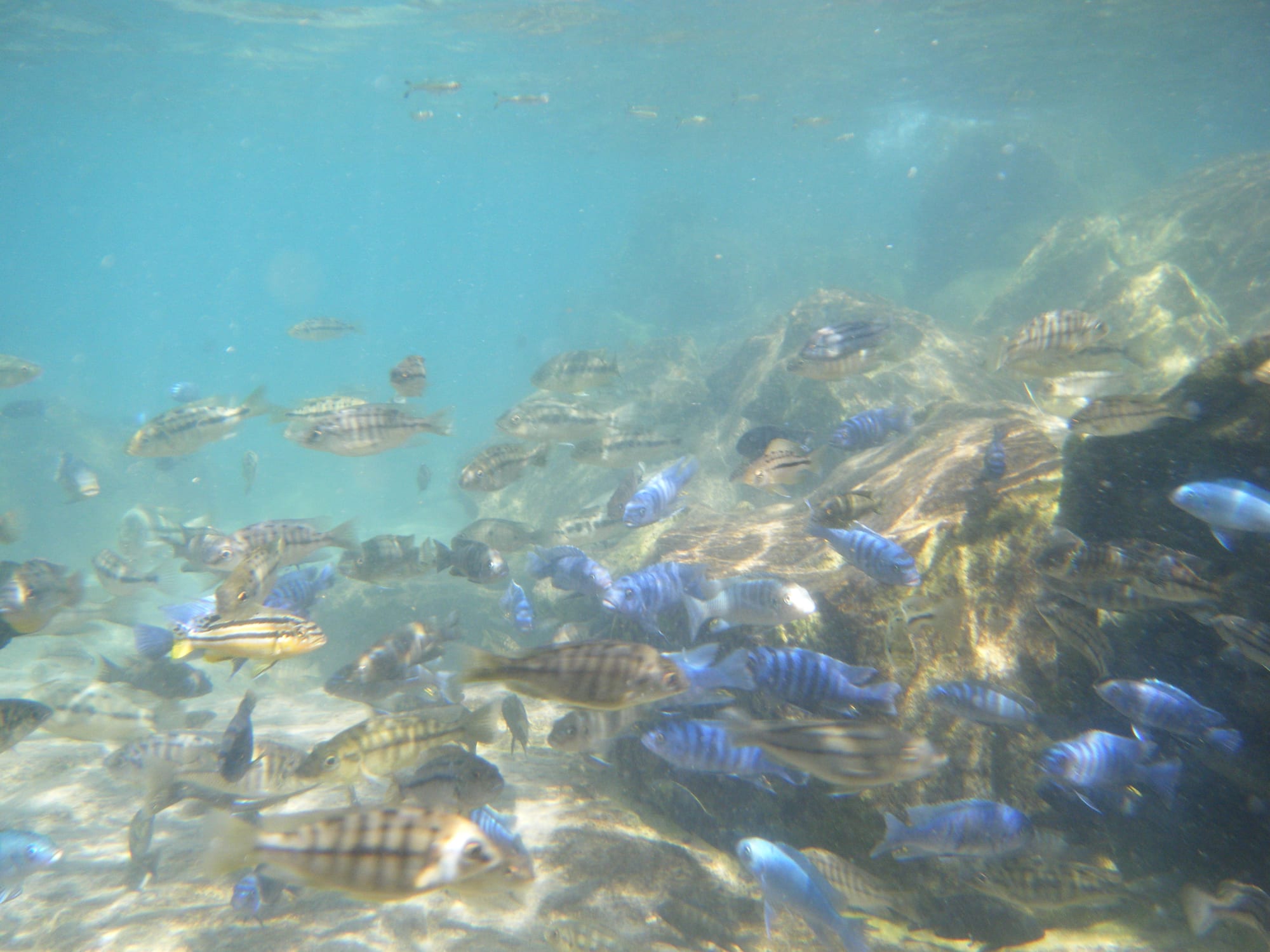
The short answer
Lake Malawi, shared by Malawi, Mozambique and Tanzania, holds at least 700 species of one family of fish, the cichlids, and some scientists put the true figure as high as 1,000. Almost all of them live nowhere else. They are the descendants of a single ancestral species that reached the lake a few million years ago and then split again and again, a process biologists call adaptive radiation: one ancestor diversifying to fill many different ways of life.
Several things made the splitting unusually fast. The lake's water level has risen and fallen by hundreds of metres, repeatedly cutting populations off from one another. Many cichlids live only on small, isolated rocky outcrops. An extra set of jaws lets them specialise in almost any food, and colour, which females use to choose their mates, is one of the main ways the species differ.
One ancestor, hundreds of descendants
The vast majority of the fish in Lake Malawi are cichlids, a family of often brightly coloured fish that is most diverse in Africa and South America. Apart from a handful of tilapia and a few widespread species, the lake's cichlids form what scientists call a species flock: all are descended from one original colonist, itself descended from ancestors in Lake Tanganyika, 350 kilometres to the north-west. That colonist is thought to have arrived 3.4 million years ago at the earliest, which is very recent by the standards of evolution. Some species in the lake seem to have separated only a few hundred years ago.
No other lake comes close. Lake Victoria, the runner-up, has more than 500 species of cichlid, almost all found only there, and Lake Tanganyika at least
- Together the three great lakes of the East African Rift hold about 2,000
cichlid species, the richest example of adaptive radiation among living vertebrates.
A large part of the explanation is opportunity. In the great rift lakes, jobs that elsewhere belong to whole families of fish, from grazing algae to hunting other fish, were open to cichlids, and they filled nearly all of them.
A lake that kept emptying and filling
Lake Malawi lies in the East African Rift, a valley opening where the African plate is slowly splitting in two. The basin began to form about 8.6 million years ago, and deep water first appeared around 4.5 million years ago. Today the lake is 560 to 580 kilometres long and 706 metres deep at its deepest point, although below about 250 metres the water holds no oxygen, so fish live only in the upper layers.
Its level has never been steady. Over its history the surface has stood anywhere from almost 600 metres below today's level to 10 to 20 metres above it, and at times the lake nearly dried out, leaving only one or two small, salty pools in its deepest parts. Sediment cores covering the last 1.3 million years record at least 24 drops of 200 metres and 14 of 400 metres. As recently as 1390 to 1860 AD, the water may have stood 120 to 150 metres lower than now.
Each fall split the lake, or its shoreline habitats, into separate pieces, and each rise flooded new rocky shores for fish to colonise. Populations that were isolated long enough went their own way, which biologists believe helped species multiply.
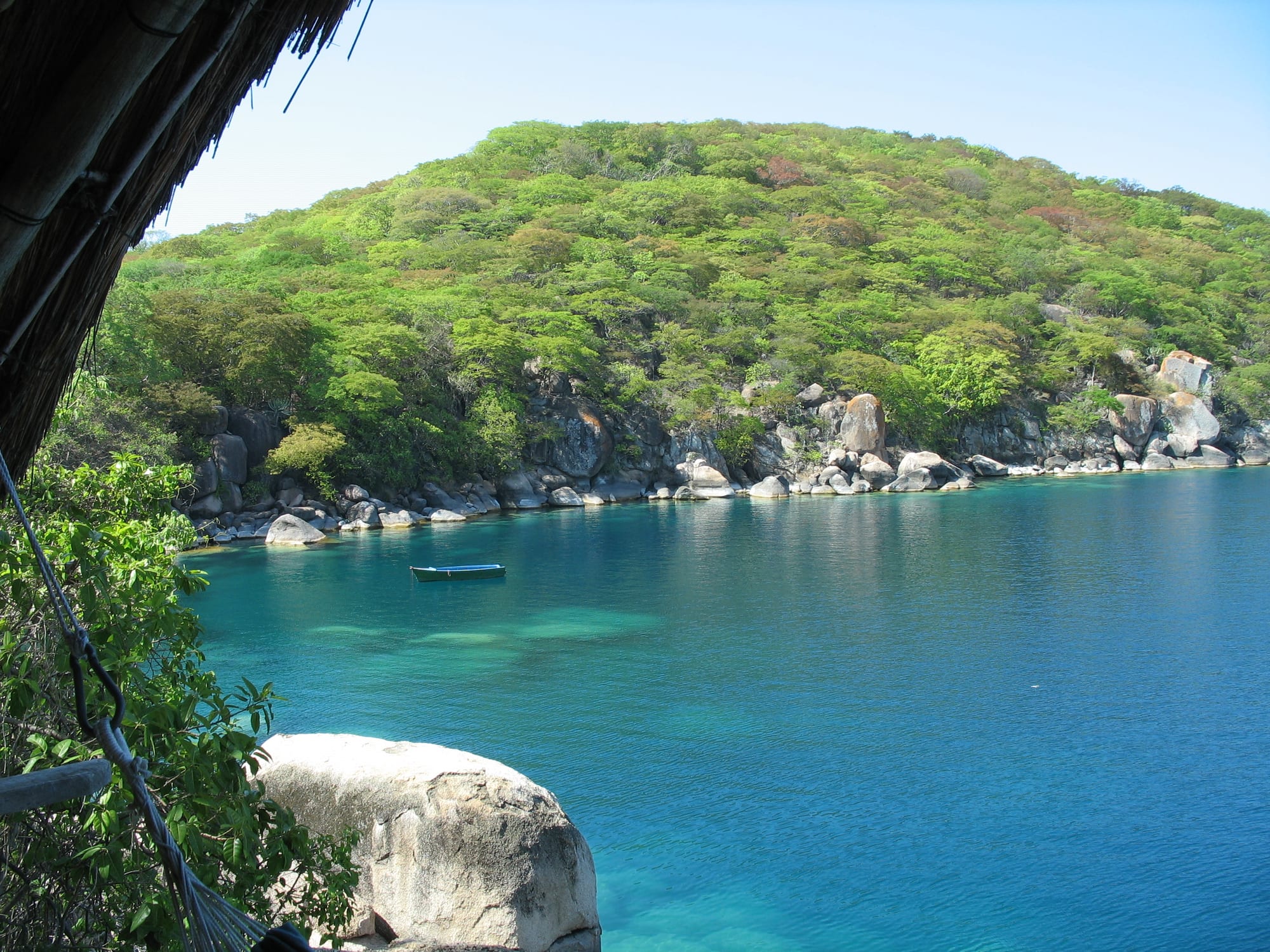
The lake's clear water helps the fish see one another: visibility can reach 20 metres, although under half that is more usual. The water is also warm, with the surface typically between 24 and 29 °C, and slightly alkaline.
Rocks that work like islands
The most famous of the lake's cichlids are the mbuna, a word meaning "rockfish" in the Tonga language of Malawi. They live among boulder piles and rocky shores, are mostly less than 13 centimetres long, and defend fierce little territories. Rocky outcrops along the shore are separated by sand and open water, so each works rather like an island. When rising water created new rocky habitats, fish colonised them, and the many isolated outcrops allowed new mbuna species to form. The result is a lake full of tiny ranges: some species live in a single bay, around one rocky islet, or along a few hundred metres of shore. The other main group, known as haps, includes large hunters and open-water fish that feed in schools on plankton.
Two sets of jaws and a taste for colour
Cichlids carry a second set of jaws in their throats, called pharyngeal jaws, formed from bones fused into one tooth-bearing plate and worked by their own muscles. The front jaws grab food and the throat jaws process it. That division of labour lets different species scrape algae, crush snails, sift plankton, catch insects or eat other fish, and it is thought to be one of the main reasons the family is so diverse. Members of a single species can even develop different jaw shapes on different diets, and if they then breed mostly with fish that feed the same way, the difference can grow into a new species.
Colour does the rest. Female cichlids prefer vivid, dominant males, and in many Malawi species adult males are far more brightly coloured than females. Colour is one of the most important differences between cichlid species. All members of the Malawi species flock are also mouthbrooders: the female carries her eggs, and often her young, in her mouth.
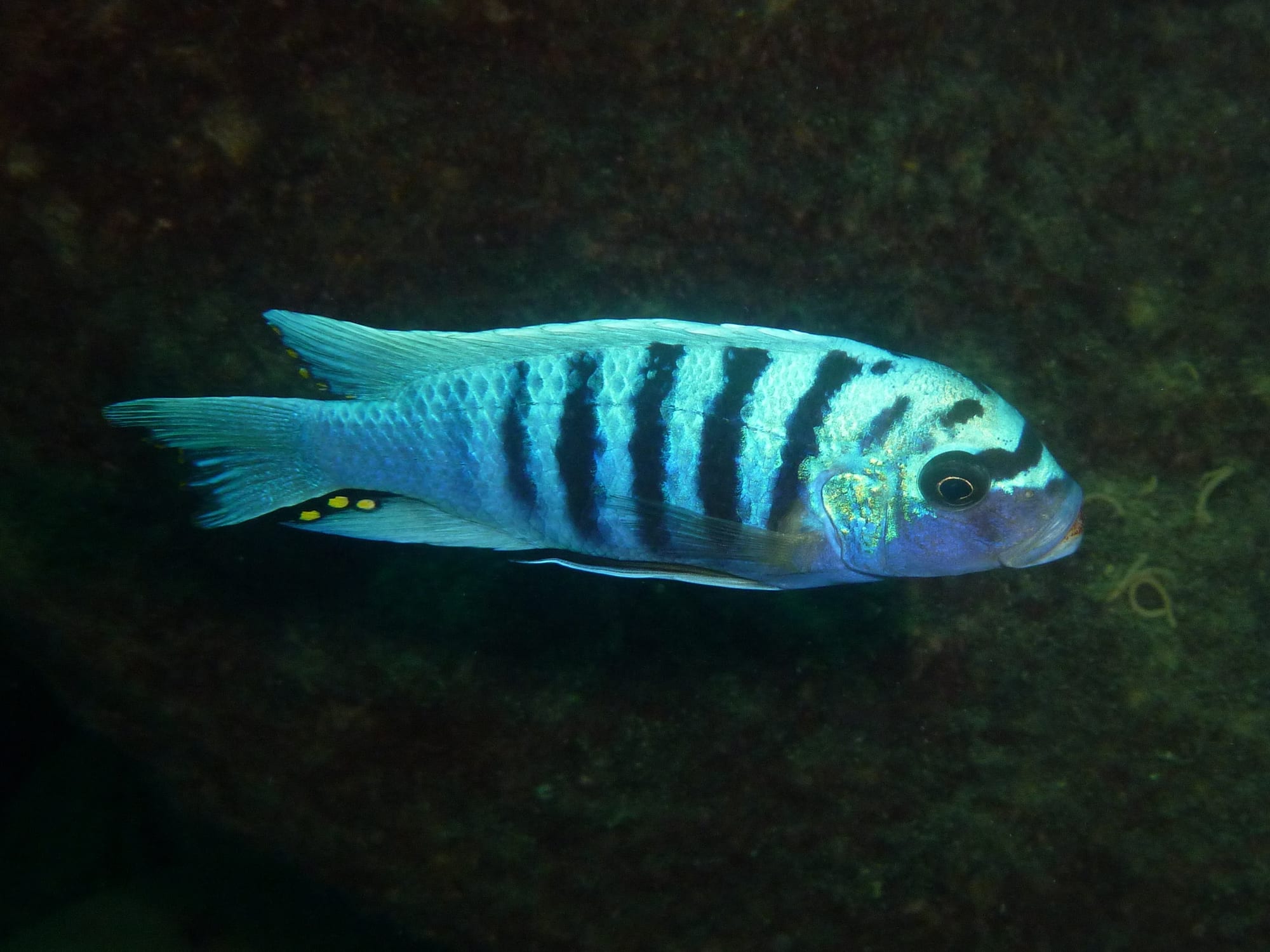
The yellow dots on the fin near the tail are egg spots, found on most adult males of this group. As a female gathers her eggs into her mouth, the male displays the spots; she reaches for them as if they were more eggs, and the eggs in her mouth are fertilised.
Seeing the cichlids today
The best place to see them is Lake Malawi National Park, at the southern end of the lake around Cape Maclear. Created to protect fish and their habitat, it was inscribed as a UNESCO World Heritage Site in 1984, with more than 350 cichlid species recorded within it, almost all endemic. The radiation has been compared with that of the finches Charles Darwin studied on the Galápagos Islands. The park covers about 95 square kilometres of land and water, including most of the Nankumbu Peninsula and thirteen islands, and its waters extend only 100 metres from the shore.
The variety is fragile. In Lake Victoria, at least 200 cichlid species, about 40 per cent of its haplochromines, are thought to have died out after the introduced Nile perch, pollution and other changes took hold. Lake Malawi has not suffered that kind of collapse, but the IUCN lists 117 of its cichlids as threatened, partly because so many have tiny ranges, and overfishing has already cut some of the chambo, the lake's most important food fish, by about 94 per cent.