Culture & Customs · Canada
Why does Quebec speak French?
France settled the St Lawrence valley first, and its settlers' descendants held on to their language through British rule, then made it the law.
By Globeway Editorial · 13 October 2026
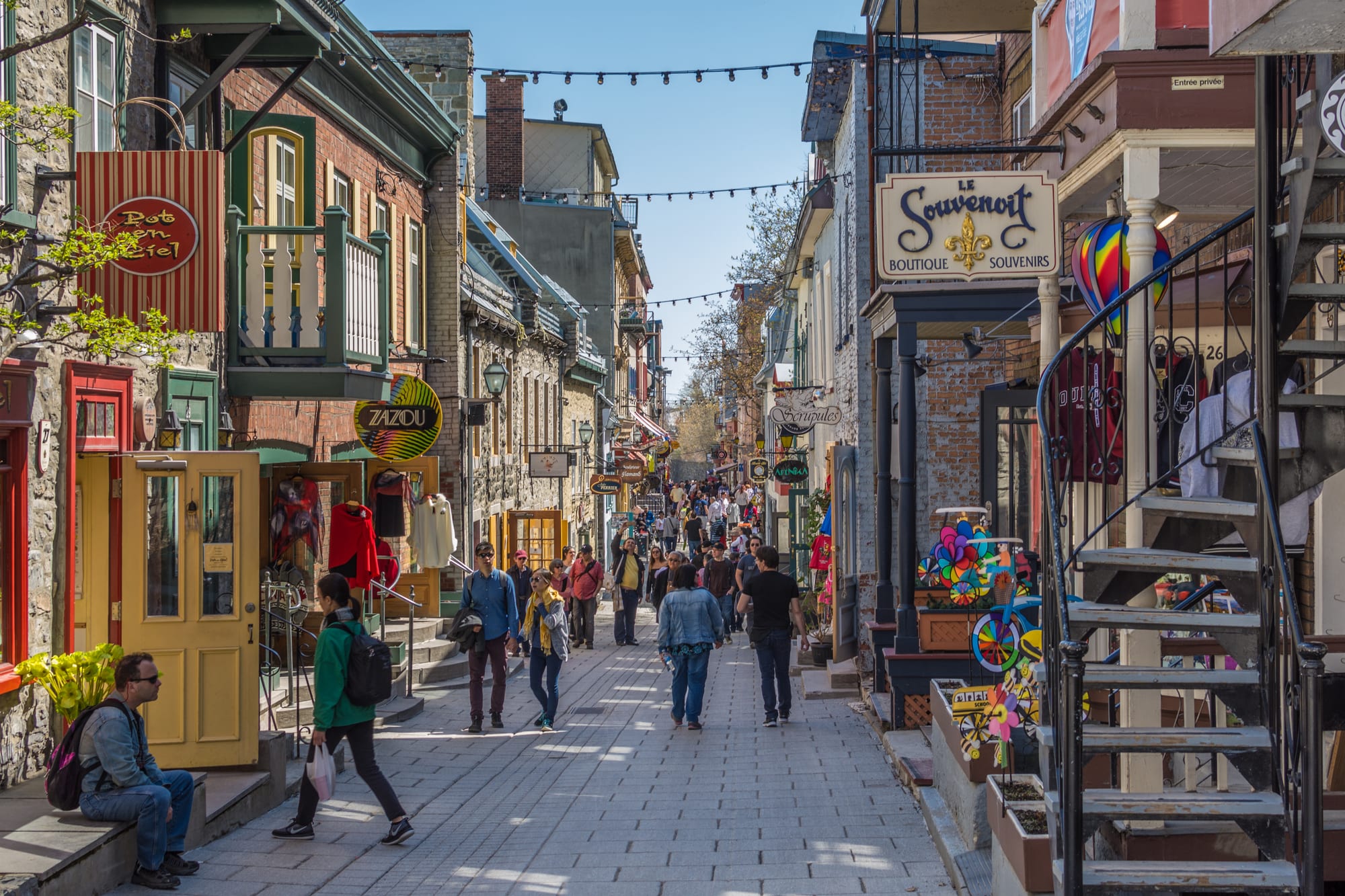
The short answer
Quebec speaks French because France got there first. From 1534 until 1763, the valley of the St Lawrence River was the French colony of Canada, the most developed part of New France, and its settlers spoke French. When Britain conquered the colony in the Seven Years' War, it took over some 60,000 to 70,000 French-speaking Catholics who had no intention of leaving, and who kept their language, their church and, after 1774, their civil law.
For the next two centuries English held the power and the money, and British officials openly hoped the French would fade away. They did not. A high birth rate, a church that ran schools and parishes in French, and a fierce sense of survival kept the language alive, and from the 1960s Quebec's own government turned it into the law of the land. Today French is the mother tongue of more than three-quarters of Quebecers, and about 94 per cent can speak it.
A French colony on the St Lawrence
In 1534 the explorer Jacques Cartier planted a cross on the Gaspé Peninsula and claimed the land for King Francis I. Lasting settlement came later: on 3 July 1608 Samuel de Champlain founded Quebec, taking the name from an Algonquin word, at a point where the river narrows. Montreal followed in 1642.
Growth was slow. To fix a shortage of women, the French crown sent around 800 unmarried women, the Filles du Roi or King's Daughters, to the colony. By 1754 New France held about 55,000 Canadiens, the French settlers of the St Lawrence, alongside 10,000 Acadians on the Atlantic coast and a few thousand in Louisiana. The French they spoke came from the 17th- and 18th-century speech of France, chiefly the common language of Paris, coloured by regional dialects such as Norman, Poitevin, Saintongeais and Picard.
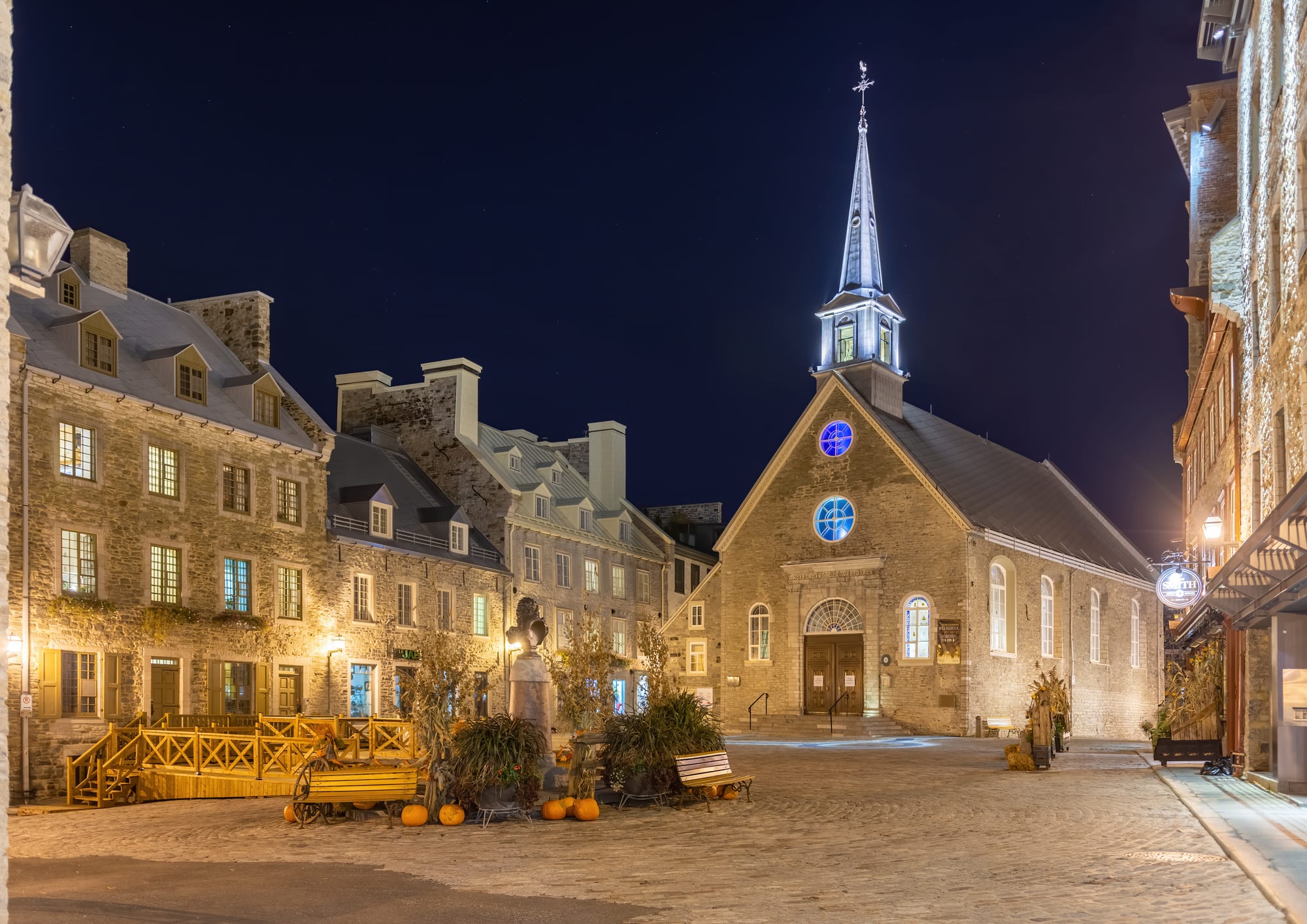
This square is where French North America began: Champlain's fortified dwelling stood here in 1608.
Conquered, but not converted
During the Seven Years' War a British army took Quebec City in September 1759, after the battle on the open ground outside its walls known as the Plains of Abraham. Montreal fell the next year, and the Treaty of Paris, signed on 10 February 1763, handed the colony to Great Britain.
At first Britain tried to impose its own rules. Anyone holding public office had to swear an oath rejecting the Catholic faith, which shut most Canadiens out of government. But the governors, James Murray and then Guy Carleton, soon found that a handful of British officials could not rule a whole French-speaking population against its will. With unrest growing in the Thirteen Colonies to the south, London worried that the Canadiens might join the rebellion. The Quebec Act of 1774 was the result: it guaranteed the free practice of Catholicism, let the Church collect its tithes again and restored French civil law for private matters. The French-speaking majority, around 90,000 people by then, kept the institutions that held their society together.

The battle fought on this high ground in 1759 decided that Quebec would pass to Britain.
The plan to make them English
The tolerance had limits. In 1791 Britain split the province into Upper Canada, settled largely by English-speaking Loyalists who had left the new United States, and Lower Canada, the French-speaking core. After the rebellions of 1837–38, Lord Durham was sent to investigate. His report concluded that the real problem was the conflict between the French and the English, and that the answer was the assimilation of the French.
The Act of Union of 1840 merged the two Canadas, in the hope that the French presence would gradually disappear. It did not, partly because of what French Canadians later called la revanche des berceaux, the revenge of the cradles. With almost no immigration from France, the only way to keep their share of the population was to have more children than the English, and for generations they did. The Catholic Church, which ran education and much of social life in French, reinforced the effect. The idea of la survivance, survival as a people against an English-speaking continent, became a central part of French-Canadian identity.
The pressure was real. Rural Quebec could not support all those children, and about 900,000 Quebecers, most of them French-speaking, left for the factory towns of New England between 1840 and 1930.
- 1534
Jacques Cartier claims the Gaspé Peninsula for France.
- 1608
Samuel de Champlain founds Quebec.
- 1759
British victory on the Plains of Abraham.
- 1763
Treaty of Paris hands New France's Canada to Britain.
- 1774
Quebec Act protects Catholicism and French civil law.
- 1840
Act of Union merges the Canadas, aiming at assimilation.
- 1960
The Quiet Revolution begins.
- 1977
Charter of the French Language (Bill 101) becomes law.
From survival to law
Until 1960 French was the language of the home, the parish and the farm, while English was often the language of business and advancement. The Quiet Revolution changed that. Jean Lesage's Liberals won power in 1960 with the slogan Maîtres chez nous, "masters of our own house". The provincial government took over health and education from the Church and nationalised electricity under Hydro-Québec. French Canadians in the province began to call themselves Québécois.
Language laws followed. A law of 1969, Bill 63, fell short of what many francophones expected. In 1974 Robert Bourassa's government made French the official language of Quebec for the first time. Then, on 26 August 1977, René Lévesque's Parti Québécois government passed the Charter of the French Language, known as Bill 101, drafted by Camille Laurin. It set out to make French "the normal and everyday language of work, instruction, communication, commerce and business". Commercial signs must be in French, and if another language appears, French must be markedly predominant. Children go to French-language schools unless a parent was mainly educated in English in Canada, which steers the children of immigrants into French. The law was strengthened again in 2022 by Bill 96.
The changes were divisive. Many English speakers moved out of Quebec in the 1970s, and several English schools in Montreal closed. The language question also fed the movement for independence: in the 1995 referendum, Quebecers chose to stay in Canada by 50.6 per cent to 49.4.
A French all its own
Quebec French is not a copy of the French of France. Its closest ancestor is the speech of 17th- and 18th-century Paris, and it developed separately for more than two centuries after 1763. It has its own swear words, the sacres, and Quebecers tend to avoid English loanwords in formal speech more carefully than people in France. Most stop signs in Quebec say arrêt, while in France they say stop.
French is spoken across Canada, the mother tongue of about 7.8 million people in 2021, and it is one of the country's two official languages under the federal Official Languages Act of 1969. But Quebec, with more than 8.5 million people at the 2021 census, is the only province where French is the majority language and the sole official one.