Attractions & Natural Wonders · Russia
Why does St Petersburg have white nights?
At almost 60 degrees north, the midsummer Sun dips only just below the horizon, so St Petersburg's June nights never get fully dark.
By Globeway Editorial · 13 October 2026
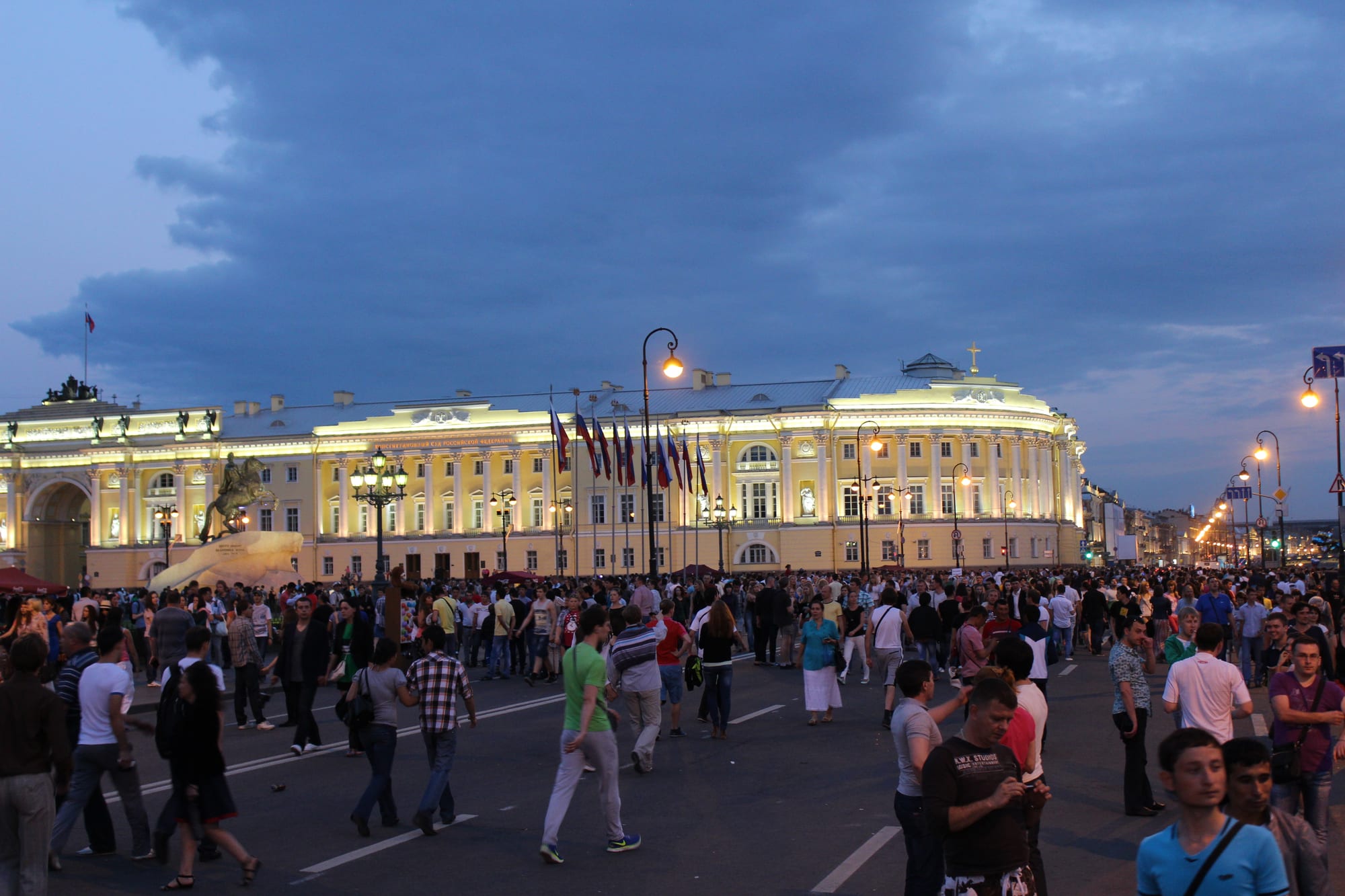
The short answer
St Petersburg lies at almost 60 degrees north, the northernmost city in the world with more than a million people. Because the Earth's axis is tilted, the northern hemisphere leans towards the Sun in June, and at this latitude the Sun sets for only a few hours and never sinks far below the horizon. Around the summer solstice it dips only 6°38′ below the horizon at the darkest moment of the night. Light from the Sun just below the horizon keeps the sky glowing, so the city passes from dusk to dawn without ever reaching true darkness.
These are the white nights. They are not the midnight sun of the far north, where the Sun never sets at all: in St Petersburg it does set, but the night is a long twilight. The official season runs from 11 June to 2 July, although the nights are noticeably light from late May to mid-July.
A tilted planet and a northern city
The Earth spins on an axis tilted at about 23.44 degrees to its path around the Sun. That tilt causes the seasons. In June the North Pole leans towards the Sun, so the further north a place lies, the longer its summer days. North of the Arctic Circle the Sun stays above the horizon at midnight. Because the atmosphere bends sunlight over the horizon, a phenomenon called refraction, the midnight sun can be seen from about 65°44′ north.
St Petersburg is roughly six degrees further south. Its centre stands at 59°56′ north, and the city was founded there by Peter the Great on 27 May 1703, on the delta of the Neva river where it meets the Gulf of Finland. Over the year its days range from 5 hours 53 minutes in December to 18 hours 50 minutes in June. The brightest night falls on 21 to 22 June, when the Sun is below the horizon for only 5 hours 12 minutes.
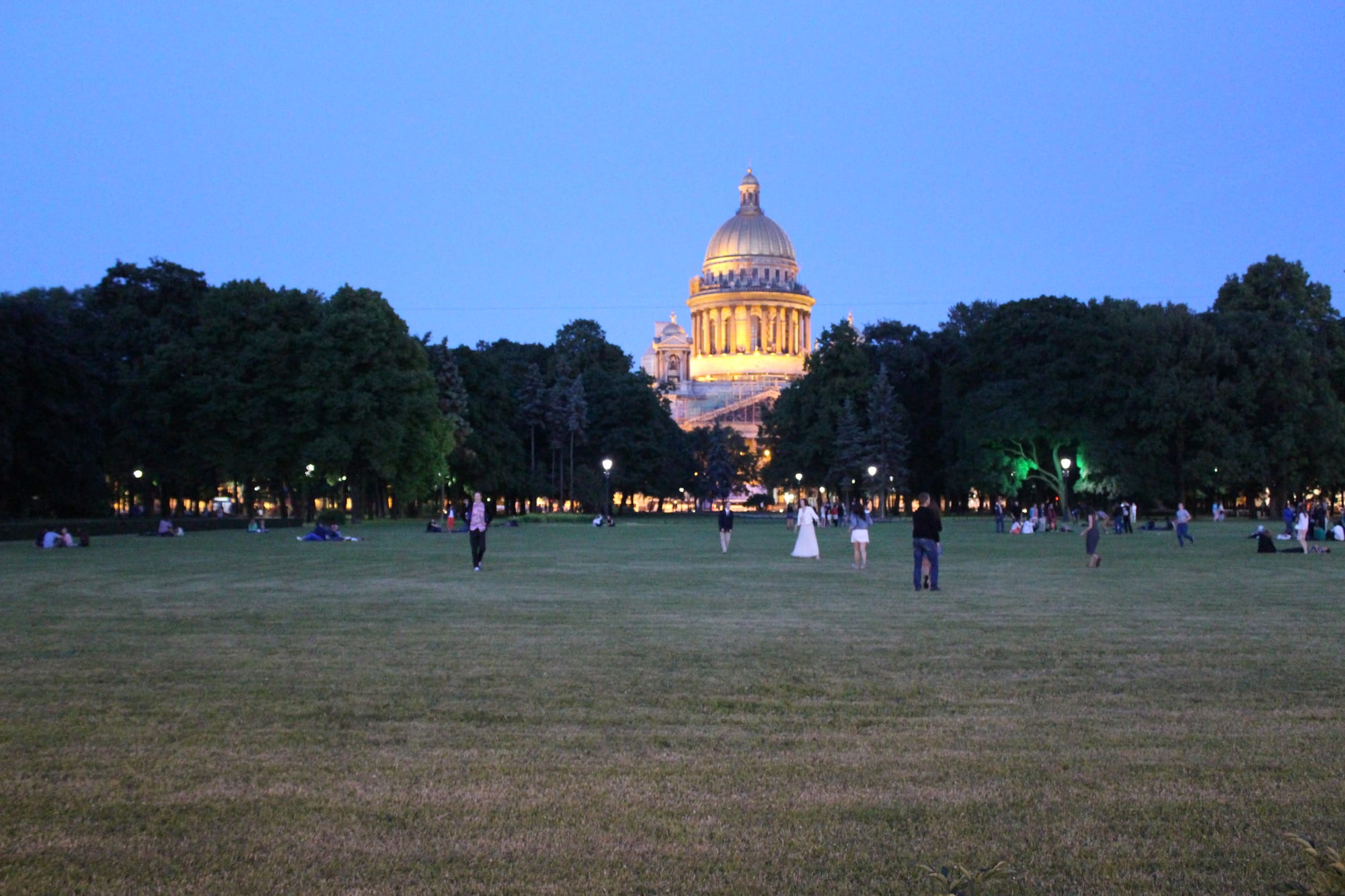
The street lamps are on, but the sky above the city is still blue. With some 5.6 million residents in 2021, St Petersburg is the fourth-most populous city in Europe.
Measuring the light: civil, nautical and astronomical twilight
Astronomers divide twilight into three stages, by how far the centre of the Sun lies below the horizon. During civil twilight, down to 6 degrees, there is enough natural light to see clearly outdoors without lamps. During nautical twilight, between 6 and 12 degrees, the eye can still make out the outlines of buildings and trees. Astronomical twilight runs from 12 to 18 degrees, and only below 18 degrees is the sky truly dark.
For a whole night to be civil twilight, a place must lie north of about 60°34′, six degrees south of the Arctic Circle. St Petersburg just misses it. At midsummer its civil twilight gives way to nautical twilight for 1 hour 44 minutes, and at true midnight the Sun reaches 6°38′ below the horizon. That is why the city's "official" white nights, from 11 June to 2 July, are defined as the nights when the Sun sinks no more than 7 degrees. Over a longer season, from mid-May to the end of July, the sky never gets darker than nautical twilight.
There is no single scientific definition of a white night, so the dates depend on how much darkness counts. On a clear night at the height of the season, it is light enough outdoors to read without a lamp.
Not unique, but uniquely celebrated
Many places see white nights. All of Finland and Iceland do, most of Sweden and Norway, northern Estonia, Scotland's Orkney and Shetland islands, and almost all of Alaska. In Russia they reach cities such as Arkhangelsk and Petrozavodsk. Even the far north of the United Kingdom sees twilight in the northern sky all night around the solstice.
What sets St Petersburg apart is that a great imperial capital grew up at this latitude. The city was the capital of Russia from 1712 to 1918, apart from a short break, and its writers made the light part of its identity. Alexander Pushkin wrote about the white nights more than once. In 1848 Fyodor Dostoevsky published a short story called "White Nights", told by a lonely young man who wanders the city and meets a young woman, Nastenka, crying by a railing. One of the city's nicknames is "the City of the White Nights".
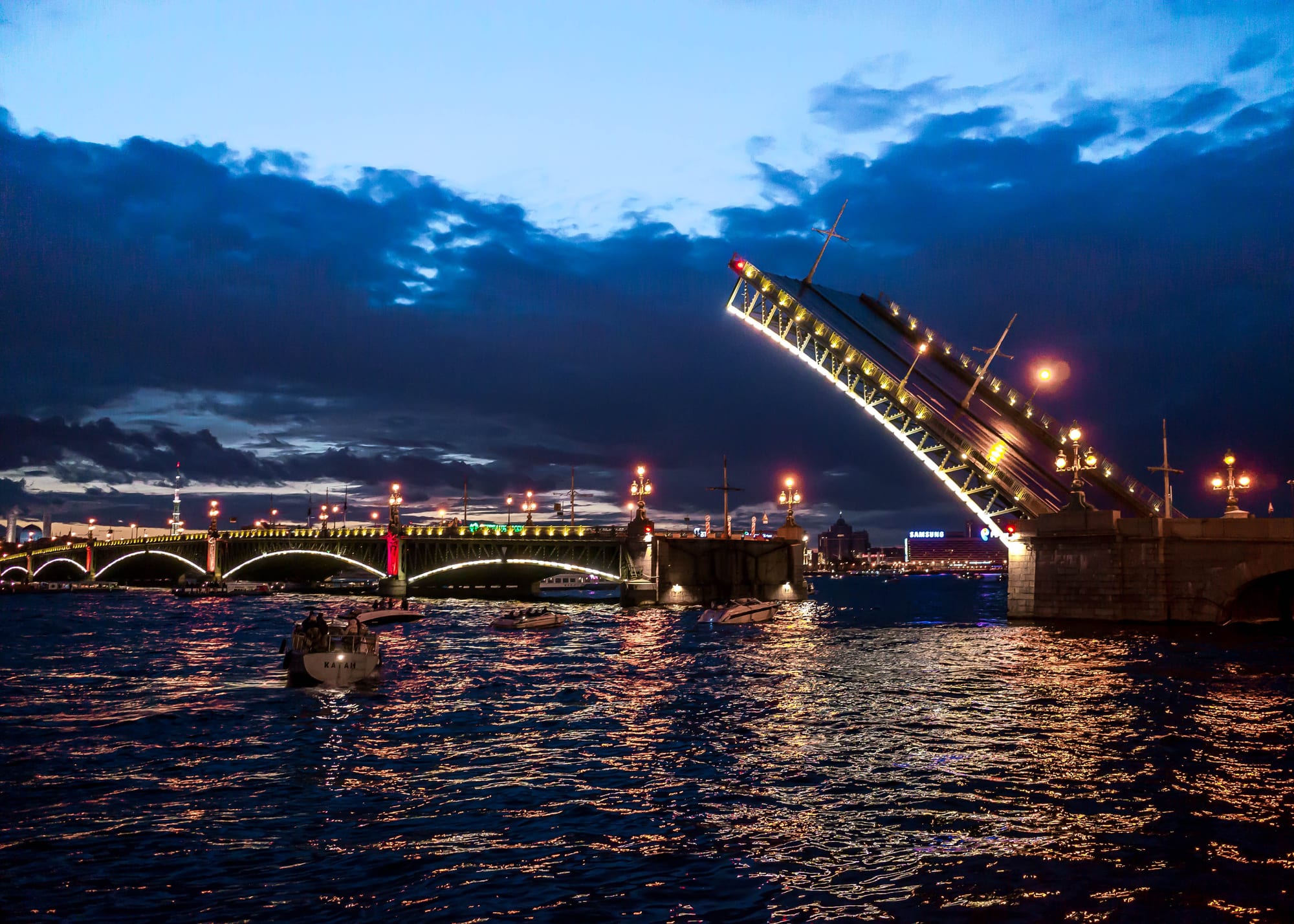
From April to November, 22 bridges across the Neva and the main canals are raised on a schedule at night to let ships pass between the Baltic Sea and the river. The first high bridge across the Neva that never needs to be drawn, the Big Obukhovsky Bridge, opened only in 2004.
Festivals in the twilight
The season is now the city's main festival time. The White Nights Festival fills the last ten days of June with concerts, carnivals and performances. Its classical heart is "Stars of the White Nights", a series of ballet, opera and orchestral performances at the Mariinsky Theatre, held every year since 1993 and directed by Valery Gergiev. The White Nights Marathon is also run through the city's streets every year.
The biggest event is Scarlet Sails. It began in 1968, when several Leningrad schools joined together to celebrate the end of the school year, inspired by Alexander Grin's 1923 romantic novel of the same name. At its climax, after races and a mock pirate battle on the Neva, a tall ship with scarlet sails appears on the river to fireworks. In 2010 the crowd reached 3 million.
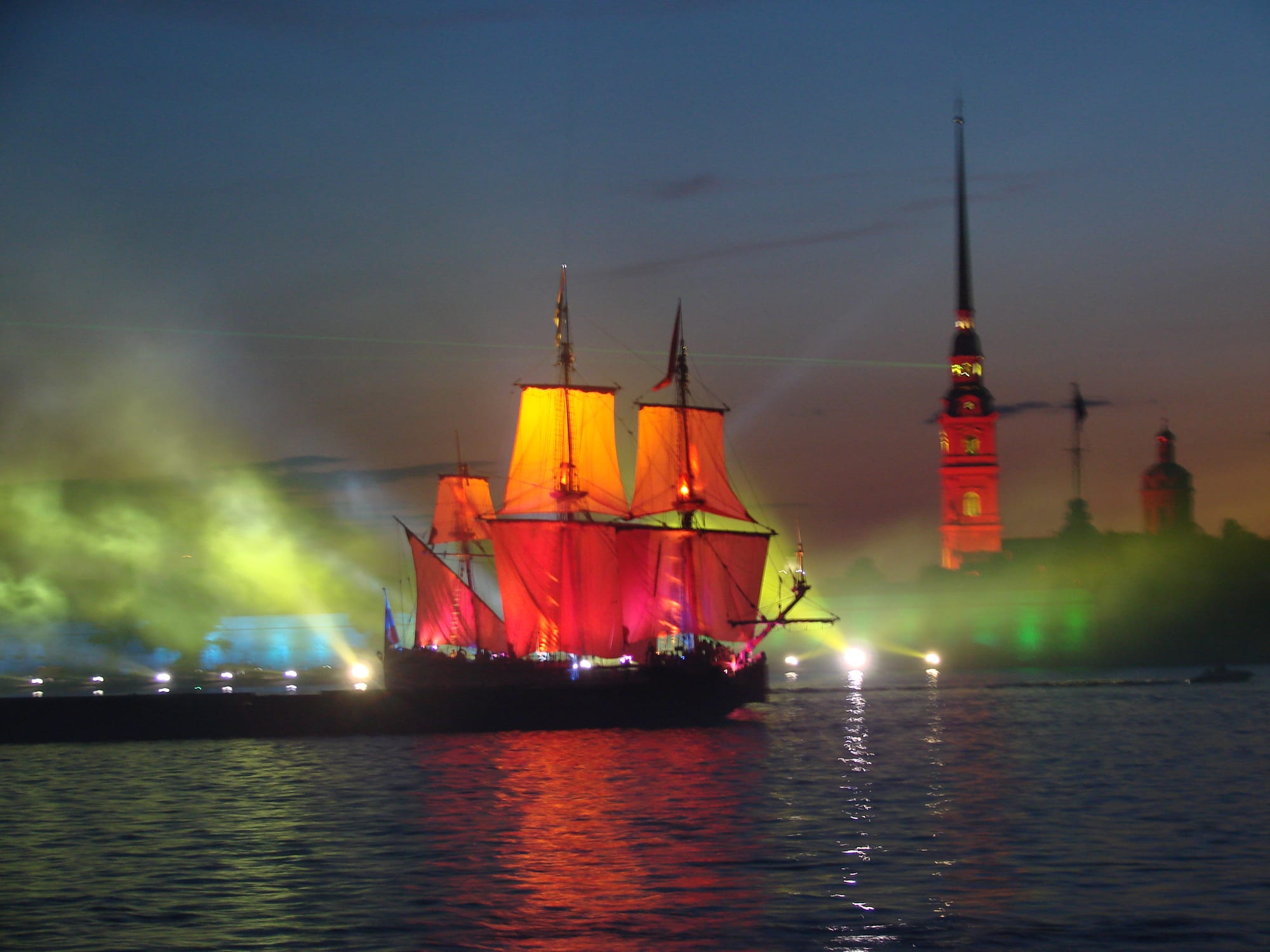
The ship in this photograph is the Shtandart, a replica of the first ship of Peter the Great's Baltic fleet, whose keel was laid in 1703, the year the city was founded.
The white nights are at their fullest in the second half of June, and the city's summer is short: the average high in July is about 23°C, and the Neva usually freezes in November or December. Half a year later the same latitude brings the opposite, with days of less than six hours in the depths of winter.