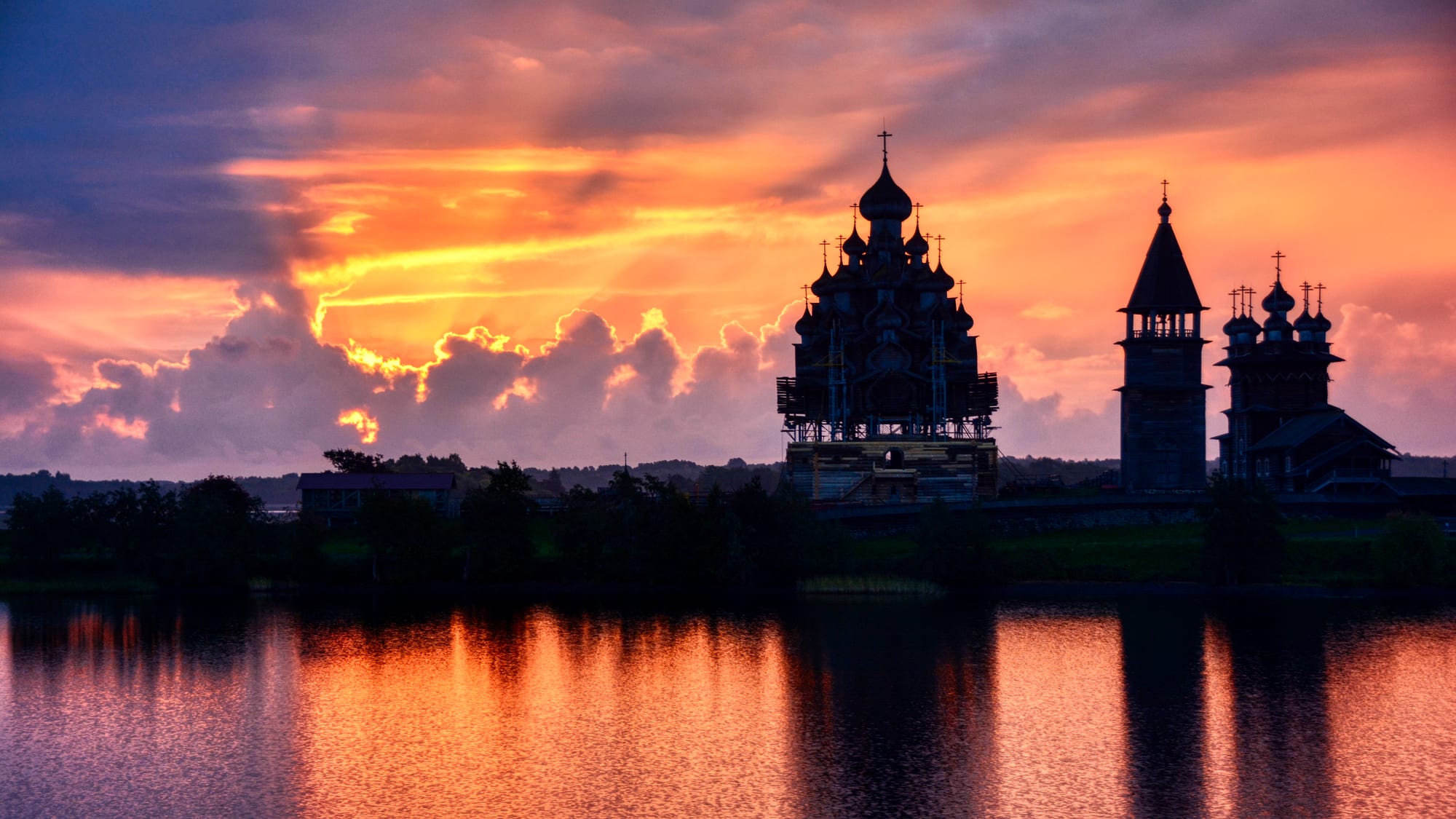
The many-domed wooden churches and bell tower of Kizhi silhouetted against an orange sunset sky above still lake water

Russia

St Petersburg & the Northwest

The wooden churches of the Kizhi Pogost at sunrise on Lake Onega, in the Republic of Karelia. (WCThornton / Wikimedia Commons · CC BY-SA 4.0)

Russia's north-western quarter, from St Petersburg and the medieval cities of Novgorod and Pskov to the lakes and forests of Karelia, the White Sea coast of Arkhangelsk and the Arctic port of Murmansk — a region of imperial palaces, wooden churches, monasteries and tundra. This page is written to explain the region, not to encourage travel.

Explore St Petersburg & the Northwest

History

The Northwest is where Rus' began. Norse traders and Slavic and Finnic peoples met along the rivers between the Baltic and the Volga, and the chronicles place Rurik's arrival at Staraya Ladoga and Novgorod in the 9th century. Novgorod grew into a republic of merchants governed by an assembly, the veche, trading furs and wax with the Hanseatic League and ruling a territory that reached the White Sea and the Urals; its birch-bark letters show a literate townspeople. Pskov became a republic of its own, and Novgorod's Prince Alexander Nevsky defeated the Swedes on the Neva in 1240 and the Teutonic Knights on the ice of Lake Peipus in 1242. Moscow annexed Novgorod in 1478 and Pskov in 1510.

The White Sea coast was settled by Pomors, and Arkhangelsk, founded in 1584, was Russia's main sea port until Peter the Great won the Baltic from Sweden. He founded St Petersburg on the Neva in 1703, made it the capital, and it stayed so until 1918. The city was the stage for the Decembrist revolt of 1825 and the revolutions of 1905 and 1917.

The Soviet era brought terror to the north: the Solovetsky camp, the forced-labour White Sea–Baltic Canal and the coal camps of Vorkuta. Finland's Winter War of 1939–40 moved the border to take in Vyborg. The siege of Leningrad from 1941 to 1944 lasted nearly 900 days and killed hundreds of thousands of civilians, mostly through starvation. Murmansk received the Allied Arctic convoys, and in the Cold War the Kola Peninsula became the base of the Northern Fleet.

Culture & Customs

St Petersburg thinks of itself as Russia's European and intellectual capital, the city of Pushkin, Dostoevsky, Akhmatova and Shostakovich, of the Mariinsky ballet and the Russian Museum. Its people are said to be more reserved and formal than Muscovites, and the city has its own vocabulary — a kerb is a porebrik, a doughnut a pyshka — that Russians love to argue about. The memory of the siege is kept with great seriousness, and 27 January, the day it was lifted, is marked every year.

The provinces are older in feeling. Novgorod and Pskov preserve the icon painting and white-walled church architecture of the medieval republics, and Pushkin's family estate at Mikhailovskoye draws literary pilgrims. Karelia is the homeland of the Karelians, whose songs were among those collected into the Kalevala, and of the Finnic Vepsians, and Komi and the Nenets okrug have their own languages; Nenets reindeer herders still migrate across the tundra.

The White Sea Pomors developed a seafaring culture of wooden churches, fishing and Old Believer piety, and the north as a whole is the stronghold of Russian wooden architecture. Vologda lace, Kholmogory bone carving and painted Mezen wooden ware are the region's best-known crafts, and Veliky Ustyug in Vologda Oblast presents itself as the home of Ded Moroz, the Russian Father Frost.

Daily Life

St Petersburg has about 5.6 million people, making it Russia's second city and one of the largest in Europe, with a port, shipyards, car plants, universities, tourism and a large IT sector; Gazprom moved its headquarters there. The surrounding Leningrad Oblast has fast-growing suburbs and the Baltic ports of Ust-Luga and Primorsk. Elsewhere the cities are much smaller: Arkhangelsk, Murmansk, Petrozavodsk, Cherepovets and Vologda each have around 250,000–350,000 people, and Veliky Novgorod and Pskov about 200,000.

The economy of the north rests on resources — timber, pulp and paper in Karelia and Arkhangelsk, steel at Cherepovets, nickel and apatite mining on the Kola Peninsula, oil and gas in Komi and the Nenets okrug, and fishing from Murmansk. Distances are long and many northern towns have lost population since the Soviet era, when Arctic wages drew workers north.

In St Petersburg the day is shaped by the seasons: dark, wet winters spent indoors and summers when the city stays out through the white nights, walking the embankments until the bridges rise. Across the north, summer weekends are for dachas, fishing and berry and mushroom picking in the forests.

Food

The Northwest eats from its lakes, rivers and forests. St Petersburg's springtime obsession is koryushka, a small smelt with a smell of fresh cucumber, fried and celebrated with its own festival; the city's other institution is the pyshka, a doughnut dusted with sugar. Lakes such as Beloye in Vologda Oblast yield snetok, a tiny smelt sold dried.

Karelia's signature is the kalitka, an open pastry filled with grain porridge or mashed potato and brushed with butter, alongside fish soups made with cream, lake whitefish and salmon. The Pomors of the White Sea bake fish pies and salt cod and herring, and Arkhangelsk's kozuli are decorated gingerbread figures traditionally baked for Christmas. In the far north reindeer meat and venison are everyday food.

Vologda butter, with its nutty flavour, is famous across Russia. Summer and autumn bring cloudberries, lingonberries, cranberries and blueberries from the bogs and forests, made into jams, mors fruit drinks and liqueurs, and wild mushrooms salted and pickled for winter.

Attractions & Natural Wonders

St Petersburg holds the Hermitage in the Winter Palace, the Russian Museum, the Peter and Paul Fortress, St Isaac's Cathedral, the Church of the Saviour on Spilled Blood, Nevsky Prospekt and the canals. Outside the city are the imperial palaces: Peterhof with its Grand Cascade, the Catherine Palace and Amber Room at Tsarskoye Selo, Pavlovsk and Gatchina, as well as the naval town of Kronstadt and Vyborg's Swedish castle.

To the south, Veliky Novgorod has its kremlin, St Sophia Cathedral and the churches of Yaroslav's Court, and Staraya Ladoga its early fortress. Pskov is dominated by the Krom and Trinity Cathedral, with the Pskov-Caves Monastery at Pechory and Pushkin's Mikhailovskoye nearby.

Karelia is a land of lakes and forest. Kizhi island on Lake Onega has the Church of the Transfiguration and an open-air museum of wooden buildings, Valaam's monastery stands on Lake Ladoga, and there are the Kivach waterfall and the flooded Ruskeala marble quarry. In Vologda Oblast the Kirillo-Belozersky and Ferapontov monasteries, the latter with Dionisius's frescoes, sit among lakes.

The Solovetsky Islands in the White Sea combine the monastery's boulder walls with the memory of the camp, and Arkhangelsk has the wooden open-air museum at Malye Korely. Murmansk offers the nuclear icebreaker Lenin as a museum, the Barents Sea coast at Teriberka, the Khibiny mountains and the northern lights. Komi's Virgin Komi Forests reach the Urals, where the weathered rock pillars of Manpupuner rise from the plateau.

Cities in St Petersburg & the Northwest

Planning basics

Budget

St Petersburg is Russia's second most expensive city, somewhat cheaper than Moscow but with high hotel prices during the White Nights. Novgorod, Pskov, Petrozavodsk and Vologda cost much less. The remote north is expensive to reach: flights to Murmansk, Arkhangelsk or Naryan-Mar and boats to Solovki and Kizhi add up. As everywhere in Russia, foreign cards do not work.

Daily Budget Midrange
USD 95–210 (mid-range hotel, restaurants, palace tickets, boat trips)
Daily Budget Shoestring
USD 35–70 (hostel, canteens and pyshki, metro and regional trains)

Book St Petersburg rooms early for June, and budget separately for the boats and flights to Kizhi, Solovki and the Arctic.

Safety

St Petersburg carries the same political and legal risks as the rest of Russia: arbitrary detention of foreigners, prosecutions for speech and protest, and very limited consular help. Ukrainian drones have struck airfields, ports and oil terminals in the Leningrad and Pskov oblasts. The Kola Peninsula is heavily militarised around the Northern Fleet, closed towns and border zones need permits, and photographing military sites can bring espionage charges.

Most governments advise against all travel to Russia; stay well away from military installations and border zones. Check current official travel advice before travelling.

Climate

St Petersburg and the south-west are damp and grey, with mild summers and cold winters moderated by the Baltic. Further north and east the climate turns subarctic: Karelia, Vologda and Arkhangelsk have long snowy winters, and Murmansk and the Nenets tundra lie above the Arctic Circle, with polar night in midwinter and midnight sun in early summer. Murmansk's port stays ice-free thanks to the North Atlantic Current.

Summer
mild, 17–23°C in St Petersburg; cooler along the White Sea and in the Arctic, with long or endless days
Winter
around −5 to −8°C in St Petersburg in January; far colder and darker in Karelia, Komi and the Arctic

Transportation

St Petersburg is linked to Moscow by the Sapsan in about four hours, and trains reach Veliky Novgorod, Pskov, Petrozavodsk and, far to the north, Murmansk. Kizhi is reached by summer hydrofoil across Lake Onega from Petrozavodsk, and the Solovetsky Islands by boat from Kem or Belomorsk or by plane from Arkhangelsk. The land border with Finland has been closed since 2023.

Allow for bridge openings when staying on St Petersburg's islands in summer, and check boat seasons for Kizhi and Solovki well ahead.

Best Time to Visit

June and July for the White Nights in St Petersburg, when the bridges open over the Neva at night and the fountains of Peterhof run; this is also the only season for the boats to Kizhi and Solovki. August and early September are quieter. Winter suits the northern lights around Murmansk and the Khibiny mountains, and St Petersburg's museums, but days are very short.