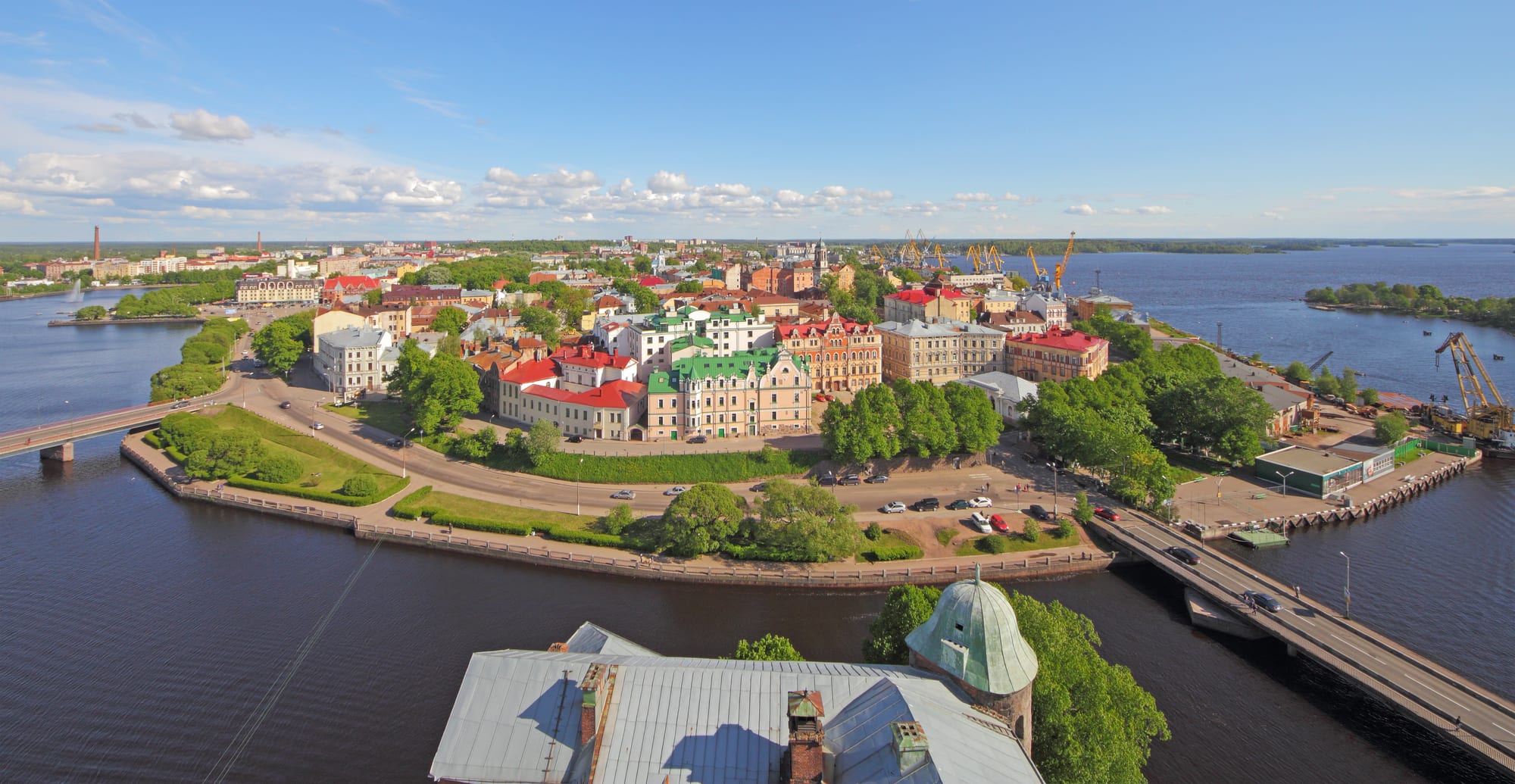
Aerial view over Vyborg's Old Town peninsula, with pastel buildings, green park strips, port cranes and the bay beyond

St Petersburg & the Northwest, Russia

Vyborg

Vyborg's Old Town and port seen from the Olaf Tower of Vyborg Castle. (A.Savin / Wikimedia Commons · CC BY-SA 3.0)

A Baltic town at the head of Vyborg Bay near the Finnish border, grown around a castle the Swedes built in 1293 — Finland's second city until the Second World War, then emptied of its Finnish population and resettled by Soviet citizens. Cobbled lanes, medieval towers, an Alvar Aalto library and the Monrepos landscape park remain. This page is written to explain the city, not to encourage travel.

Neighbourhoods

  • The Old Town
    • First-time visitors
    • Historic district

    The medieval town on a small peninsula between Vyborg Bay and the Salakkalahti inlet, the site of the former fortress. Old Town Hall Square, the Clock Tower, the Round Tower and the market lie within a short walk of the bridge to the castle, among streets of stone houses, many still in poor repair.

    Open in Maps
  • Tverdysh Island
    • Parks and walks
    • Quiet and residential

    The rocky island west of the Castle Bridge, reached across the water from the Old Town. It holds the 18th-century Anne fortifications, and the Monrepos landscape park spreads over its northern shore.

    Open in Maps
  • The station quarter and Lenin Prospekt
    • Close to public transport
    • Parks

    The newer centre that grew up in the Finnish years near the railway station and the Salakkalahti inlet, along the main street, Prospekt Lenina, and its park. The Alvar Aalto library stands in a park off Suvorovsky Prospekt nearby.

    Open in Maps

Things to do

The castle and the Old Town

  • Vyborg Castlelandmark

    The Swedish fortress founded in 1293 on an islet in the bay, extensively rebuilt in 1891–1894; its Olaf Tower can be climbed for views over the town and the bay.

    Open in Maps
  • Round Towerlandmark

    A round tower of 1547–1550 on Market Square, built under Gustav I as part of the medieval wall, originally an arsenal and later a prison; it was fitted out as a restaurant in 1938 and still serves as one.

    Open in Maps
  • Town wall and Town Hall Towerlandmark

    Surviving pieces of the wall completed in the 1470s and mostly pulled down in the 1860s, of which the Town Hall Tower is the best-known remnant.

    Open in Maps
  • Transfiguration Cathedrallandmark

    The blue-painted Orthodox cathedral in the Old Town, across the street from the Lutheran Peter and Paul church in its park.

    Open in Maps

Museums and architecture

  • Vyborg Librarymuseum

    Aino and Alvar Aalto's library of 1927–1935, a landmark of functionalist architecture with a wave-shaped timber ceiling, restored to use in 2013 after decades of neglect.

    Open in Maps
  • Hermitage-Vyborg Centermuseum

    An exhibition branch of St Petersburg's Hermitage, opened in 2010 in the 1930 art museum and drawing school building designed by Uno Ullberg.

    Open in Maps
  • Lenin's housemuseum

    The house where Lenin stayed from 24 September to 7 October 1917 while preparing the Bolshevik seizure of power, open to visitors.

    Open in Maps

Parks and the waterfront

  • Monrepos Parkpark

    An English landscape park of about 180 hectares on the shore of Vyborg Bay, the estate of Baron Ludwig Heinrich von Nicolay, who bought the land in 1788, with glacial boulders, cliffs, pavilions and the baron's mausoleum.

    Open in Maps
  • Annenkronelandmark

    Earthwork fortifications completed by 1740 on Tverdysh island, where a reenactors' festival is held in summer.

    Open in Maps
  • East Vyborg Fortresspark

    An old fortification area on a rocky hill in the south-east of the centre, known in Finnish as Patterinmäki, now a park rising about 30 metres above the sea.

    Open in Maps
  • Gorodskoy Beachbeach

    The town beach on the shore of Vyborg Bay.

    Open in Maps

Markets

  • Market Square and the market hallmarket

    The market hall and square below the Round Tower, selling food, clothes, Karelian knitwear, lace and products from Finland.

    Open in Maps

Seasonal events

  • Maypole folk festivallate May

    A folk festival, 'Mayskoye drevo', held inside Vyborg Castle.

  • Midsummer Celtic music festivallate June

    A Celtic music festival held in Monrepos Park.

  • Vyborg Thunderlate July

    A historical reenactment festival, 'Vyborgsky grom', staged on the Anne fortifications.

  • Window to Europe film festivalmid-August

    A festival of Russian cinema held every year since 1992, with competition screenings in the Vyborg Palace cinema in the rebuilt old town hall.

Eat and drink

Long-standing places and food districts in Vyborg. Hours, ratings and directions come from your maps app, always current.

Vyborg classics

  • Vyborg kringlecafe

    The town's spiced figure-of-eight pastry, known here since the 15th century and registered in Russia as a geographical indication.

    Open in Maps
  • The Round Tower restaurantrestaurant

    A Russian restaurant inside the 16th-century tower on Market Square, fitted out for dining in 1938.

    Open in Maps

Food districts and markets

  • Vyborg marketmarket

    The central market by Market Square, with fruit, vegetables and a large range of goods from Finland.

    Open in Maps
  • Old Town restaurantsneighborhood

    Russian and Scandinavian restaurants and small cafés in the streets between the castle bridge and Market Square.

    Open in Maps

Experience Vyborg

History

Vyborg began as a trading place of the Karelians on the western mouth of the Vuoksi, long since dried up. In 1293, during the Third Swedish Crusade, the Swedish marshal Torkel Knutsson built a stone castle on the site of an older Karelian fort, and it became the first centre for the spread of Christianity in Karelia. The castle was fought over between Sweden and Novgorod until the Treaty of Nöteborg in 1323 confirmed it as Swedish. King Eric of Pomerania granted the town its trade privileges in 1403, a wall was completed in the 1470s, and in 1496–97 Vyborg held out against a long Russian siege.

Peter the Great took the town in 1710 during the Great Northern War, and the Treaty of Nystad confirmed the transfer in 1721. In 1790 the Battle of Vyborg Bay, one of the largest naval battles in history, was fought just offshore. In 1812 Alexander I joined the town to the new Grand Duchy of Finland, and it became one of the Grand Duchy's most important towns; the Saimaa Canal, opened in 1856, linked it with the Finnish lakes.

In independent Finland, Viipuri was the country's second most important city, and the most multicultural, with Swedish, German, Russian, Tatar, Romani and Jewish minorities. During the Winter War more than 70,000 people were evacuated, and the town was ceded to the Soviet Union in 1940. Finnish troops retook it in 1941 and about 28,000 people had returned by 1944, when the Red Army captured it on 20 June and the Finnish population was evacuated once more. Finland gave up its claim in 1947, and Vyborg was resettled by Soviet citizens.

Culture & Customs

Vyborg's identity rests on its layered past: a Swedish castle, Russian fortifications, Finnish streets of the early 20th century and a Soviet town built into them after 1944. It belongs to the Silver Ring of historic towns of north-western Russia, and its Finnish years are remembered with deep nostalgia in Finland, where many of the evacuated families settled. The streets and districts received new Russian names in a single campaign in 1948.

Before the war Vyborg was a major Finnish centre of culture, especially of choral singing, and the Viipurin Lauluveikot male choir, founded in the town in 1897, keeps that tradition alive in Finland today. The modern town has its own theatre and several museums, and since 1992 has hosted Window to Europe, a festival of Russian cinema held each August in the Vyborg Palace cinema, which opened in 1962 in the rebuilt old town hall.

Summer is festival season, with folk music in the castle in May, Celtic music in Monrepos in June and historical reenactments on the Anne fortifications in July. Architecture draws many visitors: the Aalto library is widely recognised as a pioneering masterpiece of functionalist architecture. In 2010 the town was given the title of City of Military Glory.

Daily Life

About 72,500 people lived in Vyborg at the 2021 census, slightly below the town's official peak of about 81,000 in 1996. Since 2008 the town has been divided into ten microdistricts. Around the historic centre on its peninsula, post-war housing spread from the 1960s into the area east of Battery Hill, where war had destroyed many of the older low-rise houses.

The economy rests on paper production, the Vyborg Shipyard, the port and the town's role as the administrative centre of Vyborgsky District. A converter station built in 1982 links the Russian and Finnish power grids, and the Russian end of the Nord Stream 1 gas pipeline lies at Portovaya Bay nearby.

Many old buildings in the centre remain in poor condition, and their repair is a constant local concern. The town once lived from its position on the road and railway between St Petersburg and Helsinki; since Finland closed the border and the international trains stopped, Vyborg is no longer a crossing point on the way to Finland.

Food

Vyborg's best-known food is the Vyborg kringle, or viipurinrinkeli in Finnish, a regional form of the twisted kringle known in the town since the 15th century. Its origin is credited to the Franciscan friars who settled here in the 14th century and kept the recipe secret; the kringle was eaten after fasts, given to the poor and sold to pay for repairs to the friary. It is shaped like a figure of eight with the ends laid across the middle, has a dark brown crust, a soft yellowish crumb coloured with turmeric, and a distinctive spiced, crisp and rich taste.

The kringle gave Vyborg the nickname of the Kringle Town. After 1710 it reached the imperial court in St Petersburg, and in the 19th century two baking families, the Vaittinens and the Löppönens, fought a long rivalry over it, remembered as the Kringle War; Mrs Löppönen's kringles won a gold medal at the Paris World Exhibition of 1900, though supporters of the Vaittinens had the award overturned. After the wars of 1939–44 the Finnish bakers moved production to Lappeenranta, and the kringle is now sold across Finland, while in Russia the Vyborg kringle is registered as a geographical indication.

Eating out otherwise follows Russian habits in restaurants around the Old Town, alongside Scandinavian-style cooking. The market hall by the Round Tower sells fruit and vegetables and many products brought over from Finland, and the Round Tower itself has served as a restaurant since 1938.

Planning tools

Budget

Vyborg costs less than St Petersburg, and most visitors come for the day by train. As everywhere in Russia, Western-issued bank cards do not work, so all money has to be brought in as cash.

Daily Budget Midrange
USD 90–190 (mid-range hotel, restaurants, castle and museum tickets)
Daily Budget Shoestring
USD 35–65 (hostel or guesthouse, canteens and market food, local buses and suburban trains)

Bring all the cash needed from outside Russia; the castle's exhibitions and the tower each charge separately.

Best Time to Visit

Late May to early September, when Monrepos is green, the castle hosts its festivals and the days are long. Spring tends to be sunny and fairly dry, autumn cloudy and rainy, and winter cold and dark, with the coldest weather usually in February.

Suggested Number of Days

The compact Old Town can be seen in a day, which is how most visitors come from St Petersburg. A night or two allows time for the large landscape park and the museums at an easier pace.

First Visit
1–2 days
With Surroundings
2–3 days

Transportation

The town is compact and most sights are reached on foot. Local buses run across the town, including a route from the railway station to the castle.

Carry passport, visa and migration card at all times; Monrepos is a long walk from the Old Town, and a bus or taxi saves time.

Airport & Station Connections

Vyborg lies 130 km north-west of St Petersburg, which most visitors pass through and which has the nearest large airport. Express trains from St Petersburg's Finlyandsky station take around an hour and a quarter, and slower suburban trains a little over two hours. The E18 highway runs past the town towards Finland, but the land border with Finland has been closed since 2023 and the international trains to Helsinki have been suspended.

Walkability

Good. The Old Town, the castle bridge, Market Square and the station area are close together, and a walk around the main sights takes three to four hours. Streets are cobbled and uneven in places. Monrepos lies further out on Tverdysh island and is a sizeable park in itself.

Safety

Beyond the ordinary crime of a large European city, the decisive risks are political and legal: near-total loss of consular support, a real risk of arbitrary arrest and lengthy detention of foreigners on politically motivated charges (and their use in prisoner swaps), sweeping wartime censorship laws, and the possibility that men of certain ages, including dual nationals, face conscription or exit bans. Vyborg lies close to the closed Finnish border, with border zones and military sites in the surrounding district.

Most governments advise against all travel to Russia; stay well away from military installations and border zones. Do not photograph military or infrastructure sites. Check current official travel advice before travelling.

Climate

A humid continental climate moderated by the Baltic, colder than St Petersburg further south. Winter begins cloudy but grows sunnier from February, spring is usually sunny and fairly dry, summer moderately warm, and autumn cloudy and rainy. The average annual temperature is about 5°C.

Summer
moderately warm, with very long days in June; the highest temperature recorded in the town is 34.6°C
Winter
cold, with February the coldest month; the lowest temperature recorded is −36.8°C

Local Customs

Hospitality around the table, tea and toasts are part of everyday Russian manners, and greetings are reserved with strangers but warm among friends. Orthodox churches expect modest dress, with women usually covering their heads.

Ask before photographing people, never photograph military or infrastructure sites, and remember that public expression on the war is restricted by law.

Common Payment Methods

The currency is the rouble (RUB). Visa and Mastercard issued abroad do not work, and most foreign cards cannot be used at ATMs, so cash brought in and exchanged is the only reliable way to pay. Exchange enough roubles in St Petersburg or before arrival.