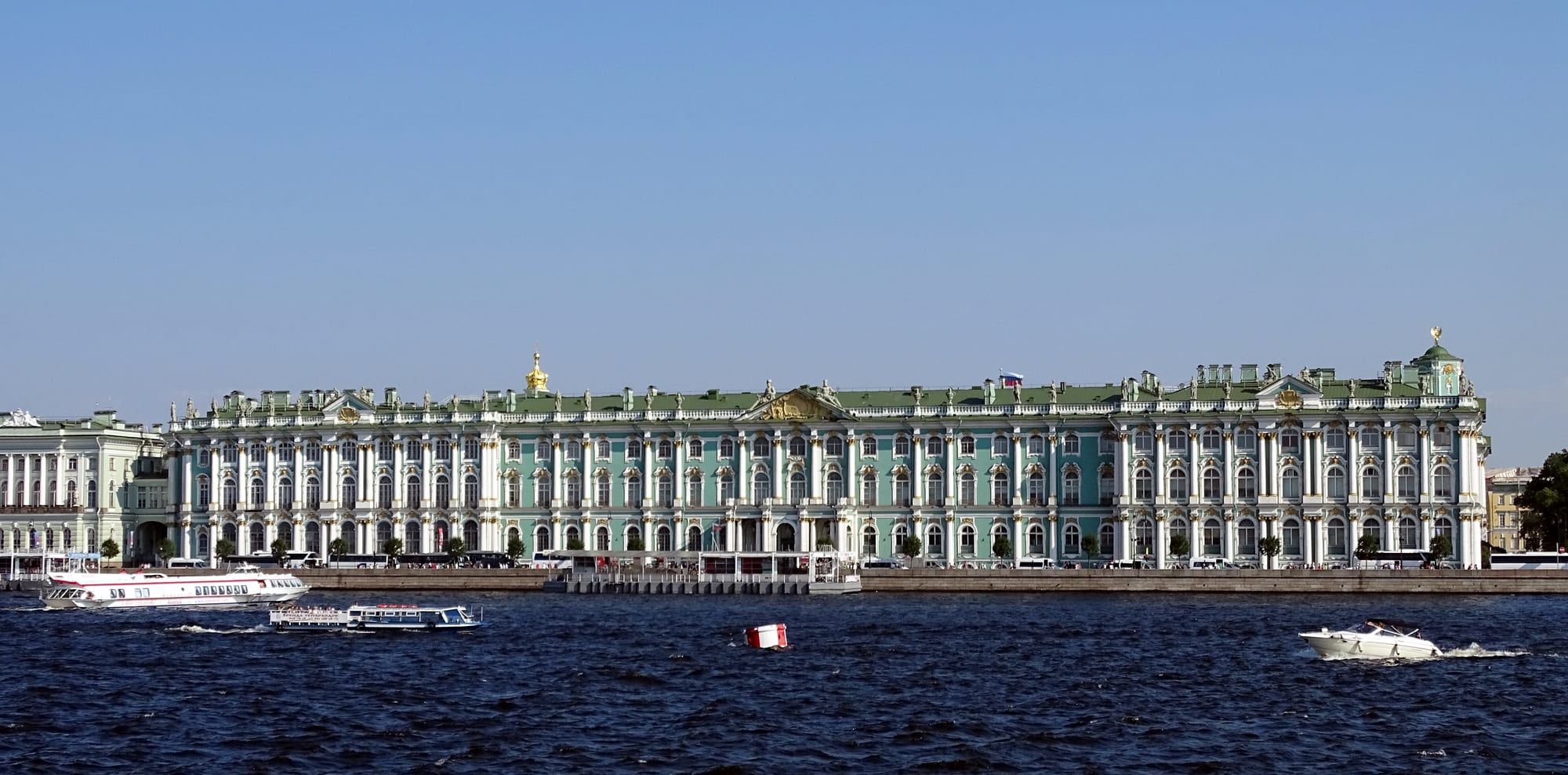
The long green and white Baroque façade of the Winter Palace across the dark blue Neva, with tour boats on the river

St Petersburg & the Northwest, Russia

Saint Petersburg

The Winter Palace, home of the Hermitage Museum, seen across the Neva. (Ad Meskens / Wikimedia Commons · CC BY-SA 4.0)

Russia's second city, built by Peter the Great from 1703 on the Neva delta at the head of the Gulf of Finland and capital of the empire for two centuries. Renamed Petrograd and then Leningrad, it survived a siege of 872 days; today it is a port and industrial city of canals, palaces and great museums. This page is written to explain the city, not to encourage travel.

Neighbourhoods

  • Nevsky Prospect and the historic centre
    • First-time visitors
    • Historic district
    • Close to public transport

    The city's main avenue runs from the Admiralty past the Kazan Cathedral, the Singer House, Gostiny Dvor and the Eliseyev food hall, crossing the Moika, Griboyedov and Fontanka canals. Palace Square, the Hermitage and the Church of the Savior on Blood are a few minutes away, and most visitors stay within walking distance of it.

    Open in Maps
  • Vasilyevsky Island
    • Museums
    • Students
    • River views

    The large island across the Neva from the Winter Palace, part of the historic centre, with the Kunstkamera on its embankment and a campus of Saint Petersburg State University. The cruise terminals lie on its western shore.

    Open in Maps
  • Petrograd Side
    • Quiet and residential
    • Architecture

    The islands north of the Neva around the Peter and Paul Fortress, where the city began, now a mostly residential district. Krestovsky Island and its stadium lie just beyond.

    Open in Maps
  • Kolomna
    • Music and ballet
    • Canals

    A quieter canal-side quarter of Admiralteysky District west of the centre, home to the Mariinsky Theatre and close to the restored New Holland Island.

    Open in Maps
  • Rubinshteyna Street and Vladimirskaya
    • Nightlife
    • Best for food

    A busy area south of Nevsky near the Fontanka, whose Rubinshteyna Street is one of the city's most popular nightclub streets.

    Open in Maps

Things to do

Famous landmarks

  • Palace Squarelandmark

    The great square in front of the Winter Palace, with the Alexander Column at its centre and the arched General Staff building opposite.

    Open in Maps
  • Peter and Paul Fortresslandmark

    The fortress where the city was founded in 1703, later a political prison; a cannon is still fired from its walls every day at noon.

    Open in Maps
  • Saint Isaac's Cathedrallandmark

    A vast cathedral built from 1818 to 1858 to Auguste de Montferrand's design, a museum since 1931, whose interior paintings were reproduced as mosaics; worship has resumed in a side chapel.

    Open in Maps
  • Church of the Savior on Bloodlandmark

    A church on the Griboyedov Canal built where Emperor Alexander II was assassinated in 1881, its walls and ceilings covered in more than 7,000 square metres of mosaics.

    Open in Maps
  • Kazan Cathedrallandmark

    A cathedral on Nevsky Prospect fronted by a great exterior colonnade, used by the Soviet state as a museum of religion and atheism from 1932.

    Open in Maps
  • Smolny Conventlandmark

    A convent on the left bank of the Neva whose blue-and-white cathedral was built by Francesco Bartolomeo Rastrelli between 1748 and 1764.

    Open in Maps
  • Alexander Nevsky Lavralandmark

    A monastery whose cemeteries hold the tombs of Lomonosov, Mussorgsky, Tchaikovsky and many other figures.

    Open in Maps
  • Cruiser Auroraattraction

    A protected cruiser that fought in the Russo-Japanese War, now a museum ship, remembered for the shot said to have signalled the attack on the Winter Palace in 1917.

    Open in Maps

Museums

  • Hermitage Museummuseum

    One of the largest art museums in the world, spread through the Winter Palace and neighbouring buildings on the Neva.

    Open in Maps
  • Russian Museummuseum

    The State Russian Museum, one of the largest art museums in the world, based in Carlo Rossi's Mikhailovsky Palace of 1819–1825 and neighbouring buildings.

    Open in Maps
  • Fabergé Museummuseum

    A private museum in the Naryshkin-Shuvalov Palace on the Fontanka with more than 4,000 works of art, including nine Imperial Easter eggs made by Fabergé for the last two tsars.

    Open in Maps
  • Kunstkameramuseum

    Peter the Great's museum of anthropology and ethnography on Vasilyevsky Island, a Petrine Baroque building crowned by an armillary sphere.

    Open in Maps
  • Moika Palacemuseum

    The Yusupov family's palace on the Moika, now a museum, where Grigori Rasputin was murdered in December 1916.

    Open in Maps

Parks, islands and the waterfront

  • Summer Gardenpark

    The early 18th-century garden of Peter the Great's Summer Palace, laid out with classical statues between the Neva and the Fontanka.

    Open in Maps
  • New Holland Islandpark

    An 18th-century triangular artificial island whose canals and Admiralty warehouses, built from 1732 to store timber for shipbuilding, are now open to the public.

    Open in Maps
  • Lakhta Centerlandmark

    Gazprom's 462-metre skyscraper in Lakhta, north-west of the centre, the tallest building in Russia and Europe.

    Open in Maps

Memorials, music and sport

  • Piskaryovskoye Memorial Cemeterylandmark

    The main burial place of the victims of the siege of Leningrad, on the Avenue of the Unvanquished.

    Open in Maps
  • Mariinsky Theatreattraction

    The opera and ballet house opened in 1860, where many works by Tchaikovsky, Mussorgsky and Rimsky-Korsakov had their premieres.

    Open in Maps
  • Krestovsky Stadiumattraction

    The retractable-roof stadium of Zenit Saint Petersburg on Krestovsky Island, opened in 2017 and used at the 2018 World Cup.

    Open in Maps

Short trips from the city

  • Peterhoflandmark

    Peter the Great's palace on the Gulf of Finland, whose Grand Cascade of 64 fountains flows into the canal leading to the sea.

    Open in Maps
  • Tsarskoye Selolandmark

    The former imperial residence south of the city, with the Catherine Palace, the Alexander Palace and their parks.

    Open in Maps
  • Pavlovsk Palacelandmark

    The palace of Grand Duke Paul, the future Paul I, and its large English landscape garden, now a state museum and public park.

    Open in Maps
  • Kronstadtattraction

    A port town on Kotlin Island, taken from Sweden in 1703 and long a naval base, reached by road along the dam that protects the city from floods.

    Open in Maps

Seasonal events

  • White Nights Festivalsummer, during the White Nights

    A season of ballet, opera, concerts, carnivals and fireworks timed to the weeks when the night sky never grows fully dark.

  • Scarlet Sailssummer, during the White Nights

    Begun in 1968 to mark the end of the school year, a night of fireworks and shows on the Neva culminating in the appearance of a tall ship under scarlet sails.

  • Anniversary of the lifting of the siege27 January

    The day the siege was lifted in 1944, marked each year with great seriousness across the city.

Eat and drink

Long-standing places and food districts in Saint Petersburg. Hours, ratings and directions come from your maps app, always current.

Saint Petersburg classics

  • Pyshkicafe

    Pyshki, Russian doughnuts dusted with sugar, are strongly associated with the city and eaten with coffee in small, plain pyshechnaya cafés.

    Open in Maps
  • Koryushka in springrestaurant

    Koryushka, a small smelt said to smell of fresh cucumber, is fried and eaten across the city in spring and has its own festival.

    Open in Maps
  • Shavermarestaurant

    The city's name for shawarma, a street food found everywhere, in cafés and on the street.

    Open in Maps

Food halls and districts

  • Eliseyev Emporiummarket

    The food hall built for the Elisseeff brothers in 1902–1903 at 56 Nevsky Prospekt, one of the city's most striking Art Nouveau interiors.

    Open in Maps
  • Rubinshteyna Streetneighborhood

    A street near the Fontanka and Mayakovskaya metro station, one of the city's most popular streets for nightlife.

    Open in Maps

Experience Saint Petersburg

History

Peter the Great founded the city on 27 May 1703 on the site of a captured Swedish fortress at the mouth of the Neva, wanting a seaport to trade with Europe better than Arkhangelsk, which froze in winter. He named it after the apostle Peter and made it the capital from 1712. In 1724 he founded the Academy of Sciences and the university here, and over the 18th and 19th centuries the city grew into one of the largest industrial cities in Europe, with a seaport and the naval base at Kronstadt. When the First World War began in 1914 it was renamed Petrograd to drop the German words Sankt and Burg.

Petrograd was the stage of the revolutions of 1917, after which the Bolsheviks moved the government to Moscow. In January 1924, days after Lenin's death, the city became Leningrad, and the large flats of the old middle classes were divided into kommunalkas, communal apartments shared by several families. The siege of Leningrad lasted 872 days, from 8 September 1941 to 27 January 1944; more than a million civilians died, mainly of starvation, and the population fell from about three million to under 600,000.

After the war the metro opened in 1955 and huge estates of near-identical apartment blocks were built on the outskirts from the 1960s. In a referendum on 12 June 1991, 55 per cent of voters chose to restore the name Saint Petersburg, and Anatoly Sobchak became the first directly elected mayor. Gazprom later re-registered here, and its 462-metre Lakhta Center became the tallest building in Russia and Europe. Since 2022 the war has cut the city's old links westward: UEFA moved the Champions League final away, and the trains to Helsinki stopped.

Culture & Customs

Saint Petersburg is Russia's cultural centre, with architecture and culture strongly inspired by Western Europe. Pushkin, Gogol and Dostoyevsky made its streets, clerks and ghosts a central subject of Russian literature, followed by Blok, Mandelshtam and Anna Akhmatova, and the apartments of many writers and composers are now museums. Tchaikovsky, Mussorgsky and Prokofiev are among the conservatory's alumni, and Shostakovich, who was born and raised here, dedicated his Seventh Symphony to the city. The Mariinsky Theatre remains one of the great houses of opera and ballet.

The city also gave Russia its rock music: bands that emerged from the underground in the 1970s founded the Leningrad Rock Club, which gave a stage to DDT, Kino, Alisa and others. Football is followed with passion, and Zenit won six league titles in a row from 2018–19 to 2023–24 and another in 2025–26. In summer the White Nights Festival fills the city with concerts, ballet and fireworks, crowned by Scarlet Sails on the Neva.

The city has 221 museums and more than 80 theatres. The memory of the siege is kept with great seriousness, and 27 January, the day it was lifted, is marked every year, with the Piskaryovskoye cemetery at the centre of remembrance.

Daily Life

About 5.6 million people lived in the city at the 2021 census, and more than 6.4 million in the metropolitan area, making it the fourth most populous city in Europe and the world's northernmost city of more than a million. From the 1960s many families moved out of the communal flats of the centre into the new estates of the outskirts.

The city is a major trade gateway and industrial centre, with oil and gas trading, shipyards, aerospace, electronics and software, and car plants. The Great Port of Saint Petersburg has cargo terminals at Petrodvorets, Kronstadt and Lomonosov, and the city links the Baltic with inland Russia through the Volga–Baltic Waterway. Saint Petersburg State University, with about 32,000 undergraduates, is the largest of its many universities.

The year sets the rhythm of daily life: days of less than six hours in late December, and white nights in June when the streets stay alive around the clock and the bridges over the Neva are raised each night for passing ships.

Food

The city's own institutions are modest. Pyshki, sugared doughnuts eaten with coffee, are sold in plain cafés, and in spring the city celebrates koryushka, a small smelt said to smell of fresh cucumber, fried and sold everywhere and honoured with its own festival. Shaverma, the local name for shawarma, is the everyday street food.

Restaurants serve the Russian classics — borsch and shchi, pelmeni dumplings, beef stroganoff and blini — along with zakuski such as herring under a fur coat, pickled cucumbers and black bread, and kvass in summer. The lakes and forests of the Northwest supply fish, mushrooms and berries such as cloudberries, lingonberries and cranberries, made into jams and mors fruit drinks.

The grandest place to shop for food is the Eliseyev Emporium on Nevsky Prospekt, a food hall built in 1902–1903 with one of the finest Art Nouveau interiors in the city. Rubinshteyna Street, near the Fontanka, is one of the city's most popular streets for nightlife.

Planning tools

Budget

Rooms are hardest to find and dearest during the White Nights in June, and some hotels offer lower prices in winter. Metro, canteen meals and pyshki are cheap; palace and museum tickets and boat trips add up. Most foreign cards no longer work in Russia, so money has to be brought in as cash and exchanged.

Daily Budget Midrange
USD 110–230 (mid-range hotel, restaurants, palace and museum tickets, boat trips)
Daily Budget Shoestring
USD 40–75 (hostel bed, canteens and pyshki, metro and buses)

Book rooms early for June, and carry enough foreign cash for the whole stay.

Best Time to Visit

June and July for the White Nights, when the sky never fully darkens, the bridges open over the Neva at night and the fountains of Peterhof run. Winter is cold and dark, with days of less than six hours in late December, but most of the main sights stay open.

Suggested Number of Days

A first visit needs three or four days for the centre and the main museums. Five to seven days leave time for the palace towns along the gulf and south of the city. Summer crowds and long museum queues can make every day slower.

First Visit
3–4 days
With Surroundings
5–7 days

Transportation

The metro, opened in 1955, has six lines and 75 stations and carries almost 2 million passengers a day; buses, trams and trolleybuses fill in, and river services run on the Neva in summer. From April to November 22 bridges over the Neva and the main canals are raised at night to let ships pass, cutting the islands off from the centre for several hours.

Allow for the night-time bridge openings when staying on the islands in summer, and use an app-booked taxi such as Yandex Go rather than a street cab.

Airport & Station Connections

Pulkovo Airport is 23 km south of the centre, linked by express buses to Moskovskaya metro station and by taxi. There are no direct flights between Russia and Western Europe or North America, so international arrivals come through third countries. The Sapsan high-speed train reaches Moscow in about four hours; the trains to Helsinki stopped in 2022 and the land border with Finland has been closed since 2023.

Walkability

The historic centre is compact and best seen on foot along Nevsky Prospect and the canal embankments, though distances between the main sights are larger than they look and the wide avenues take time to cross. The metro covers longer hops. Pavements are slushy and icy in winter.

Safety

Beyond the ordinary crime of a large European city, the decisive risks are political and legal: near-total loss of consular support, a real risk of arbitrary arrest and lengthy detention of foreigners on politically motivated charges (and their use in prisoner swaps), sweeping wartime censorship laws, and the possibility that men of certain ages, including dual nationals, face conscription or exit bans. Ukrainian drones have struck the Ust-Luga gas terminal in the surrounding Leningrad Oblast and, in June 2026, an oil terminal in the city and the naval base at Kronstadt. Pickpocketing is common on the crowded metro, especially at Gostiny Dvor station, and on Nevsky Prospect.

Most governments advise against all travel to Russia; stay well away from military installations and border zones. Keep valuables close on the metro and Nevsky Prospect, and never photograph military or infrastructure sites. Check current official travel advice before travelling.

Climate

Damp and often grey, with mild summers and cold winters moderated by the Baltic. From mid-May to the end of July the sky never grows darker than twilight, while midwinter days are very short. The average annual temperature is about 6°C.

Summer
mild — July averages a high of about 23°C, and heatwaves have reached 37°C
Winter
cold and damp — February averages a low of about −8.5°C, with snow and slush

Local Customs

Churches expect modest dress. Tipping is not essential but is appreciated in restaurants, usually by rounding the bill up to around 10 per cent; it is not expected in self-service canteens. Many Russians consider it bad luck to shake hands or pass something across a threshold.

Dress modestly in churches, treat siege memorials with respect, and never photograph military or infrastructure sites.

Common Payment Methods

The currency is the rouble (RUB). Western credit and debit cards such as Visa and Mastercard do not work in Russia, most foreign bank cards cannot be used at Russian ATMs, and cash brought in and exchanged is the only reliable means of payment.