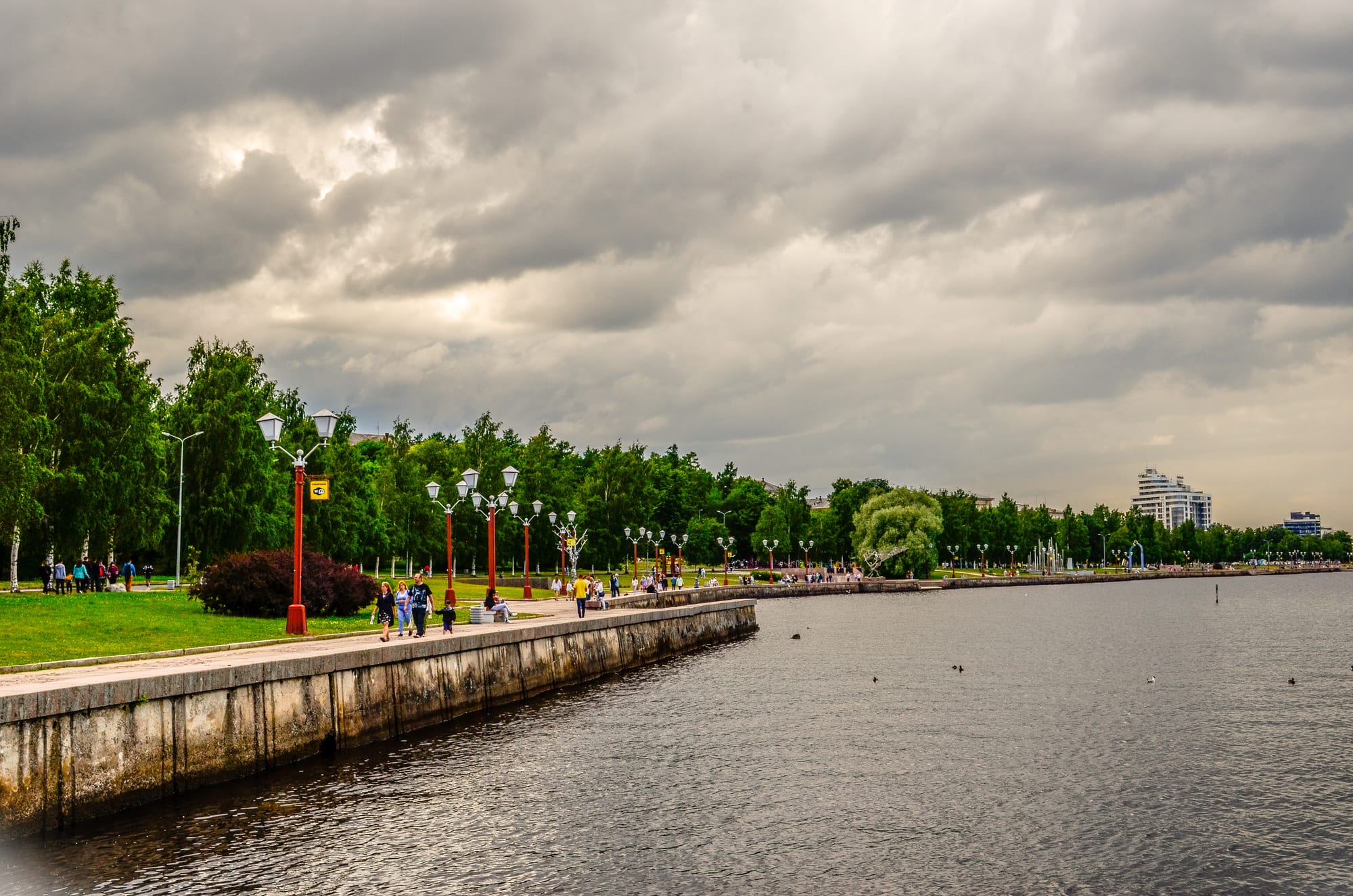
A curving stone embankment with red lamp posts, lawns and strolling people beside the grey water of Lake Onega under heavy clouds

St Petersburg & the Northwest, Russia

Petrozavodsk

The Onega embankment on the shore of Lake Onega in Petrozavodsk. (Александровы АГ / Wikimedia Commons · CC BY-SA 4.0)

The capital of the Republic of Karelia, stretched for some 27 km along the western shore of Lake Onega. Founded in 1703 around Peter the Great's cannon foundry, it grew into a neoclassical provincial capital, and is the departure point for the hydrofoils to the wooden churches of Kizhi. This page is written to explain the city, not to encourage travel.

Neighbourhoods

  • The centre and Karl Marx Avenue
    • First-time visitors
    • Architecture
    • Museums

    The neoclassical core of the city, laid out from the 1770s around the oval Round Square, now Lenin Square, with the main museums, theatres and the Alexander Nevsky Cathedral within walking distance.

    Open in Maps
  • The Onega embankment
    • Walks
    • Lake views

    The lakeside promenade along Petrozavodsk Bay, opened in 1994 and displaying Karelian granites and marbles, with sculptures given by the city's twin towns. Hydrofoils to Kizhi leave from the city's harbour.

    Open in Maps
  • Drevlyanka, Kukkovka and Sulazhgora
    • Quiet and residential
    • Local life

    The largest residential districts of the city, Drevlyanka and Kukkovka the biggest of all, linked to the centre by bus.

    Open in Maps

Things to do

The city centre

  • Lenin Square (Round Square)landmark

    An oval square laid out in 1775 at the heart of the neoclassical centre, with a large Soviet-era statue of Lenin; its old name, Round Square, is still used.

    Open in Maps
  • Alexander Nevsky Cathedrallandmark

    One of the neoclassical landmarks of the city, dedicated to Alexander Nevsky, who was considered the patron saint of the region.

    Open in Maps
  • Monument to Peter the Greatlandmark

    A bronze and granite statue of the city's founder by Ippolit Monighetti, unveiled in 1873.

    Open in Maps
  • Onega embankmentpark

    The promenade along the lake, inaugurated in 1994, with an assortment of Karelian stone, sculptures presented by twin cities around the world and a birch copse where the first church was built in 1703.

    Open in Maps

Museums and theatres

  • National Museum of Kareliamuseum

    The regional museum, opened in 1871 in one of the oldest buildings in the city, the former provincial chancellery.

    Open in Maps
  • Museum of Fine Arts of Kareliamuseum

    One of the city's three main museums, alongside the National Museum and the Kizhi museum's city exhibitions.

    Open in Maps
  • National Theatre of Kareliaattraction

    Founded in 1932, the only Finnish-language theatre in Russia and the main stage for plays in Karelian and Vepsian.

    Open in Maps
  • Karelian Musical Theatreattraction

    The city's opera and musical theatre, opened in 1955, with statuary by the sculptor Sergey Konenkov.

    Open in Maps

Short trips from the city

  • Martsialnye Vodyattraction

    The oldest spa in Russia, founded by Peter the Great in 1714 and visited by him four times; his palace is gone, but a museum tells the spa's history.

    Open in Maps
  • Kizhi Pogostlandmark

    Two wooden churches — the 22-domed Transfiguration Church and the 9-domed Intercession Church — and a bell tower on Kizhi island, a UNESCO World Heritage Site since 1990, beside an open-air museum of wooden buildings.

    Open in Maps
  • Kivach Nature Reservepark

    A strict nature reserve founded in 1931 to protect Karelian taiga, including the 10.4-metre Kivach waterfall on the Suna river.

    Open in Maps

Eat and drink

Long-standing places and food districts in Petrozavodsk. Hours, ratings and directions come from your maps app, always current.

Karelian classics

  • Kalitkicafe

    Karelian pasties with a thin rye crust and a filling of rice, barley, millet or mashed potato, eaten with butter mixed with chopped egg, sold in bakeries and cafés.

    Open in Maps
  • Lake fishrestaurant

    Restaurants serving Karelian food offer fish dishes; Karelian dining often features fish cooked whole in its own soup.

    Open in Maps

Food districts

  • Restaurants in the city centreneighborhood

    Most of the city's restaurants and cafés are in the centre between Lenin Square, Karl Marx Avenue and the lake.

    Open in Maps

Experience Petrozavodsk

History

People lived on this shore of Lake Onega some seven thousand years ago, and in the Middle Ages several lakeside villages stood on the site. On 11 September 1703 Prince Menshikov founded the settlement of Petrovskaya Sloboda at Peter the Great's command, around a new iron foundry making cannons and anchors for the Baltic Fleet in the Great Northern War. The works were renamed the Petrovsky zavod, the "Petrine factory", which gave the city its name. By 1717 it was the largest settlement in Karelia, with about 3,500 people, a timber fort and small palaces for the tsar and Menshikov.

After Peter's death the settlement emptied and the foundry closed in 1734, but in 1773 Catherine the Great founded a new one, the Alexandrovsky works, to make cannons for the wars with the Ottoman Empire; Charles Gascoigne modernised it in 1787–1796. In 1777 the settlement became a town named Petrozavodsk, a neoclassical centre was built around the new Round Square, and in 1784 it became the regional capital in place of Olonets.

Under Soviet rule the population grew more than fourteenfold, from about 19,800 in 1918 to 283,000 in 1991. Finnish forces occupied the city from 1941 to 1944, calling it Äänislinna, and opened concentration camps there, eleven of them by the time the city was retaken. From 1940 to 1941 and from 1944 to 1956 it was the capital of the Karelo-Finnish Soviet Socialist Republic. In 2015 the city was named a City of Military Glory.

Culture & Customs

Petrozavodsk stands out among the towns of northern Russia for its neoclassical architecture, from the Round Square to the Alexander Nevsky Cathedral, and for the statues of Peter the Great, the poet Gavrila Derzhavin, who governed Olonets in the 18th century, and Alexander Nevsky. The city's Finnish, Karelian and Vepsian name is Petroskoi. The National Theatre's Karelian and Vepsian productions reflect the republic's Finnic peoples.

Cultural life reflects that mix. The National Theatre of Karelia, founded in 1932, is the only Finnish-language theatre in Russia and the main stage for plays in Karelian and Vepsian, and the city also has the Karelia Philharmonic, founded in 1933, the Karelian Musical Theatre of 1955 and the National Library of Karelia. The Kizhi museum reserve, whose island churches are a UNESCO World Heritage Site, has exhibition halls in the city.

The lake shapes local identity: the embankment, inaugurated in 1994 and lined with sculptures given by twin cities around the world, is the city's showpiece, and the Shoksha quarries nearby supplied the red quartzite used in St Isaac's Cathedral and Lenin's Mausoleum.

Daily Life

About 281,000 people lived in Petrozavodsk in 2022, making it the capital and largest city of the Republic of Karelia. The city stretches along Petrozavodsk Bay on a series of lake terraces, ringed by forest on the south-west, and is counted among the greenest medium-sized cities in Russia.

The city is officially classed as equivalent to the Far North. Petrozavodsk State University and the Karelian Research Centre of the Russian Academy of Sciences, one of the largest research centres in north-western Russia, make it the republic's centre of learning, and quarries around the city produce stone and road aggregates. Much of the population lives in large residential districts, the biggest being Drevlyanka, with about 60,000 people, and Kukkovka, with about 50,000.

Buses link the outer districts of Drevlyanka, Kukkovka and Sulazhgora with the centre, and new trolleybuses have been bought since 2022 for a network that has run since 1961.

Food

Karelia's signature is the kalitka, or Karelian pasty: a thin open crust of rye filled with rice, barley porridge or mashed potato and spread, while hot, with butter, often mixed with chopped boiled egg. The pasties are also eaten throughout Finland, and have had traditional speciality guaranteed status in Europe since 2003. The oldest pasties had rye crusts filled with barley; potato and then buckwheat arrived as fillings in the 19th century, and rice later.

Lake Onega and the surrounding waters supply the other staples. Karelian dining often features fish cooked whole in its own soup, and the forests that ring the city are part of a large green zone.

The Russian classics are everywhere too — shchi, pelmeni dumplings, kasha and blini, zakuski of pickled cucumbers, herring and black bread, kvass in summer and strong tea with jam. Most restaurants and cafés are in the centre, between Lenin Square, Karl Marx Avenue and the lake.

Planning tools

Budget

Petrozavodsk costs much less than Saint Petersburg, with cheap canteens, buses and trolleybuses. The hydrofoil to Kizhi and the island's museum are the main extra costs in summer. Most foreign cards no longer work in Russia, so enough cash for the stay has to be brought in.

Daily Budget Midrange
USD 85–180 (mid-range hotel, restaurant meals, museum tickets, the Kizhi hydrofoil)
Daily Budget Shoestring
USD 35–60 (hostel bed, canteen meals, trolleybuses)

Budget separately for the Kizhi boat, and carry enough foreign cash for the whole stay.

Best Time to Visit

Summer is the main season, and hydrofoils run from Petrozavodsk to Kizhi from mid-May to mid-October; the nearby lakes moderate the climate, which is mild for the latitude. Winter is long and snowy, with short days.

Suggested Number of Days

Two days are enough for the centre and the lakeside. Four or five days allow for the island trip and the nature reserves and spas to the north, and depend on the boat season and the weather on the lake.

First Visit
2 days
With Surroundings
4–5 days

Transportation

Trolleybuses have run since 1961 and covered six routes in 2025, and buses link the outer districts of Sulazhgora, Drevlyanka and Kukkovka with the centre. In summer hydrofoils run across Lake Onega to Kizhi from Petrozavodsk harbour.

Use an app-booked taxi such as Yandex Go rather than a street cab, and carry passport, visa and migration card at all times.

Airport & Station Connections

The railway station, at the southern end of Lenin Avenue, is on the line from Saint Petersburg to Murmansk; the fastest Lastochka trains from Saint Petersburg take just under five hours, others seven to eight, and through trains run to Moscow. By road the city is about 410 km from Saint Petersburg on the R21 Kola highway. Petrozavodsk Airport, a joint civil-military airfield, is 12 km north-west of the city. The land border with Finland has been closed since 2023.

Walkability

The centre is compact and easy to walk, and Lenin Avenue leads straight from the station to the embankment. The city stretches a long way along the lake, so outer districts need a bus. Pavements are snowbound and icy for much of the winter.

Safety

Beyond the ordinary crime of a large European city, the decisive risks are political and legal: near-total loss of consular support, a real risk of arbitrary arrest and lengthy detention of foreigners on politically motivated charges (and their use in prisoner swaps), sweeping wartime censorship laws, and the possibility that men of certain ages, including dual nationals, face conscription or exit bans. The city's airport is also a military air base, and the republic borders Finland, a NATO member, along a closed frontier.

Most governments advise against all travel to Russia; stay well away from military installations and border zones. Never photograph the airport, military sites or infrastructure. Check current official travel advice before travelling.

Climate

Humid continental, bordering on subarctic, but milder than other places at this latitude because of Atlantic and Baltic air and the lake. Winters are long and cold and summers short and warm. The average annual temperature is about 3.7°C.

Summer
short and warm — July averages about 17°C
Winter
long and cold but mild for the latitude, with about 161 frost days a year; the average for the whole year is about 3.7°C

Local Customs

Karelian, Vepsian and Finnish heritage is part of local identity, and Petroskoi is the city's Finnish and Karelian name. Churches expect modest dress. Tipping is not obligatory but has become expected in restaurants since the end of the Soviet era. Many Russians consider it bad luck to shake hands or pass something across a threshold.

Dress modestly in churches and never photograph military sites, the airport or infrastructure.

Common Payment Methods

The currency is the rouble (RUB). Most foreign credit and debit cards no longer work in Russia and most cannot be used at Russian ATMs, so enough cash for the whole stay has to be brought in.