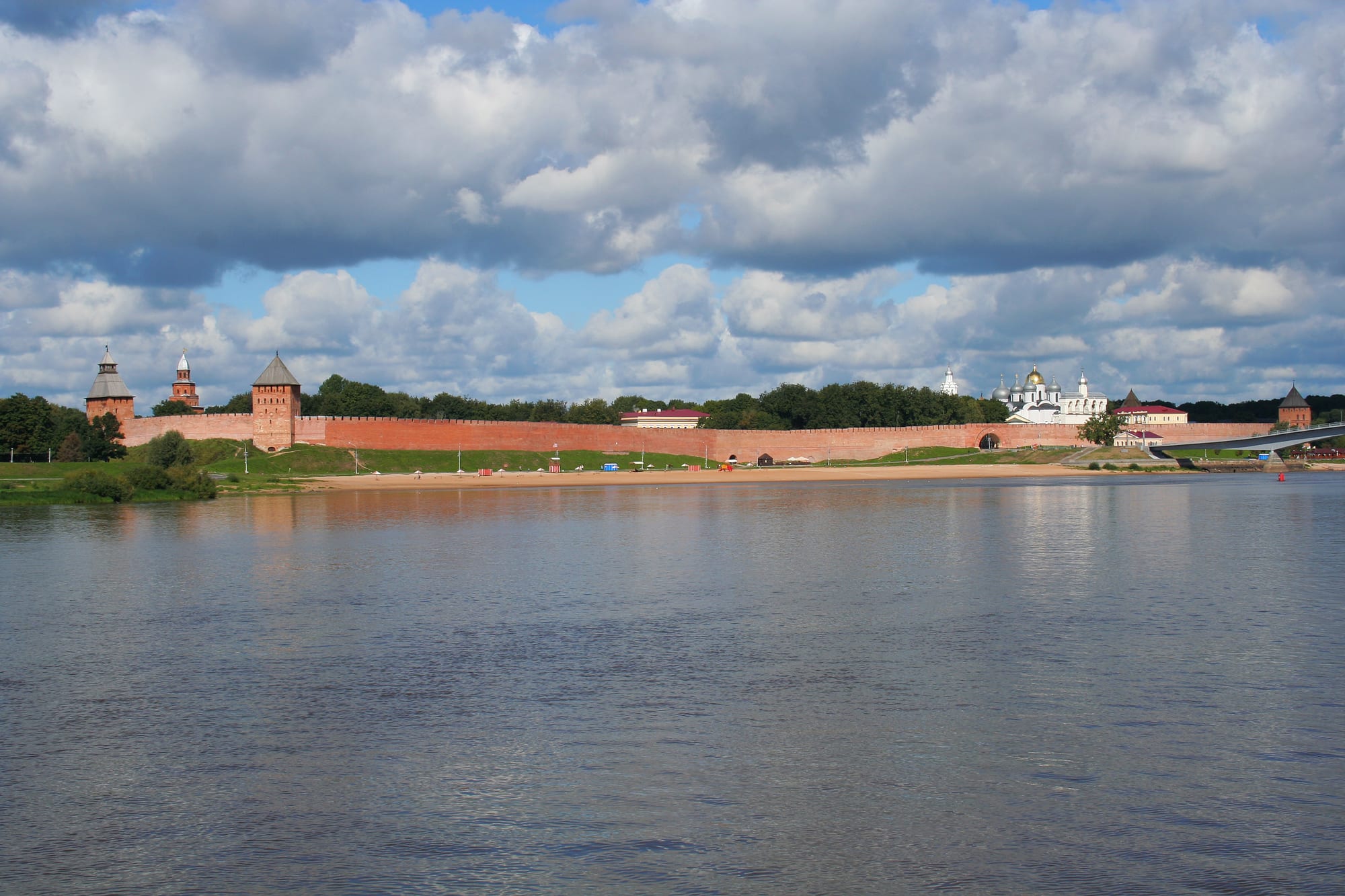
The long red-brick wall and towers of the Novgorod kremlin above a sandy riverbank, with the gold and silver domes of St Sophia behind

St Petersburg & the Northwest, Russia

Veliky Novgorod

The Novgorod kremlin and St Sophia Cathedral seen across the Volkhov river. (A.Savin / Wikimedia Commons · CC BY-SA 3.0)

One of the oldest cities in Russia, on the Volkhov river just below Lake Ilmen. From 1136 to 1478 it was the capital of the Novgorod Republic, a merchant city-state trading with the Hanseatic League; nearly destroyed in the Second World War, it was rebuilt around its kremlin and medieval churches. This page is written to explain the city, not to encourage travel.

Neighbourhoods

  • The kremlin and the Sofia Side
    • First-time visitors
    • Historic district

    The west bank of the Volkhov, around the walled kremlin, or Detinets, with St Sophia Cathedral, the Millennium of Russia monument and the main museums. The streets beyond were laid out on a radial, semicircular plan, and the railway and bus stations lie about 1.5 km west of the centre.

    Open in Maps
  • The Trade Side and Yaroslav's Court
    • Churches
    • River views

    Across the footbridge on the east bank, the old merchant half of the city, where the princes' court and the market once stood. Today it is a riverside quarter of medieval churches around the arcades of the old trading rows.

    Open in Maps
  • Towards Lake Ilmen
    • Monasteries
    • Open-air museum

    South of the centre, along the Volkhov towards its outflow from Lake Ilmen, lie the Yuriev Monastery, the open-air museum of wooden architecture and the early settlements of Gorodishche and Peryn, reached by town bus.

    Open in Maps

Things to do

The kremlin

  • Novgorod Kremlin (Detinets)landmark

    The city's fortress on the west bank of the Volkhov, free to enter, which also holds the Palace of Facets of 1433, the oldest palace in Russia, and the oldest Russian bell tower.

    Open in Maps
  • Cathedral of St Sophialandmark

    Built in 1045–1050 under Vladimir, son of Yaroslav the Wise, the oldest church building in Russia outside the Caucasus and, with a few exceptions, the oldest building still in use in the country, with famous bronze west doors.

    Open in Maps
  • Millennium of Russialandmark

    A bronze monument unveiled in the kremlin in 1862, ringed with figures of tsars, churchmen and cultural figures from Russian history.

    Open in Maps
  • Kremlin beachbeach

    A beach on the bank of the Volkhov below the kremlin, reached through a gate in the wall.

    Open in Maps

Yaroslav's Court and the medieval churches

  • Yaroslav's Courtlandmark

    The former chief square of Novgorod on the Trade Side, with St Nicholas Cathedral of 1113–1123 and the church of St Paraskeva Piatnitsa of 1207.

    Open in Maps
  • Church of the Saviour on Ilyina Streetlandmark

    A church of 1374 on the Trade Side, one of the original church designs of 14th-century Novgorod.

    Open in Maps
  • Church of St Theodore Stratilates on the Brooklandmark

    A church of 1360–1361 with fine frescoes from the 1380s, the culmination of one of Novgorod's own 14th-century church designs.

    Open in Maps

Monasteries and early churches

  • Yuriev Monasterylandmark

    Usually cited as Russia's oldest monastery, founded according to legend around 1030 near Lake Ilmen, with a tall three-domed cathedral begun in 1119.

    Open in Maps
  • Antoniev Monasterylandmark

    A monastery founded in 1117 whose cathedral, completed in 1119, is like the Yuriev cathedral one of the few three-domed churches in Russia.

    Open in Maps
  • Nereditsa Churchlandmark

    The Saviour church at Nereditsa of 1198, once famous for the best-preserved pre-Mongol wall paintings in the Russian Empire, reduced to rubble in the Second World War and rebuilt.

    Open in Maps
  • Khutyn Monasterylandmark

    A monastery on the right bank of the Volkhov outside the city whose Saviour Cathedral of 1515 was built by Muscovite masters after the conquest of 1478.

    Open in Maps
  • Vitoslavlitsy Museum of Wooden Architecturemuseum

    An open-air museum founded in 1964 near the Yuriev Monastery, with more than twenty wooden churches, houses and mills brought from across the Novgorod region.

    Open in Maps

Short trips from the city

  • Ryurikovo Gorodishcheattraction

    The 9th-century settlement within today's city boundaries that preceded Novgorod, the original residence of its princes.

    Open in Maps
  • Perynlandmark

    A peninsula at the outflow of the Volkhov from Lake Ilmen, with the site of a medieval pagan shrine and an early 13th-century chapel.

    Open in Maps
  • Lake Ilmenpark

    The large lake a few kilometres south of the city, from which the Volkhov flows north towards Lake Ladoga.

    Open in Maps

Eat and drink

Long-standing places and food districts in Veliky Novgorod. Hours, ratings and directions come from your maps app, always current.

Novgorod classics

  • Medovukharestaurant

    Honey mead is a local favourite, a Slavic drink made by fermenting honey with water.

    Open in Maps

Food districts

  • Cafés around Sofiyskaya Squareneighborhood

    The square outside the kremlin and the streets around it have cafés and restaurants, some with summer terraces.

    Open in Maps

Experience Veliky Novgorod

History

The city's own charter takes 859, its first mention in a late chronicle, as its founding year. Its forerunner was Gorodishche, a 9th-century settlement a short distance upriver, and the Primary Chronicle says the local tribes invited the Varangian chieftain Rurik to rule them in 862, which is why Russian tradition calls Novgorod a cradle of Russian statehood; Norse sagas knew it as Hólmgarðr. Under Kievan Rus' it was the second city of the realm, the seat of the heir to the throne. It received its first bishop in 989, Yaroslav the Wise ruled here from 1010 to 1019, and his son Vladimir built St Sophia Cathedral in 1045–1050.

In 1136 the townspeople dismissed their prince, and until 1478 Novgorod was the centre of a republic in which the veche, or assembly, elected the posadnik and shared power with the boyars and the archbishop. Its territory stretched from the Gulf of Finland to the Urals, and its furs and beeswax drew the Hanseatic League, which kept its easternmost trading post, the Peterhof, here. Some 1,000 birch-bark letters from the 11th to 15th centuries suggest that literacy was widespread among the townspeople. The city never fell to the Mongols, and its prince Alexander Nevsky defeated the Swedes in 1240 and the German crusaders in 1242. Ivan III of Moscow crushed the republic in 1478.

Ivan IV's oprichniki sacked the city in 1570, and Swedish forces occupied it from 1611 to 1617. Novgorod became a provincial capital under the empire, and German troops occupied it from August 1941 to January 1944; of 2,346 houses only 40 survived undamaged. Rebuilt to plans by Alexey Shchusev, it saw its monuments listed by UNESCO in 1992 and took the name Veliky Novgorod in 1999. Archaeological rescue work continues across the city.

Culture & Customs

For centuries Novgorod was one of the most important centres of Russian art. Around fifty medieval and early modern churches still stand in and around the city, from the austere stone walls and helmet domes of St Sophia to the small 13th-century churches and the frescoed 14th-century churches of the Trade Side; many were destroyed or badly damaged in the war and later restored. The archbishops' scriptorium produced some of the oldest Russian chronicles, and the Novgorod Codex, the oldest East Slavic book, was found here.

The birch-bark letters are a source of local pride, among them the notes and drawings of Onfim, a boy who scratched his homework into bark in the 13th century. The merchant Sadko, a hero of Russian folk tales, is a Novgorodian. In its later history the city's land became a stronghold of the Old Believers, and its craftsmen were known for silver filigree, called skan', and for painted chests used across Russia.

Novgorod belongs to the Silver Ring of historic towns of north-western Russia. The Millennium of Russia monument in the kremlin, unveiled in 1862, sets out the country's history in bronze, and the Malyi Theatre runs an international theatre festival, Tsar-Skazka, held every two years. Souvenir stalls sell wooden handicrafts and birch-bark paintings.

Daily Life

About 224,000 people lived in the city at the 2021 census, making it the largest city and administrative centre of Novgorod Oblast. In the Middle Ages, at its peak, it had only 20,000 to 30,000 inhabitants. The modern city grew out of the post-war reconstruction, which followed Shchusev's plans only in part, and taller buildings later appeared in the centre.

Industry is the most stable sector of the economy, and the city accounts for more than half of the oblast's industrial production; electronics and other industries were created here in the decades after the war. After the war the city also became known as a centre of Soviet and international tourism. Yaroslav the Wise Novgorod State University is the main university.

Buses and trolleybuses link the riverside centre with the residential districts, and the railway and bus stations stand opposite each other west of the centre. Archaeological rescue work still continues across the city, and systematic research has gone on since 1932.

Food

Novgorod's food is that of north-western Russia. The lakes and rivers of the Northwest supply fish, and the forests supply mushrooms, salted and pickled for winter, and berries — cloudberries, lingonberries, cranberries and blueberries — made into jams and mors fruit drinks. Soups such as shchi made from cabbage, pelmeni dumplings, kasha porridge and pirozhki buns are everyday food, and blini are eaten in great quantities at Maslenitsa before Lent.

Honey mead, medovukha, is a local favourite — a Slavic drink made by fermenting honey with water and sometimes flavoured with herbs or berries. Kvass, a cloudy, sweet-and-sour drink fermented from rye bread, and strong tea with jam are the everyday non-alcoholic drinks, and zakuski such as pickled cucumbers, herring and black bread open a proper meal, often with vodka and toasts.

Eating out centres on the cafés and restaurants around Sofiyskaya Square outside the kremlin, with cheap self-service canteens for everyday meals.

Planning tools

Budget

Novgorod costs much less than Saint Petersburg, with cheap canteens, buses and taxis, and entry to the kremlin grounds is free. The real difficulty is payment: most foreign cards no longer work in Russia, so money has to be brought in as cash and exchanged.

Daily Budget Midrange
USD 80–170 (mid-range hotel, restaurant meals, museum tickets, taxis)
Daily Budget Shoestring
USD 35–60 (hostel bed, self-service canteens, buses and trolleybuses)

Carry enough foreign cash for the whole stay, as most foreign cards do not work.

Best Time to Visit

Late May to early September brings long, light evenings, swimming from the kremlin beach and the monasteries at their greenest. Winters are cold and snowy, with short days, though the churches and museums are quiet.

Suggested Number of Days

Two days are enough for the centre on both banks of the river. Three or four days allow time for the monasteries and villages to the south. A day trip from Saint Petersburg, about three hours away by train, leaves little time beyond the kremlin.

First Visit
2 days
With Surroundings
3–4 days

Transportation

Buses and trolleybuses reach every part of the city at short intervals; the trolleybus network, opened in 1995, was the first in Russia after the fall of the Soviet Union. Taxis are cheap and plentiful, and bicycles are a good way to cover the flat riverside distances.

Use an app-booked taxi such as Yandex Go rather than a street cab, and carry passport, visa and migration card at all times.

Airport & Station Connections

The city has no working airport; the nearest international airport is Saint Petersburg's Pulkovo, about 180 km to the north. Suburban trains run from Saint Petersburg, and night trains from Moscow; the road to Saint Petersburg is about 190 km on the M10 highway, and buses run on it. The railway station is about 1.5 km west of the centre, with the bus station opposite.

Walkability

Novgorod is easy on foot: the kremlin, Sofiyskaya Square and the Trade Side are linked by a footbridge over the Volkhov, and almost everything in the centre is within walking distance. The monasteries to the south need a bus or taxi. Pavements are icy in winter.

Safety

Beyond the ordinary crime of a large European city, the decisive risks are political and legal: near-total loss of consular support, a real risk of arbitrary arrest and lengthy detention of foreigners on politically motivated charges (and their use in prisoner swaps), sweeping wartime censorship laws, and the possibility that men of certain ages, including dual nationals, face conscription or exit bans. Novgorod itself is a provincial city where these national risks, rather than street crime, are the main concern.

Most governments advise against all travel to Russia; stay well away from military installations and border zones. Never photograph military or infrastructure sites. Check current official travel advice before travelling.

Climate

Humid continental, with warm summers and fairly cold winters with frequent snow. June is the wettest month and March the driest.

Summer
warm — July has a daily mean of about 19°C, and days above 30°C occur
Winter
cold and snowy — February has a daily mean of about −6°C, and the record low is −45°C

Local Customs

Churches and monasteries expect modest dress, and several are working religious houses. Tipping is not essential but is appreciated in restaurants, usually by rounding the bill up to around 10 per cent; it is not expected in self-service canteens. Many Russians consider it bad luck to shake hands or pass something across a threshold.

Dress modestly in churches and monasteries and never photograph military or infrastructure sites.

Common Payment Methods

The currency is the rouble (RUB). Western credit and debit cards such as Visa and Mastercard do not work in Russia, most foreign bank cards cannot be used at Russian ATMs, and cash brought in and exchanged is the only reliable means of payment.