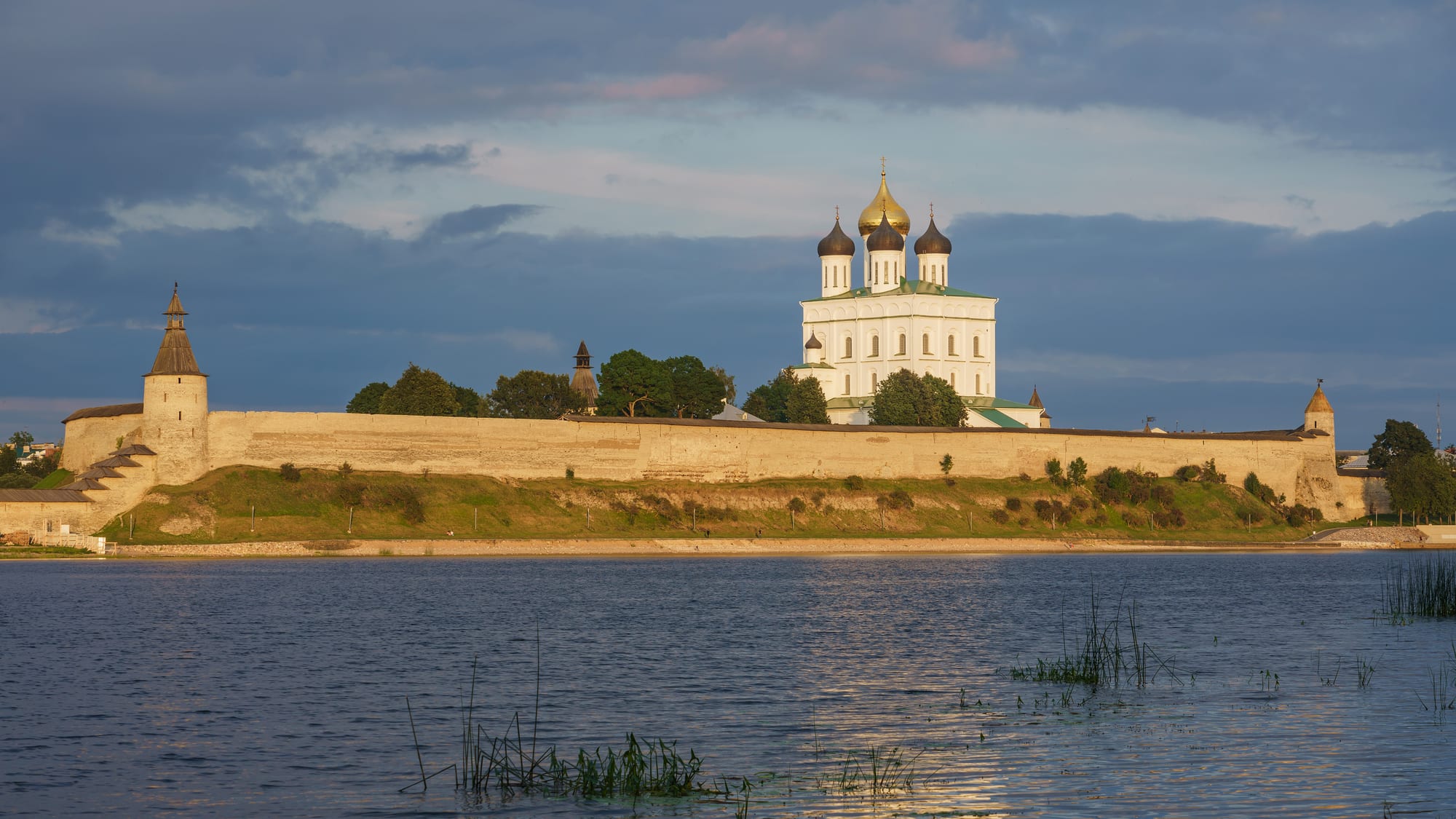
The long stone wall of the Pskov Krom and the white Trinity Cathedral with a gold dome above the calm Velikaya river at golden hour

St Petersburg & the Northwest, Russia

Pskov

The Pskov Krom and Trinity Cathedral above the Velikaya river before sunset. (A.Savin / Wikimedia Commons · FAL)

One of the oldest cities in Russia, at the meeting of the Velikaya and Pskova rivers about 20 km from the Estonian border. Capital of the medieval Pskov Republic and for centuries a border fortress that withstood dozens of sieges, it keeps its stone Krom and a UNESCO-listed school of church architecture. This page is written to explain the city, not to encourage travel.

Neighbourhoods

  • The Krom and the old centre
    • First-time visitors
    • Historic district

    The walled Krom at the junction of the rivers, with Trinity Cathedral and the excavated remains of Dovmont's Town, and the old centre beyond it with merchant mansions such as the Pogankin Chambers and many 15th- and 16th-century churches.

    Open in Maps
  • Zavelichye
    • River views
    • Churches and monasteries

    The west bank of the Velikaya, facing the Krom across the water, where the Hanseatic trading post moved after a fire and where the Mirozhsky Monastery stands at the mouth of the Mirozha. It gives the classic view of the Krom.

    Open in Maps
  • Zapskovye
    • Quiet and residential
    • Historic district

    The district across the small Pskova river north of the Krom, where German merchants lived as early as the 13th century, now a quieter area of old churches and houses.

    Open in Maps

Things to do

The Krom

  • Pskov Kromlandmark

    The citadel at the junction of the Velikaya and Pskova rivers, whose walls date from the late 15th century; it withstood twenty-six sieges in the 15th century alone.

    Open in Maps
  • Trinity Cathedrallandmark

    The 78-metre cathedral inside the Krom, first built in stone in 1138 and rebuilt in the 1690s, holding the tombs of the saint princes Vsevolod and Dovmont.

    Open in Maps
  • Dovmont's Townattraction

    The core of the citadel, named after the 13th-century prince Dovmont, where the remains of medieval Pskov have been excavated and shown as an open-air museum.

    Open in Maps

Churches, monasteries and museums

  • Mirozhsky Monasterylandmark

    A 12th-century monastery on the left bank of the Velikaya whose Transfiguration Cathedral, one of two pre-Mongol buildings left in Pskov, keeps its 12th-century frescoes.

    Open in Maps
  • Church of St Basil on the Hilllandmark

    A church in the city centre whose stone building of 1413 replaced a wooden one, among the many 15th- and 16th-century churches built by Pskov's masons.

    Open in Maps
  • Church of Saints Kozma and Demian near the Bridgelandmark

    A 15th-century church, a protected monument of the city's own school of church building.

    Open in Maps
  • Snetogorsky Monasterylandmark

    A monastery on the high right bank of the Velikaya, 3.5 km from the centre, whose cathedral was built in 1310–1311 and painted in 1313.

    Open in Maps
  • Pskov Museummuseum

    The city museum in the Pogankin Chambers, a late 17th-century merchant's house that was one of the largest stone buildings in the area, with a large collection of silver, art and icons.

    Open in Maps

Short trips from the city

  • Izborskattraction

    A village 30 km west of Pskov near the Estonian border, with one of the oldest and most impressive fortresses of western Russia.

    Open in Maps
  • Pskov-Caves Monasterylandmark

    A monastery in Pechory, near the Estonian border, one of the few in Russia never closed, even in the Soviet era, and a spiritual centre for the Seto people.

    Open in Maps
  • Mikhaylovskoye Museum Reservemuseum

    Pushkin's family estate and the surrounding villages around Pushkinskiye Gory, a museum reserve dedicated to the poet, who is buried at the nearby monastery.

    Open in Maps

Eat and drink

Long-standing places and food districts in Pskov. Hours, ratings and directions come from your maps app, always current.

Pskov classics

  • Solyanka and syrnikicafe

    Cafés and canteens in the centre serve solyanka, a sour soup with meat, fish or mushrooms and brine, syrniki, small curd-cheese pancakes, and kompot to drink.

    Open in Maps

Food districts

  • Restaurants near the Kromneighborhood

    Most of the city's restaurants and cafés are in the old centre around the Krom and along the streets leading to it.

    Open in Maps

Experience Pskov

History

Pskov's first mention comes in the chronicle under the year 903, when Igor of Kiev married a local woman, Olga, later Saint Olga; the city celebrated its 1,100th anniversary in 2003. Its first prince was Sudislav, youngest son of Vladimir the Great, and in the 12th and 13th centuries it followed the Novgorod Republic. The Teutonic Knights took it in 1241, but Alexander Nevsky recaptured it months later. The townspeople then chose the Lithuanian prince Daumantas, known in Russia as Dovmont, as their leader; he fortified the town, and the core of the citadel still bears the name Dovmont's Town.

In 1348 Novgorod recognised Pskov's independence, and the city became the capital of the Pskov Republic, dominated by merchants trading with the Hanseatic League. Its veche issued the Pskov Charter, a main source of the all-Russian law code of 1497. Ringed at one point by five stone walls, the Krom withstood twenty-six sieges in the 15th century alone, a local school of icon painting flourished, and Pskov's masons were thought the best in Russia. In January 1510 the veche met for the last time and the city was annexed by Moscow; three hundred families were deported, but with more than 30,000 people it remained one of the three largest cities of Muscovy. In 1581–1582 its mostly civilian defenders held out against Stephen Báthory's Polish-Lithuanian army, and in 1615 against the Swedes.

Peter the Great's conquests on the Baltic ended its role as a border fortress, and the city declined. Nicholas II abdicated aboard the imperial train here in March 1917. German troops occupied Pskov from July 1941 to July 1944, and at liberation only 143 of 62,000 civilian residents remained. In 2019 ten of its churches and monasteries were listed by UNESCO.

Culture & Customs

Pskov's architecture is its signature. Its masons drew on Byzantine and Novgorod traditions, merged them with local building and local stone, and worked as far afield as Moscow, Kazan and Sviyazhsk; their churches, from the 12th to the early 17th century, are now the UNESCO site Churches of the Pskov School of Architecture. The Mirozhsky Monastery's cathedral, one of two pre-Mongol buildings left in the city, keeps its 12th-century frescoes, and a local school of icon painting flourished in the republican era.

The city's heroic past is part of its identity. Alexander Nevsky's campaign to recapture Pskov was dramatised in Sergei Eisenstein's 1938 film Alexander Nevsky, and the deportation of noble families under Ivan IV is the subject of Rimsky-Korsakov's opera Pskovityanka. The relics and sword of Dovmont are kept in the Krom, and the Trinity Cathedral has been the mother church of the diocese since 1589.

Literary pilgrims pass through on the way to the Pushkin estates at Mikhaylovskoye, and the Pskov-Caves Monastery at Pechory, never closed even in the Soviet era, draws Orthodox pilgrims and is a spiritual centre for the Seto people. Pskov is part of the Silver Ring of historic towns of north-western Russia, and in 2019 its museum was merged with that of Izborsk into a single museum reserve.

Daily Life

About 185,000 people lived in Pskov in 2025, down from about 204,000 at the 1989 census. The city is the administrative centre of Pskov Oblast, lies about 20 km from the Estonian border and in the Soviet era was largely rebuilt, with many old churches demolished to make room for new construction.

Industry includes AVAR, which makes electrical equipment for cars, lorries, buses and tractors, and a large poultry farm, the city's largest single source of air pollution. The airport is shared with military aviation. After the destruction of the Second World War, Pskov developed from the late 1950s into a large industrial centre.

Daily life is that of a provincial capital, with the rivers at its centre — the Krom at the junction of the Velikaya and the Pskova, embankments on both banks and bridges linking the old districts. The city's drinking water has been the subject of a long project to move from the Velikaya to underground sources.

Food

Pskov eats in the tradition of north-western Russia. The rivers and Lake Pskov, the southern part of Lake Peipus, supply fish, and the forests mushrooms and berries such as cloudberries, lingonberries, cranberries and blueberries, made into jams and mors fruit drinks or salted and pickled for winter. Shchi, a cabbage soup, pelmeni dumplings, kasha porridge and pirozhki buns are everyday food, and blini are eaten in vast quantities at Maslenitsa before Lent.

Cafés and canteens in the centre serve solyanka, a thick sour soup made with meat, fish or mushrooms and brine; syrniki, small fried pancakes of curd cheese; and kompot, a sweet drink of stewed fruit. Zakuski such as pickled cucumbers, herring and black bread open a proper meal, often with vodka and toasts, while kvass, a cloudy drink fermented from rye bread, and strong tea with jam are the everyday non-alcoholic drinks.

Most restaurants are in the old centre around the Krom. In the 16th century the city held two large fairs a year, in January and May.

Planning tools

Budget

Pskov costs much less than Saint Petersburg, with cheap hostels, canteens and buses. The real difficulty is payment: most foreign cards no longer work in Russia, so money has to be brought in as cash and exchanged.

Daily Budget Midrange
USD 75–160 (mid-range hotel, restaurant meals, museum tickets, taxis or a driver to Izborsk and Pechory)
Daily Budget Shoestring
USD 30–55 (hostel bed, canteen meals, city buses)

Carry enough foreign cash for the whole stay, as most foreign cards do not work.

Best Time to Visit

Late May to early September brings long, light evenings and green riverbanks, and the best conditions for the trips to Izborsk, Pechory and the Pushkin estates. Summer and autumn are the wetter seasons. Winter is cold, with short days, but the churches and museums are quiet.

Suggested Number of Days

Two days cover the Krom, the old centre and the river banks. Three or four days allow time for the fortress village, the cave monastery and the poet's estates in the south of the oblast, which are best reached by car.

First Visit
2 days
With Surroundings
3–4 days

Transportation

City buses link the centre with the residential districts and the stations; the city's tram ran only from 1912 to 1941. App-booked taxis are the easy way to reach Izborsk, Pechory and the countryside, and buses also run to the towns of the oblast.

Use an app-booked taxi such as Yandex Go rather than a street cab, and carry passport, visa and migration card at all times.

Airport & Station Connections

Daily long-distance trains run from Saint Petersburg's Vitebsky station, with a commuter train from the Baltiysky station, and a night train comes from Moscow's Leningradsky station. Buses from Saint Petersburg take about four to five and a half hours. Princess Olga Pskov International Airport, which shares its runway with military aviation, has had scheduled flights to Moscow and other Russian cities.

Walkability

The Krom, the old centre and the riverside churches are close together and easy to cover on foot, and bridges link the centre with Zavelichye and Zapskovye. The Mirozhsky and Snetogorsky monasteries are a longer walk or a short bus ride. Pavements are icy in winter.

Safety

Beyond the ordinary crime of a large European city, the decisive risks are political and legal: near-total loss of consular support, a real risk of arbitrary arrest and lengthy detention of foreigners on politically motivated charges (and their use in prisoner swaps), sweeping wartime censorship laws, and the possibility that men of certain ages, including dual nationals, face conscription or exit bans. Pskov lies close to the border with Estonia, a NATO member, and the city's airport, which is shared with military aviation, was struck in a drone attack in August 2023 that destroyed two transport aircraft.

Most governments advise against all travel to Russia; stay well away from military installations and border zones. Never photograph the airport, military sites or infrastructure. Check current official travel advice before travelling.

Climate

Humid continental, with some maritime influence from the nearby Baltic, so a little less extreme than central Russia. Winters are cold and summers warm, and summer and autumn bring more rain than winter and spring. The average annual temperature is about 6°C.

Summer
warm, and wetter than winter and spring; July 2010, the hottest month on record, averaged 23.2°C
Winter
cold, though a little milder than in central Russia; the average for the whole year is about 6°C

Local Customs

Churches and monasteries expect modest dress, and the Pskov-Caves Monastery and others are working religious houses. Tipping is not essential but is appreciated in restaurants, usually by rounding the bill up to around 10 per cent; it is not expected in self-service canteens. Many Russians consider it bad luck to shake hands or pass something across a threshold.

Dress modestly in churches and monasteries, and never photograph military or border installations.

Common Payment Methods

The currency is the rouble (RUB). Western credit and debit cards such as Visa and Mastercard do not work in Russia, most foreign bank cards cannot be used at Russian ATMs, and cash brought in and exchanged is the only reliable means of payment.