Aerial view of a narrow pine-forested sand spit between the open sea and a lagoon, with a white dune and a village

Russia

Kaliningrad

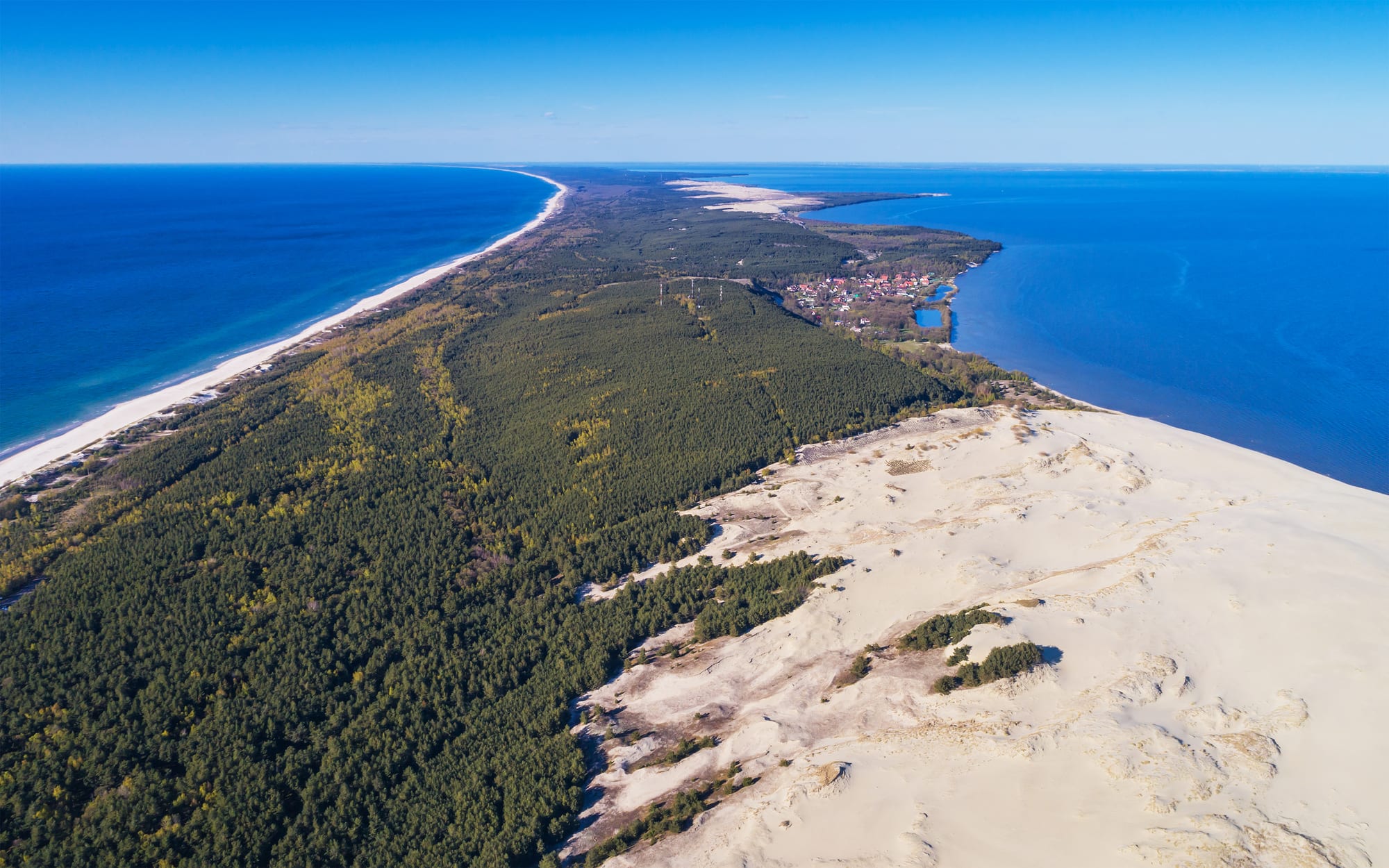
The Curonian Spit from above the Epha Dune, with the Baltic Sea on the left and the Curonian Lagoon on the right. (A.Savin / Wikimedia Commons · FAL)

Russia's Baltic exclave, wedged between Poland and Lithuania and cut off from the rest of the country — the former German city of Königsberg and the northern half of East Prussia, with the dunes of the Curonian Spit, the resorts of Svetlogorsk and most of the world's mined amber. This page is written to explain the region, not to encourage travel.

Explore Kaliningrad

History

The land was home to the Old Prussians, a Baltic people, until the Teutonic Knights conquered it in the 13th century. In 1255 they founded Königsberg on the Pregel (today's Pregolya), naming it in honour of King Ottokar II of Bohemia, and the town became a member of the Hanseatic League. In 1525 the grand master, Albert of Hohenzollern, turned the order's lands into the secular Duchy of Prussia, and in 1544 he founded the university known as the Albertina. Königsberg was the coronation city of the Prussian kings from 1701, and the philosopher Immanuel Kant spent almost his whole life there.

For centuries East Prussia was German, with Lithuanian and Polish minorities, and in 1807 Napoleon and Tsar Alexander I made peace at Tilsit, today's Sovetsk. After the First World War the province was separated from the rest of Germany by the Polish Corridor. In 1944 British bombing destroyed Königsberg's old centre, and the Red Army stormed the city in April 1945.

At Potsdam the northern part of East Prussia went to the Soviet Union and the south to Poland. The remaining German population was deported by 1948 and replaced with settlers from across the USSR, and in 1946 the city was renamed after the Soviet official Mikhail Kalinin. The ruins of the royal castle were demolished and replaced by the unfinished House of Soviets. A closed military zone throughout the Cold War, the region became an exclave in 1991 when Lithuania regained independence, and it has since become a focus of Russia's confrontation with NATO.

Culture & Customs

Kaliningrad's identity is unusual for Russia: a population that arrived after 1945 living among German churches, villas, forts and cobbled roads. For decades the German past was suppressed, but since the 1990s it has been partly embraced, with the cathedral restored, old Prussian names used in tourism and the city's surviving gates and forts turned into museums. The residents, sometimes called "Kaliningraders", often describe themselves as closer to Europe, and before 2022 many travelled regularly to Poland and Lithuania.

Kant remains the local hero; the university bears his name, and his tomb stands beside the cathedral. The mathematical puzzle of the Seven Bridges of Königsberg, solved by Leonhard Euler in 1736, is another point of local pride, although only a few of the original bridges survive.

Amber is the region's craft and emblem: it washes up on the beaches after storms, is carved and set in jewellery, and fills the Amber Museum in a former city fortification tower. The Orthodox cathedral of Christ the Saviour on Victory Square is the main church today, while Lutheran and Catholic churches from the German era serve as concert halls or have been handed to the Orthodox Church. Military culture is visible everywhere, and the Baltic Fleet is based at Baltiysk.

Daily Life

About a million people live in the oblast, and roughly half of them in Kaliningrad city. Smaller towns include Sovetsk, Chernyakhovsk, Baltiysk, Gusev and the resort towns of Svetlogorsk and Zelenogradsk. Many residents moved from other parts of Russia and the former Soviet Union, and the region has continued to attract newcomers.

A special economic zone brought assembly plants for cars and electronics, and the port, fishing, amber mining at Yantarny, farming and tourism are important. The exclave depends on transit through the European Union or by sea for supplies, and EU sanctions since 2022 have blocked part of the goods once brought in by rail across Lithuania. Military bases employ many people.

Daily life has a slightly more Central European rhythm than elsewhere in Russia: cafés, walks along the Upper Pond and the Pregolya embankments, and summer weekends on the coast. Since 2022 the border with Poland and Lithuania, once crossed for shopping and cheap petrol, has become a hard line, and residents are more isolated from their neighbours than at any time since the Soviet era.

Food

The region's cooking mixes Russian and Soviet staples with echoes of East Prussia. Königsberger Klopse, meatballs in a white sauce with capers, and Königsberg marzipan, baked so that its top is lightly browned, are the best-known dishes of the old city, now revived in local restaurants and confectioners. Tilsit gave its name to Tilsiter, a semi-hard cheese first made in the area by Swiss settlers in the 19th century.

The Baltic and the Curonian Lagoon supply most of the protein: smoked eel, sprats, Baltic herring and cod, sold hot-smoked at markets and on the Curonian Spit. Zander and bream come from the lagoon. Fish soups and potatoes are everyday fare.

Local beer has a long tradition — Königsberg's Ponarth brewery was well known before the war — and small breweries have revived it. Berry jams, smoked fish sandwiches and kvass complete a picnic on the coast.

Attractions & Natural Wonders

Kaliningrad city has the cathedral on Kant Island with Kant's tomb and an organ used for concerts, the Museum of the World Ocean with its research vessels, the Amber Museum in the Dohna Tower, the Friedland Gate and other city gates, the Orthodox cathedral on Victory Square and the pre-war villas of the Amalienau district. A ring of Prussian forts surrounds the city.

The coast north of the city is the amber coast. Svetlogorsk has a promenade, a funicular and wooden spa architecture above the Baltic, and Zelenogradsk, the former Cranz, is the gateway to the Curonian Spit. Yantarny's amber mine lies on the western shore, where visitors can search the beaches after storms.

The Curonian Spit, a UNESCO World Heritage Site shared with Lithuania, is protected as a national park. A road runs its length past the Dancing Forest of twisted pines, the high Epha Dune and the Rybachy bird station, founded in 1901 as one of the world's first ornithological stations, where millions of migrating birds pass each spring and autumn. Inland, the ruins of Teutonic castles and the old towns of Sovetsk and Chernyakhovsk recall East Prussia.

Cities in Kaliningrad

Planning basics

Budget

Kaliningrad is cheaper than Moscow and St Petersburg, and hotels, cafés and the coastal resorts are moderately priced outside the July and August peak. The real costs come from access: most visitors must fly in via mainland Russia, and prices on the coast rise sharply in summer. Foreign cards do not work, and cash cannot be withdrawn with them.

Daily Budget Midrange
USD 85–180 (mid-range hotel, restaurants, day trips to the Curonian Spit)
Daily Budget Shoestring
USD 35–65 (hostel, canteens, buses and suburban trains to the coast)

Bring all the cash needed from outside Russia; there is no way to top up funds with a foreign card in the exclave.

Safety

Kaliningrad is one of the most heavily militarised places in Europe, home to the Baltic Fleet at Baltiysk and to nuclear-capable missiles, and it sits on a tense front line with NATO. The national risks all apply: arbitrary detention of foreigners, espionage charges for photographing military or port sites, and very limited consular help. The border regime with Poland and Lithuania can change quickly, and leaving by land may not be possible.

Most governments advise against all travel to Russia; keep well away from military areas at Baltiysk and elsewhere. Check current official travel advice before travelling.

Climate

Milder and wetter than the rest of Russia, with a maritime climate close to that of northern Poland and Lithuania. Winters are grey and damp, often hovering around freezing, with less snow than inland Russia; summers are mild, and the coast is cooled by sea breezes. Autumn brings frequent rain and Baltic storms.

Summer
mild, typically 18–24°C by day; the sea warms to bathing temperature in July and August
Winter
cool and damp, around −3 to 2°C in January, with rain, sleet and occasional snow

Transportation

The exclave is reached mainly by air from Moscow and St Petersburg. Trains from mainland Russia cross Lithuania and need a Lithuanian transit document, and land crossings into Poland and Lithuania are heavily restricted. Inside the oblast, suburban trains and buses run from Kaliningrad to Svetlogorsk and Zelenogradsk in about an hour, and buses cross the Curonian Spit.

Check transit rules for the Lithuanian rail corridor well ahead, and allow a full day for the Curonian Spit.

Best Time to Visit

June to early September is the main season, when the beaches at Svetlogorsk and Zelenogradsk are busy and the Curonian Spit is at its greenest. May and September are quieter and good for walking the dunes and seeing the bird migrations over the spit. Winters are dark and wet.