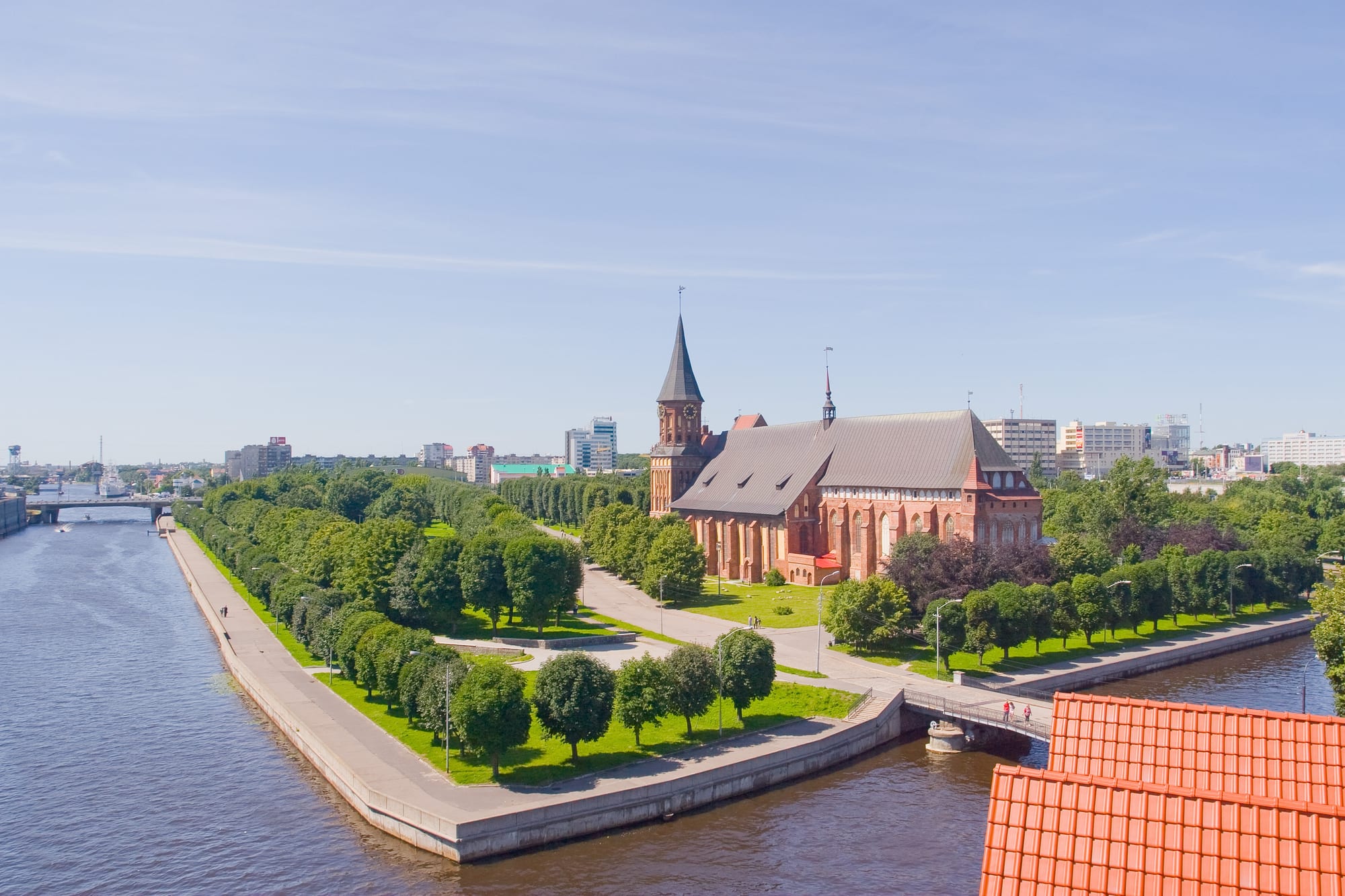
The red-brick Gothic cathedral with a tall spire among trees on Kant Island, with the Pregolya river curving past on the left

Kaliningrad, Russia

Kaliningrad

Königsberg Cathedral on Kant Island in the Pregolya river, Kaliningrad. (Gumerov Ildar / Wikimedia Commons · Public domain)

The capital of Russia's Baltic exclave, on the Pregolya river between Poland and Lithuania — founded as Königsberg by the Teutonic Knights in 1255, the coronation city of the Prussian kings and Kant's home, then destroyed in 1944–45, emptied of Germans and rebuilt as a Soviet city. A restored cathedral, city gates and amber remain. This page is written to explain the city, not to encourage travel.

Neighbourhoods

  • Kant Island
    • First-time visitors
    • Historic district

    The former Kneiphof, one of the three medieval towns of Königsberg, on an island between the branches of the Pregolya. Today it is a park around the restored cathedral and Kant's tomb, crossed by the Leninsky Prospekt viaduct with a footpath down to the island.

    Open in Maps
  • Fishing Village
    • Riverside walks
    • Best for food

    A modern riverside quarter on Oktyabrsky Island, built in the half-timbered style of pre-war Königsberg rather than as a reconstruction, with hotels, restaurants and an embankment along the Pregolya, close to the cathedral.

    Open in Maps
  • Victory Square and the centre
    • Close to public transport
    • Shopping

    The heart of the post-war city, in a northern suburb that survived the war intact. City hall in the 1923 Stadthaus, the Orthodox cathedral, banks, shopping centres and the North railway station for trains to the coast surround the square.

    Open in Maps
  • Amalienau
    • Architecture
    • Quiet and residential

    A villa suburb laid out in western Königsberg from 1901 for the upper class, with leafy streets of pre-war houses, many of them maintained after Soviet officials took them over after the war.

    Open in Maps
  • The Upper and Lower Ponds
    • Parks and walks
    • Museums

    Two artificial lakes north of the centre. The Lower Pond, about a kilometre long, has a promenade popular in summer; the larger Upper Pond has the Amber Museum on its shore.

    Open in Maps

Things to do

Königsberg landmarks

  • Königsberg Cathedrallandmark

    The 14th-century Brick Gothic cathedral on Kant Island, burnt out in the RAF raids of August 1944 and rebuilt from 1992, now a concert hall with two organs, with Kant's tomb against its outer wall.

    Open in Maps
  • King's Gatelandmark

    A city gate of 1765, redesigned by Friedrich August Stüler in 1850, with statues of Ottokar II, Frederick I and Duke Albert, restored with new statues for the city's 750th anniversary in 2005.

    Open in Maps
  • Brandenburg Gatelandmark

    One of the seven surviving city gates, built in 1657 and much altered in 1843, and the only one still used by traffic as intended.

    Open in Maps
  • Friedland Gatemuseum

    Another of the old city gates, now home to a museum.

    Open in Maps
  • Juditten Churchlandmark

    Kaliningrad's oldest building, a fortified church of the late 13th century in the Mendeleyevo district, once a medieval pilgrimage shrine and now Russian Orthodox.

    Open in Maps
  • Königsberg Stock Exchangemuseum

    A Neo-Renaissance exchange of 1875 on the Pregolya's southern bank, one of the few central buildings to survive the war, now home to the Kaliningrad Museum of Fine Arts.

    Open in Maps
  • Königsberg Synagoguelandmark

    A new synagogue opened in 2018 on the site of the one of 1896 that was destroyed after Kristallnacht in November 1938, as a modified replica of the destroyed building.

    Open in Maps

The Soviet and Russian city

  • Victory Squarelandmark

    The central square of the post-war city, renovated with a fountain and a triumphal column for the 750th anniversary in 2005.

    Open in Maps
  • Cathedral of Christ the Saviourlandmark

    The largest church in the oblast, an Orthodox cathedral completed in 2006 beside Victory Square.

    Open in Maps
  • Kaliningrad Stadiumattraction

    The stadium on Oktyabrsky Island built for the 2018 FIFA World Cup, home to FC Baltika Kaliningrad.

    Open in Maps

Museums

  • Kaliningrad Regional Amber Museummuseum

    About 14,000 amber pieces in the Dohna Tower, a Napoleonic-era fortification on the Upper Pond, including the world's second-largest piece of amber and thousands of inclusions.

    Open in Maps
  • Museum of the World Oceanmuseum

    A maritime museum on the Pregolya embankment with museum ships moored alongside, among them the research vessel Vityaz and the Cold War submarine B-413.

    Open in Maps
  • Kaliningrad Regional Museum of History and Artsmuseum

    The city's oldest museum, founded in 1946 in the former Stadthalle, with branches including a wartime bunker and a Prussian fort.

    Open in Maps
  • Bunker Museummuseum

    A wartime bunker, now a branch of the regional museum, covering the city's German past and its capture in 1945, with dioramas of the fighting.

    Open in Maps

Parks and lakes

  • Lower Pondpark

    An artificial lake in northern Kaliningrad, the Schlossteich of Königsberg, ringed by a promenade.

    Open in Maps
  • Upper Pondpark

    A 41-hectare artificial lake in the north of the city, the Oberteich of Königsberg, with the Amber Museum on its shore.

    Open in Maps
  • Kaliningrad Zoopark

    Founded as the Königsberg Tiergarten in 1896, one of Russia's oldest and largest zoos, spread over 16.5 hectares that also form an arboretum.

    Open in Maps

Short trips from the city

  • Zelenogradskattraction

    The former spa of Cranz on the Baltic coast, the gateway to the Curonian Spit.

    Open in Maps
  • Yantarnyattraction

    A settlement on the Sambian Peninsula about 40 km from the city, home to the world's largest amber mine and a range of amber products.

    Open in Maps
  • Curonian Spitpark

    A spit of pine forest and high dunes between the Baltic and the Curonian Lagoon, shared with Lithuania and listed as a UNESCO World Heritage Site.

    Open in Maps

Seasonal events

  • Kaliningrad In RockAugust

    One of the city's two big rock festivals.

  • Kaliningrad City JazzAugust

    An annual jazz festival in the city.

  • City DaySeptember

    A two-day celebration of the city's founding in 1255, with concerts, performances, sport and fireworks.

Eat and drink

Long-standing places and food districts in Kaliningrad. Hours, ratings and directions come from your maps app, always current.

Kaliningrad classics

  • Königsberger Klopserestaurant

    The old city's best-known dish — meatballs in a creamy white sauce with capers — revived in restaurants since the 1990s.

    Open in Maps
  • Königsberg marzipancafe

    Marzipan flamed on top to a golden-brown finish, flavoured with rose water and often filled with jam, a speciality of the city since 1809.

    Open in Maps

Food districts and drink

  • Fishing Villageneighborhood

    Restaurants and cafés by the river in the modern quarter near the cathedral.

    Open in Maps
  • Victory Squareneighborhood

    Restaurants and cafés in and around the shopping centres of the main square, including a brewpub making its own beer.

    Open in Maps

Experience Kaliningrad

History

The Teutonic Knights destroyed the Old Prussian fort of Twangste in 1255 and built a fortress in its place, naming it Königsberg in honour of King Ottokar II of Bohemia. Three towns grew around it — the Altstadt, Löbenicht and Kneiphof, chartered between 1286 and 1327 — and the city, a member of the Hanseatic League from 1340, traded with Poland, Lithuania, England and the Netherlands. After the order was secularised in 1525, Königsberg became the capital of the Duchy of Prussia under Polish suzerainty, an early centre of the Reformation and home to a university founded in 1544. It was later the coronation city of the Prussian kings, though the capital moved to Berlin in 1701, and a centre of German, Polish and Lithuanian printing and learning, where Kant was born, taught and died.

The city grew to around 370,000 people as the capital of East Prussia. British bombing in 1944 and the Soviet siege of the following spring destroyed much of it, and the Red Army took it on 9 April 1945. The Potsdam Agreement placed it under Soviet rule; in July 1946 it was renamed after Mikhail Kalinin, and between 1947 and 1948 the remaining Germans were expelled, and the territory was settled with Soviet citizens, mostly ethnic Russians. The old centre was not rebuilt, and the ruins of the castle were demolished in the late 1960s on Brezhnev's orders.

For decades the city was closed to foreigners. After 1991 it was cut off from the rest of Russia by independent states, and after 2004 by members of NATO and the European Union. The cathedral was rebuilt from 1992, the city celebrated its 750th anniversary in 2005 and hosted World Cup matches in 2018, and the unfinished House of Soviets was demolished in 2023–24.

Culture & Customs

Kaliningrad lives among the remains of a city its people did not build. The German past was long ignored, but since the 1990s residents have examined it more openly, restoring the cathedral and the city gates and using the old names. Kant is the local hero: his tomb stands against the cathedral wall, a statue of him first unveiled in 1864 was recast in 1992, and the city's university bears his name. The writer E. T. A. Hoffmann was born here and has a museum, and Euler's 1736 solution of the puzzle of the seven bridges is a point of pride, though only two structures from his day survive. The city's name has been debated: in 2022 the government confirmed that renaming it would be "inappropriate", while the Polish authorities recommend the historical Polish name, Królewiec, in Polish.

Music is a strength. The regional philharmonic has an organ hall in the former Church of the Holy Family, the cathedral has two organs, and international festivals of classical, organ and jazz music are held, including the Don Cento Jazz festival every summer since 2006 and the Kaliningrad In Rock festival in August. The city has drama, musical and puppet theatres and belongs to the Silver Ring of historic towns of north-western Russia.

Sport centres on FC Baltika Kaliningrad, which plays at the stadium built for the 2018 World Cup. Amber is the local craft, sold across the city and shown at the Amber Museum. City Day in September marks the founding of 1255 with concerts and fireworks.

Daily Life

About 490,000 people lived in Kaliningrad in 2020, and the city has drawn many newcomers from the rest of Russia over the past two decades. Most residents are Russians who settled after 1945 and their descendants, with Belarusian and Ukrainian minorities and small communities of Tatars, Germans, Armenians, Poles and Lithuanians. Most of the city lies north of the Pregolya, in the Tsentralny and Leningradsky districts, with the Moskovsky district to the south.

A special economic zone created in 1996 gives manufacturers tax and customs breaks, and the city has become a manufacturing hub: one in three televisions in Russia is made in the region, and car plants assemble vehicles. Shipping, fishing and amber are the other main industries, and the city is the headquarters of the Russian Navy's Baltic Fleet. Kaliningrad was named the best city in Russia for business by Forbes in 2013.

Daily life has a slightly Central European rhythm — walks around the ponds and along the river, cafés and summer weekends on the coast. A few months after the 2022 invasion of Ukraine, Lithuania began applying EU sanctions that blocked about half the goods brought into the region by rail, and Russia answered with more shipments by sea. In February 2025 the city's power grid was disconnected from Russia's when the Baltic states interrupted the interconnector, and the region had to balance its grid internally.

Food

The settlers who arrived after 1945 brought their own cooking from across the Soviet Union, and everyday food is Russian: okroshka cold soup in summer, soups, dumplings and salads. Since the early 1990s, as the city rediscovered its past, restaurants have revived dishes of East Prussia. Königsberger Klopse are meatballs in a creamy white sauce with capers. Königsberg marzipan, first made by the Pomatti brothers in 1809, who became confectioners to the Prussian court, is flamed so that its surface turns golden brown, contains rose water and is often filled with jam. Another old speciality, Königsberger Fleck, a beef tripe soup, has not returned to local tables.

The Baltic and the Curonian Lagoon supply fish, and the city was built up after the war as one of the main fishing ports of the Soviet Union. Fish dishes and salads appear on most menus, beside pizza, sushi and Italian–Asian restaurants, which are among the most popular places to eat today; shawarma is increasingly common.

The city has its own vodka, Stari Königsberg, and its own beer, Ostmark, and a brewery restaurant on Victory Square makes its own beer. The Fishing Village by the river and the streets around the main square hold many of the restaurants and cafés.

Planning tools

Budget

Kaliningrad is cheaper than Moscow and St Petersburg, and hotels and restaurants are moderately priced, rising in July and August when the coast is busy. The real costs are in getting here, almost always by air via mainland Russia. Western-issued cards do not work, and most foreign cards cannot be used at ATMs.

Daily Budget Midrange
USD 85–180 (mid-range hotel, restaurants, museum tickets, a day trip to the coast)
Daily Budget Shoestring
USD 35–65 (hostel, canteens, buses and trolleybuses)

Bring all the cash needed from outside Russia, as Western-issued cards do not work.

Best Time to Visit

June to August is warmest, with long days for walking the river and a trip to the coast; September is usually still warm and sunny at first and brings City Day. Spring starts cold and windy and grows sunnier. November turns damp and foggy, and winter is grey but mild by Russian standards.

Suggested Number of Days

Two or three days cover the city itself. Four or five allow for day trips out to the coast, and the number depends mainly on how much of the surrounding region is included.

First Visit
2–3 days
With Surroundings
4–5 days

Transportation

Buses and minibuses are the main way around and are cheap, with some routes stopping running around 22:00–23:00. There are also three trolleybus lines, one remaining tram route on the oldest tram system in Russia, opened in 1895, and suburban trains. Kaliningrad North station serves the coastal towns. Taxis can be booked through apps.

Carry passport, visa and migration card at all times, and use an app to book taxis rather than taking street cabs.

Airport & Station Connections

Khrabrovo Airport is 24 km north of the city, with mainly domestic flights; buses and taxis run to the centre. Russian aircraft are banned from EU airspace, which flights to and from mainland Russia must avoid. Trains from mainland Russia cross Lithuania without stopping and need a Lithuanian transit document, and road crossings into Poland and Lithuania can involve long delays at the border.

Walkability

The centre is walkable: Kant Island, the Fishing Village, the river embankments and Victory Square are within easy reach of each other, and the stadium stands on Oktyabrsky Island, the same island as the Fishing Village. The city gates, the ponds and Amalienau are further out and easier by bus. Broad Soviet avenues and road viaducts break up some routes.

Safety

Beyond the ordinary crime of a large European city, the decisive risks are political and legal: near-total loss of consular support, a real risk of arbitrary arrest and lengthy detention of foreigners on politically motivated charges (and their use in prisoner swaps), sweeping wartime censorship laws, and the possibility that men of certain ages, including dual nationals, face conscription or exit bans. Kaliningrad is the headquarters of the Baltic Fleet and one of the most heavily militarised places in Europe, and the border regime with Poland and Lithuania can change quickly.

Most governments advise against all travel to Russia; keep well away from military areas at Baltiysk and elsewhere. Never photograph military or port sites, and do not count on leaving by land. Check current official travel advice before travelling.

Climate

A mild, damp climate with maritime influence, on the boundary between oceanic and humid continental. Monthly average temperatures range from about −1.5°C to 18°C, and the city gets about 1,700 hours of sunshine a year. Spring starts cold and windy, and autumn turns cold, damp and foggy in November.

Summer
mostly warm, with plenty of sunshine and heavy showers; the temperature reaches 30–35°C at least once in most years
Winter
cold and cloudy but moderate for Russia, with periods of snow; January and February are the coldest months, sometimes dropping to −15°C

Local Customs

Russian manners apply — reserved greetings with strangers, warm hospitality and toasts at the table. The German past is part of local identity: old Prussian names are used freely, and Kant is treated as the city's own. Orthodox churches expect modest dress, with women usually covering their heads.

Ask before photographing people, never photograph military or port facilities, and remember that public expression on the war is restricted by law.

Common Payment Methods

The currency is the rouble (RUB). Visa and Mastercard issued abroad do not work, and ATMs will not accept foreign cards, so cash brought in and exchanged is the only reliable way to pay.