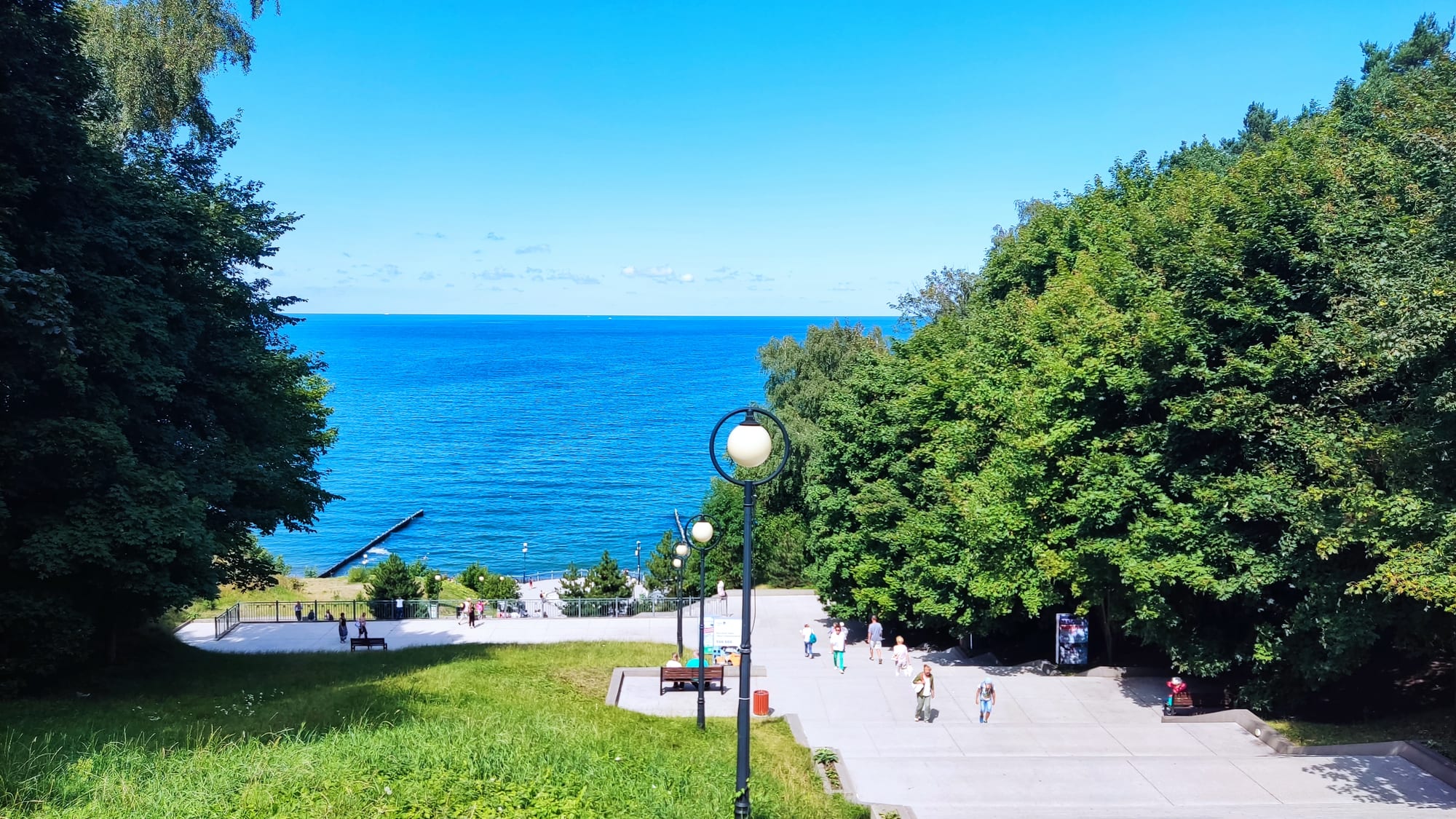
A wide paved stairway and lamp posts leading down through green trees to the promenade and the deep blue Baltic Sea

Kaliningrad, Russia

Svetlogorsk

Steps from the upper town down to the seaside promenade in Svetlogorsk. (Alexander Grebenkov / Wikimedia Commons · CC BY 3.0)

A small Baltic resort on the Sambian coast north of Kaliningrad — the German spa of Rauschen until 1947, built up from 1820 with villas, a water tower and a promenade below the wooded cliff. It largely escaped the destruction of the Second World War and keeps some of the best-preserved Prussian-era architecture in the region. This page is written to explain the city, not to encourage travel.

Neighbourhoods

  • The upper town
    • First-time visitors
    • Architecture
    • Close to public transport

    The centre on the clifftop, 40–50 metres above the sea, built up in the early 20th century with villas and boarding houses in half-timbered, neo-Gothic and historicist styles around the old water tower. The Svetlogorsk-2 station and the bus stop are here.

    Open in Maps
  • The promenade and the beach
    • Beaches
    • Seafront walks

    A seafront walk of more than a kilometre at the foot of the wooded cliff, reached by long staircases and a cable car, with sculptures, canopied benches, food stalls and amber sellers. It is very busy in summer and quiet in winter.

    Open in Maps
  • Lake Tikhoye and the lower town
    • Quiet and residential
    • Parks

    The old mill pond of the fishing village, where the first holidaymakers stayed before the town moved up to the cliff. The lake remains a quiet corner with clean air and thick shoreline vegetation.

    Open in Maps

Things to do

The seafront

  • The promenadetrail

    A seafront walk first laid out on wooden stilts in 1908, now more than a kilometre long, decorated with a bronze mermaid among fish and a nymph in a mother-of-pearl shell.

    Open in Maps
  • Zodiac sundiallandmark

    A sundial 10.1 metres across, made by a team under the sculptor Nikolai Frolov and installed on the embankment in 1974.

    Open in Maps
  • Nymphlandmark

    A statue of a young nymph by the German sculptor Hermann Brachert, one of the town's symbols, at the foot of the long staircase from the centre.

    Open in Maps
  • Cable cartransit hub

    Enclosed cabins that carry passengers between the beach and the town, a necessity for many on a slope that rises some 40 metres.

    Open in Maps

The old spa town

  • Water towerlandmark

    A 25-metre reinforced-concrete tower by Otto Kuckuck, built in 1900–1908 for a hydrotherapy clinic, once the tallest building in Rauschen, with an observation deck under its helmet-shaped roof.

    Open in Maps
  • Wheel of Historymuseum

    An exhibition opened in 2014 on the story of Rauschen and Svetlogorsk, with everyday objects and rare photographs.

    Open in Maps
  • Lake Tikhoyepark

    The former Mühlenteich, a mill pond dammed by the Teutonic Order, on whose shores the first visitors stayed in fishermen's houses.

    Open in Maps

Short trips from the town

  • Pionerskyattraction

    A neighbouring coastal town to the east, on the railway and the Primorsky Ring road from Kaliningrad.

    Open in Maps
  • Yantarnyattraction

    A settlement to the south-west on the Sambian Peninsula, home to the world's largest amber mine.

    Open in Maps
  • Zelenogradskattraction

    The former spa of Cranz further east along the coast, the gateway to the Curonian Spit.

    Open in Maps

Eat and drink

Long-standing places and food districts in Svetlogorsk. Hours, ratings and directions come from your maps app, always current.

Svetlogorsk classics

  • Fisherman's Houserestaurant

    A restaurant known as one of the best places in the region to try traditional fish dishes of the Baltic.

    Open in Maps
  • Promenade food stallsneighborhood

    Food and drink stalls along the seafront, busy in summer and mostly closed in winter.

    Open in Maps

Cafés in the upper town

  • Upper town cafés and restaurantsneighborhood

    Year-round cafés and restaurants in the streets of the centre near the station.

    Open in Maps

Experience Svetlogorsk

History

Svetlogorsk began in 1258 as a fishing settlement of the Sambians, the Old Prussian people of the peninsula, called Ruse-moter. The Teutonic Order dammed the stream that flows into the lake and built a mill, the largest in Sambia in the order's time; the lake became the Mühlenteich and the name drifted into Rauschen. In the early 19th century the village became fashionable with German holidaymakers, who stayed by the lake because a high dune blocked the way to the sea, and on 24 June 1820 it was recognised as a spa. Frederick William IV ordered the seafront to be improved during his visit in 1840.

A railway from Königsberg arrived in 1900 and was extended in 1906, and the resort boomed. A wooden promenade on stilts was built along the beach in 1908 and a funicular in 1912, while villas and boarding houses in half-timbered, neo-Gothic and historicist styles filled the upper town, along with a water tower and hydrotherapy clinic and a church consecrated in 1907. The composer Otto Nicolai, Wilhelm von Humboldt, Käthe Kollwitz and Thomas Mann were among its guests. During the First World War the resort was taken over by convalescing German officers.

Soviet troops took Rauschen on 14 April 1945, the German residents were expelled, and on 17 June 1947 the town was renamed Svetlogorsk. Unlike Königsberg it largely escaped wartime destruction. It became a Soviet resort, and in May 1972 a military transport plane crashed into a kindergarten, killing all eight on board and more than twenty children and three adults on the ground. In 2019 it became a town of regional significance.

Culture & Customs

Svetlogorsk keeps some of the best-preserved Prussian-era architecture of any former Soviet town in historic Prussia, and its identity rests on that resort past. Its symbols mix the old and the new: the water tower, the Nymph by the German sculptor Hermann Brachert, who lived for more than ten years in neighbouring Otradnoye, the Soviet-era zodiac sundial of 1974 and a modern Frog Princess statue near the station. The town is a member of the Cittaslow network of slow towns.

For a town of its size it has a busy cultural calendar. It hosts conferences, art festivals, workshops and concerts, the Baltic Seasons arts festival, the Amber Panther film festival and, since 2004, Baltic Debuts, a festival of films by young directors from the Baltic and Northern European countries and Russia. In 1995 the composer and pianist Andrei Makarov opened an organ concert hall in a former German Catholic chapel, Santa Maria Stella Maris, which he had restored at his own expense. In 2015 the KVN festival Golosyashchy KiViN moved here from Jurmala in Latvia because of the political situation.

Summer life centres on the promenade, where tables of amber jewellery and trinkets line the streets and the seafront, and on the beach below the cliff.

Daily Life

About 16,000 people lived in Svetlogorsk at the 2021 census. It is the administrative centre of Svetlogorsky District, and since 2018 its urban settlements have been merged into one municipality. The economy rests on tourism and health: sanatoriums, spas and holiday homes, including military sanatoriums, alongside the cafés, restaurants and shops of the resort.

The year has two rhythms. In summer the town fills with holidaymakers from Kaliningrad and the rest of Russia, the promenade is crowded and the stalls are open; in the 1980s trains left Kaliningrad every 20 minutes and many city residents came to swim after work. In winter most seafront stalls close and the town returns to a quiet residential life.

Transport links have improved: the Primorsky Ring highway, completed to Svetlogorsk in 2012, replaced a dangerous old road and shortened the way to the airport, and the railway runs to two stations in the town. The steep slope between the town and the beach shapes everyday movement, and the cable car is a necessity for older residents.

Food

Svetlogorsk eats from the Baltic. Fish from the coast is the obvious choice, and the town has restaurants known for traditional fish dishes of the Baltic region.

Restaurants in Kaliningrad offer specialities of former East Prussia: Königsberger Klopse, meatballs in a creamy white sauce with capers, and Königsberg marzipan, flamed on top to a golden-brown finish and flavoured with rose water. The region also has its own beer and vodka brands, Ostmark and Stari Königsberg. Settlers who arrived after 1945 brought their own cooking from across the Soviet Union, so summer menus can include okroshka, the cold soup served across Russia.

Most eating out in summer happens along the promenade, where food and drink stalls line the seafront, though most of them close in winter. The upper town has cafés and restaurants open all year. Everyday Russian food — soups, dumplings, blini and salads — is easy to find throughout the town.

Planning tools

Budget

Svetlogorsk is moderately priced outside July and August, when it fills with holidaymakers and prices on the coast rise sharply. Many visitors come for the day from Kaliningrad by train or bus. Western-issued cards do not work, so money must be brought in as cash.

Daily Budget Midrange
USD 85–180 (mid-range hotel or sanatorium, restaurants, excursions along the coast)
Daily Budget Shoestring
USD 35–65 (guesthouse, cafés and stalls, trains and buses from Kaliningrad)

Bring all the cash needed from outside Russia, and book summer rooms early.

Best Time to Visit

June to early September is the beach season, when the promenade is busiest and the stalls are open. May and September are quieter and good for walking. The town has the longest frost-free season in the region, but winters are grey and many seafront businesses close.

Suggested Number of Days

The town is small and many visitors come for a day from Kaliningrad. Staying two or three nights allows a slower pace and time for the rest of the coast; a beach holiday in summer can easily take longer.

First Visit
1 day
With Surroundings
2–3 days

Transportation

The town is small enough to cover on foot. The cable car and long staircases link the upper town with the beach, and buses run to Kaliningrad, Otradnoye and other coastal towns from the stop near Svetlogorsk-2 station.

Carry passport, visa and migration card at all times, and use the cable car if the steep steps are a problem.

Airport & Station Connections

Suburban trains from Kaliningrad's South and North stations run to Svetlogorsk-1 and Svetlogorsk-2, the terminus nearest the centre, taking about an hour, though there are fewer than ten a day in each direction. Buses run from Kaliningrad's bus station every 20 minutes. By road the Primorsky Ring highway, about 45 km from Kaliningrad, also links the town with Khrabrovo Airport.

Walkability

Everything is within walking distance, but the town is split between the clifftop and the beach, with a height difference of about 40 metres climbed by steep staircases and serpentine paths. The promenade itself is flat and runs for more than a kilometre.

Safety

Beyond the ordinary crime of a large European city, the decisive risks are political and legal: near-total loss of consular support, a real risk of arbitrary arrest and lengthy detention of foreigners on politically motivated charges (and their use in prisoner swaps), sweeping wartime censorship laws, and the possibility that men of certain ages, including dual nationals, face conscription or exit bans. The Kaliningrad exclave is one of the most heavily militarised places in Europe, and the town has military sanatoriums.

Most governments advise against all travel to Russia; keep well away from military areas at Baltiysk and elsewhere. Do not photograph military sites, and do not count on leaving the exclave by land. Check current official travel advice before travelling.

Climate

A mild climate strongly shaped by the sea. The average annual temperature is about 7°C, and the frost-free period, 180–190 days, is the longest in Kaliningrad Oblast.

Summer
mild — July, the warmest month, averages about 17°C
Winter
cool and damp — January, the coldest month, averages about −3°C

Local Customs

A resort town with relaxed habits in summer, but Russian manners apply — reserved greetings with strangers and warm hospitality at the table. Churches expect modest dress.

Ask before photographing people, never photograph military facilities, and remember that public expression on the war is restricted by law.

Common Payment Methods

The currency is the rouble (RUB). Visa and Mastercard issued abroad do not work, and most foreign cards cannot be used at ATMs, so cash brought in and exchanged is the only reliable way to pay.