The two snow-covered summits of Mount Elbrus rising above glaciers and dark volcanic rock under a deep blue sky

Russia

The North Caucasus

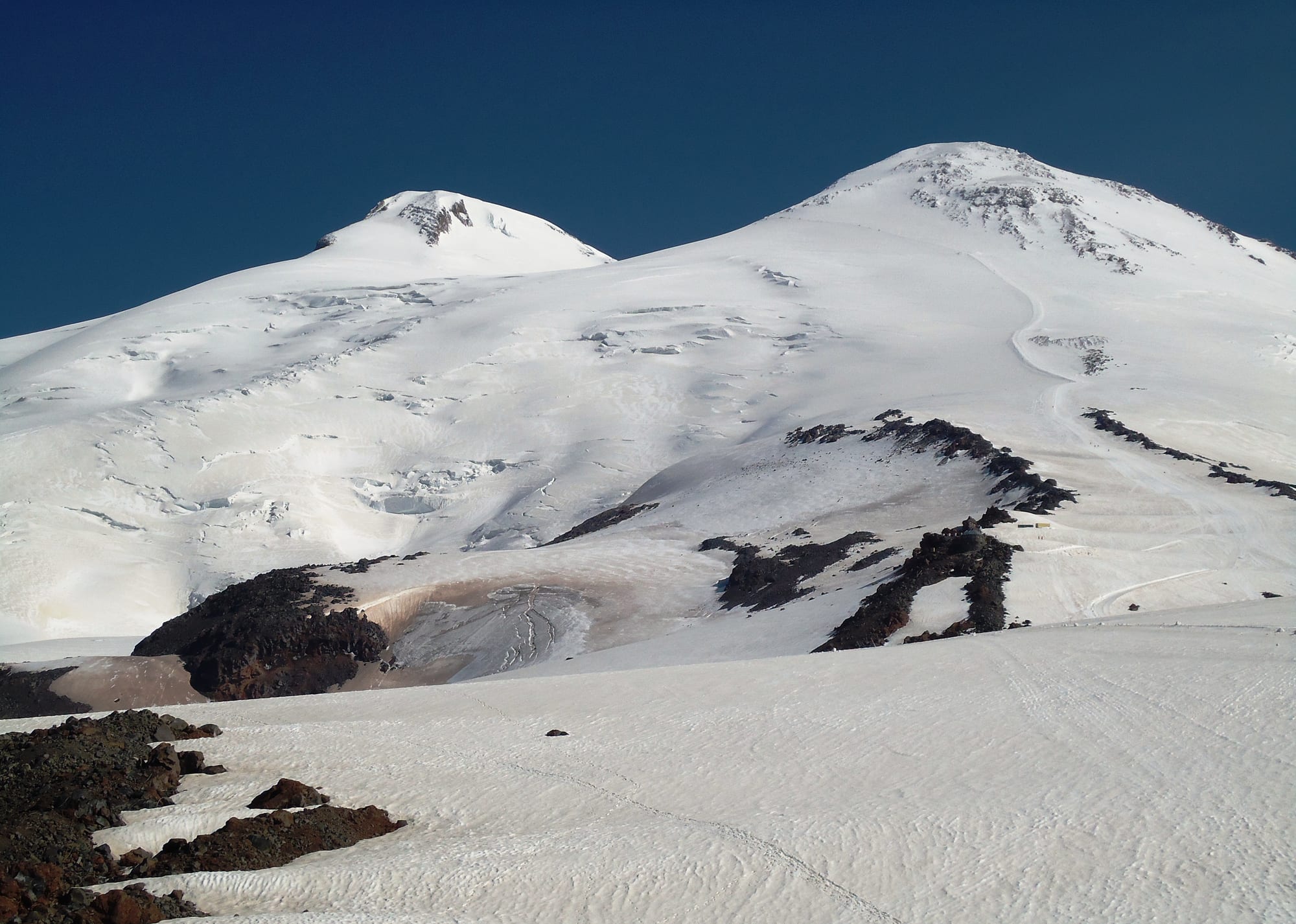
The twin summits of Mount Elbrus seen from the south-east, above the climbing route from the Priyut 11 hut. (SKas / Wikimedia Commons · CC BY-SA 4.0)

Russia's mountainous southern edge, running from the spa towns of Stavropol Krai up to Mount Elbrus and across the republics of Kabardino-Balkaria, North Ossetia, Ingushetia and Chechnya to Dagestan and ancient Derbent on the Caspian — a mosaic of peoples, languages and faiths shaped by conquest and war. This page is written to explain the region, not to encourage travel.

Explore The North Caucasus

History

The Caucasus has been a crossroads since antiquity. Derbent, where the mountains meet the Caspian, controlled the coastal route between the steppe and Persia, and in the 6th century the Sasanian Persians built the Naryn-Kala citadel and walls that still stand. Arab armies arrived in the 7th century and brought Islam to Dagestan. In the centre, the Alans, an Iranian-speaking people and ancestors of today's Ossetians, built a Christian kingdom whose 10th-century churches survive at Arkhyz, until the Mongols and Timur destroyed it.

Russian expansion began in earnest in the late 18th century, with Vladikavkaz founded in 1784 as a fortress on the road to Georgia and Grozny in 1818. The Caucasian War lasted decades: Imam Shamil united Dagestani and Chechen highlanders in a Muslim state until his surrender at Gunib in 1859. Meanwhile Russian society discovered the spa towns of Pyatigorsk and Kislovodsk, where the poet Mikhail Lermontov was killed in a duel in 1841.

Soviet rule brought collectivisation, persecution of religion and, in 1943–44, the deportation of whole peoples — Chechens, Ingush, Karachays and Balkars — to Central Asia, where many died before they were allowed back in 1957. After 1991 Chechnya declared independence, and two wars, in 1994–96 and from 1999, destroyed Grozny and killed tens of thousands. The region also saw the Ossetian–Ingush conflict of 1992, and in 2004 the Beslan school siege in North Ossetia, in which more than 330 hostages died, over half of them children. Since 2007 Chechnya has been ruled by Ramzan Kadyrov, and an Islamist insurgency has flared in Dagestan and Kabardino-Balkaria.

Culture & Customs

The North Caucasus is the most diverse part of Russia. Dagestan alone has more than thirty peoples — Avars, Dargins, Kumyks, Lezgins, Laks and others — with no single majority, and Russian serves as their common language. Chechens and Ingush speak related Nakh languages, the Kabardians and Circassians Adyghe languages, the Karachays and Balkars a Turkic language, and the Ossetians an Iranian one.

Most peoples are Sunni Muslim, and religious observance has grown strongly since the Soviet era, especially in Chechnya, Ingushetia and Dagestan, where alcohol is scarce and dress is conservative. North Ossetia is mostly Orthodox Christian, with older traditions of sacred groves and shrines. Stavropol Krai is largely Russian and Orthodox.

Across the region, honour, family and clan loyalties, respect for elders and hospitality to guests carry great weight, and the rules of mountain etiquette are strict. Weddings are huge events with the lezginka, the fast Caucasian dance, performed by men and women. Crafts have deep roots: the silversmiths and weapon-makers of Kubachi, the pottery of Balkhar and the carpets of southern Dagestan. Wrestling and mixed martial arts are passions, and Dagestan has produced many world champions. Medieval stone tower complexes in Ingushetia and Chechnya are symbols of clan identity.

Daily Life

Makhachkala, with about 600,000 people, is the largest city, followed by Stavropol, then Grozny and Vladikavkaz at about 300,000 each, and Nalchik. The spa towns of Pyatigorsk, Kislovodsk, Yessentuki and Zheleznovodsk form a separate cluster in the south of Stavropol Krai, and many Dagestanis still live in mountain villages or have moved down to the Caspian lowlands.

The republics are among the poorest regions of Russia and depend heavily on subsidies from Moscow; unemployment is high and many young men work elsewhere in Russia or in the security forces. Farming, fruit growing, construction, trade and the sanatoriums of the spa towns provide jobs, and Stavropol Krai is a major grain-growing region. Dagestan has a fishing and brandy industry on the Caspian.

Birth rates are high, families are large and populations young, in contrast with the rest of the country. Daily life is shaped by religion and kinship, by the presence of police and checkpoints, and in Chechnya by the pervasive authority of Kadyrov's administration. Men from the region have been heavily recruited for the war in Ukraine.

Food

Mountain food here is built on meat, dough, cheese and dairy. Ossetian pies are the region's best-known dish: round, thin pies filled with cheese, meat, potato or beet leaves, with three served at a feast, representing the sun, the earth and water. The Karachays and Balkars make khychin, a flat griddle bread filled with cheese and potato, and drink ayran, a fermented milk drink.

Dagestan's khinkal is different from the Georgian dumpling: pieces of boiled dough served with boiled meat, broth and garlic sauce. Chudu, thin flat pies with meat, cheese or greens, and kurze, pleated dumplings, are also Dagestani, as is urbech, a thick paste ground from flax or other seeds or nuts and eaten with honey. In Chechnya the national dish is zhizhig-galnash, boiled meat with dumplings and garlic sauce.

Kislovodsk gave its name to Narzan mineral water, and the springs of Yessentuki and Pyatigorsk are drunk for health. Dagestan produces brandy at Kizlyar and Derbent. Shashlik, grilled lamb, is eaten everywhere, and fresh cheeses come from the herds of the high pastures.

Attractions & Natural Wonders

Mount Elbrus is reached through the Baksan valley in Kabardino-Balkaria, where cable cars climb from Azau towards the Garabashi huts and Cheget offers views across the range. In Karachay-Cherkessia, Dombay lies in the Teberda Nature Reserve beneath glaciers and peaks, and Arkhyz has medieval Alan churches and the Special Astrophysical Observatory's large telescopes.

The spa towns around Kislovodsk were built for the 19th-century aristocracy: Kislovodsk's park and Narzan Gallery, Pyatigorsk's Mount Mashuk and Lermontov sites, and the pump rooms of Yessentuki and Zheleznovodsk.

North Ossetia has Vladikavkaz, the Dargavs "city of the dead" with its stone crypts, and the Karmadon gorge. Ingushetia's mountain valleys hold the medieval tower complexes of Vovnushki and Egikal. Grozny has the Heart of Chechnya mosque and its rebuilt centre, and in the mountains of Chechnya are the towers of the Argun gorge and Lake Kezenoyam on the border with Dagestan.

Dagestan's mountain villages are its greatest sight: Gunib, where Shamil surrendered, the abandoned village of Gamsutl, and the craft centres of Kubachi and Balkhar. The Sulak Canyon, carved by the Sulak River, and the Sarykum sand dune are the natural wonders. Ancient Derbent, on the Caspian, has its Naryn-Kala citadel, walls running down to the sea, and an old Juma Mosque in its maze of lanes.

Cities in The North Caucasus

Planning basics

Budget

The North Caucasus is one of the cheapest parts of Russia for food, guesthouses and local transport, although the spa towns of Kislovodsk and Pyatigorsk and the ski areas at Elbrus and Dombay charge more in season. Guides and drivers for the mountains and for Dagestan's remote villages are a significant extra cost. Foreign cards do not work, and cash is needed everywhere.

Daily Budget Midrange
USD 85–180 (hotel or sanatorium, restaurants, cable cars, a driver or guide)
Daily Budget Shoestring
USD 30–60 (guesthouse, cafés and bakeries, shared taxis and buses)

Carry enough cash for the whole stay, and agree prices with drivers and guides before setting out.

Safety

This is the most dangerous region of Russia apart from the Ukrainian border. Most governments advise against all travel to the North Caucasus republics because of terrorism, kidnapping and armed attacks: gunmen struck churches, a synagogue and police in Derbent and Makhachkala in June 2024, and a mob stormed Makhachkala airport in 2023 looking for passengers from Israel. Chechnya is run by Ramzan Kadyrov's security forces, with documented torture, disappearances and severe persecution of LGBT people. Checkpoints are everywhere, and consular help is very limited.

Most governments advise against all travel to Chechnya, Ingushetia, Dagestan and the neighbouring republics; mountain hazards and avalanches add further risk. Check current official travel advice before travelling.

Climate

The foothills and Stavropol plains are continental, with hot summers and cold winters; Kislovodsk is known for its many sunny days. The high Caucasus is alpine, with permanent snow and glaciers on Elbrus and snow from about November to April in the ski valleys. Dagestan's Caspian coast is hot and dry in summer and mild in winter.

Summer
warm to hot, 25–32°C in the lowlands; cool and changeable in the mountains, with afternoon storms
Winter
cold and snowy in the mountains; around 0°C in the foothills; mild on the Caspian coast

Transportation

Mineralnye Vody airport is the hub for the spa towns, Elbrus and Dombay, and Makhachkala, Grozny, Vladikavkaz and Nalchik also have airports. Long- distance trains from Moscow reach Kislovodsk, Nalchik, Vladikavkaz and Makhachkala in more than a day. Local travel is by minibus, shared taxi or hired driver; the Baksan valley road to Elbrus takes several hours from the spa towns. The road across the mountains to Georgia runs through Vladikavkaz and the Upper Lars crossing.

Use known drivers or guides for mountain roads and remote villages, and carry a passport for frequent police checkpoints.

Best Time to Visit

June to September is the season for the mountains, mountain villages and the Elbrus climbing routes. May and September to October are pleasant in the spa towns and in Dagestan, and the ski season at Elbrus and Dombay runs roughly from December to April. Ramadan affects opening hours in the Muslim republics.