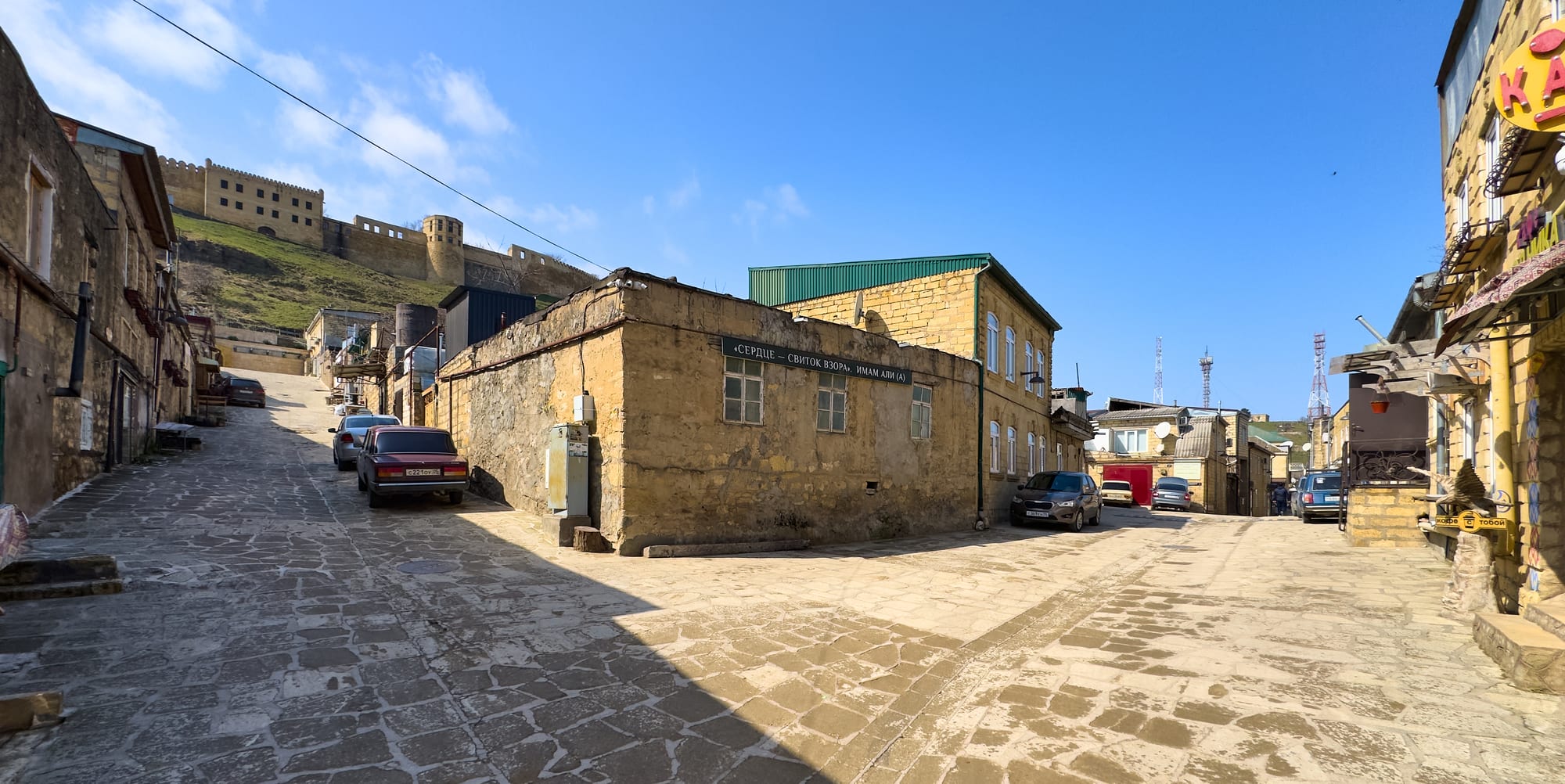
A lane of low stone houses in the old town of Derbent

The North Caucasus, Russia

Derbent

A street in the old town of Derbent. (Vyacheslav Bukharov / Wikimedia Commons · CC BY-SA 4.0)

Russia's southernmost city, on a narrow strip of land between the Caspian Sea and the Caucasus in southern Dagestan, and often called its oldest — a Persian gateway fortress whose Sasanian citadel and twin walls running down to the sea are a UNESCO World Heritage Site, with an old town of mosques, baths and lanes between them. This page is written to explain the city, not to encourage travel.

Neighbourhoods

  • Old town
    • First-time visitors
    • Historic district
    • Architecture

    The historic city between the two long walls, a maze of stone lanes and quarters running downhill from the citadel towards the sea, with the Juma Mosque, smaller mosques, old baths, cisterns and the city gates.

    Open in Maps
  • Naryn-Kala
    • History
    • Views

    The walled citadel on the hill at the top of the old town, enclosing about 4.5 hectares, with baths, the ruins of the shah's palace, a cross-domed structure that some consider an early church, and views down the walls to the Caspian.

    Open in Maps
  • Lower town
    • Close to public transport
    • Local life

    The newer city below the old town towards the sea, with the railway station, the parks named after Sergei Kirov and Nizami Ganjavi, the lighthouse on the wall and the shops of the modern centre.

    Open in Maps
  • Northern seafront
    • Beaches
    • Quiet and residential

    The north of the city, where a laid-out embankment and beach make the most pleasant stretch of the coast; the historic shoreline itself is largely industrial.

    Open in Maps

Things to do

The fortress

  • Naryn-Kalalandmark

    The citadel built under the Sasanian emperor Khosrow I, part of the UNESCO-listed fortress, connected to the sea by double walls built to block the Caspian Gates.

    Open in Maps
  • Fortifications of Derbentlandmark

    The twin long walls running from the citadel to the Caspian, dating from the 6th century and repaired by Arab, Mongol, Timurid, Shirvan and Persian rulers, with gates and towers along their length.

    Open in Maps
  • Derbent Lighthouselandmark

    The southernmost lighthouse in Russia, standing on the fortress wall in the city centre about half a kilometre from the shore.

    Open in Maps

Mosques, churches and cemeteries

  • Juma Mosquelandmark

    A Shia Friday mosque and madrasa in the heart of the old town, considered the oldest mosque in Russia; some features suggest it was rebuilt from a Christian church.

    Open in Maps
  • Kyrkhlyar cemeterylandmark

    A revered cemetery founded in the 7th century, the oldest active Muslim cemetery in Russia, named after forty early Muslim fighters said to be buried here.

    Open in Maps
  • Church of the Holy All-Saviormuseum

    An Armenian church of 1860 whose dome still rises over the skyline, now the museum of carpets and decorative arts of the Derbent museum-reserve.

    Open in Maps
  • Kyrhlyar Mosquelandmark

    A mosque beside the Kyrkhlyar gate of the old town.

    Open in Maps

Museums

  • House of Peter Imuseum

    The site of the earthen hut where Peter the Great stayed in 1722 during his Persian campaign, now under a glass-walled pavilion with a museum.

    Open in Maps
  • Museum of the History of World Cultures and Religionsmuseum

    A museum in the city devoted to the many faiths and peoples that have passed through Derbent.

    Open in Maps

The seafront

  • Northern embankment and beachbeach

    The city's laid-out seafront promenade and beach, in the north of Derbent.

    Open in Maps

Eat and drink

Long-standing places and food districts in Derbent. Hours, ratings and directions come from your maps app, always current.

Dagestani classics

  • Central marketmarket

    The city's market beside the northern bus station, a busy local trading place where minibuses and shared taxis also gather.

    Open in Maps
  • Old town cafésneighborhood

    Cafés and restaurants in the old town and centre, the places to look for Dagestani dishes such as khinkal, chudu and kurze.

    Open in Maps
  • Derbent brandyneighborhood

    The city is the centre of Russian brandy production.

    Open in Maps

Experience Derbent

History

Historical records of Derbent go back to the 8th century BC, and it is considered Russia's oldest city. Its whole history comes from geography: a strip of land about three kilometres wide between the Caspian and the mountains, the eastern of the only two practicable routes across the Caucasus. Under Persian rule it belonged to Caucasian Albania, and in the late 5th or early 6th century the Sasanian king Kavad I re-founded it; his son Khosrow I built the citadel and the walls, about 20 metres high, that ran down to the sea to keep the northern nomads out. Its Persian name, Darband, means a gate in a barrier.

The Arabs took it in 643 and called it Bab al-Abwab, the Gate of Gates, bringing Islam to the region; in the 9th century it was, by Arab accounts, the largest city in the Caucasus. It later passed to an emirate, the Mongols, Timur and the Shirvanshahs, and in the 16th century to Safavid Iran. Peter the Great took it briefly in 1722, and after the Russo-Persian War it was ceded to Russia by the Treaty of Gulistan in 1813.

Under Russian rule Derbent became the spiritual centre of the Mountain Jews, who made up about a third of the population in the mid-20th century before most emigrated after 1991. Today the citadel, the ancient city and the fortress are a UNESCO World Heritage Site. On 23 June 2024 armed attackers struck in Derbent and Makhachkala; the city's synagogue was set on fire and largely destroyed.

Culture & Customs

Derbent has always been a meeting point of peoples. Today Lezgins and Azerbaijanis each make up more than a third of the population, with Tabasarans, Dargins, Russians and Aghuls among the rest; in 1886 people of Persian descent were still a majority. The city keeps four theatres for its communities — Azerbaijani, Lezgin, Tabasaran and Judeo-Tat — an unusual sign of that mix.

Religion is woven into the city's fabric. The Juma Mosque, Shia and considered the oldest mosque in Russia, stands among smaller neighbourhood mosques, while the Kyrkhlyar cemetery, honouring forty early Muslim fighters, is the oldest active Muslim cemetery in the country. An Armenian church of 1860, now a museum of carpets and crafts, and an Orthodox church of 1899 recall the Christian communities, and the Mountain Jews, though now few, remain part of the city's story.

Across Dagestan the fast-paced lezginka is the best-known folk dance, and the republic has produced a disproportionate number of Olympic and world champions in freestyle wrestling. Derbent's own craft traditions connect with the carpets of southern Dagestan, displayed in the museum-reserve.

Daily Life

Derbent has roughly 128,000 people and is the administrative centre of the surrounding Derbentsky District, although it is not formally part of it. The economy includes machine building, food processing, textiles, fishing, building materials and wood, and the city is the centre of Russian brandy production. It also has a university and several technical schools, and about two kilometres outside the city is the Chayka (Seagull) holiday colony. The city covers about 70 square kilometres on the slopes of the Tabasaran Mountains, south of the Rubas River.

The city has two faces: the old quarters inside the walls, with their stone houses along narrow lanes, and the modern city below, with its station, parks and newer housing.

Like the rest of Dagestan, Derbent depends heavily on subsidies from Moscow, and police and checkpoints are a constant presence. Dagestani soldiers have fought in Russia's invasion of Ukraine, many of them killed, and in September 2022 the republic was a centre of protests against mobilisation.

Food

Derbent eats the food of Dagestan, built on meat, dough, cheese and dairy. Khinkal here is not the Georgian dumpling but pieces of boiled dough served with boiled meat, broth and garlic sauce. Chudu are thin flat pies filled with meat, cheese or greens, and kurze are long-shaped dumplings. Urbech, a thick paste ground from flax or other seeds or nuts, is eaten with honey. Chorba, a soup usually made with lamb and beef, fried vegetables and herbs, is cooked across the Caucasus and especially in Dagestan, and salty Nogai tea, brought to the region by the Nogais, is popular among Dagestanis.

Shashlyk, grilled meat, is widely eaten, and the city's fishing industry adds Caspian fish to the table.

Brandy is the city's best-known product: Derbent is the centre of Russian brandy production, while Kizlyar, in the north of Dagestan, has a brandy factory of its own. Even so, in the Muslim republics of the North Caucasus alcohol is scarce in everyday life, and dress and behaviour are conservative.

Planning tools

Budget

The North Caucasus is one of the cheapest parts of Russia for food, guesthouses and local transport, and Derbent is no exception. Foreign bank cards do not work, so cash is needed for everything, and drivers or guides for the mountains are the main extra cost.

Daily Budget Midrange
USD 85–180 (hotel, restaurants, a driver or guide)
Daily Budget Shoestring
USD 30–60 (guesthouse, cafés and bakeries, minibuses and shared taxis)

Carry enough cash for the whole stay, and agree prices with drivers and guides before setting out.

Best Time to Visit

May and September to October are pleasant, before and after the hot, dry summer; winters are mild on the Caspian coast. Ramadan affects opening hours in Dagestan.

Suggested Number of Days

One or two days are enough for the citadel, the walls and the old town. The mountain villages and craft centres of southern Dagestan need more time and, in practice, a local driver or guide.

First Visit
1–2 days
With Surroundings
3–4 days

Transportation

Derbent is small enough to cover on foot and by taxi. Minibuses and shared taxis run within the city and out to southern Dagestan, leaving from the two bus stations, the central market and the railway station; timetables are rarely posted and are best asked about locally.

Carry a passport for the frequent police checkpoints on the roads of Dagestan, and use known drivers for trips into the mountains.

Airport & Station Connections

Derbent has no airport; the nearest is Makhachkala Uytash Airport, near Kaspiysk to the north. Makhachkala itself is about 120 km away; commuter trains take around three hours and minibuses are faster. Long-distance trains from Moscow take about two nights, and the Azerbaijani border is about 50 km south on the road to Baku.

Walkability

The old town is made for walking but steep: its lanes climb from the lower town up to the citadel, often on uneven stone paving. Comfortable shoes help, and the summer heat makes the climb hard at midday. The northern seafront is a taxi ride away.

Safety

Beyond the ordinary crime of a large European city, the decisive risks are political and legal: near-total loss of consular support, a real risk of arbitrary arrest and lengthy detention of foreigners on politically motivated charges (and their use in prisoner swaps), sweeping wartime censorship laws, and the possibility that men of certain ages, including dual nationals, face conscription or exit bans. Dagestan carries the extra risks of the North Caucasus — terrorism, kidnapping and armed attacks: on 23 June 2024 gunmen attacked churches, synagogues and a police post in Derbent and Makhachkala, and Derbent's synagogue was burned. Checkpoints are frequent, and consular help is very limited.

Most governments advise against all travel to Chechnya, Ingushetia, Dagestan and the neighbouring republics; mountain hazards and avalanches add further risk. Most governments advise against all travel to Russia and against any travel near the Ukrainian border. Follow local news and police instructions, and avoid crowds and demonstrations. Check current official travel advice before travelling.

Climate

A semi-arid climate on the Caspian shore, between temperate and subtropical. Summers are hot and dry; winters are mild, and snow usually lies for only about two weeks a year. Records range from −19°C to 38.8°C.

Summer
hot and dry — July averages about 25.7°C
Winter
mild — February, usually the coldest month, averages about 3°C

Local Customs

Derbent is a largely Muslim city, home mainly to Lezgins and Azerbaijanis, with Tabasarans, Dargins and others; the Juma Mosque is Shia, and both Shia and Sunni traditions are present. Dress is conservative, alcohol is less visible than elsewhere in Russia despite the local brandy, and hospitality and respect for elders carry great weight.

Dress modestly, covering shoulders and knees; women should cover their hair in mosques, and everyone removes shoes. Ask before photographing people, and be discreet with alcohol in public.

Common Payment Methods

The currency is the Russian rouble (RUB). Visa and Mastercard cards issued abroad do not work in Russia, and ATMs will not accept them, so visitors rely on cash brought in and exchanged at banks. Markets, cafés and drivers expect cash.