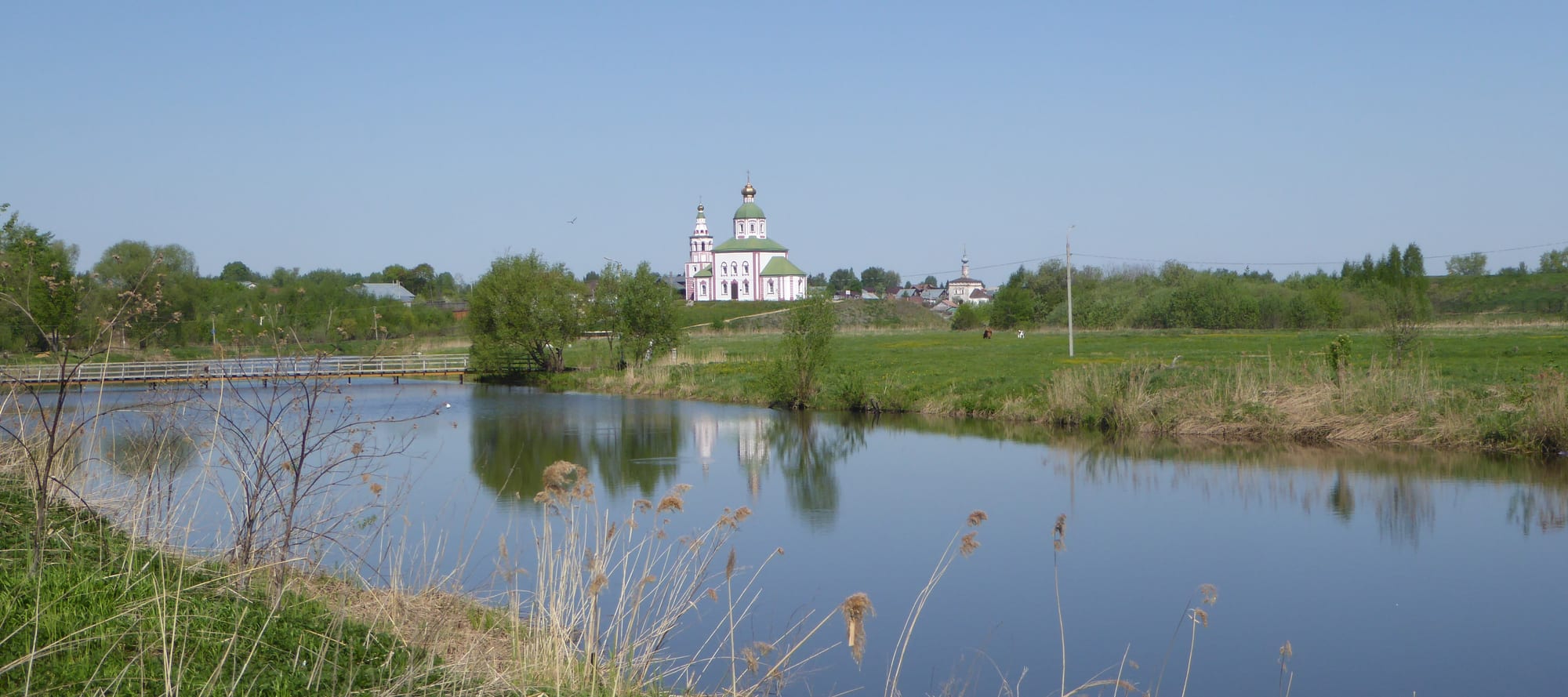
A white church with green domes above water meadows and the still Kamenka river, reflected under a clear blue sky

Russia

Moscow & Central Russia

The Kamenka river and its water meadows in Suzdal, one of the Golden Ring towns of Vladimir Oblast. (© Pierre André / Wikimedia Commons · CC BY-SA 4.0)

The historic core of European Russia, from Moscow and the Golden Ring towns of the upper Volga to Smolensk in the west and the black-earth farmland of Voronezh and Kursk in the south — the heartland where the Russian state took shape. This page is written to explain the region, not to encourage travel.

Explore Moscow & Central Russia

History

The region's story begins in the forests of the upper Volga and Oka, where Slavic settlers mixed with Finno-Ugric peoples such as the Merya. In the 12th century the princes of Vladimir-Suzdal made this area the new centre of Rus' as Kiev declined: Yuri Dolgoruky, the founder of Moscow in the chronicles' account of 1147, built at Suzdal, and his son Andrei Bogolyubsky raised the white-stone cathedrals of Vladimir. The Mongols sacked Vladimir, Suzdal and Ryazan in 1237–38, and for more than two centuries the princes ruled as tributaries of the Golden Horde.

Moscow rose within that system, collecting tribute for the khans and attracting the head of the Church. Dmitry Donskoy defeated a Horde army at Kulikovo, in today's Tula Oblast, in 1380, and the stand-off on the Ugra river in 1480 ended Ivan III's subordination to the Horde. Moscow absorbed Tver, Ryazan and Smolensk and became the capital of Muscovy. After the Time of Troubles, the young Mikhail Romanov was offered the throne at the Ipatiev Monastery in Kostroma in 1613.

Peter the Great moved the capital to St Petersburg but built his first fleet at Voronezh; Napoleon fought at Borodino in 1812 and occupied a Moscow that then burned. The Bolsheviks returned the government to Moscow in 1918. In the Second World War the Germans reached the city's outskirts in 1941, Tula held out against encirclement, and the 1943 battle of Kursk was one of the largest battles ever fought. In the Soviet era the region became Russia's industrial and scientific core, and since 2022 its southern border oblasts have been drawn directly into the war with Ukraine.

Culture & Customs

Central Russia regards itself as the Russian norm: its speech is the basis of the standard language, and its landscape of birch woods, rivers and onion-domed village churches is the one painted by Levitan and described by Turgenev and Tolstoy. Orthodoxy is strongest in the monastery towns, where pilgrims visit the Trinity Lavra at Sergiev Posad and the convents of Suzdal, and the great feasts of Easter and Christmas fill the churches.

Moscow's culture is on a different scale — the Bolshoi, the Tretyakov Gallery, the Moscow Conservatory, theatres and publishers — and the gap between the capital and the provinces, in money, pace and outlook, is a constant theme of Russian life. Provincial towns keep their own identities through literature and craft: Oryol and Turgenev, Ryazan and the poet Sergei Yesenin, Kaluga and the space pioneer Konstantin Tsiolkovsky, Tula and its gunsmiths.

The folk crafts of the region are famous across Russia: Gzhel blue-and-white ceramics and Pavlovsky Posad printed shawls from Moscow Oblast, lacquer miniatures from Palekh and Mstyora, Tula samovars, and wooden toys from Sergiev Posad, the centre of matryoshka making since the 1890s. Maslenitsa, the pancake week before Lent, is marked with fairs and the burning of a straw effigy. Summer means the dacha, and many Muscovites leave the city every weekend for their plots in the surrounding oblasts.

Daily Life

Moscow, with about 13 million people, is the most populous city entirely in Europe and the country's centre of government, finance, media and business, drawing migrants from across Russia and Central Asia. Around it Moscow Oblast holds several million more in commuter towns such as Balashikha, Khimki, Podolsk and Mytishchi. Voronezh, with about a million people, is the largest city of the south; Yaroslavl, Tula, Ryazan, Lipetsk, Tver, Kursk, Ivanovo and Bryansk each have several hundred thousand.

The economy is heavily concentrated in the capital: services, government, retail and IT in Moscow, with manufacturing in the oblasts — steel at Lipetsk, iron ore from the Kursk Magnetic Anomaly around Stary Oskol, arms at Tula, textiles in Ivanovo, and grain, sugar beet and sunflowers on the black earth of Voronezh, Tambov, Belgorod and Kursk. Wages outside Moscow are far lower, and many villages in the non-black-earth north of the region have emptied.

Daily life in Moscow is fast and digital, with long commutes by metro and car. Since 2022 Western brands have gone or been renamed, and the city has adjusted to drone alerts and tighter policing. In Belgorod, Kursk and Bryansk the war is present every day, with air-raid warnings, shelters and evacuations of border villages.

Food

Moscow was the stage for much of what the world knows as Russian cuisine. The Olivier salad was created at the Hermitage restaurant in the 1860s, and the capital's old merchant tables were famous for kulebyaka, a large layered pie of fish, rice and eggs, and for blini with caviar. Borodinsky bread, a dark sourdough rye flavoured with coriander, is the capital's everyday loaf, and Soviet-era plombir ice cream is still a Moscow habit.

The provinces each have a speciality. Tula's pryanik is a dense gingerbread, stamped with a pattern and baked with a filling; Kolomna and Belyov make pastila, a light confection of whipped baked apples. Suzdal is known for medovukha, a lightly alcoholic honey drink, and Vladimir for its cherries. The Yaroslavl area is known for cheese, and the tart Antonovka apple spread across Russia from the Kursk area.

Everyday food across the region is cabbage shchi, buckwheat kasha, pelmeni, pickled cucumbers and mushrooms gathered in the autumn woods, served with kvass or tea and, at a proper table, vodka and a round of toasts.

Attractions & Natural Wonders

Moscow is the centre: the Kremlin with its cathedrals and Armoury, Red Square and St Basil's Cathedral, the Tretyakov Gallery and the Pushkin Museum, the Bolshoi Theatre, the palatial stations of the metro, the Novodevichy Convent and cemetery, and the Church of the Ascension at Kolomenskoye above the Moskva river. The battlefield of Borodino lies to the west in Moscow Oblast, and the old town of Kolomna has a restored kremlin.

The Golden Ring runs north-east of the capital. Sergiev Posad holds the Trinity Lavra of St Sergius; Pereslavl-Zalessky sits on Lake Pleshcheyevo; Rostov Veliky has its kremlin on Lake Nero; and Yaroslavl, on the Volga, has the 17th-century Church of Elijah the Prophet and a monastery-kremlin. Vladimir keeps its Dormition and St Demetrius cathedrals and the Golden Gate, and nearby stands the Church of the Intercession on the Nerl, alone in the water meadows. Suzdal, with its kremlin, monasteries and museum of wooden architecture, is the best preserved of all. Further along the Volga, Kostroma has the Ipatiev Monastery.

To the south, Tula has its kremlin, the weapons museum and Tolstoy's estate at Yasnaya Polyana, with the Kulikovo battlefield further out. Voronezh keeps a replica of Peter the Great's ship Goto Predestinatsia as a museum ship, and the Divnogorye chalk pillars and cave church stand on the Don to the south. In Tver Oblast, Lake Seliger and the source of the Volga lie in the Valdai Hills, while Smolensk's long fortress wall guards the western approach.

Cities in Moscow & Central Russia

Planning basics

Budget

Moscow is the most expensive city in Russia, with hotel and restaurant prices close to those of Western European capitals, while the Golden Ring towns, Tula, Voronezh and the provincial capitals cost markedly less. Suburban trains, buses and canteen meals are cheap everywhere. The payment problem is the same as nationally: foreign cards do not work, so all money has to be brought in as cash.

Daily Budget Midrange
USD 110–240 (mid-range hotel, restaurants, fast trains to the Golden Ring, museum tickets)
Daily Budget Shoestring
USD 40–75 (hostel, canteens, metro and suburban trains; less outside Moscow)

Carry enough foreign cash for the whole stay; Moscow's museums and restaurants take no foreign cards, and exchange is only in cash.

Safety

The dangers here are serious. Moscow has been hit repeatedly by Ukrainian drones since 2023, and the border oblasts of Belgorod, Kursk and Bryansk are under frequent shelling and drone attack; Ukrainian forces crossed into Kursk Oblast in 2024. The 2024 attack on Crocus City Hall near Moscow killed more than 140 people. Foreigners face a real risk of arbitrary detention, surveillance is pervasive in the capital, and consular help is very limited.

Most governments advise against all travel to Russia and against any travel near the Ukrainian border. Check current official travel advice before travelling.

Climate

Humid continental throughout, with warm summers and long, cold, snowy winters. The south of the region, around Voronezh, Belgorod and Kursk, is a little warmer and drier than Moscow, while Tver, Yaroslavl and Kostroma in the north are cooler and snowier. Summer heatwaves can bring days above 30°C, and the snow usually lies from late November to late March.

Summer
warm, typically 20–26°C by day in Moscow, sometimes above 30°C; thunderstorms common
Winter
cold and snowy, around −6 to −10°C in January, with colder spells below −20°C

Transportation

Moscow is the rail and road hub for the whole country, with the Sapsan to St Petersburg in about four hours and regular fast trains to Vladimir, Yaroslavl, Tula and Voronezh. Sergiev Posad is reached by suburban train, Suzdal is reached by bus from Vladimir, and buses link the smaller Golden Ring towns. Moscow's metro is the way to move around the capital. Airports in the southern oblasts have been closed to civilian flights since 2022, and Moscow's airports have been shut repeatedly during drone attacks since 2023.

Buy long-distance rail tickets in advance with a passport, and expect sudden flight delays or diversions during drone alerts.

Best Time to Visit

Late May to early September is the main season, with long days, open riverboats on the Volga and the Golden Ring towns at their greenest. September brings the brief golden autumn. Winter has snow-covered monasteries and Maslenitsa festivities before Lent, but short days and hard cold. The 9 May Victory Day parade closes much of central Moscow.