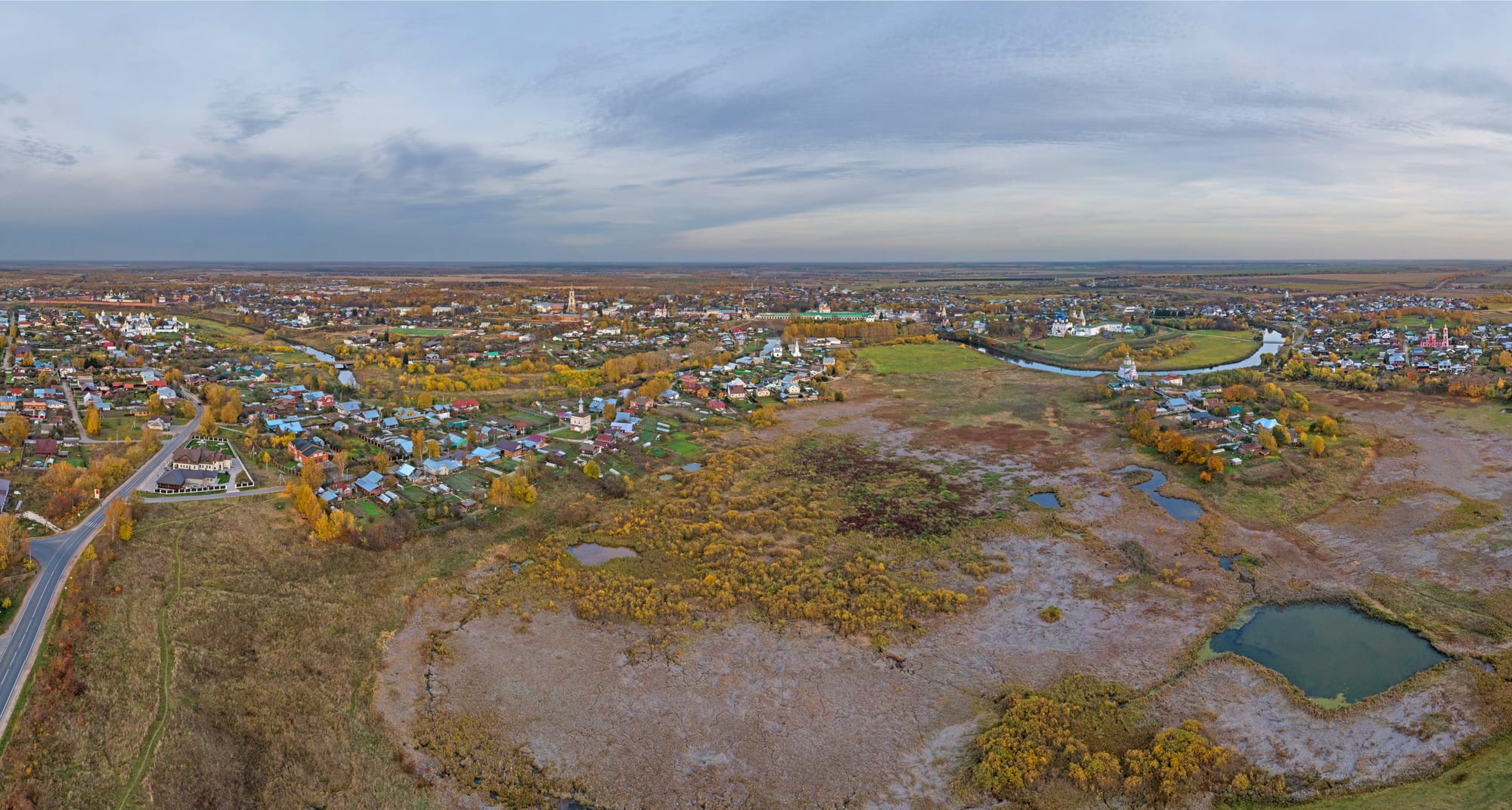
Aerial view of a low town of coloured roofs and white churches beside a winding river and water meadows

Moscow & Central Russia, Russia

Suzdal

Suzdal from the air, with the Kamenka river winding past its churches and meadows. (Ludvig14 / Wikimedia Commons · CC BY-SA 4.0)

A small town on the Kamenka river in Vladimir Oblast, 26 km north of Vladimir, that was a princely capital in the 12th century and a monastery town for centuries after. Bypassed by the railway and protected since 1967, it keeps its kremlin, monasteries, merchant churches and wooden houses among water meadows. This page is written to explain the town, not to encourage travel.

Neighbourhoods

  • The Kremlin
    • First-time visitors
    • Historic district

    The oldest part of the town, inside a 1.4-kilometre earth rampart in a bend of the Kamenka. The blue-and-gold domes of the Nativity Cathedral, the Archbishop's Chambers and a wooden church rise above the river meadows.

    Open in Maps
  • Trading Square and the posad
    • Shopping
    • Close to the bus

    The old settlement of shopkeepers and craftsmen east of the kremlin, centred on the long arcade of the Trading Rows built in 1806–1811. Merchants' churches, guesthouses and cafés line the streets around it, and buses from Vladimir stop nearby.

    Open in Maps
  • The northern monasteries
    • Churches
    • Quiet walks
    • Views

    North of the centre, the walled Monastery of Saint Euthymius stands on the high bank of the Kamenka facing the white Intercession Convent across the meadows. Lanes of wooden houses and gardens run between them.

    Open in Maps

Things to do

Kremlin and monasteries

  • Suzdal Kremlinlandmark

    The town's original fortress and religious centre, part of a UNESCO World Heritage Site since 1992, whose Archbishop's Chambers hold the town's history exhibition and an 18th-century reception hall.

    Open in Maps
  • Cathedral of the Nativitylandmark

    The cathedral of 1222–25 with blue-and-gold domes, rebuilt in brick in 1528–30 after its upper part collapsed; its original 13th-century door is shown in the Archbishop's Chambers.

    Open in Maps
  • Monastery of Saint Euthymiuslandmark

    A monastery founded in 1352 on the high bank of the Kamenka, behind red-brick walls of 1640–44 with twelve towers; it served as a prison from 1766 and again in Soviet times.

    Open in Maps
  • Intercession Conventlandmark

    A convent founded in 1364, whose plain white Intercession Cathedral of 1518 holds the tombs of noble nuns; Peter the Great's first wife was banished here.

    Open in Maps

Museums and the old town

  • Museum of Wooden Architecture and Peasant Lifemuseum

    An open-air museum of log houses and wooden churches moved here from villages elsewhere.

    Open in Maps
  • Trading Rowsmarket

    The long arcaded market building of 1806–1811 on the main square, still lined with shops.

    Open in Maps

Short trips from the town

  • Church of Boris and Gleb, Kidekshalandmark

    A white-stone church built in 1152 by Yury Dolgoruky in a village where the Kamenka meets the Nerl, 4 km east of the town and part of the World Heritage Site.

    Open in Maps
  • Church of the Intercession on the Nerllandmark

    A small white-stone church standing alone in the water meadows at the confluence of the Nerl and the Klyazma, regarded as a symbol of medieval Russia.

    Open in Maps

Seasonal events

  • Open Russian Festival of Animated FilmMarch

    A national festival of animated film held in the town every year since 2002.

  • Cucumber Daya Saturday in July

    A local celebration of Suzdal's cucumbers, with folk music performances, held since 2001.

Eat and drink

Long-standing places and food districts in Suzdal. Hours, ratings and directions come from your maps app, always current.

Suzdal classics

  • Medovukhamarket

    The honey-based alcoholic drink the town is famous for, made at a local mead-brewing works.

    Open in Maps

Food districts and markets

  • Trading Squareneighborhood

    The cafés and restaurants of the town centre cluster around the old arcade of the Trading Rows.

    Open in Maps

Experience Suzdal

History

Suzdal is first mentioned in the chronicles under 1024, in a land already settled by Finnic and East Slavic tribes. At the turn of the 12th century Vladimir Monomakh arrived with settlers and began a stone cathedral around 1102, and his son Yury Dolgoruky, appointed prince here, made Suzdal the capital of a virtually independent Rostov-Suzdal principality, founding new towns, among them Moscow. In 1157 the capital moved to Vladimir, and Suzdal became part of the Grand Principality of Vladimir.

The Mongols sacked the town in 1238; the Nativity Cathedral survived, though its interior was looted. Suzdal joined Nizhny Novgorod in a combined principality in 1341 and was annexed by Moscow in 1392. Tatars sacked it again in 1445, bringing down the upper part of the cathedral. The town then revived as a religious centre: Vasily III and Ivan IV funded building in the 16th century, and convents such as the Intercession received noble women sent into enforced seclusion, among them Vasily's first wife Solomonia and Peter the Great's first wife Eudoxia.

In the late 17th and 18th centuries wealthy merchants paid for some 30 churches, many still standing. In 1864 the merchants failed to win a railway, which went through Vladimir instead, and the town stopped growing. That neglect preserved it. In 1943 senior German officers captured at Stalingrad were held in the Saint Euthymius Monastery; in 1967 Suzdal received federally protected status, which limited new building, and in 1992 its kremlin and the monastery joined the UNESCO list with Vladimir's white-stone monuments.

Culture & Customs

Suzdal's identity rests on its architecture and its role as a place of pilgrimage. The town counts 305 listed monuments, including 30 churches, 14 bell towers and five monasteries and convents; monastic life returned to the Intercession Convent in 1992. A local style of bell tower with a concave tent roof, found in only a handful of churches, is unique to the town. The bell tower of the Saint Euthymius Monastery, whose original bells were destroyed in the 1930s, now has 17 bells.

Because so little changed, the town became a favourite set for film-makers: more than 60 films were shot in and around it, from Andrei Tarkovsky's Andrei Rublev in 1966 to Tsar in 2009. In 1982 it became the first Russian town to receive the Golden Apple award of the World Federation of Travel Journalists and Writers. Since 2002 it has hosted the Open Russian Festival of Animated Film each March.

Local celebrations are rural in feel. Cucumber Day each July honours the town's cucumbers, said to be the best in central Russia, with folk music. Meadows, streams and wooden houses are everywhere, and chickens and livestock are a common sight in the streets.

Daily Life

About 8,750 people lived in Suzdal in 2025, fewer than at the 2021 census, which counted about 9,300. The town is the administrative centre of Suzdalsky District, and tourism is its main industry; there is also a mead-brewing works. It is the smallest of Russia's Golden Ring of historic towns, and its streets have kept much of their rural character. Since 1967 new building has been limited, and the town keeps a rural look of wooden and brick houses.

Life follows the tourist calendar. Summer weekends and holidays bring coaches and day-trippers from Moscow and Vladimir, while weekdays out of season are quiet. Livestock are a common sight on the streets, some of which remain unpaved.

In the Soviet era nearly all of Suzdal's economy was planned around its tourist potential, and wooden buildings were brought in from villages elsewhere to form an open-air museum. Vladimir, 26 km away, has the nearest railway station, and buses run between the two towns every 20 to 30 minutes.

Food

Suzdal is best known for medovukha, an alcoholic drink made by fermenting honey with water, which has been produced in Eastern Europe since pagan times. Unlike in Western Europe, where wine and beer had largely replaced mead by the Middle Ages, it stayed popular in Russia well into the 19th century, and the town's own mead-brewing works keeps the tradition going. Unlike mead, medovukha is quick to make, with less than a month of fermentation, and it is sometimes flavoured with herbs or berries.

The other local pride is the cucumber. Suzdal's have a reputation as the best in central Russia, and mushrooms have been part of Russian cooking since its peasant beginnings.

Restaurants in the town serve traditional Russian food such as bliny with caviar, shchi cabbage soup, pelmeni dumplings and buckwheat kasha, and the town's cafés cluster around the Trading Rows of 1806–1811 on the main square. The Vladimirka, one of the best-known cherry varieties, takes its name from nearby Vladimir.

Planning tools

Budget

Suzdal costs markedly less than Moscow, though prices rise at summer and holiday weekends, when the town fills with visitors. Most accommodation is in small guesthouses. As everywhere in Russia, most foreign cards no longer work, so money mostly has to be brought in as cash.

Daily Budget Midrange
USD 90–180 (comfortable guesthouse, restaurant meals, museum tickets, taxis)
Daily Budget Shoestring
USD 35–65 (guesthouse room, canteens and cafés, buses)

Carry enough foreign cash for the whole stay; most foreign cards do not work in Russian shops or ATMs.

Best Time to Visit

The busy seasons are summer and mid-winter, with crowds peaking at weekends and on holidays. Late May to September brings green meadows and long evenings; winter has snow on the domes but hard cold. Off-season weekdays are quiet without losing the town's character.

Suggested Number of Days

The town has more churches and monasteries than one day comfortably allows, so an overnight stay suits most visitors. Adding nearby villages and the city of Vladimir takes the total to three or four days.

First Visit
1–2 days
With Surroundings
3–4 days

Transportation

Suzdal is small enough to cross on foot, and four local bus routes exist but are rarely needed. Taxis wait in front of the Trading Rows and are the easy way to reach outlying villages such as Kideksha.

Carry passport, visa and migration card at all times.

Airport & Station Connections

There is no railway. Most people take a fast train from Moscow to Vladimir, about 1 hour 40 minutes, then a bus that runs every 20–30 minutes from the bus station beside Vladimir's railway station; a few direct buses run from Moscow, about four hours. The bus can be ridden on past Suzdal's own bus station, 1 km east of the centre, into the town.

Walkability

Very good. The kremlin, Trading Square and the northern monasteries are all within a short walk of each other, and paths follow the Kamenka through the meadows. Some side streets are unpaved and muddy after rain or the spring thaw.

Safety

Beyond the ordinary crime of a large European city, the decisive risks are political and legal: near-total loss of consular support, a real risk of arbitrary arrest and lengthy detention of foreigners on politically motivated charges (and their use in prisoner swaps), sweeping wartime censorship laws, and the possibility that men of certain ages, including dual nationals, face conscription or exit bans. In Suzdal itself, a quiet small town, everyday crime is not the concern; the legal and political risks apply everywhere in the country.

Most governments advise against all travel to Russia and against any travel near the Ukrainian border. Carry passport and visa at all times. Check current official travel advice before travelling.

Climate

Humid continental, with warm summers and long, cold, snowy winters. In nearby Ivanovo, July has a daily mean of about 19°C and January about −9°C.

Summer
warm — in nearby Ivanovo July averages about 19°C, and days can pass 30°C
Winter
cold and snowy — in nearby Ivanovo January averages about −9°C, with frequent snowfall

Local Customs

Suzdal is a working religious centre as well as a museum town: several monasteries and convents have active communities, and services should not be disturbed. Tipping in restaurants is not obligatory but expected; around 10 per cent is normal and more would be unusual.

Ask before photographing monks, nuns or worshippers; photographing military or infrastructure sites can bring espionage charges.

Common Payment Methods

The currency is the rouble (RUB). Most credit and debit cards issued abroad no longer work in Russia, and most cannot be used at Russian ATMs, so cash brought in and exchanged is the most reliable means of payment. Exchange before arriving, in Moscow or Vladimir.