White cathedral with golden domes on a snowy hilltop at dawn, beside a long yellow classical building and bell tower

Moscow & Central Russia, Russia

Vladimir

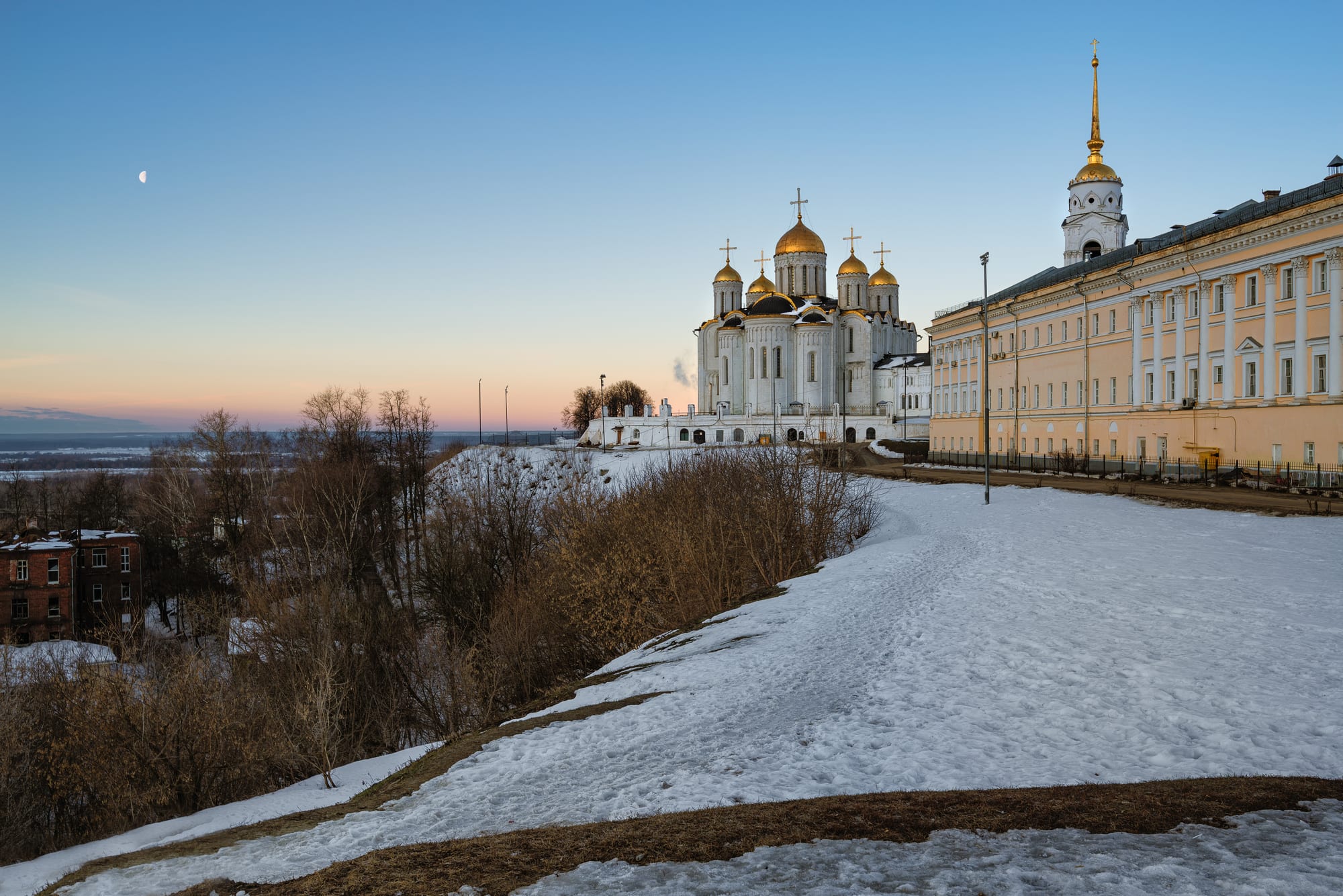
The Dormition Cathedral on its hill above the Klyazma in Vladimir, just before sunrise in March. (Эдуард Косарев / Wikimedia Commons · CC BY-SA 4.0)

The capital of Vladimir Oblast, on a steep hill above the Klyazma about 200 km east of Moscow, which in the 12th century became the capital of the Vladimir-Suzdal principality. Its carved white-stone cathedrals and Golden Gate survive among the streets of an industrial city of about 340,000. This page is written to explain the city, not to encourage travel.

Neighbourhoods

  • Cathedral Square
    • First-time visitors
    • Historic district
    • Views

    The top of the hill above the Klyazma, where the Dormition and St Demetrius cathedrals stand near the edge of the slope with views over the river and the plain beyond. Most of the city's sights are within a few minutes' walk.

    Open in Maps
  • Bolshaya Moskovskaya Street
    • Walking
    • Shopping
    • Close to public transport

    The main street of the historic centre, running west from Cathedral Square past the Trading Rows and old merchant houses to the Golden Gate, with many of the city's restaurants and hotels. Trolleybuses run along it to the station.

    Open in Maps
  • Around the station
    • Close to public transport

    The railway and bus stations side by side at the bottom of the hill, east of the centre, where trains from Moscow arrive and buses leave for Suzdal and the rest of the oblast.

    Open in Maps

Things to do

White-stone monuments

  • Dormition Cathedrallandmark

    Built for Andrey Bogolyubsky and regarded as the mother church of Russia through the 13th century; the grand princes were crowned here, and from 1299 to 1325 the city was the seat of the metropolitans.

    Open in Maps
  • Cathedral of Saint Demetriuslandmark

    A single-domed cathedral finished in 1197 for Vsevolod the Big Nest, the upper half of its outer walls covered in carved white-stone reliefs.

    Open in Maps
  • Golden Gatelandmark

    The city gate of 1158–64, the only ancient Russian city gate to survive, even partially, with a museum inside on the Mongol invasion of the 13th century.

    Open in Maps

Museums and churches

  • Nativity Monasterylandmark

    A monastery on Bolshaya Moskovskaya Street where the remains of Alexander Nevsky were kept until Peter the Great moved them to St Petersburg in 1703.

    Open in Maps
  • Museum of crystal, lacquer miniatures and embroiderymuseum

    A collection in the red-brick Trinity Church beside the Golden Gate, showing glassware from Gus-Khrustalny and nearby towns alongside painted miniatures and embroidery.

    Open in Maps
  • Regional history museummuseum

    The oblast's main history museum, on Bolshaya Moskovskaya Street west of Cathedral Square.

    Open in Maps
  • Museum of the Vladimir cherrymuseum

    An exhibition space opened in 2017 in a former house in the centre, devoted to the cherry that is one of the symbols of the city.

    Open in Maps

Short trips from the city

  • Bogolyubovoattraction

    The village some 10 km north-east where Andrey Bogolyubsky built his palace and was assassinated in 1175, with a monastery on the site.

    Open in Maps
  • Church of the Intercession on the Nerllandmark

    Andrey Bogolyubsky's small white-stone church alone in the water meadows near Bogolyubovo, one of the jewels of early Russian architecture.

    Open in Maps
  • Suzdalattraction

    The small monastery town 26 km north of the city, reached by frequent buses from the station.

    Open in Maps

Eat and drink

Long-standing places and food districts in Vladimir. Hours, ratings and directions come from your maps app, always current.

Food districts

  • Bolshaya Moskovskaya Streetneighborhood

    The main street of the historic centre, where most of the city's restaurants and cafés are found between the Golden Gate and Cathedral Square.

    Open in Maps
  • Trading Rowsmarket

    The old arcaded market building on Bolshaya Moskovskaya Street, between Cathedral Square and the Golden Gate.

    Open in Maps

Experience Vladimir

History

The founding of Vladimir is disputed. Soviet historians dated it to 1108 and credited Vladimir Monomakh, and the city celebrated its 850th anniversary in 1958; since 2005 the city charter has named 990 and Vladimir the Great instead. For its first decades it was a defensive outpost of the Rostov-Suzdal principality, but under Yury Dolgoruky's son Andrey Bogolyubsky, from 1157, it became the capital of Vladimir-Suzdal. Andrey built the Golden Gate and the Dormition Cathedral and tried in 1164 to win the city its own metropolitan, separate from Kiev. He was assassinated at his palace at Bogolyubovo in 1175.

The golden age ended with the Mongols, who overran the city on 8 February 1238; a great fire destroyed 32 limestone buildings as it fell, and the grand prince's family died in a church where they had taken refuge. Vladimir never fully recovered. The title of Grand Prince of Vladimir passed to the princes of Moscow, the metropolitans moved to Moscow in 1325, and coronations moved to the Moscow Kremlin, whose Dormition Cathedral was loosely copied from Vladimir's.

Under the empire the city became a provincial capital, and the road east to Siberia, the Vladimirka, carried convicts and exiles past it; Alexander Herzen was exiled here in 1838–40. The railway from Moscow arrived in 1861. In the Soviet period most parish churches were closed, industry grew, and in 1944 Vladimir became the capital of a new oblast. In 1958 its monuments were joined with Suzdal's in a museum-reserve, and in 1992 they were inscribed together as a UNESCO World Heritage Site.

Culture & Customs

Vladimir's identity rests on the White Monuments it shares with Suzdal: the Dormition Cathedral, the Cathedral of Saint Demetrius and the Golden Gate, three survivors of the many carved limestone buildings of the 12th century. Their exterior sculpture in high relief, unlike anything else in northern Rus', is the city's great artistic legacy, and the 1958 anniversary left monuments that link the Soviet era to this medieval past.

The city's other symbols are humbler. The Vladimir cherry is celebrated in its own museum, opened in 2017, and the crystal of Gus-Khrustalny, lacquer miniatures and embroidery from the surrounding towns are shown in the Trinity Church by the Golden Gate. The regional drama theatre and a puppet theatre are the main stages.

The city also carries a darker association. Vladimir Central, the second-largest prison in Russia, is a maximum-security jail, and in 2006 a memorial was raised in a city cemetery to the Japanese prisoners of war and others of many nations held there. From 1918 to 1991 the Nativity Monastery was occupied by the Cheka and its successors, the Soviet security police.

Daily Life

About 342,000 people lived in Vladimir in 2025, down slightly from about 350,000 at the 2021 census. As the oblast capital it is the region's centre of government, health care and education, with Vladimir State University and several branch institutes.

The economy rests on electrical and chemical factories, food processing plants and two large thermal power stations, with tourism to the historic sites an important contributor. Its Soviet-era landmarks include the Torpedo Stadium of 1952, a concrete arch bridge over the Klyazma from 1960 and the drama theatre of 1971, and trolleybuses have run since 1952. In 2022 several of the city's twinnings with foreign towns were ended over the invasion of Ukraine. The headquarters of the 27th Guards Rocket Army of the Strategic Missile Troops is in the city.

Vladimir is also a transport junction. More than 20 pairs of long-distance trains a day stop on the line between Moscow and Nizhny Novgorod, buses link it with every district centre of the oblast and with cities such as Ivanovo, Kostroma, Ryazan and Yaroslavl.

Food

The food of Vladimir is the everyday cooking of central Russia: cabbage shchi, buckwheat kasha, pelmeni dumplings and pickled cucumbers, served with kvass or tea. Blini are a staple, and pirozhki are small stuffed buns whose fillings are almost always cooked before baking.

The city's own speciality is the cherry. The Vladimir cherry is one of the city's symbols, honoured with its own museum, and one of the best-known cherry varieties, the Vladimirka, takes its name from the city. Nearby Suzdal is known for medovukha, an alcoholic drink made by fermenting honey with water.

Most of the city's restaurants and cafés line Bolshaya Moskovskaya Street in the historic centre, between the Golden Gate and Cathedral Square. Maslenitsa, the pancake week before Lent, brings blini with sour cream, cottage cheese or caviar, and Orthodox Easter and Christmas are the great feasts of the year, when meals open with zakuski, hors d'oeuvres such as salted, pickled or smoked fish.

Planning tools

Budget

Vladimir costs markedly less than Moscow for rooms and meals, and city trolleybuses and buses to Suzdal are cheap. As everywhere in Russia, most foreign cards no longer work, so money mostly has to be brought in as cash.

Daily Budget Midrange
USD 85–170 (mid-range hotel, restaurants, museum tickets, taxis)
Daily Budget Shoestring
USD 35–60 (hostel or budget room, canteens, trolleybuses)

Carry enough foreign cash for the whole stay; most foreign cards do not work in Russian shops or ATMs.

Best Time to Visit

Late May to September is the main season, with long days and green views from the hill over the Klyazma; September brings a short golden autumn. Winter is long and cold but the white cathedrals stand out against the snow, and the city is quiet.

Suggested Number of Days

The historic centre is compact, so one or two days cover a first visit. The city also makes a natural base for the surrounding villages and towns, which takes the stay to three or four days.

First Visit
1–2 days
With Surroundings
3–4 days

Transportation

Local transport is buses, trolleybuses, fixed-route minibuses and taxis. The trolleybus along Bolshaya Moskovskaya Street is the most useful line, linking the station with the historic centre. Buses from the station reach every district centre of the oblast.

Carry passport, visa and migration card at all times.

Airport & Station Connections

The city lies about 200 km east of Moscow on the railway and the M7 highway to Nizhny Novgorod. Fast trains from Moscow's Kursky station take about 1 hour 45 minutes; slower suburban and long-distance trains take longer. At least 20 pairs of long-distance trains pass through daily, and the station sits at the bottom of the hill, a short trolleybus ride from the centre.

Walkability

The historic centre is compact and walkable along Bolshaya Moskovskaya Street, from the Golden Gate to Cathedral Square and the Nativity Monastery. The climb from the station up the hill is steep, and the valleys of small streams cut through the city, so trolleybuses help for longer distances.

Safety

Beyond the ordinary crime of a large European city, the decisive risks are political and legal: near-total loss of consular support, a real risk of arbitrary arrest and lengthy detention of foreigners on politically motivated charges (and their use in prisoner swaps), sweeping wartime censorship laws, and the possibility that men of certain ages, including dual nationals, face conscription or exit bans. Vladimir hosts the headquarters of a strategic rocket army and a maximum-security prison, so military and security sites are close to everyday life.

Most governments advise against all travel to Russia and against any travel near the Ukrainian border. Do not photograph military or prison buildings. Check current official travel advice before travelling.

Climate

Humid continental, with long, cold winters and short, warm summers. In nearby Ivanovo, July has a daily mean of about 19°C and January about −9°C.

Summer
warm — in nearby Ivanovo July averages about 19°C, and days can pass 30°C
Winter
cold and snowy — in nearby Ivanovo January averages about −9°C, with frequent snowfall

Local Customs

The cathedrals are working churches as well as museums, and services should not be disturbed. Tipping in restaurants is not obligatory but expected; around 10 per cent is normal and more would be unusual, and taxis are not tipped.

Photographing military or infrastructure sites can bring espionage charges; LGBT people face severe legal repression.

Common Payment Methods

The currency is the rouble (RUB). Most credit and debit cards issued abroad no longer work in Russia, and most cannot be used at Russian ATMs, so cash brought in and exchanged is the most reliable means of payment.