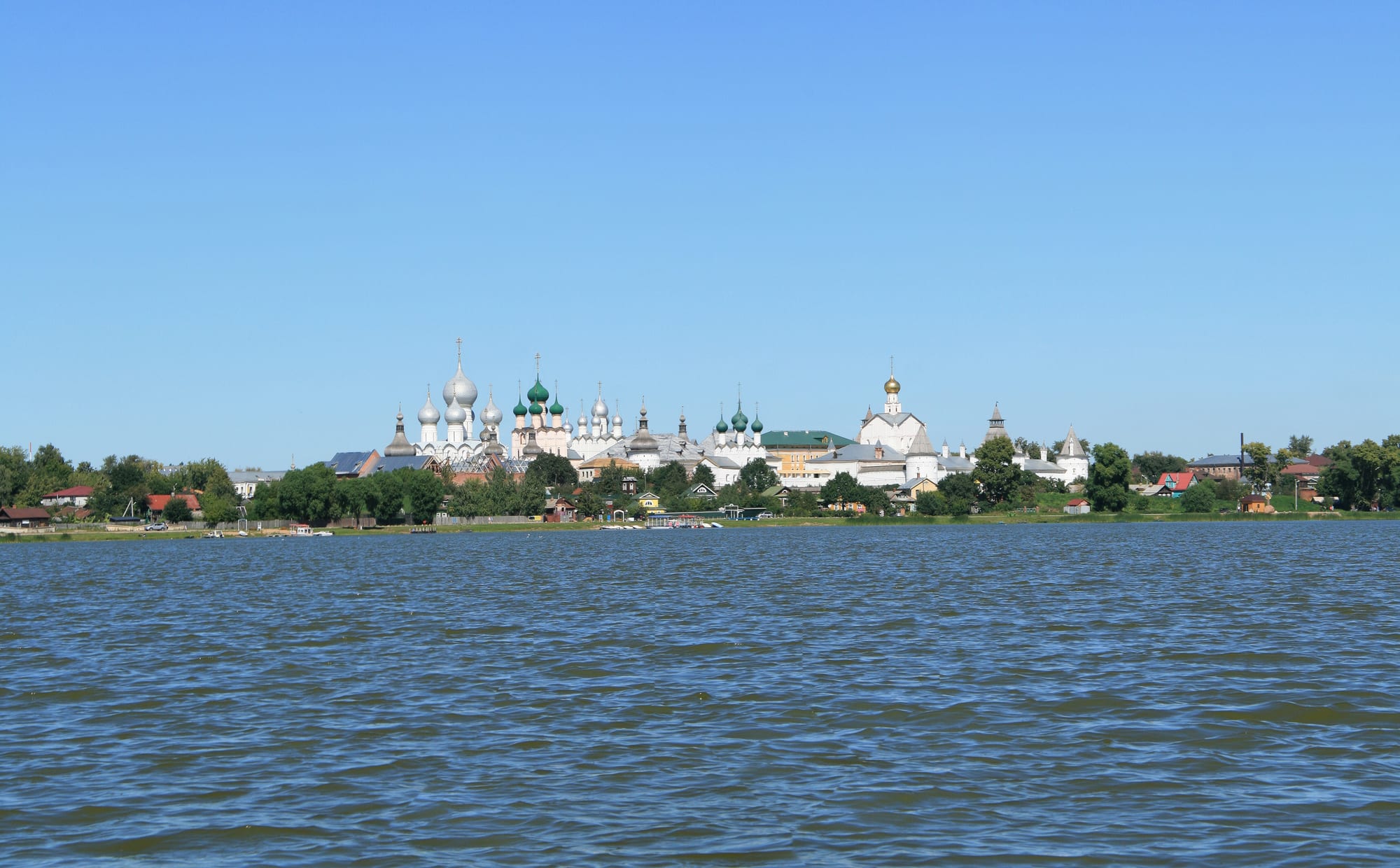
White walls, towers and silver and green onion domes of the Rostov Kremlin seen across the blue water of Lake Nero

Moscow & Central Russia, Russia

Rostov Veliky

The Rostov Kremlin and its churches seen from Lake Nero. (Ludvig14 / Wikimedia Commons · CC BY-SA 4.0)

One of the oldest towns in Russia, on the shore of Lake Nero in Yaroslavl Oblast and a stop on the Golden Ring. Once the seat of a medieval principality and of powerful metropolitans, it is now a small town dominated by their walled residence, its churches and its enamel workshops. This page is written to explain the city, not to encourage travel.

Neighbourhoods

  • The kremlin and the old centre
    • First-time visitors
    • Historic district

    The walled residence of the metropolitans, the Assumption Cathedral and its belfry fill the heart of the town. Low merchant houses and the town's museums are a short walk away.

    Open in Maps
  • The lakeshore and the town park
    • Walks
    • Lake views

    The town park runs along the shore of Lake Nero in the centre, below the kremlin walls. Boat excursions run on the shallow lake, and the park's embankment hosts the town's water show each year.

    Open in Maps
  • The monastery outskirts
    • Quiet and residential
    • Churches and monasteries

    Two monasteries face the lake on either side of the centre: the Abraham Monastery in the south-east and the neoclassical Spaso-Yakovlevsky Monastery on the western edge. The streets between are mostly quiet, low-rise and residential.

    Open in Maps

Things to do

The kremlin and the churches

  • Rostov Kremlinlandmark

    The walled residence of the Rostov metropolitans, built mostly between 1667 and 1694 under Metropolitan Iona Sysoyevich, with painted churches, palaces and towers; it has been on UNESCO's tentative list since 1998.

    Open in Maps
  • Assumption Cathedral and belfrylandmark

    The town's main cathedral and its oldest building, raised in 1508–1512 on the site of 12th- and 13th-century predecessors; its 17th-century belfry holds named bells, the largest of them, Sysoy, cast in 1688 and weighing 32 tonnes.

    Open in Maps

Monasteries

  • Spaso-Yakovlevsky Monasterylandmark

    A lakeside monastery founded in 1389 and venerated as the shrine of St Dmitry of Rostov, most of whose buildings date from the late 18th and early 19th centuries, in neoclassical style; it is a men's monastery.

    Open in Maps
  • Abraham Monasterylandmark

    One of the oldest monasteries in Russia, founded in the 11th century on the lake shore; its cathedral was commissioned by Ivan the Terrible in 1553 to mark the conquest of Kazan.

    Open in Maps

Museums

  • Museum of Finiftmuseum

    A branch of the kremlin museum, opened in 2000 in the Judgement Office, one of the oldest buildings of the kremlin, with what is described as the world's largest collection of Rostov enamels.

    Open in Maps
  • Museum of Rostov Merchantsmuseum

    A branch of the kremlin museum opened in 2008 in the former main house of the Kekin merchant family's estate.

    Open in Maps

The lake

  • Lake Neropark

    A shallow lake about 13 km long, estimated at half a million years old, with boat excursions from the town and fishing along its shores.

    Open in Maps

Short trips from the town

  • Ishnya Churchlandmark

    A wooden church of 1687 on the Ishnya river a few kilometres west of the town, the oldest wooden building in Yaroslavl Oblast and a museum in summer.

    Open in Maps
  • Sarskoye Gorodishcheattraction

    The site of a medieval fortified settlement on the Sara river south of the town, linked with the Merya people and seen as the forerunner of Rostov.

    Open in Maps
  • Borisoglebsky Monasterylandmark

    In the settlement of Borisoglebsky, a monastery of Saints Boris and Gleb whose towered walls and bell tower were built under Ivan the Terrible, now a museum.

    Open in Maps
  • Yaroslavlattraction

    The capital of the oblast on the Volga, whose historic centre of 17th-century churches is a UNESCO World Heritage Site.

    Open in Maps

Eat and drink

Long-standing places and food districts in Rostov Veliky. Hours, ratings and directions come from your maps app, always current.

Rostov classics

  • Mead and kvass in the kremlincafe

    Medovukha, the Slavic honey drink made by fermenting honey with water, and home-made kvass are served to visitors inside the kremlin.

    Open in Maps

Food districts

  • Cafés around the kremlinneighborhood

    The streets around the kremlin and the cathedral square hold most of the town's cafés and restaurants serving Russian home cooking.

    Open in Maps

Experience Rostov Veliky

History

Rostov is first mentioned in the chronicles under the year 862, already as an important settlement. Its forerunner was Sarskoye Gorodishche, a fortified settlement on the Sara river south of the lake that some scholars see as the capital of the Finnic Merya people and others as a Viking trading post on the Volga route; Norse sources knew the town as Rostofa. By the end of the 10th century Rostov was the centre of a principality held by Yaroslav the Wise, which later became the core of Rostov-Suzdal, and in the 12th century it earned the title Veliky, "the Great". From 988 it was also one of the first bishoprics of Rus', whose bishops later became archbishops and, from the 16th century, metropolitans.

The principality was absorbed into the Grand Principality of Moscow in 1474, and in 1608, during the Time of Troubles, Polish forces destroyed the town completely. Metropolitan Iona Sysoyevich then rebuilt it around a grand residence beside the cathedral, raised between 1667 and 1694 and now known as the kremlin. The title had already fallen out of use by the 17th century as the town's importance declined, and when the see moved to Yaroslavl in 1788 Rostov lost its religious authority too. The town turned to crafts and trade: painted enamel became its speciality in the 18th and 19th centuries, and by 1900 it had about 14,500 inhabitants and 21 factories.

In 1883 a museum of church antiquities opened in the kremlin, the origin of today's state museum. On 24 August 1953 a tornado tore through the town and out over Lake Nero. Soviet planners built several mostly defence-related factories on the outskirts, and an optical-mechanical plant opened in 1975. On 8 January 2025 the town's name officially changed from Rostov back to Rostov Veliky.

Culture & Customs

Rostov's identity rests on its church heritage. The kremlin's churches are elaborately painted inside, and their silver "blind" domes were copied across the town; the belfry of the Assumption Cathedral holds some of the largest and most famous bells in Russia, each with its own name. The town's monasteries stand apart: the Spaso-Yakovlevsky Monastery belongs to the Russian Orthodox Church and is venerated as the shrine of St Dmitry of Rostov, the archbishop who opened a school and a small theatre in the town.

The town is best known for finift, painted enamel on metal, counted among the classic symbols of Russian handicraft. For centuries it decorated priests' vestments, church vessels and icon screens; only after a cooperative was formed in the 1920s did workshops turn to jewellery and boxes, and that cooperative grew into a large jewellery factory with its own enamel museum. Black-polished pottery, made in Rostov since the 16th century, is the other local craft.

Rostov is one of the towns of the Golden Ring, and tradition names it the birthplace of the legendary knight Alyosha Popovich. Its kremlin has served as a film set, including for Leonid Gaidai's 1973 comedy Ivan Vasilievich Changes His Profession. Each year the lakeside park hosts a water show with a parade of the boats of Lake Nero.

Daily Life

About 27,000 people lived in the town at the start of 2024, down from about 35,700 at the 1989 census; Rostov is also the administrative centre of the surrounding Rostovsky District. The town covers about 32 square kilometres, and the factories built in the Soviet era stand on its outskirts, away from the historic centre.

The economy mixes industry and tourism. The optical-mechanical plant built in 1975 became the town's main employer, and food production goes back to the 19th century: a chicory works that later made coffee substitutes, and a kvass plant that still bears the name Russkiy Kvas. A former roof-window factory has made tobacco products since 2019. Enamel workshops and the kremlin museum, with its branches across the town, draw a steady flow of visitors along the Golden Ring.

The railway station, still called Rostov Yaroslavsky, lies on the main line from Moscow to Yaroslavl and Arkhangelsk, and the town bus fleet was replaced in June 2025.

Food

Rostov's table is that of central Russia: soups such as shchi made from cabbage, kasha porridge, stuffed pirozhki buns, black bread, and pickled cucumbers and mushrooms brought out as zakuski before a meal. In summer the cold soup okroshka replaces the hot ones, and before Lent, as everywhere in Russia, blini pancakes are eaten in vast quantities for Maslenitsa, served with sour cream, caviar or curd cheese.

The town has a long connection with kvass, a cloudy, sweet-and-sour, low-alcohol drink made by fermenting rye bread or rye flour with malt, and a kvass plant still works here. Visitors to the kremlin can try home-made kvass and medovukha, a Slavic drink made by fermenting honey with water and sometimes flavoured with herbs or berries, which was popular in Russia well into the 19th century. Tea drunk strong with jam remains the everyday drink.

Eating out centres on the cafés and small restaurants around the kremlin and the cathedral square, which cater to visitors on the Golden Ring.

Planning tools

Budget

Rostov Veliky costs markedly less than Moscow, and canteen meals, local buses and suburban trains are cheap. The real difficulty is payment: most foreign cards no longer work in Russia, so money has to be brought in as cash and exchanged.

Daily Budget Midrange
USD 90–180 (mid-range hotel, restaurant meals, museum tickets, train fares)
Daily Budget Shoestring
USD 35–65 (guesthouse or hostel bed, canteen meals, local buses and suburban trains)

Carry enough foreign cash for the whole stay and exchange it before arriving, as most foreign cards do not work.

Best Time to Visit

Late May to early September brings long days, boat trips on Lake Nero and the Golden Ring towns at their greenest. September has the short golden autumn. Winter brings snow-covered churches but short days and hard cold.

Suggested Number of Days

The town is small, and one or two days cover the centre and the lakeshore. Three or four days allow time for the surrounding villages and the neighbouring towns. The season matters, as some outlying sights open only in summer.

First Visit
1–2 days
With Surroundings
3–4 days

Transportation

The centre is compact and walkable. A small network of town bus routes covers the rest, with a fleet renewed in 2025, and app-booked taxis are the usual alternative to street cabs. The surrounding villages are reached by bus, taxi or car.

Use an app-booked taxi such as Yandex Go rather than a street taxi, and carry passport, visa and migration card at all times.

Airport & Station Connections

The town's station is on the Moscow–Yaroslavl railway, with express and local trains from Moscow; by road Moscow is about 200 km away, roughly three hours by car. The nearest airport is Golden Ring Yaroslavl International Airport, beyond Yaroslavl. There are no direct flights between Russia and Western Europe or North America, so international arrivals come through third countries.

Walkability

The kremlin, the cathedral square, the museums and the lakeshore park lie within a few minutes' walk of one another, and both monasteries can be reached on foot along the lake. Pavements can be icy and snowbound for much of the winter.

Safety

Beyond the ordinary crime of a large European city, the decisive risks are political and legal: near-total loss of consular support, a real risk of arbitrary arrest and lengthy detention of foreigners on politically motivated charges (and their use in prisoner swaps), sweeping wartime censorship laws, and the possibility that men of certain ages, including dual nationals, face conscription or exit bans. Rostov Veliky itself is a quiet provincial town, but the same national risks apply here, and drone attacks have repeatedly forced the temporary closure of Moscow's airports.

Most governments advise against all travel to Russia and against any travel near the Ukrainian border. Photographing military or infrastructure sites can bring espionage charges. Check current official travel advice before travelling.

Climate

Humid continental, with warm summers and long, cold, snowy winters. A thaw usually comes from the end of March into April.

Summer
warm — in nearby Yaroslavl, June and July often bring days above 30°C, and July is the wettest month
Winter
cold and snowy — in nearby Yaroslavl, January averages −12°C, drops below −20°C are not uncommon, and the snow usually lies 35–50 cm deep

Local Customs

Churches and monasteries expect modest dress, and the Spaso-Yakovlevsky Monastery is a working religious house. Tipping is not essential but is appreciated in restaurants, usually by rounding the bill up to around 10 per cent; it is not expected in self-service canteens. Many Russians consider it bad luck to shake hands, greet someone or pass something across a threshold.

Dress modestly in churches and never photograph military or infrastructure sites.

Common Payment Methods

The currency is the rouble (RUB). Western credit and debit cards such as Visa and Mastercard do not work in Russia, most foreign bank cards cannot be used at Russian ATMs, and cash brought in and exchanged is the only reliable means of payment.