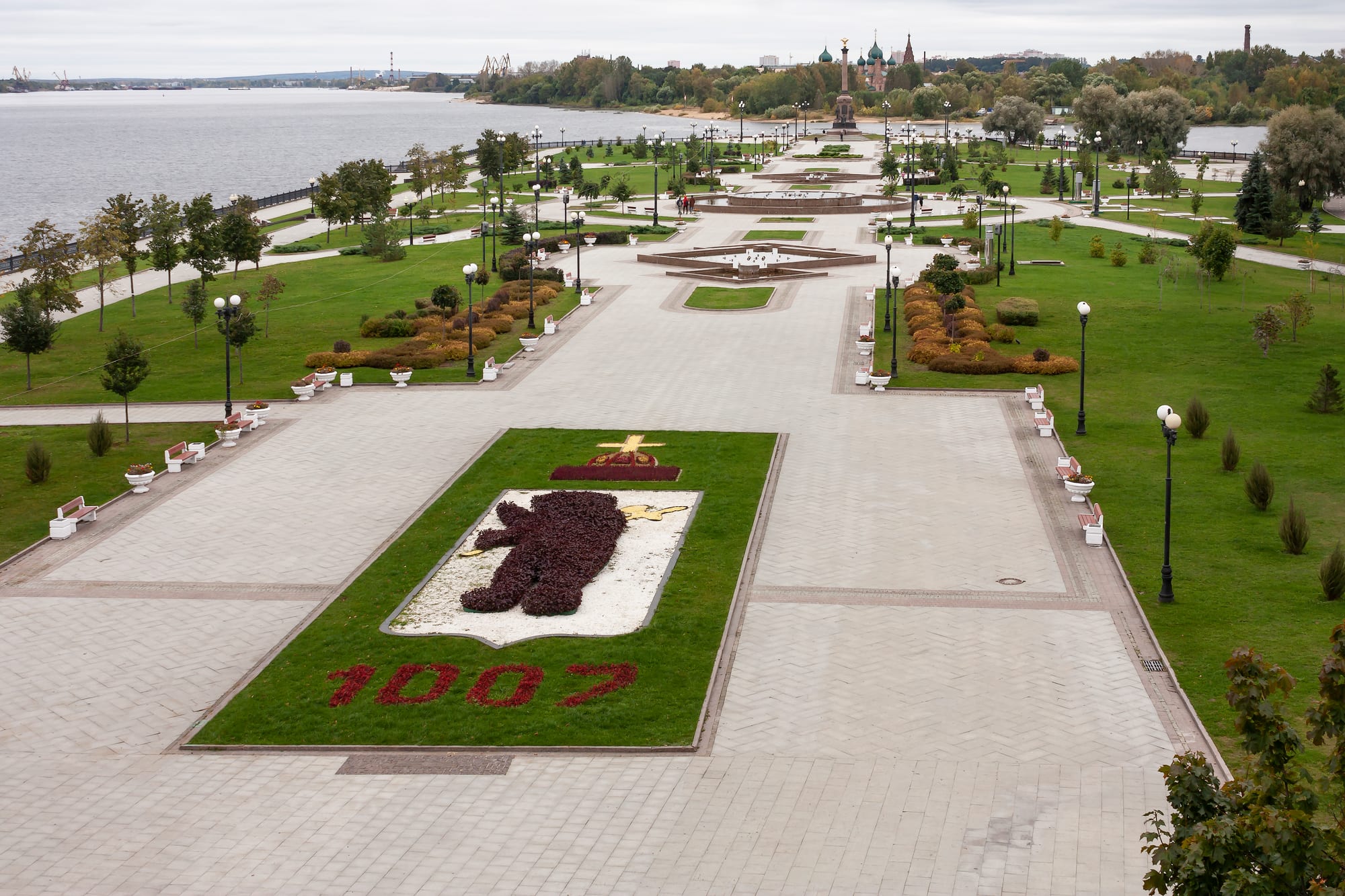
A long paved park with lawns, lamps and a flowerbed shaped as a bear, running along a wide river towards distant church domes

Moscow & Central Russia, Russia

Yaroslavl

Strelka Park at the confluence of the Volga and the Kotorosl in Yaroslavl, where the city was founded. (AlixSaz / Wikimedia Commons · CC BY-SA 4.0)

A Volga city of about 560,000 at the mouth of the Kotorosl, some 250 km north-east of Moscow, traditionally founded by Yaroslav the Wise and the oldest existing town on the Volga. Rich 17th-century merchants filled it with tiled brick churches, and its classical centre is a UNESCO World Heritage Site amid a large industrial city. This page is written to explain the city, not to encourage travel.

Neighbourhoods

  • The old town
    • First-time visitors
    • Historic district
    • Close to the river

    The UNESCO-listed centre between the Volga and the Kotorosl, laid out on a plan of 1778 around Ilyinskaya Square and the Church of Elijah the Prophet. Classical boulevards, merchant churches, the Volkov Theatre and the Volga embankment are all here, ending at the Strelka park on the point where the rivers meet.

    Open in Maps
  • The Kotorosl and Tolchkovo
    • Churches
    • Off the beaten track

    The bank of the Kotorosl beyond the Transfiguration Monastery, once the Tolchkovo settlement, where the fifteen-domed Church of St John the Baptist stands beside factories.

    Open in Maps
  • Krasnoperekopsky
    • Local life
    • Ice hockey

    One of the city's six districts, home to industry and housing. Its Neftestroy area, named for its closeness to the oil refinery, holds the hockey arena of Lokomotiv Yaroslavl.

    Open in Maps
  • The left bank
    • Quiet and residential
    • River views

    The residential districts across the Volga, built up from the 1960s once a road bridge opened in 1965, with views back to the old town.

    Open in Maps

Things to do

Churches and monasteries

  • Church of Elijah the Prophetlandmark

    The 17th-century merchant church at the centre of Ilyinskaya Square, around which the city's 1778 plan was drawn.

    Open in Maps
  • Transfiguration Monasterylandmark

    The walled monastery by the Kotorosl, often mistaken for a kremlin, whose cathedral of 1506–1516 is the oldest unchanged building in the city.

    Open in Maps
  • Church of St John the Baptistlandmark

    Built in 1671–87 at Tolchkovo and regarded as the high point of the Yaroslavl school, with fifteen onion domes, glazed tiles, a 45-metre bell tower and frescoes covering the whole interior.

    Open in Maps
  • Dormition Cathedrallandmark

    The cathedral by the Strelka, demolished in 1937 and rebuilt from 2004, consecrated in 2010 for the city's millennium.

    Open in Maps

The river and the old town

  • Volga embankmenttrail

    A shaded promenade along the high bank of the Volga, stabilised and laid out by 1820 and still a place for residents to stroll.

    Open in Maps
  • Strelkapark

    The park on the cape where the Kotorosl meets the Volga, the traditional place where Yaroslav the Wise first stepped ashore.

    Open in Maps
  • Volkov Theatreattraction

    The oldest drama theatre in Russia, founded by Fyodor Volkov in the 1750s and housed since 1911 in its building on Volkov Square.

    Open in Maps
  • River cruisesattraction

    Boats from the river station run along the Volga, and cruise ships on the river stop at the city.

    Open in Maps

Sport

  • Arena 2000attraction

    The 9,000-seat ice hockey arena of Lokomotiv Yaroslavl, opened in 2001.

    Open in Maps

Short trips from the city

  • Karabikhamuseum

    A village 15 km south of the centre where the poet Nikolay Nekrasov lived and worked, now with a Nekrasov museum.

    Open in Maps
  • Tutayevattraction

    A small town formed in 1822 from two older towns facing each other across the Volga, Romanov and Borisoglebsk.

    Open in Maps
  • Rostov Kremlinlandmark

    The 16th–17th-century residence of the metropolitans of Rostov, an ensemble of cathedral, churches and courts in the old town of Rostov.

    Open in Maps

Eat and drink

Long-standing places and food districts in Yaroslavl. Hours, ratings and directions come from your maps app, always current.

Food districts

  • The Volga promenadeneighborhood

    The best place to eat out in the city, with restaurants and cafés along the high bank of the river.

    Open in Maps
  • The old town centreneighborhood

    Cafés, bars and restaurants in the streets around Volkov Square and the theatre.

    Open in Maps

Experience Yaroslavl

History

In the 9th century a Scandinavian-Slavic settlement at nearby Timerevo traded along the Volga. Tradition says Yaroslav the Wise, prince of Rostov, founded the city where he first stepped ashore at the Strelka, making it the oldest existing town on the Volga. From 1218 it was the capital of a Principality of Yaroslavl, until Moscow absorbed it in 1463. The Golden Horde sacked it in 1257, 1293 and 1322.

Its Volga position made it rich. In the 16th century English and German merchants kept warehouses here. From April to June 1612, while Minin and Pozharsky's volunteer army gathered here before liberating Moscow, it was the country's de facto capital. In the 17th century it was Russia's second-largest city, and merchants paid for many of the brick churches that still define the old town. After a fire in 1658 destroyed most of its remaining wooden buildings, including the old kremlin, the city was rebuilt almost entirely in brick, and in 1778 a new classical plan was drawn around Ilyinskaya Square.

Industry came with the Tames textile mill of 1772 and the railway to Moscow in 1870. In July 1918 an anti-Bolshevik uprising was crushed by the Red Army with artillery and aircraft, killing about 600 residents and wrecking some 2,000 buildings. Soviet industrialisation brought rubber, tyre and engine plants, German air raids struck the vital Volga rail bridge in 1942–43, and the population passed half a million in 1968; and in 2005 the historic centre joined the UNESCO list. In 2011 almost the whole Lokomotiv hockey team died in a plane crash on take-off from the city's airport.

Culture & Customs

Yaroslavl's architecture is its signature. The Yaroslavl school of the 17th century produced brick churches with clusters of domes, coloured glazed tiles and interiors covered in frescoes, of which St John the Baptist at Tolchkovo is considered the finest. The city's coat of arms, a bear holding a golden halberd, is tied to the legend of the city's founding, and the bear appears on monuments and flowerbeds across the city.

The city regards itself as the home of Russian theatre. Fyodor Volkov founded the Volkov Theatre in the 1750s as Russia's first public theatre; it is regarded as the country's oldest drama theatre and has occupied its present building since 1911. The poet Nikolay Nekrasov, who lived and worked at nearby Karabikha, is remembered in a museum there.

Sport means ice hockey. Lokomotiv Yaroslavl recovered from the 2011 air disaster to become one of the strongest clubs in Russia, Russian champions in 1997, 2002 and 2003 and winner of the Gagarin Cup in 2025 and 2026, and home games fill Arena 2000. The city's millennium was celebrated in September 2010, when the rebuilt Dormition Cathedral was consecrated by the Patriarch.

Daily Life

About 564,000 people lived in Yaroslavl in 2025, slightly fewer than the 577,000 counted at the 2021 census. The city is the capital of Yaroslavl Oblast and one of the main industrial centres of central Russia, with a large oil refinery, a petrochemical plant, a tyre factory, a diesel engine works and the old Krasny Perekop textile mill.

The city spreads along both banks of the Volga and the Kotorosl. The old town on the right bank holds the offices, theatres and the university, which traces its roots to a school of higher sciences opened in 1803. From the 1960s large residential districts spread across the city, for the first time onto the left bank of the Volga, and Neftestroy in the south has grown around the refinery and the hockey arena.

Several railways and highways meet here, and long-distance trains between Moscow and Siberia pass through. Summer life centres on the Volga embankment and the Strelka, where residents stroll in the evenings, while winter revolves around the hockey season.

Food

Food in Yaroslavl is the everyday cooking of central Russia: cabbage shchi, buckwheat kasha, pelmeni dumplings and pickled cucumbers and mushrooms gathered in the autumn woods, served with kvass or tea, and at a proper table with vodka and a round of toasts. Blini are eaten in quantity at Maslenitsa, the pancake week before Lent, with sour cream, smoked fish or curd.

The city's long history as a Volga trading port shows less in its dishes than in its setting. The best place to eat out is the Volga promenade, where restaurants and cafés look over the river, and the streets around Volkov Square in the old town hold more cafés and bars. Canteen-style stolovaya eateries, where diners take a tray along a counter, are the cheap everyday choice across Russian cities.

Festive tables open with zakuski — pickled vegetables, cured fish, salads and black bread — and stuffed pirozhki buns are an everyday snack. Tea, often taken with jam, remains a fixture of the Russian table.

Planning tools

Budget

Yaroslavl costs markedly less than Moscow, and buses, minibuses and trolleybuses are cheap. River cruises and the main museums are the larger costs. As everywhere in Russia, Western-issued cards do not work, so money has to be brought in as cash.

Daily Budget Midrange
USD 85–180 (mid-range hotel, restaurants, museum tickets, a river trip)
Daily Budget Shoestring
USD 35–60 (hostel or budget room, canteens, trolleybuses)

Carry enough foreign cash for the whole stay, as Western-issued cards do not work in Russia.

Best Time to Visit

Late May to September, when the embankment is busy, boats run on the Volga and days are long; June and July often bring days over 30°C. Winters are long, cold and snowy, with the river frozen.

Suggested Number of Days

The historic centre fits into one or two days. With the smaller towns and estates of the oblast nearby, three or four days give a fuller stay, and a river trip on the Volga adds time.

First Visit
1–2 days
With Surroundings
3–4 days

Transportation

Buses, minibuses (marshrutkas) and trolleybuses run during the day and late into the night. The most useful trolleybus line runs from the railway station along Svobody Street to the old town. The river station handles cruise ships and local boats.

Carry passport, visa and migration card at all times.

Airport & Station Connections

Yaroslavl is about 266 km from Moscow by rail, and around 13 trains a day make the 3–4 hour journey from Moscow's Yaroslavsky station, including trains on the Trans-Siberian route. An overnight train runs from St Petersburg, buses run from Moscow via Sergiyev Posad and Rostov, and Golden Ring Yaroslavl International Airport, formerly Tunoshna, lies 18 km south-east of the city.

Walkability

The old town is compact and pleasant on foot, from Ilyinskaya Square and the Volga embankment to the Strelka and the monastery. Tolchkovo and the outer districts need a bus or taxi, and the railway station is a trolleybus ride from the centre.

Safety

Beyond the ordinary crime of a large European city, the decisive risks are political and legal: near-total loss of consular support, a real risk of arbitrary arrest and lengthy detention of foreigners on politically motivated charges (and their use in prisoner swaps), sweeping wartime censorship laws, and the possibility that men of certain ages, including dual nationals, face conscription or exit bans. Yaroslavl's oil refinery and other industrial plants are strategic sites.

Most governments advise against all travel to Russia and against any travel near the Ukrainian border. Do not photograph the refinery, factories or other industrial and military sites. Check current official travel advice before travelling.

Climate

Humid continental, with warm summers and long, cold winters. April can already bring days of 20°C, and the hottest point usually comes in June or July.

Summer
warm — days often pass 30°C in June and July
Winter
cold and snowy — January averages around −10°C, and frosts below −20°C are not unusual

Local Customs

Ice hockey is the city's passion, and Lokomotiv games at Arena 2000 fill the stands. Churches are working places of worship, and services should not be disturbed. Tipping in restaurants is not obligatory but expected, and a tip of more than 10 per cent would be unusual.

Photographing military or infrastructure sites can bring espionage charges; LGBT people face severe legal repression.

Common Payment Methods

The currency is the rouble (RUB). Western-issued Visa and Mastercard cards do not work and most foreign cards cannot be used at ATMs, so cash roubles exchanged from money brought into the country are the only reliable means of payment.