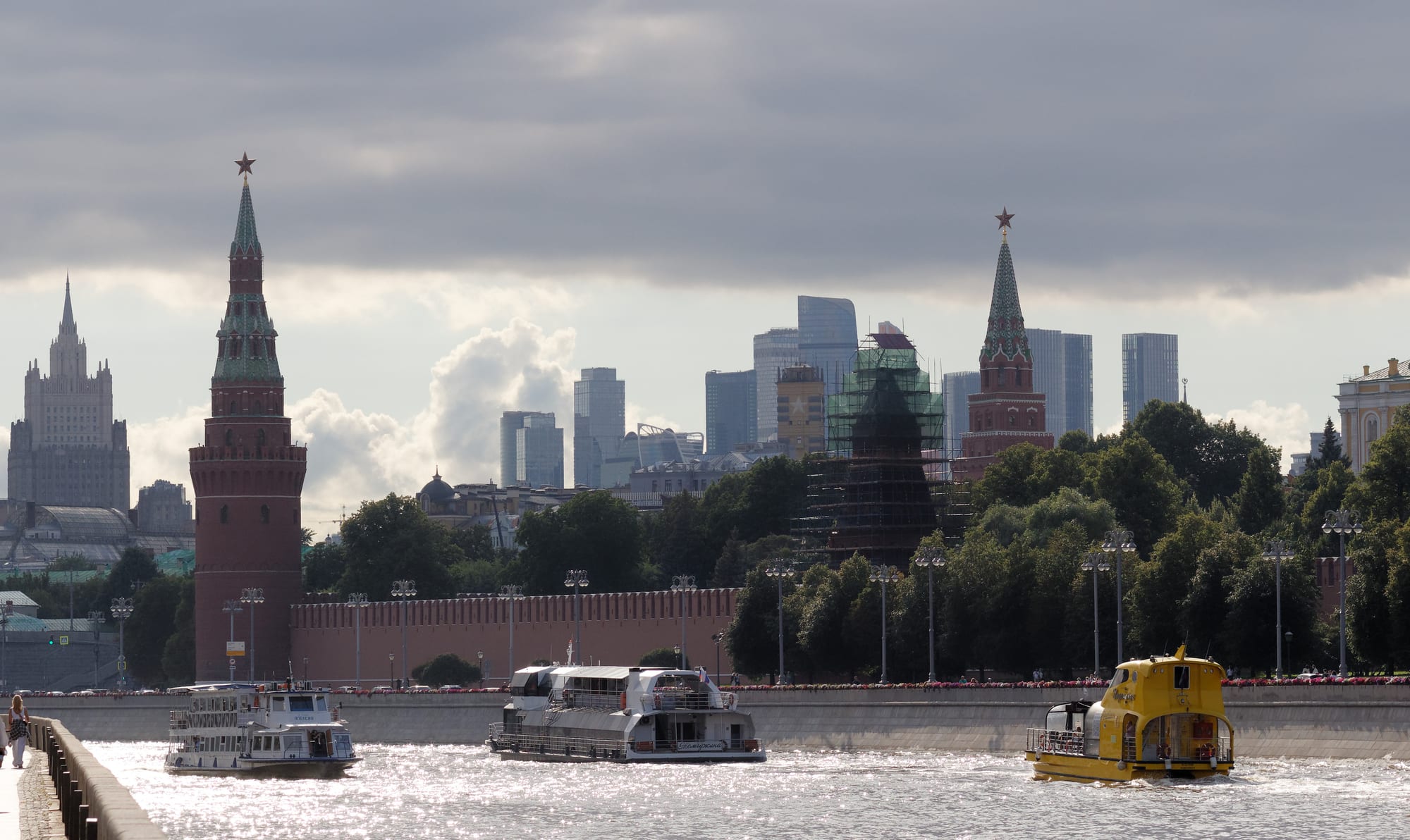
Red-brick Kremlin towers and wall above the Moskva River with river boats, and the glass towers of Moscow-City behind under grey cloud

Moscow & Central Russia, Russia

Moscow

Passenger boats on the Moskva River below the Kremlin, with the towers of Moscow-City on the skyline beyond. (Retired electrician / Wikimedia Commons · CC0)

Russia's capital on the Moskva River, first recorded in 1147, which grew from a fortified hill into the centre of a unified Russian state and, after 1918, of the Soviet Union. It is now a city of about 13 million around the Kremlin and Red Square, ringed by boulevards, Soviet apartment districts and new towers. This page is written to explain the city, not to encourage travel.

Neighbourhoods

  • Kitay-gorod
    • First-time visitors
    • Historic district
    • Close to public transport

    The old merchant quarter on the far side of Red Square from the Kremlin, a tight grid of narrow streets and very densely built blocks within the remains of its 16th-century walls. Small churches, monastery courtyards, the GUM arcade and the pedestrian Nikolskaya Street make it the most central place to be.

    Open in Maps
  • Tverskoy
    • Theatres
    • Shopping
    • Close to public transport

    The district running north-west from the Kremlin along Tverskaya Street, the city's main avenue. It holds Theatre Square and the Bolshoi, the State Duma, the mayor's office and many of the capital's grandest shops and restaurants.

    Open in Maps
  • Arbat
    • Walking
    • Historic district

    West of the Kremlin, built around the Arbat, a pedestrian street about a kilometre long that has existed since at least the 15th century. Rebuilt after the fire of 1812, it was long home to petty nobility, artists and academics; the street is now an important tourist attraction, beside the wide Soviet-era New Arbat.

    Open in Maps
  • Zamoskvorechye
    • Museums
    • Quiet streets
    • Churches

    The old merchants' quarter across the river from the Kremlin, known for its mix of architecture, its many churches and an atmosphere more like a provincial town. The Tretyakov Gallery stands just beyond it, in neighbouring Yakimanka.

    Open in Maps
  • Khamovniki
    • Museums
    • Parks and the river
    • Upmarket

    The district stretching south-west from the Kremlin into the bend of the Moskva, with the Pushkin Museum, the Cathedral of Christ the Saviour, the Novodevichy Convent and Luzhniki Stadium. Its streets between the Boulevard and Garden Rings, the 'Golden Mile', are the most expensive housing in central Moscow.

    Open in Maps
  • Presnya
    • Nightlife
    • Modern Moscow

    The western part of the centre, from the leafy Patriarch Ponds and the Moscow Zoo to the riverside Russian White House and the skyscrapers of the Moscow-City business district on the Presnenskaya Embankment.

    Open in Maps

Things to do

The Kremlin and Red Square

  • Moscow Kremlinlandmark

    The walled citadel on its hill above the river, holding five palaces and four cathedrals within its walls, with the Grand Kremlin Palace now the residence of the Russian president.

    Open in Maps
  • Red Squarelandmark

    The great square between the Kremlin wall and Kitay-gorod, scene of executions, ceremonies, processions and parades, including the Victory Day parade each May.

    Open in Maps
  • Saint Basil's Cathedrallandmark

    The cluster of patterned, brightly painted onion domes at the end of Red Square, commissioned by Ivan the Terrible in the 1550s and now a museum.

    Open in Maps
  • Lenin's Mausoleumlandmark

    The granite tomb below the Kremlin wall where Lenin's preserved body has been on display since shortly after his death in 1924.

    Open in Maps
  • GUMlandmark

    The Upper Trading Rows of 1890–93, whose façade runs for 242 metres along the east side of Red Square, now a shopping centre with cafés.

    Open in Maps
  • Cathedral of Christ the Saviourlandmark

    The huge white cathedral by the river, a rebuilt copy of the 19th-century church that saw the premiere of Tchaikovsky's 1812 Overture and was blown up on Soviet orders in 1931.

    Open in Maps

Museums and theatre

  • Kremlin Armourymuseum

    One of the oldest museums in Moscow, inside the Kremlin, begun as the royal arsenal in 1508 and holding the weapons, jewellery and household treasures of the tsars.

    Open in Maps
  • Tretyakov Gallerymuseum

    The main collection of Russian art, from medieval icons to the painters of the 19th and early 20th centuries, behind a fairy-tale façade designed by Viktor Vasnetsov.

    Open in Maps
  • Pushkin State Museum of Fine Artsmuseum

    The city's largest museum of European art, from antiquity to the French Impressionists, across the street from the Cathedral of Christ the Saviour.

    Open in Maps
  • State Historical Museummuseum

    The red-brick building closing the north end of Red Square, devoted to the history of Russia from prehistoric times.

    Open in Maps
  • Garage Museum of Contemporary Artmuseum

    A privately funded gallery of contemporary art in Gorky Park, housed since 2015 in a building designed by Rem Koolhaas, with archives of Russian art since the 1950s.

    Open in Maps
  • Bolshoi Theatreattraction

    The columned theatre on Theatre Square, home of one of the world's best-known ballet and opera companies.

    Open in Maps

Parks, monasteries and the river

  • Zaryadye Parkpark

    A landscaped park beside Red Square, opened in 2017 on the site of the old Zaryadye quarter, with views back over the Kremlin and the river.

    Open in Maps
  • Gorky Parkpark

    The central park of culture and leisure along the Moskva, named after Maxim Gorky, with riverside walks, cafés and, in winter, skating.

    Open in Maps
  • Novodevichy Conventlandmark

    A convent founded by Grand Duke Vasily III in 1524 that, unlike other Moscow cloisters, has remained virtually intact since the 17th century, with a cemetery beside its walls where Chekhov and Gogol are buried.

    Open in Maps
  • Kolomenskoyepark

    A former royal estate of 390 hectares on the steep banks of the Moskva, south-east of the centre, with the white tower-church of the Ascension.

    Open in Maps
  • VDNKhpark

    The Soviet Union's great exhibition ground, a park of grand pavilions, fountains and sculpture in the north of the city.

    Open in Maps

Getting around and sport

  • Moscow Metrotransit hub

    Opened in 1935 and at once the centrepiece of the city's transport, with deep stations decorated in marble, mosaics and chandeliers.

    Open in Maps
  • Luzhniki Stadiumattraction

    Russia's national stadium, with 81,000 seats, the main arena of the 1980 Olympic Games, in a bend of the river in Khamovniki.

    Open in Maps

Short trips from the city

  • Arkhangelskoyelandmark

    A historic country estate with a palace and formal park around 20 km west of Moscow, near Krasnogorsk.

    Open in Maps
  • Trinity Lavra of St Sergiuslandmark

    The walled monastery at Sergiyev Posad, north-east of the capital, the most important in the Russian Orthodox Church.

    Open in Maps

Seasonal events

  • Maslenitsathe week before Orthodox Lent, February or March

    Pancake week, marked with fairs, blini and the burning of a straw effigy.

  • Victory Day9 May

    The largest state occasion of the year, with a military parade on Red Square that closes much of the centre.

  • Circle of Lightlate September or October

    An international light festival in which designers project light shows and graphics onto the city's buildings.

Eat and drink

Long-standing places and food districts in Moscow. Hours, ratings and directions come from your maps app, always current.

Moscow classics

  • Café Pushkinrestaurant

    A Russian restaurant on Tverskoy Boulevard, opened in 1999 by the restaurateur Andrei Dellos in a building put up in 1999, with rooms styled as a pharmacy and a library.

    Open in Maps
  • Stolovaya 57restaurant

    A well-known stolovaya — a canteen where diners take a tray along a counter of soups and hot dishes — inside the GUM arcade on Red Square.

    Open in Maps

Food districts and markets

  • Danilovsky Marketmarket

    A food market in Danilovsky District, south of the centre, with produce stalls and food counters.

    Open in Maps
  • Kitay-gorod and Nikolskaya Streetneighborhood

    The streets between Red Square and Lubyanka, packed with cafés, bars and restaurants of every price.

    Open in Maps

Experience Moscow

History

Moscow is first mentioned in the chronicles in 1147, as a meeting place of Prince Yuri Dolgorukiy, then a minor town on the western border of the principality of Rostov-Suzdal. Its princes grew powerful as collectors of tribute for the Golden Horde, and the town became the capital of the Grand Principality of Moscow, which led the unification of the Russian lands in the 15th century. In the first half of the 17th century the population doubled to about 200,000, before plague killed most of the inhabitants in 1654–55.

Peter the Great moved the court to St Petersburg, and Moscow's population fell to about 130,000 by 1750 before growing tenfold over the rest of the imperial era. When Napoleon took the city in 1812, Muscovites had been evacuated, and a fire destroyed much of it; the rebuilding produced the Bolshoi Theatre and the Manege, and by 1915 the city had 1.8 million people.

On 12 March 1918 Lenin moved the capital back to Moscow, and the city became the centre of the Soviet state. The metro opened in 1935 and in 1941–42 the German advance was stopped on the city's outskirts in the Battle of Moscow. After the war more than 11,000 prefabricated apartment blocks were built to house its growing population. In 2012 the city more than doubled in area by expanding south-west into Moscow Oblast. Since 2023 drones have struck the city repeatedly during the war with Ukraine, and in March 2024 an attack on Crocus City Hall near Moscow killed more than 140 people.

Culture & Customs

Moscow is the centre of Russian cultural life on a scale no other city in the country matches. Among its theatres are the Bolshoi, the Malyi, the Vakhtangov and the Moscow Art Theatre, and the Tretyakov Gallery and the Pushkin Museum hold the great national and European collections. The Cathedral of Christ the Saviour, the original of which saw the premiere of Tchaikovsky's 1812 Overture, was rebuilt on its site between 1995 and 2000.

Most Muscovites who have a religion are Russian Orthodox, and the city's many churches and monasteries fill at Easter and Christmas. The capital also has a large Muslim population and four mosques. Victory Day on 9 May, with its parade on Red Square and families marching with portraits of relatives who fought, is the central public ritual, and Maslenitsa fairs mark the end of winter.

The city has several big football clubs and the national stadium at Luzhniki. Since 2022 the war has reshaped public life: laws against "discrediting" the armed forces have brought more than 10,000 prosecutions, many critics of the war have emigrated, and Western brands have left, McDonald's outlets reopening under a Russian name. Many Muscovites keep dachas, country houses outside the city.

Daily Life

The 2021 census counted about 13 million people in the city, up from 11.5 million in 2010, and more than 21.5 million live in the wider metropolitan area. Migrants from across Russia and from Central Asia make up a large share of the workforce, and many live in the city without official registration. The city is the political and economic centre of Russia and one of the world's largest urban economies.

Most Muscovites live in prefabricated apartment blocks of the Soviet and post-Soviet decades, spread across districts far from the centre, and travel in by metro; the Moscow Central Circle and the Big Circle Line, finished in 2023, ring the city outside the centre. Ride-hailing apps are the usual way to order a taxi, and car-sharing schemes that the mayor, Sergey Sobyanin, has described as the largest in Europe.

The war has changed the rhythm of the city. Drone attacks have repeatedly closed the airports, and the partial mobilisation of September 2022 set off a wave of emigration, with hundreds of thousands of men leaving the country. At the same time a busy restaurant scene keeps the centre lively.

Food

Several dishes known far beyond Russia have Moscow origins. The Olivier salad was invented in the 1860s by Lucien Olivier, the chef of the Hermitage, one of the city's most celebrated restaurants, and became its signature dish. Classic Russian dishes include kulebyaka (coulibiac), a pie usually filled with salmon or sturgeon, rice or buckwheat and hard-boiled eggs, and blini with caviar. Borodinsky bread, the dark rye loaf flavoured with coriander, has a modern recipe that first appeared in 1933 in the memos of a Moscow baking plant, and plombir, an ice cream of vanilla, cream, eggs and sugar, was first produced in Moscow in 1937.

Everyday eating ranges from food stalls by metro stations to stolovaya canteens, where diners carry a tray along a counter of soups and hot dishes, to expensive restaurants. Shchi, borsch, pelmeni and kasha are the basics.

The capital's grand food halls and markets are part of its character, among them Danilovsky Market south of the centre; the famous Yeliseyev grocery on Tverskaya Street, opened in 1901, has been closed since 2021. Tea, kvass and vodka remain the traditional drinks.

Planning tools

Budget

Moscow is expensive by Russian standards, though the metro and canteen meals are cheap. The real difficulty is payment: most foreign-issued cards no longer work in Russia, so money mostly has to come from cash brought in and exchanged.

Daily Budget Midrange
USD 140–280 (mid-range hotel, restaurants, museum and theatre tickets, taxis)
Daily Budget Shoestring
USD 45–85 (hostel bed, canteens and markets, metro)

Bring enough foreign cash for the whole stay; most foreign cards do not work in Russian shops or ATMs.

Best Time to Visit

Late May to early September brings long days, open-air cafés and boats on the river; September has a short golden autumn. Winter lasts from about mid-November to the end of March, cold and snowy, with short days but skating rinks and lit-up streets. The Victory Day parade on 9 May closes much of the centre.

Suggested Number of Days

A first visit usually takes three or four days, since the city is huge and its museums are large. Allow five days or more to add the monasteries and estates of Moscow Oblast or a Golden Ring town. Queues and security checks at the main sights can make any day slower than planned.

First Visit
3–4 days
With Surroundings
5–7 days

Transportation

The metro, opened in 1935, is the way to move around the city: deep, fast and frequent, with the Moscow Central Circle rail ring since 2016 and the Big Circle Line completed in 2023. A rechargeable Troika card works on the metro, buses and trams. Taxis are ordered through apps, and car-sharing is widespread.

Carry passport, visa and migration card at all times, and use the Yandex Go app rather than street taxis.

Airport & Station Connections

Sheremetyevo, the busiest airport in Russia and the hub of Aeroflot, lies 29 km north-west of the centre; Domodedovo and Vnukovo serve the south. Aeroexpress trains link the airports to the city. Direct international flights now go mainly to former Soviet states, the Middle East, Serbia and Asia. Moscow's airports have been shut repeatedly during drone attacks since 2023. Fast trains run to St Petersburg and the Golden Ring towns from the city's rail terminals.

Walkability

The historic core inside the Boulevard Ring — the Kremlin, Red Square, Kitay-gorod, Tverskaya and the Arbat — is walkable, and the riverside embankments make long pleasant walks. Beyond it, distances are huge and the avenues very wide, with crossings often by underpass, so most journeys between districts are made by metro.

Safety

Beyond the ordinary crime of a large European city, the decisive risks are political and legal: near-total loss of consular support, a real risk of arbitrary arrest and lengthy detention of foreigners on politically motivated charges (and their use in prisoner swaps), sweeping wartime censorship laws, and the possibility that men of certain ages, including dual nationals, face conscription or exit bans. Moscow has been hit repeatedly by Ukrainian drones since 2023, and the 2024 attack on Crocus City Hall near Moscow killed more than 140 people. Surveillance is pervasive in the capital.

Most governments advise against all travel to Russia and against any travel near the Ukrainian border. Avoid demonstrations, do not photograph government, military or infrastructure sites, and carry passport and visa at all times. Check current official travel advice before travelling.

Climate

Humid continental, with long, cold winters that usually last from mid-November to the end of March, and warm summers. Weather can swing widely, and the centre is noticeably warmer than the suburbs on frosty nights.

Summer
warm, with heat waves between May and September when daytime highs often exceed 30°C, sometimes for a week or two
Winter
cold and snowy — January now averages about −7°C, with colder spells when nights fall below −20°C

Local Customs

Tipping is not obligatory but expected in restaurants; around 10 per cent is normal and more would be unusual, and taxis are not tipped. Russian Orthodox churches expect quiet and respectful behaviour during services. Many Muscovites have dachas, country houses outside the city. Since 2022, public criticism of the war can bring prosecution under wartime censorship laws.

Photographing military or infrastructure sites can bring espionage charges; LGBT people face severe legal repression.

Common Payment Methods

The currency is the rouble (RUB). Most credit and debit cards issued abroad no longer work in Russia, and most cannot be used at Russian ATMs, so cash brought in and exchanged is the most reliable means of payment.