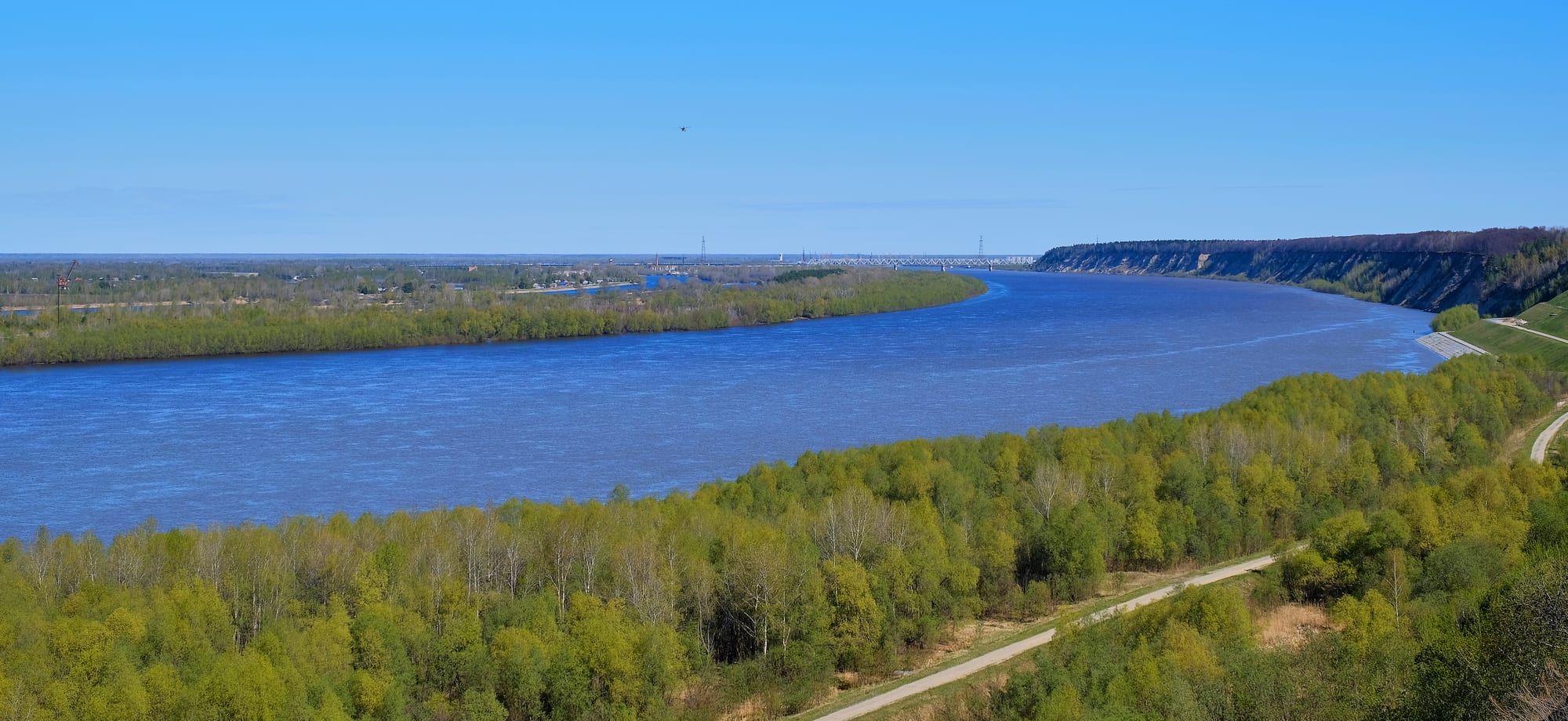
A broad blue river curving between green spring woods and a high bank under a clear sky, with a bridge in the distance

Russia

The Urals

The Irtysh River in spring, seen from the kremlin in Tobolsk. (Vyacheslav Bukharov / Wikimedia Commons · CC BY-SA 4.0)

The band of Russia that straddles the low Ural Mountains between Europe and Asia and runs north across the West Siberian plain to the Arctic tundra of Yamal — the country's metal-working heartland around Yekaterinburg and Chelyabinsk, and the source of most of its oil and gas. This page is written to explain the region, not to encourage travel.

Explore The Urals

History

The southern Urals steppe was settled early: Arkaim and the other Sintashta sites, from around 2000 BC, are linked to the earliest known chariots and to intensive bronze-working. For most of history the forests and tundra belonged to the Khanty and Mansi, and the far north to the Nenets reindeer herders. The Khanate of Sibir, a Tatar state on the Irtysh, controlled the fur trade until 1582, when the Cossack leader Yermak, hired by the Stroganov merchants, crossed the mountains and took its capital near present-day Tobolsk.

Russian settlement followed fast. Tyumen, founded in 1586, was the first Russian town in Siberia, and Tobolsk, founded the next year, became the administrative and church capital of all Siberia. Under Peter the Great the Urals turned into an industrial region: the Demidov family and state engineers built ironworks and copper works worked by serfs, and Yekaterinburg was founded in 1723 as a factory-fortress named after Catherine I. Tobolsk declined when the Trans-Siberian Railway bypassed it, and in 1917 it became the place of exile of the deposed Nicholas II; the family was moved to Yekaterinburg and shot in the Ipatiev House in July 1918.

The Soviet era made Sverdlovsk and Chelyabinsk into arms-making giants, above all when factories were evacuated east in 1941 and Chelyabinsk became "Tankograd". Secret nuclear towns followed, and the 1957 Kyshtym disaster at the Mayak plant was hidden for decades. Oil at Samotlor and gas at Urengoy in the 1960s–70s transformed the north. Boris Yeltsin rose through the Sverdlovsk party before becoming Russia's first president.

Culture & Customs

Uralians see themselves as practical, blunt and hard-working, shaped by factories and distance from Moscow, and Yekaterinburg likes to call itself Russia's third capital. It has long had an independent streak: an active rock scene in the 1980s, a strong theatre life, street art and, until direct mayoral elections were abolished in 2018, an opposition mayor.

The folk heritage is mining lore. Pavel Bazhov's Ural tales, collected as The Malachite Box, tell of the Mistress of the Copper Mountain and the stone-carvers of the old works, and malachite, jasper and gem-cutting remain local crafts. Zlatoust is known for engraved steel blades and Kasli for its cast-iron sculpture.

The north has a different culture. The Khanty, Mansi and Nenets are small Indigenous peoples, speaking Finno-Ugric and Samoyedic languages; many Nenets still follow the reindeer on seasonal migrations across Yamal, living in skin tents and keeping sacred sites alongside Orthodox Christianity. Siberian Tatars, descendants of the Khanate of Sibir, still live around Tobolsk and Tyumen.

The Romanov murder is now a site of Orthodox pilgrimage: each July a night procession walks from the Church on the Blood to the Ganina Yama monastery, where the bodies were first disposed of.

Daily Life

About 12 million people live in the region, most in the south: Yekaterinburg with around 1.5 million, Chelyabinsk over a million, Tyumen approaching 900,000, and steel towns such as Magnitogorsk and Nizhny Tagil. Surgut, Nizhnevartovsk, Khanty-Mansiysk, Novy Urengoy, Noyabrsk and Salekhard are the northern centres, many of them built from scratch for oil and gas. Kurgan lies on the steppe to the south-east.

The economy rests on metals, machinery, arms and energy. Magnitogorsk and Chelyabinsk make steel, Nizhny Tagil builds tanks at Uralvagonzavod, and Yekaterinburg is a banking, trade and services centre as well as an industrial one. Khanty-Mansi and Yamal produce most of Russia's oil and gas, and the Yamal LNG plant at Sabetta ships liquefied gas through the Arctic. Much northern work is done in long shifts, with workers flown in for weeks at a time.

Winter shapes life: long dark months, heating seasons from autumn to spring, ice fishing and cross-country skiing. The war economy has brought high wages at the tank, artillery and munitions plants of the south, while heavy smog in Chelyabinsk and Magnitogorsk remains a constant local complaint. Tyumen, cushioned by oil money, has grown quickly in recent decades.

Food

The Urals claim pelmeni, small meat dumplings in thin dough, as their own; the name is usually traced to a Finno-Ugric word for "ear bread", and Ural families traditionally made them by the hundred and froze them outdoors for winter. Shangi, soft open buns topped with mashed potato or curd, and pirogi filled with fish, cabbage or mushrooms are everyday baking, and pickled mushrooms, lingonberries, cranberries and cedar nuts come from the taiga.

The north eats fish and reindeer. The Ob and Irtysh supply prized whitefish — muksun, nelma and shchokur — which are salted, smoked or, in the Arctic style, eaten as stroganina, thin shavings of raw fish frozen hard and dipped in salt and pepper. Reindeer meat is stewed, dried or eaten raw by herders. Tobolsk has its own tradition of fish pies and of Siberian Tatar dishes such as flat pies filled with meat.

Drink is tea with berry jam, kvass, mors (a cranberry or lingonberry drink), and vodka, often infused with cedar nuts, berries or herbs at home. Many towns still have old stolovaya canteens serving borsch, cutlets and buckwheat at modest prices.

Attractions & Natural Wonders

Yekaterinburg is the main city: the Church on the Blood on the site of the Ipatiev House, the Yeltsin Center, the dam-lake at the heart of the old factory, the Constructivist buildings of the 1920s–30s and the Ural geological museum's minerals. Outside the city lie the Ganina Yama monastery, the Europe–Asia boundary markers on the old Moscow road, the leaning Demidov tower at Nevyansk and the monastery town of Verkhoturye.

Tyumen has a lively riverside and hot-spring pools on its outskirts, and Tobolsk, a few hours north-east, is the region's most beautiful old town: the Tobolsk Kremlin and St Sophia Cathedral above the Irtysh, the governor's house where the Romanovs were held, and the lower town of wooden houses and churches. Dmitri Mendeleev, of the periodic table, was born here.

Chelyabinsk has a pedestrian street, war memorials and fragments of the 2013 meteorite in its regional museum; Zlatoust and Taganay National Park offer ridge walks among rocky outcrops, and the mountain lakes around Turgoyak are the summer escape. Arkaim, on the steppe near the Kazakh border, draws archaeology visitors. Kurgan has a museum of the Decembrists exiled there.

The north is visited mainly for work, but Khanty-Mansiysk has an ethnographic museum and a winter-sports centre, and Salekhard, on the Arctic Circle, is the gateway to the Yamal tundra, with its reindeer herders, lakes and the gas-field landscapes of the Arctic.

Cities in The Urals

Planning basics

Budget

Yekaterinburg and Tyumen are mid-priced by Russian standards, and the oil-and-gas towns of Khanty-Mansi and Yamal are among the most expensive places in the country, with high wages, costly flights and hotels priced for company business. Foreign cards do not work, so everything is paid from cash brought in and exchanged.

Daily Budget Midrange
USD 85–180 (mid-range hotel, restaurants, museums; much more in the northern oil towns)
Daily Budget Shoestring
USD 30–60 (hostel, canteens, city trams and suburban trains in the south)

Budget separately for any trip north: flights to Khanty-Mansiysk or Salekhard and hotels there cost far more than in Yekaterinburg.

Safety

The Urals lie far from the front line, but the national risks apply in full: arbitrary detention of foreigners on political charges, wartime censorship laws and near-total loss of consular support. The region is full of arms factories and nuclear sites, including closed towns that foreigners cannot enter, and parts of the Arctic north need special permits. Extreme cold, remote roads and thin mobile coverage add natural risks.

Do not photograph factories, military sites, bridges or energy infrastructure, and keep political opinions offline. Check current official travel advice before travelling.

Climate

Continental in the south, with warm summers and long, cold winters, and subarctic to Arctic in the north, where Yamal has polar night in December and midnight sun in June. The Ural range itself is low and makes little difference; the great contrast is latitude, and spring comes late everywhere.

Summer
warm in the south, typically 20–28°C; short and cool in the north, with mosquitoes and midges in the taiga and tundra
Winter
cold, often −15 to −25°C in Yekaterinburg and Chelyabinsk; far colder and dark on Yamal

Transportation

Yekaterinburg is the hub, on the Trans-Siberian about a day and a night by train from Moscow or a little over two hours by air. Trains and roads link it with Chelyabinsk and Tyumen, and Tobolsk is a few hours beyond Tyumen by train. The north is reached mainly by air; Salekhard can also be approached by rail to Labytnangi across the Ob. Distances are huge and winter roads are hazardous.

Carry passport, visa and migration card on every journey, and check permit rules before heading anywhere near the Arctic coast.

Best Time to Visit

June to early September in the south and the Tobolsk area; July and August are the only warm months on Yamal. Late winter suits skiing in the southern Urals. Timing matters less than the national picture: most governments advise against all travel to Russia.