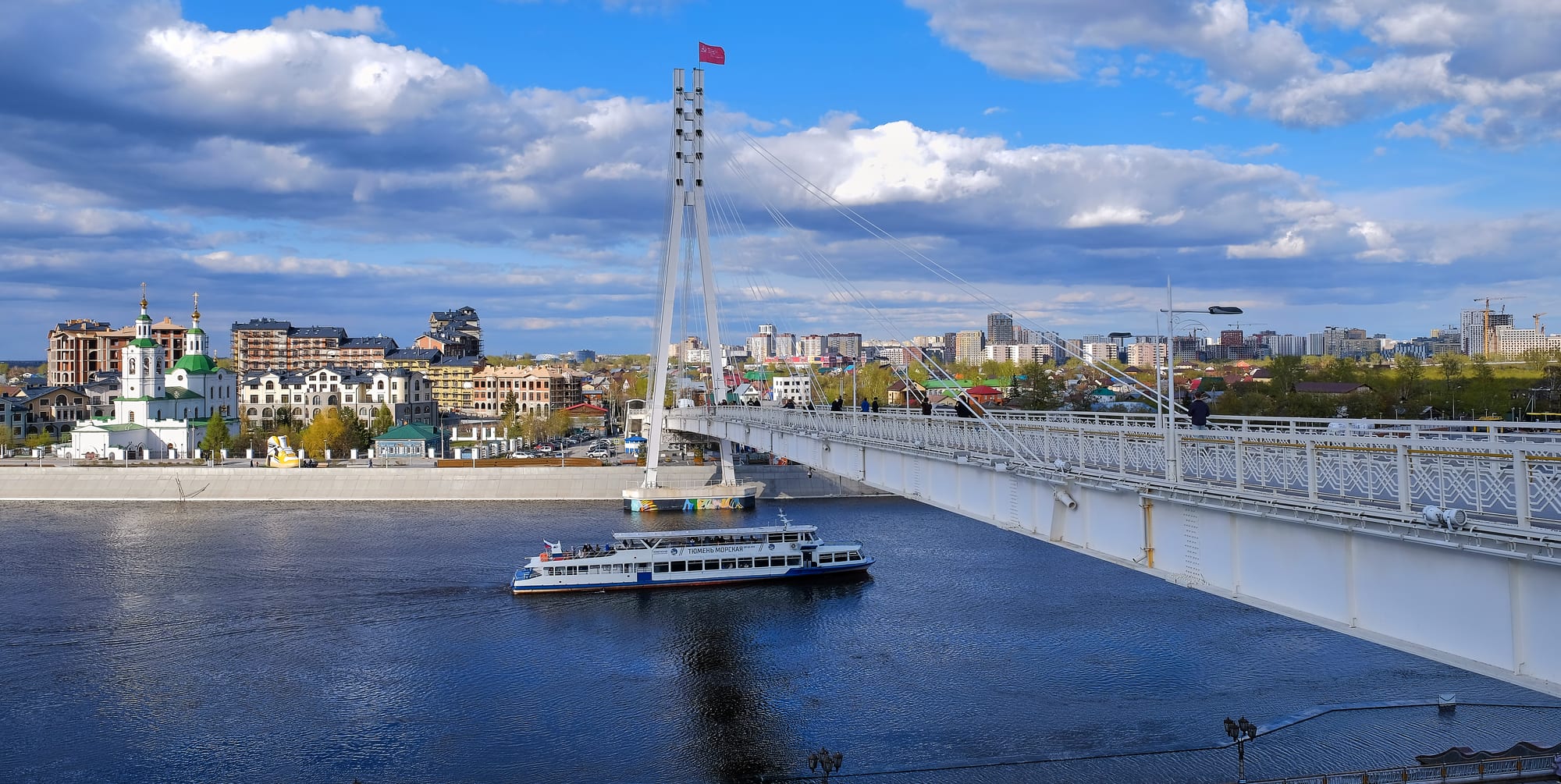
A white cable-stayed footbridge over a wide river, with a river boat below and a green-domed church nearby

The Urals, Russia

Tyumen

Lovers' Bridge over the Tura River in Tyumen, seen from the right bank. (Vyacheslav Bukharov / Wikimedia Commons · CC BY-SA 4.0)

A city on the Tura River just east of the Urals, founded in 1586 as the first Russian settlement in Siberia on the site of the Tatar town of Chimgi-Tura. A trading and railway town for three centuries, it became the supply base for the West Siberian oil and gas fields and has grown fast since. This page is written to explain the city, not to encourage travel.

Neighbourhoods

  • Old Tyumen and Republic Street
    • First-time visitors
    • Historic district
    • Architecture

    The historic centre on the high right bank of the Tura, around the foundation site of the town. Republic Street, the old Tsarskaya Street, runs through it, lined with brick and wooden merchant houses, churches and the Kolokolnikov estate, with the occasional Soviet low-rise block between them.

    Open in Maps
  • The Tura embankment
    • Walks
    • Views
    • Summer evenings

    The landscaped riverfront below the old town, terraced down to the water and used for concerts and city holidays. Lovers' Bridge crosses the river here to the low left bank, and the churches of the old town stand above it.

    Open in Maps
  • Yamskaya Sloboda
    • Historic district
    • Churches

    One of the old suburbs that grew up beside the fortress by the 1640s, beyond which the Trinity Monastery was founded. Its streets keep old brick and wooden houses and are one of the two areas of the city noted for their historic character.

    Open in Maps
  • Bukharskaya Sloboda
    • Wooden houses
    • Local life
    • Quiet and residential

    A historic residential area on the low bank of the Tura, across the river from the old centre. It is made up mostly of very old one- and two-storey wooden houses and has a mostly Muslim population.

    Open in Maps
  • The Soviet centre and Tsvetnoy Boulevard
    • Close to public transport
    • Shopping
    • Families

    The district east of the historic centre, built between 1948 and 1978 in four- and five-storey blocks, where most of the city's political and business life is concentrated. Its focus is Tsvetnoy Boulevard, a pedestrian zone of squares, fountains, a circus and sculptures facing the city administration.

    Open in Maps

Things to do

Famous landmarks

  • Lovers' Bridgelandmark

    A cable-stayed footbridge about 250 metres long over the Tura, opened in 1987 and renamed in 2003; newlyweds come here for wedding photographs, and love locks have been hung on its railings since 2005.

    Open in Maps
  • Church of the Saviourlandmark

    One of the oldest and most expressive churches in Siberia, a Siberian Baroque building of the late 18th century on Lenin Street, used for decades as an archive after it was closed in 1930.

    Open in Maps
  • Holy Trinity Monasterylandmark

    One of the oldest monasteries in Siberia, founded in 1616 and rebuilt in stone in 1709–1711 with special permission of Peter the Great, at a time when stone building outside Saint Petersburg was prohibited; it was revived as a working monastery in 1995.

    Open in Maps
  • Znamensky Cathedrallandmark

    The main Orthodox church of the city and the cathedral of the Tobolsk metropolis, a stone church begun in 1768 on the site of earlier wooden churches lost to fire.

    Open in Maps
  • Tsvetnoy Boulevardattraction

    A pedestrian zone of about 650 metres in the centre, rebuilt in 2004 on the site of an old city garden, with five squares, fountains, a circus, a sports centre, kiosks and sculptures; it is the stage for city festivals.

    Open in Maps
  • Square of Siberian Catsattraction

    A small square on Pervomayskaya Street with cat figures recalling the cats sent from Tyumen to Leningrad after the siege, in 1944, to deal with the rats in the Hermitage and the city.

    Open in Maps

Museums and theatre

  • Slovtsov Museum Complexmuseum

    The regional museum, founded in 1879 and one of the oldest in Siberia, named after the scholar Ivan Slovtsov, with collections on local history and archaeology.

    Open in Maps
  • Kolokolnikov Estatemuseum

    The former estate of the Kolokolnikov merchant family on Republic Street, now a museum holding exhibitions, workshops and guided tours on the life of old Tyumen.

    Open in Maps
  • Tyumen Museum of Fine Artsmuseum

    The city's art museum, one of the institutions of Tyumen's museum network.

    Open in Maps
  • Tyumen Bolshoi Drama Theatreattraction

    A drama company that traces its history to 1858 and plays in a building of about 36,000 square metres, billed as the largest drama theatre in Russia by floor area.

    Open in Maps

Parks and the river

  • The Tura embankmenttrail

    The terraced and landscaped riverfront promenade below the old town, the city's main place for walks and the setting for holiday concerts, sports and games.

    Open in Maps
  • Gagarin Forest Parkpark

    A forest park of about 105 hectares, the largest of the green spaces inside the city.

    Open in Maps
  • Zatyumensky Forest Parkpark

    A second forest park inside the city, of about 77 hectares.

    Open in Maps

Short trips from the city

  • Hot springs around Tyumenattraction

    About five geothermal springs on the city's outskirts with water valued for bathing cures, popular with people from Tyumen and from the neighbouring Sverdlovsk, Kurgan and Chelyabinsk regions.

    Open in Maps
  • Pokrovskoyeattraction

    A village in Yarkovsky District, known as the birthplace of Grigori Rasputin and home to a museum dedicated to him.

    Open in Maps

Seasonal events

  • Maslenitsalate winter, the week before Orthodox Lent

    The Butter Week folk holiday of the last week before Great Lent, marked with blini, sleigh rides and the burning of a straw effigy.

  • Victory Day9 May

    The state commemoration of the end of the Second World War in Europe, with parades and gatherings in a city that sent more than 20,000 of its people to the front.

Eat and drink

Long-standing places and food districts in Tyumen. Hours, ratings and directions come from your maps app, always current.

Tyumen classics

  • Pelmenirestaurant

    The dumplings of thin unleavened dough filled with minced meat that became a staple during Russian expansion into the Urals and Siberia; Siberian-style, they are sprinkled with vinegar and ground pepper, or served with butter or sour cream.

    Open in Maps
  • Siberian river fishrestaurant

    Whitefish such as muksun, from the waters of the Siberian Arctic, eaten as stroganina — long, thin shavings of the raw fish, frozen.

    Open in Maps

Food districts

  • Republic Streetneighborhood

    The old main street of the historic centre, with cafés and restaurants among its merchant houses, close to the embankment.

    Open in Maps
  • Tsvetnoy Boulevardneighborhood

    The pedestrian heart of the Soviet-era centre, with cafés, restaurants and food kiosks among its squares and pavilions.

    Open in Maps

Experience Tyumen

History

Long before Russians came, the site was Chimgi-Tura, or Chingi-Tura, a Tatar town that served as the capital of the Siberian Khanate in the 15th century. Its name comes from the Turkic and Mongolic word for ten thousand. The Cossack leader Yermak conquered the area in 1585, and the fighting destroyed the khanate's capitals. On 29 July 1586 Tsar Feodor I ordered a fortress built on the ruins, and Tyumen became the first Russian settlement in Siberia. It stood on the Tyumen portage, an old trade route between Central Asia and the Volga, and for decades raids by Siberian Tatars and Kalmyks kept its population mostly made up of streltsy and Cossack garrisons.

By the 18th century Tyumen was a trading town between Siberia, China and central Russia, known for its leatherworkers and blacksmiths; Swedish prisoners taken at Poltava in 1709 arrived, and some stayed. The first steamboat in Siberia was built here in 1836. The railway arrived in 1885, and for some years Tyumen was the empire's easternmost railhead, where cargo moved between trains and the boats of the Tura, Tobol, Irtysh and Ob. By 1900 it had passed its old rival Tobolsk, which it replaced as the regional capital when Tyumen Oblast was created in 1944.

The Civil War brought Kolchak's Whites and the Reds in turn, and the 1930s made Tyumen an industrial city. In 1941 twenty-two factories were evacuated here from the west and the town became a hospital city; Lenin's body was secretly hidden in a building of what is now the agricultural academy. The discovery of oil and gas in the 1960s made Tyumen the supply base for the fields around Surgut and Nizhnevartovsk, and tens of thousands of workers arrived, faster than the city could plan for them.

Culture & Customs

Tyumen's sense of itself rests on being first — the first Russian town in Siberia, the gateway from the Urals — and on the oil wealth that has rebuilt much of it. The old merchant town survives in brick and wooden houses with carved details, and the city is nicknamed the Capital of Villages for its many timber houses. The Tura embankment, rebuilt as a terraced promenade, is now its main public space, and Lovers' Bridge has become a symbol of the city: newlyweds come for photographs, and so many love locks are hung on it that they are cut off every couple of years.

A local story is commemorated in the Square of Siberian Cats. In 1944 the city collected cats and sent 238 of them to Leningrad, where the siege had left the Hermitage overrun with rats, and they helped found a new population of cats in the city. Cultural life centres on the drama theatre, which dates from 1858, a philharmonic orchestra, museums and the University of Tyumen, which has more than 27,000 students.

The population is mainly Russian and Orthodox, but the old Bukharskaya Sloboda has a mostly Muslim population, and there are mosques, a synagogue and a Catholic church. The biathlete Anton Shipulin is among the sportsmen who call Tyumen their home town. The children's writer Vladislav Krapivin, also born in the city, is its best-known literary name.

Daily Life

About 847,000 people lived in Tyumen at the 2021 census, up from about 510,000 in 2002, the growth coming mainly from migration and from absorbing surrounding settlements. The city is a service and management centre for the oil and gas industry of Western Siberia, with the offices of large energy companies, oilfield service firms, design institutes, factories and a shipyard, alongside universities, hospitals and the oblast government.

The cityscape is a mix: the historic centre and the old sloboda suburbs of low brick and wooden houses; a band of 1950s–70s blocks east of the centre, where most offices are; five-storey prefabricated estates from the 1960s and 70s that now count as central and green; and newer high-rise estates on the southern and south-eastern edges, which residents consider the least pleasant places to live. Rapid growth without much planning has left the city with congested roads; paid parking was introduced in 2015.

The Tura shapes the year. Spring floods peak in the second half of May, held back by a dike, and summer evenings are spent on the embankment. Winters are long and very cold, and the geothermal springs on the outskirts are popular with residents and with visitors from the neighbouring regions.

Food

Tyumen eats the food of the Urals and Siberia. Pelmeni, small dumplings of thin unleavened dough filled with minced meat, became a staple of Russian cooking during the expansion into the Urals and Siberia; in Siberia they were traditionally frozen outdoors in winter and kept as preserved food, and they are served with butter or smetana (sour cream), or Siberian-style with vinegar and ground pepper. Tatar cooking has its own version, pilmän, served in a clear soup with dill.

Siberian Russian cooking makes much of the whitefish of the northern rivers, such as muksun and the Arctic cisco, and of local methods of eating them raw, frozen or with spices. The best known is stroganina, long thin shavings of frozen raw fish, a dish of the northern Russians and the Indigenous peoples of Arctic Siberia, made with nelma, muksun or other whitefish.

To drink there is kvass, a cloudy, sweet-and-sour, low-alcohol drink fermented from rye bread, and mors, a still drink made from lingonberries or cranberries. Most eating out happens in the cafés and restaurants of the historic centre and around Tsvetnoy Boulevard, and in self-service canteens where diners pick dishes from a counter.

Planning tools

Budget

Tyumen is mid-priced by Russian standards, cheaper than Moscow but cushioned by oil money. Foreign bank cards do not work, so the whole stay has to be paid from cash brought into the country and exchanged for roubles.

Daily Budget Midrange
USD 85–180 (mid-range hotel, restaurants, museums, taxis by app)
Daily Budget Shoestring
USD 30–60 (hostel bed, canteens and pelmeni, buses and marshrutkas)

The embankment, Lovers' Bridge, Tsvetnoy Boulevard and the churches of the old town cost nothing to see; budget extra for the hot springs outside the city.

Best Time to Visit

June to early September, when the embankment is busiest and the evenings are long. The Tura floods in spring, usually peaking in the second half of May. Winters are long and very cold, though the hot springs draw visitors in every season. Timing matters less than the national picture: most governments advise against all travel to Russia.

Suggested Number of Days

The historic centre and the riverfront can be seen in a day or two. Allow three or four days to add the hot springs and the countryside of the oblast; long rail journeys to or from the city add to the total.

First Visit
1–2 days
With Surroundings
3–4 days

Transportation

The city is divided by the Tura, the Tyumenka and the Trans-Siberian Railway, and its roads run well over capacity, with frequent traffic jams. Municipal buses and private marshrutka minibuses carry most passengers, the marshrutkas nearly a third of all capacity. Taxis are plentiful.

Carry passport, visa and migration card at all times, and allow extra time for road journeys across the river at rush hour.

Airport & Station Connections

Roshchino International Airport is 13 km west of the city, with flights from Moscow of about two hours, and from other Russian cities and some Central Asian capitals. All Trans-Siberian trains stop at the central railway station, 36 to 48 hours from Moscow; Yekaterinburg is 300 km to the west, and there are also trains to Omsk and Tobolsk.

Walkability

The historic centre, the embankment and Tsvetnoy Boulevard are compact enough to walk between, and the embankment and Lovers' Bridge are the pleasantest routes. Beyond the centre the city is a spread of low-rise districts and housing estates where buses are needed. Pavements are icy for much of the winter.

Safety

The Urals lie far from the front line, but the national risks apply in full: arbitrary detention of foreigners on political charges, wartime censorship laws and near-total loss of consular support. In Tyumen, the oil and gas industry and the bridges are sensitive sites. Extreme winter cold is the main natural hazard.

Most governments advise against all travel to Russia and against any travel near the Ukrainian border. Do not photograph factories, pipelines, bridges or military sites, and keep political opinions offline. Check current official travel advice before travelling.

Climate

Humid continental, with warm, somewhat humid summers and long, very cold winters, though average by Siberian standards. The weather changes quickly, and the city is a few degrees warmer than the surrounding countryside.

Summer
warm — July averages about 18.6°C, and the record high is 38°C
Winter
very cold — January averages about −16.7°C, and the record low is −50°C, in February 1951

Local Customs

Tyumen is mainly Orthodox, with a mostly Muslim population in the old Bukharskaya Sloboda, two mosques, a synagogue and a Catholic church. Newlyweds visit Lovers' Bridge for photographs, and locals hang padlocks on its railings. Tipping is not necessary but expected in restaurants; more than 10 per cent would be unusual, and it is not customary in taxis or self-service canteens.

Cover shoulders and knees in churches, where women usually cover their hair, and dress modestly at mosques; ask before photographing people.

Common Payment Methods

The currency is the rouble (RUB). Western and Japanese credit and debit cards — Visa, Mastercard, American Express and JCB — do not work in Russia, and most foreign cards cannot be used at Russian ATMs; some shops serving many foreigners accept UnionPay. Bring enough cash for the whole stay and exchange it at banks.