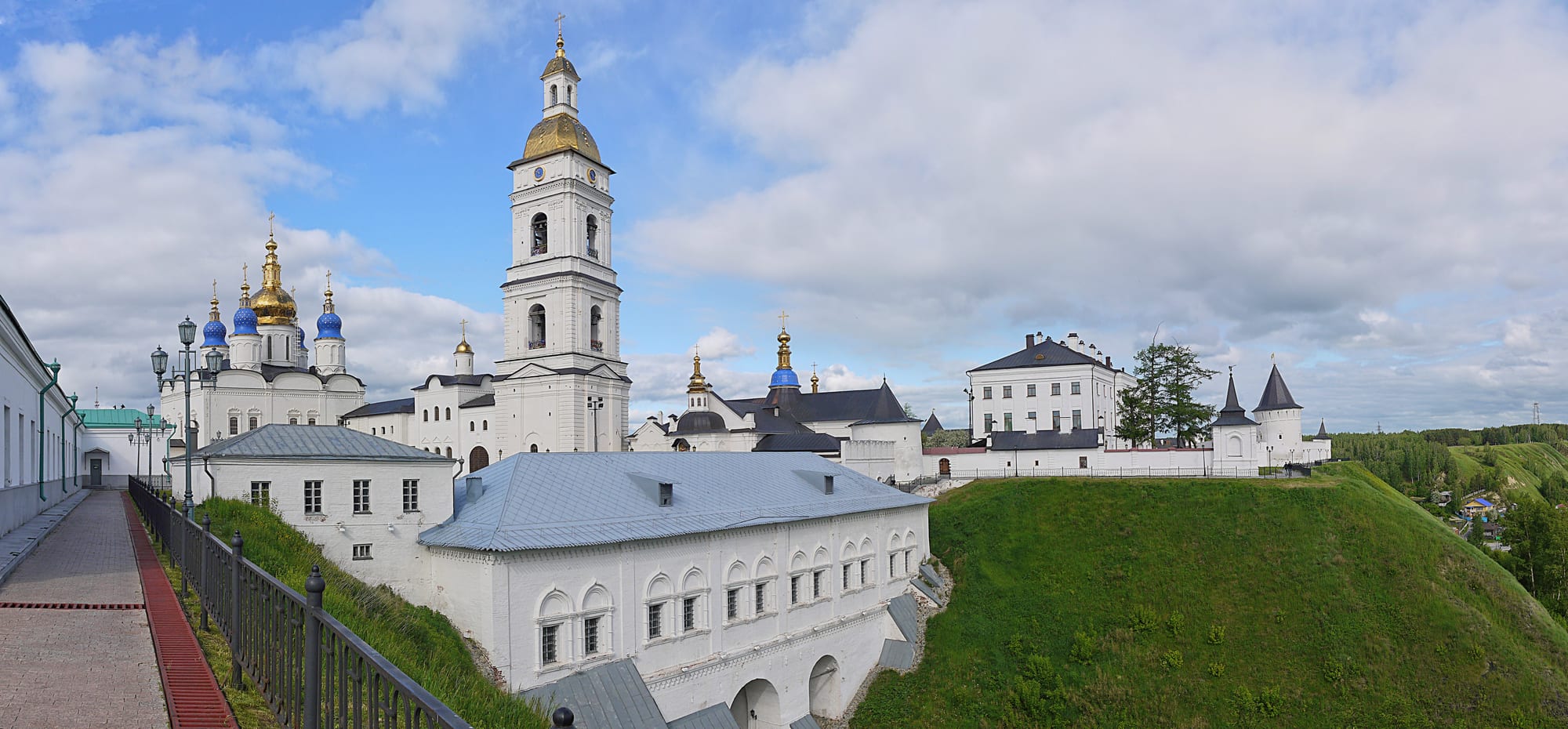
White kremlin buildings, a tall white bell tower with a golden dome and a cathedral with blue and gold domes on a grassy hilltop under a cloudy sky

The Urals, Russia

Tobolsk

Inside the Tobolsk Kremlin, with the bell tower and St Sophia-Assumption Cathedral on the hill above the lower town. (Óðinn / Wikimedia Commons · CC BY-SA 2.5 ca)

A town of about 100,000 where the Tobol meets the Irtysh in western Siberia — founded by Cossacks in 1587 and for two centuries the capital of Russian Siberia, with the only stone kremlin in Siberia. Bypassed by the Trans-Siberian, it became a place of exile, including for the last tsar in 1917–18, and is now a petrochemical town. This page is written to explain the town, not to encourage travel.

Neighbourhoods

  • The upper town and the kremlin
    • First-time visitors
    • Historic district
    • Views

    The white-walled kremlin on Trinity Cape, high above the Irtysh, with St Sophia-Assumption Cathedral, the bell tower, the bishops' palace and the old trading arcades, with views over the river and the lower town.

    Open in Maps
  • Podgora, the lower town
    • Historic district
    • Wooden architecture
    • Walks

    The old town below the cliff, rebuilt after the great fire of 1788, with 18th- and 19th-century churches, wooden and stone houses, the Governor's Mansion on Mira Street where the imperial family lived in exile, and the old Zavalnoye cemetery.

    Open in Maps
  • The new town
    • Local life
    • Close to the station

    The Soviet-era and modern districts beyond the historic centre, where much of everyday town life goes on, with the railway station further out.

    Open in Maps

Things to do

The kremlin and the upper town

  • Tobolsk Kremlinlandmark

    The only stone kremlin in Siberia, built around 1700, partly by Swedish prisoners of war, with towers, walls, the Departmental Palace, the Trading Arcades and the Swedish Chamber, and a museum-reserve since 1961.

    Open in Maps
  • St Sophia-Assumption Cathedrallandmark

    The five-domed cathedral of 1683–86 inside the kremlin, the oldest stone building in Siberia, modelled on the Ascension Cathedral of the Moscow Kremlin.

    Open in Maps
  • Yermak monumentlandmark

    A granite monument to the Cossack leader Yermak, who began the Russian conquest of Siberia, built to a design by Alexander Brullov in 1839.

    Open in Maps

The lower town and the exiles

  • Governor's Mansionmuseum

    The classical house of the 1790s where Nicholas II, his family and retainers were held from August 1917 to April 1918; restored and reopened in 2018 as the Museum of the Family of Emperor Nicholas II.

    Open in Maps
  • Prison Castlemuseum

    The transit and hard-labour prison built in 1838, through which Fyodor Dostoevsky and other famous exiles passed, recently restored.

    Open in Maps
  • Zavalnoye cemeterylandmark

    The old town cemetery, with the graves of Decembrists exiled to Tobolsk, among them Wilhelm Küchelbecker.

    Open in Maps
  • Bone-carving museummuseum

    Opened in 2019 at the town's bone-carving factory, the only one of its kind in Russia, telling the story of the craft and its masters.

    Open in Maps

Short trips from the town

  • Abalakattraction

    A village on the Irtysh with the Holy Sign Monastery, opened in 1783, and a reconstructed wooden fort of the time of Yermak's conquest.

    Open in Maps
  • Pokrovskoyeattraction

    The village where Grigori Rasputin was born, with a museum dedicated to him.

    Open in Maps

Seasonal events

  • Summer in the Tobolsk Kremlinsummer

    A season of events in the kremlin that won the Russian Event Awards' grand prize for the best tourist event in hybrid format in 2023.

  • Victory Day9 May

    The biggest state occasion of the year, with parades and families marching with portraits of relatives who fought in the Second World War.

Eat and drink

Long-standing places and food districts in Tobolsk. Hours, ratings and directions come from your maps app, always current.

Tobolsk classics

  • Irtysh fishrestaurant

    Siberian whitefish such as muksun, valued locally as food, and stroganina, the northern dish of raw fish frozen and cut into long thin slices, are the flavours to look for.

    Open in Maps
  • Lower town cafésneighborhood

    The cafés and canteens of the historic centre, in the lower town and near the kremlin.

    Open in Maps

Experience Tobolsk

History

Tobolsk grew out of the Russian conquest of Siberia. In 1582 the Cossacks of Yermak Timofeyevich took Qashliq, the capital of the Khanate of Sibir, nearby; after years of fighting, a group of Cossacks under Daniil Chulkov founded Tobolsk in 1587 near its ruins, where the Irtysh turns north at its meeting with the Tobol. It was the second Russian town in Siberia after Tyumen, and it quickly became the base for the conquest of the lands beyond and a trading town on the river routes to China and Bukhara.

In 1708 Tobolsk became the capital of the vast Siberia Governorate, and Siberia's first school, theatre and newspaper were founded here. Swedish prisoners taken at Poltava in 1709 made up about a quarter of the population and helped build the kremlin, whose stone walls and buildings went up around 1700 under the cartographer and first historian of Siberia, Semyon Remezov. Through the 18th century the town's importance shrank as Siberia was divided, and the seat of the Governor-General of Western Siberia moved to Omsk in the 1820s or 1830s, but it remained a provincial capital until 1920.

Tobolsk became a place of exile: Decembrists settled here after 1825, and Dostoevsky passed through its prison. The decisive blow came in the 1890s, when the Trans-Siberian Railway bypassed it to the south. In August 1917 the Provisional Government sent the deposed Nicholas II and his family to the Governor's Mansion; they stayed until April 1918, when the Bolsheviks moved them to Yekaterinburg, where they were killed. The railway finally arrived in 1967, and oil refining and petrochemicals now drive the town's economy.

Culture & Customs

Tobolsk sees itself as the old capital of Siberia and the cradle of its church: it is the seat of the first Orthodox diocese in Siberia and an important centre of Orthodox education, and in 1994 the Holy Synod named it, with Moscow and St Petersburg, one of Russia's main spiritual centres. Its drama theatre, named after the writer Pyotr Yershov, traces its foundation to 1705.

The town is proud of its famous people: the chemist Dmitri Mendeleev was born in the village of Verkhnie Aremzyani near Tobolsk and studied at the town's gymnasium, and the composer Alexander Alyabyev, the painter Vasily Perov and the geographer Semyon Remezov are among the notable people linked with the town, which put up a monument to Alyabyev in 2017. Its exiles are just as much part of the story, from the Swedish prisoners and the Decembrists to the imperial family.

Siberian Tatars, descendants of the people of the Khanate of Sibir, make up about a sixth of the population, and the town has a Siberian Tatar cultural centre and a festival of their heritage. Bone-carving survives as a traditional craft, with its own factory museum, and a festival of historical re-enactment is held at Abalak.

Daily Life

About 100,000 people lived in Tobolsk at the 2021 census. The historic upper and lower towns hold the kremlin, a museum-reserve since 1961.

The economy rests on oil refining and petrochemicals. The Sibur petrochemical complex is the main employer of the town and of Tyumen Oblast, and in 2013 it opened Russia's largest polypropylene plant. The river port is a major transfer point for goods bound for the north, which arrive by rail and continue by water. Tourism has grown fast: about 335,000 visitors came in 2023, most from the oil regions of Khanty-Mansi and Yamal and from Yekaterinburg, Omsk and other cities, and the town counts 18 museums.

Winter is long and very cold, and life moves indoors and onto the buses; in summer the kremlin's events and the Irtysh embankments fill up. The opening of the airport in 2021 brought direct flights from Moscow and other big cities for the first time.

Food

Muksun, a whitefish of the Siberian Arctic waters and major rivers, is valued locally as food, and with nelma it is one of the fish used for stroganina, a dish of the northern Russians and the Indigenous peoples of Arctic Siberia: raw fish frozen and cut into long, thin slices. Chir and omul, two more Siberian whitefish, are also used for it. Tobolsk was also known for its confectionery, made by companies run by Karelian immigrants.

Siberian Tatar cooking brings barley, noodles, kattama, boortsog and peremech, a fried pie, along with dairy foods such as kaymak and qurut. Pelmeni, the dumplings that became a Russian staple during the expansion into the Urals and Siberia, and other Russian staples — borsch and shchi, pirozhki, kasha and blini — are the everyday food, and zakuski of pickled cucumbers and mushrooms, herring and black bread open a proper meal. Tea drunk strong with jam and kvass are the traditional drinks.

Planning tools

Budget

Tobolsk is mid-priced by Russian standards. As everywhere in Russia, the difficulty is payment rather than price: most foreign cards no longer work, so the money for the stay has to be brought in as cash.

Daily Budget Midrange
USD 85–180 (mid-range hotel, restaurants and the kremlin museums)
Daily Budget Shoestring
USD 30–60 (hostel, canteens and town buses)

Carry enough foreign cash for the whole stay; the kremlin grounds and the lower town's streets cost nothing to walk.

Best Time to Visit

June to early September, when the kremlin hosts its summer programme and the Irtysh and the woods are green. Winters are long and very cold. Timing matters less than the national picture: most governments advise against all travel to Russia.

Suggested Number of Days

One or two days are enough for the town itself. Allow about three to add short trips into the countryside along the Irtysh and towards Tyumen.

First Visit
1–2 days
With Surroundings
3 days

Transportation

Buses are the only public transport, on about two dozen town routes, plus suburban and intercity lines. Taxis are ordered by phone or app.

Carry passport, visa and migration card on every journey.

Airport & Station Connections

Tobolsk Remezov Airport, about 10 km south of the town, opened in 2021, with flights to Moscow, St Petersburg, Yekaterinburg and other Russian cities. The railway, opened in 1967, brings some 20 to 30 passenger trains a day, and buses run to Tyumen, Khanty-Mansiysk, Chelyabinsk and Kurgan along the Tyumen–Khanty-Mansiysk highway.

Walkability

The historic town is walkable: the kremlin on its cape and the lower town below it are close together, and the main sights are within a short walk of each other, though the climb up the cliff is steep. The new town and the station are further away and need a bus or taxi. The slopes are icy in winter.

Safety

The Urals lie far from the front line, but the national risks apply in full: arbitrary detention of foreigners on political charges, wartime censorship laws and near-total loss of consular support. Men of certain ages, including dual nationals, may face conscription or exit bans. The region is full of sensitive industrial and energy sites, and Tobolsk's petrochemical complex is one of them. Extreme winter cold adds natural risks.

Most governments advise against all travel to Russia and against any travel near the Ukrainian border. Do not photograph the petrochemical complex, bridges, energy infrastructure or military sites, and keep political opinions offline. Check current official travel advice before travelling.

Climate

Humid continental, bordering on subarctic, with very cold winters and warm summers. The average temperature over the year is about 1°C.

Summer
warm, with July temperatures typically ranging from about 13°C at night to 24°C by day
Winter
very cold, with January temperatures typically ranging from about −22°C to −13°C

Local Customs

Most residents are Russian and Orthodox, and about a sixth are Siberian Tatars, traditionally Muslim. Tobolsk is the seat of the first Orthodox diocese in Siberia and one of Russia's main spiritual centres: in churches women usually cover their heads and men remove hats, and modest dress is expected. Hospitality around the table, with zakuski and toasts, matters.

Do not photograph industrial sites, military sites or police, and avoid political conversations with strangers; wartime laws punish public criticism of the army.

Common Payment Methods

The currency is the rouble (RUB). Western credit and debit cards such as Visa and Mastercard do not work in Russia, and most foreign bank cards cannot be used at Russian ATMs, so all the money needed has to be brought in as cash.