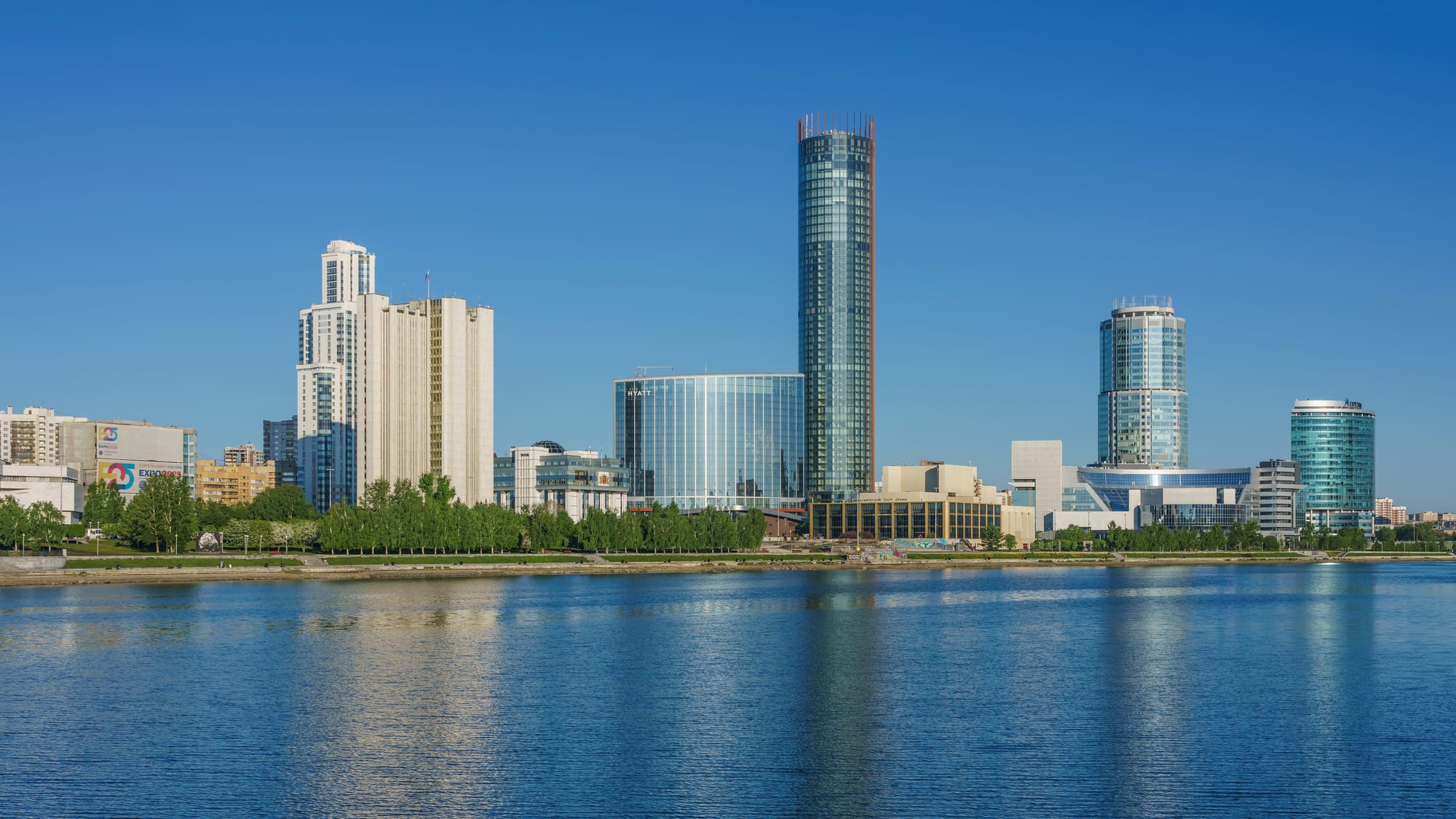
Glass towers and white high-rises rising behind a green waterfront, reflected in a calm blue lake under a clear sky

The Urals, Russia

Yekaterinburg

The towers of the Yekaterinburg City business district seen across the City Pond on the Iset River. (A.Savin / Wikimedia Commons · FAL)

Russia's fourth-largest city, with about 1.55 million people on the Iset River just east of the Urals — founded as an ironworks-fortress in 1723, the place where the last tsar and his family were killed in 1918, and as Sverdlovsk a Soviet heavy-industry powerhouse. Today it is a business city of skyscrapers, constructivist buildings and street art. This page is written to explain the city, not to encourage travel.

Neighbourhoods

  • The historic centre and the City Pond
    • First-time visitors
    • Historic district
    • Museums

    The core of the old ironworks town around the dam on the Iset, with 1905 Square, the oldest square in the city, the fine arts museum around the ironworks' hospital of 1730, the Kharitonov Palace and the Church on the Blood a short walk apart.

    Open in Maps
  • Yekaterinburg City
    • Architecture
    • Business travellers
    • Views

    The business district on Boris Yeltsin Street on the Iset embankment, where the 52-storey Iset Tower and other glass skyscrapers rise.

    Open in Maps
  • Verkh-Isetsky
    • Industrial history
    • Local life

    The district around the upper pond and the Verkh-Isetsky works, founded in 1726 as a separate factory settlement known as VIZ and joined to the city in 1926.

    Open in Maps
  • Uralmash
    • Constructivist architecture
    • Soviet history

    The workers' district in the north built around the giant Urals Machine-Building Plant, with constructivist buildings of the 1920s–30s and the White Tower.

    Open in Maps
  • Akademicheskiy
    • Quiet and residential

    The city's newest district, created in 2020 from parts of the Leninsky and Verkh-Isetsky districts and enlarged in 2021.

    Open in Maps

Things to do

The Romanovs and the Soviet past

  • Church on the Bloodlandmark

    The Orthodox church consecrated in 2003 on the site of the Ipatiev House, where Nicholas II, his family and household were murdered in July 1918; the house itself was demolished in 1977.

    Open in Maps
  • Yeltsin Centermuseum

    The cultural centre opened in 2015, with a museum of Russia's recent political history and of Boris Yeltsin, its first president; in 2017 the Council of Europe recognised it as the best museum in Europe.

    Open in Maps
  • 1905 Squarelandmark

    The oldest square in the city and its main civic space, in front of the city administration building.

    Open in Maps

Museums

  • Yekaterinburg Museum of Fine Artsmuseum

    The largest art museum in the Urals, on the bank of the Iset around a hospital of 1730, holding Russian paintings and the Kasli cast-iron pavilion made for the 1900 Paris World Fair.

    Open in Maps
  • Nevyansk Icon Museummuseum

    A private museum opened in 1999, displaying more than 300 icons of the Nevyansk school from the 18th to the 20th centuries, with free entry.

    Open in Maps
  • Sverdlovsk Regional Museum of Local Loremuseum

    One of the oldest museums in the city, founded in 1870, with archaeological finds from the Stone and Bronze Age settlements around Yekaterinburg.

    Open in Maps
  • Kharitonov Palacelandmark

    A Neoclassical townhouse begun in 1794 for the Old Believer merchant Lev Rastorguyev, an architectural monument of federal significance with a park behind it.

    Open in Maps

Skyline and the river

  • Iset Towerlandmark

    The 52-storey, 213-metre skyscraper of the Yekaterinburg City district, the tallest building in the city.

    Open in Maps
  • Vysotskylandmark

    A skyscraper that is the third-tallest building in Russia outside Moscow.

    Open in Maps

Music, stage and sport

  • Ural Philharmonic Orchestraattraction

    An orchestra of about a hundred musicians, based at the Sverdlovsk Philharmonic, giving more than 100 concerts a year.

    Open in Maps
  • Yekaterinburg Opera and Ballet Theatreattraction

    The city's opera house, which won four Golden Mask awards in 2020, including best opera production.

    Open in Maps
  • Yekaterinburg Arenaattraction

    The rebuilt 1957 stadium that hosted 2018 World Cup matches, home of FC Ural, the country's oldest football club.

    Open in Maps

Short trips from the city

  • Ganina Yamalandmark

    The mine pit in the forest north of the city where the Romanovs' bodies were first thrown in 1918, now the site of the Monastery of the Holy Imperial Passion-Bearers, built in 2001.

    Open in Maps
  • Leaning Tower of Nevyansklandmark

    The 57.5-metre tower of the Demidov ironmasters in the town of Nevyansk, built between about 1721 and 1745, which leans about three degrees from the vertical.

    Open in Maps
  • Europe–Asia border markerslandmark

    Several symbolic monuments near the city mark the line of the Urals that divides Europe from Asia.

    Open in Maps

Seasonal events

  • Night of MuseumsMay

    The city's museums take part every year in the international night when museums stay open late.

  • Victory Day9 May

    The biggest state occasion of the year, with parades and families marching with portraits of relatives who fought in the Second World War.

  • Romanov anniversarymid-July

    On the anniversary of the murder, a night-long service is held at the Church on the Blood, and at daybreak a procession walks for about four hours to Ganina Yama.

Eat and drink

Long-standing places and food districts in Yekaterinburg. Hours, ratings and directions come from your maps app, always current.

Food districts and markets

  • Shartashsky marketmarket

    The city's one agricultural market.

    Open in Maps
  • Stolovaya canteensrestaurant

    Yekaterinburg has hundreds of stolovaya dining rooms, the everyday canteens of Russian cities.

    Open in Maps
  • City-centre cafésneighborhood

    The streets around 1905 Square and the City Pond hold many of the city's cafés, coffee houses and restaurants, with Russian, Japanese and Italian food the usual mix.

    Open in Maps

Experience Yekaterinburg

History

People lived along the Iset long before the city: a Neolithic settlement with stone-working workshops has been excavated there, and Bronze Age peoples also lived in the area. The first Russian ironworks within today's boundaries was founded at Uktus in 1702, and in 1720 Peter the Great sent Vasily Tatishchev to the Urals to manage the mines, followed in 1722 by the engineer Georg Wilhelm de Gennin. They chose a better-watered site on the Iset, and the new ironworks, dam and fortress began work in November 1723. The town was named after the emperor's wife, the future Catherine I, and was at once a factory and a frontier fort between Europe and Asia.

The Siberian Route, opened through the city in 1763, made it a trading town, and by the early 19th century it was the capital of Russian mining, with its own mint and gold workings. In 1918 the deposed Nicholas II and his family were held in the Ipatiev House; as the Czechoslovak Legion closed in, they were murdered there in the early hours of 17 July.

Renamed Sverdlovsk in 1924, the city became a centre of Stalin's heavy industry, with the giant Uralmash plant, and its population tripled. In the Second World War it built armoured vehicles, took in evacuated factories and sheltered part of the Hermitage collections. In 1977 the Ipatiev House was demolished on a Politburo resolution, by order of the local party chief, Boris Yeltsin, and in 1979 an anthrax leak from a military facility caused an outbreak in the city. During the 1991 coup attempt Yeltsin named it a reserve capital, and in September 1991 it took back the name Yekaterinburg. It hosted the BRIC and Shanghai Cooperation Organisation summits in 2009 and World Cup matches in 2018.

Culture & Customs

Yekaterinburg likes to call itself Russia's third capital, and its cultural life supports the claim: about 50 museums, the third-largest number of theatres in the country, the Ural Philharmonic Orchestra and an opera house that won four Golden Masks in 2020. Its stages range from the drama and musical comedy theatres to the Kolyada-Theatre. The writers Pavel Bazhov and Dmitry Mamin-Sibiryak, who described the old Ural works, are remembered in the United Museum of Ural Writers.

The city is the home of "Ural rock" — Nautilus Pompilius, Chaif, Agata Kristi and Urfin Dzhyus were all formed here — and today it calls itself Russia's capital of street art. Stenograffia, held each year, is considered the largest and oldest street-art festival in Russia. Architecturally the city is known for constructivism: more than 140 buildings of the 1920s–30s, from housing blocks to the White Tower at Uralmash, now overlooked by the new glass towers of Yekaterinburg City.

The city has had an independent streak. In 2013 it elected Yevgeny Roizman of the Civil Platform party, founder of the icon museum, as mayor — the last direct mayoral election before they were abolished in 2018. The Romanov murder has made it a centre of Orthodox pilgrimage, and each July a procession walks from the Church on the Blood to Ganina Yama.

Daily Life

About 1.55 million people lived in Yekaterinburg at the start of 2025, and up to 2.2 million in the wider urban area. It is the fourth city of Russia and the capital of the Urals Federal District, and its economy ranks third in the country after Moscow and St Petersburg.

In Soviet times industry made up almost all of the economy, much of it for defence. Today metalworking and machine-building — Uralmash, the turbine plant, copper and steel companies — sit beside banking, trade, logistics and software; the city has the regional headquarters of the Central Bank and the largest software firm in Russia, SKB Kontur. Wages and retail spending are among the highest of Russia's big cities, and the Ural Federal University is the largest in the country. The Central Military District is commanded from here.

Most people live in Soviet housing estates, from the five-storey blocks of the 1960s in Kirovsky and Chkalovsky districts to newer towers in Akademicheskiy. Residents name healthcare, housing and transport as the city's main problems; the metro, with one line, struggles with old trains and too little money. Winter shapes the year, from the long heating season to cross-country skiing on trails around the city.

Food

Pelmeni are tied to the region's history. These dumplings, a filling wrapped in thin unleavened dough and considered a national dish, became a Russian staple during the expansion into the Urals and Siberia, and their name was borrowed from the Komi and Udmurt languages. They are eaten smothered in butter or Siberian-style, sprinkled with vinegar and freshly ground pepper, and are commonly topped with sour cream or dill.

Beyond pelmeni the city eats in the Russian way: borsch and shchi, blini, kasha, pirozhki and cold okroshka in summer, with zakuski of pickled cucumbers and mushrooms, herring and black bread to open a proper meal. Tea is drunk strong with jam, and kvass is the traditional soft drink. Yekaterinburg has hundreds of stolovaya dining rooms, as well as many cafés and coffee houses.

Restaurants in the centre mostly offer the usual Russian mix of Russian, Japanese and Italian food. The Shartashsky market is the city's one agricultural market.

Planning tools

Budget

Yekaterinburg is mid-priced by Russian standards: cheaper than Moscow, with wages among the highest of Russia's big cities. As everywhere in Russia, the difficulty is payment rather than price: most foreign cards no longer work, so the money for the stay has to be brought in as cash.

Daily Budget Midrange
USD 85–180 (mid-range hotel, restaurants, museums and a concert or opera)
Daily Budget Shoestring
USD 30–60 (hostel, stolovaya canteens, trams and the metro)

Carry enough foreign cash for the whole stay; the Nevyansk Icon Museum is free, and the embankments and squares cost nothing.

Best Time to Visit

June to early September, when the weather is warm and the river embankments are busy; July brings the Romanov anniversary pilgrimage, and May the Night of Museums. Winters are long and cold, with snow from autumn to spring. Timing matters less than the national picture: most governments advise against all travel to Russia.

Suggested Number of Days

Two or three days are enough for a first visit to the city itself. Allow about four to include short trips out to the forests and old ironworks towns of the Urals around it.

First Visit
2–3 days
With Surroundings
4 days

Transportation

Trams, running since 1929, are the backbone of public transport, with buses and trolleybuses alongside. The single metro line, opened in 1991, has nine stations over about 13 km and links the centre with Uralmash in the north. Taxis are ordered by app. The city keeps Yekaterinburg Time, two hours ahead of Moscow.

Carry passport, visa and migration card on every journey, and set phones to local time — two hours ahead of Moscow.

Airport & Station Connections

Koltsovo International Airport, one of the busiest in Russia, is about 16 km south-east of the city. All Trans-Siberian trains stop at the main railway station, with trains to Moscow, about 1,667 km to the west, and on into Siberia, and six federal highways meet in the city.

Walkability

The centre is compact and pleasant on foot: the dam, 1905 Square, the museums, the Church on the Blood and the business district are all within a walk of each other along the Iset and the City Pond. The outer districts are spread out and need the tram or metro. Pavements are icy in winter.

Safety

The Urals lie far from the front line, but the national risks apply in full: arbitrary detention of foreigners on political charges, wartime censorship laws and near-total loss of consular support. Men of certain ages, including dual nationals, may face conscription or exit bans. The region is full of arms factories and nuclear sites, including closed towns that foreigners cannot enter, and Yekaterinburg is the headquarters of the Central Military District.

Most governments advise against all travel to Russia and against any travel near the Ukrainian border. Do not photograph factories, military sites, bridges or energy infrastructure, and keep political opinions offline. Check current official travel advice before travelling.

Climate

Humid continental, with warm summers and cold winters and sharp swings in between: the Urals block mild western air, leaving the city open to Arctic cold from the north and hot air from Central Asia. Winter can bring anything from −40°C frost to a thaw with rain, and snow cover is usually 40–50 cm deep.

Summer
warm, with July averaging about 19°C; the record high is 40°C, set in July 2023
Winter
long and cold, with January averaging about −12.6°C; the record low is −44.6°C

Local Customs

Most of the city is Orthodox, with Muslim, Old Believer, Catholic, Protestant and Jewish communities. In Orthodox churches women usually cover their heads and men remove hats. The Church on the Blood and Ganina Yama are pilgrimage sites, where quiet and modest dress are expected. Hospitality around the table, with zakuski and toasts, matters, and Victory Day is treated with great seriousness.

Do not photograph factories, military sites or police, and avoid political conversations with strangers; wartime laws punish public criticism of the army.

Common Payment Methods

The currency is the rouble (RUB). Western credit and debit cards such as Visa and Mastercard do not work in Russia, and most foreign bank cards cannot be used at Russian ATMs, so all the money needed has to be brought in as cash.