History · San Marino
Why is San Marino the world's oldest republic?
A hermit's legend dates it to 301, but its real claim rests on councils recorded since 1243, statutes from 1600 and centuries of shrewd survival.
By Globeway Editorial · 13 October 2026
The short answer
San Marino calls itself the world's oldest republic because no other surviving state can point to republican government stretching back so far without a break. Its founding date, AD 301, comes from a legend about a Christian stonemason named Marinus, so the claim rests partly on tradition. The firmer evidence starts later: elected joint heads of state, the Captains Regent, are recorded from 1243, written statutes from 1263, and the Statutes of 1600 still sit at the heart of its constitution, and they are often described as the oldest governing documents still in force.
It survived because it was small, poor, perched on a mountain and politically clever. Over the centuries it fended off local lords, was briefly occupied more than once, charmed Napoleon, sheltered Garibaldi, and stayed outside the new Kingdom of Italy. Every other medieval Italian republic, from Venice to Genoa to Lucca, was swept away; San Marino, 61 square kilometres of hills entirely surrounded by Italy, is the one that remains.
A hermit's mountain
According to tradition, Marinus came from the island of Rab, in what is now Croatia, to work on the walls of Rimini. Ordained a deacon there, he fled to Monte Titano, a limestone outcrop little more than 10 kilometres from the Adriatic, to build a chapel and live as a hermit, away from the persecution of Christians under the emperor Diocletian. A sympathetic landowner from Rimini, Felicissima, is said to have given the mountain to the small community that gathered around him. His feast day, 3 September, commemorates the founding and is the national holiday.
Legend gives Marinus dying words that the republic has treated as its founding charter: "I leave you free from both men", usually understood as the emperor and the pope. The earliest manuscripts about his life date only from the 10th century, and the historian William Miller described the founding stories as "a mixture of fables and miracles" that may still hold "some grains of fact". The first solid evidence of a monastic community on the mountain comes from a monk named Eugippius, writing around 511.
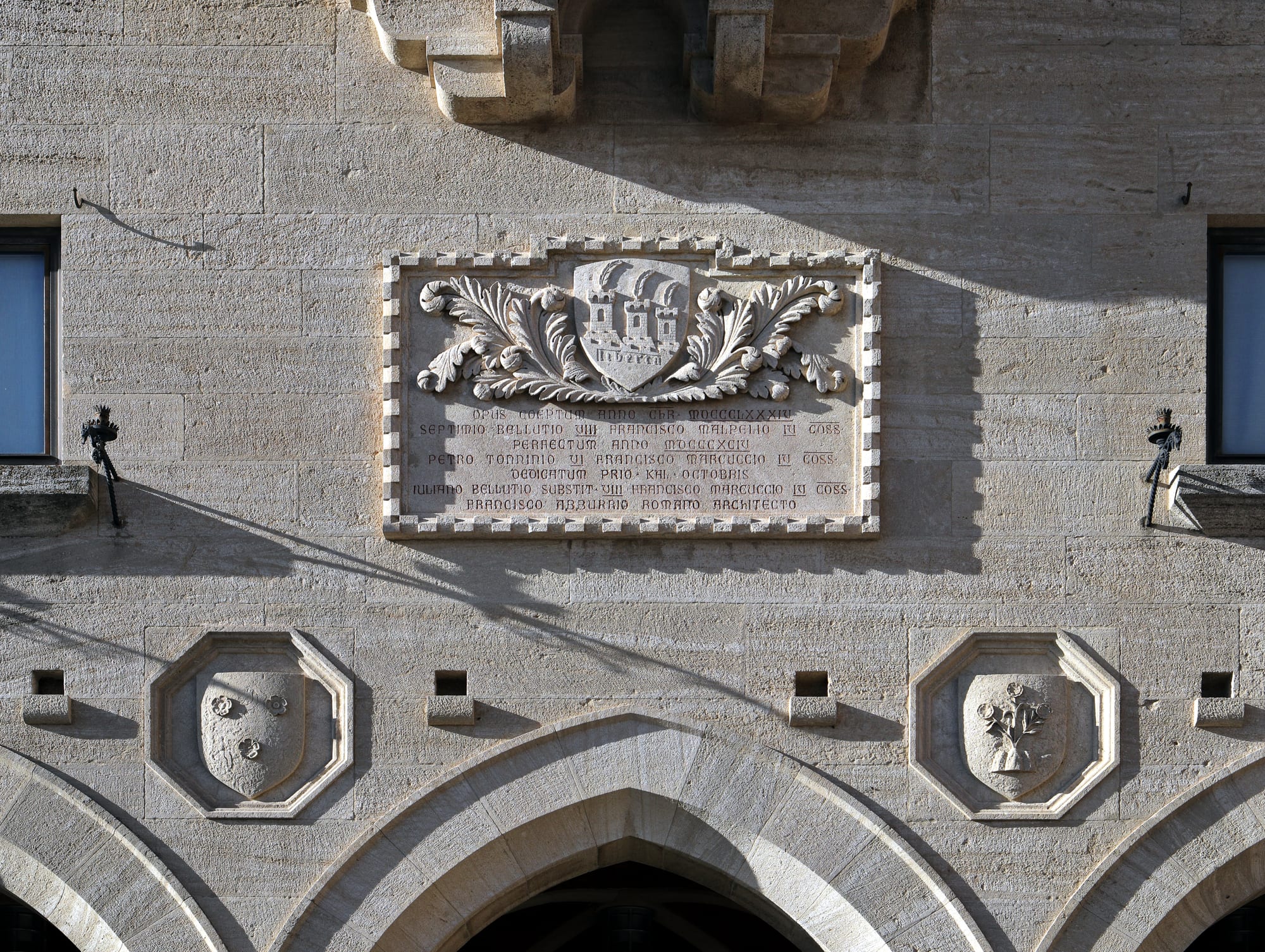
The same emblem appears on the national coat of arms and flag: a shield with three towers on three peaks above a scroll bearing the word LIBERTAS, Latin for freedom.
Councils, captains and the Statutes of 1600
What makes San Marino a republic rather than a principality is the way it has been governed. The first known body was the Arengo, an assembly of the heads of the leading families with no single leader and no fixed meeting place. As the population grew it became crippled by family feuds, and by the 13th century real power had passed to an elected Grand and General Council.
In 1243 the council chose the first two consuls, later called Captains Regent, for a six-month term. The arrangement echoed the paired consuls of ancient Rome, and it has never stopped: the council still elects two Captains Regent every six months, installed on 1 April and 1 October, and no one may hold the office again within three years. At the end of their term they answer to a review called the Regency Syndicate, a check on power that goes back to the Statutes of 1499.
The state's earliest statutes date from 1263. The Statutes of 1600, a collection of laws that came into force that year, named the council the "supreme, absolute and only prince" of the community. Scholars disagree about whether these documents amount to a written constitution, but they remain at the core of San Marino's constitutional framework, and the oath of the Captains Regent is still taken in the form they prescribe.
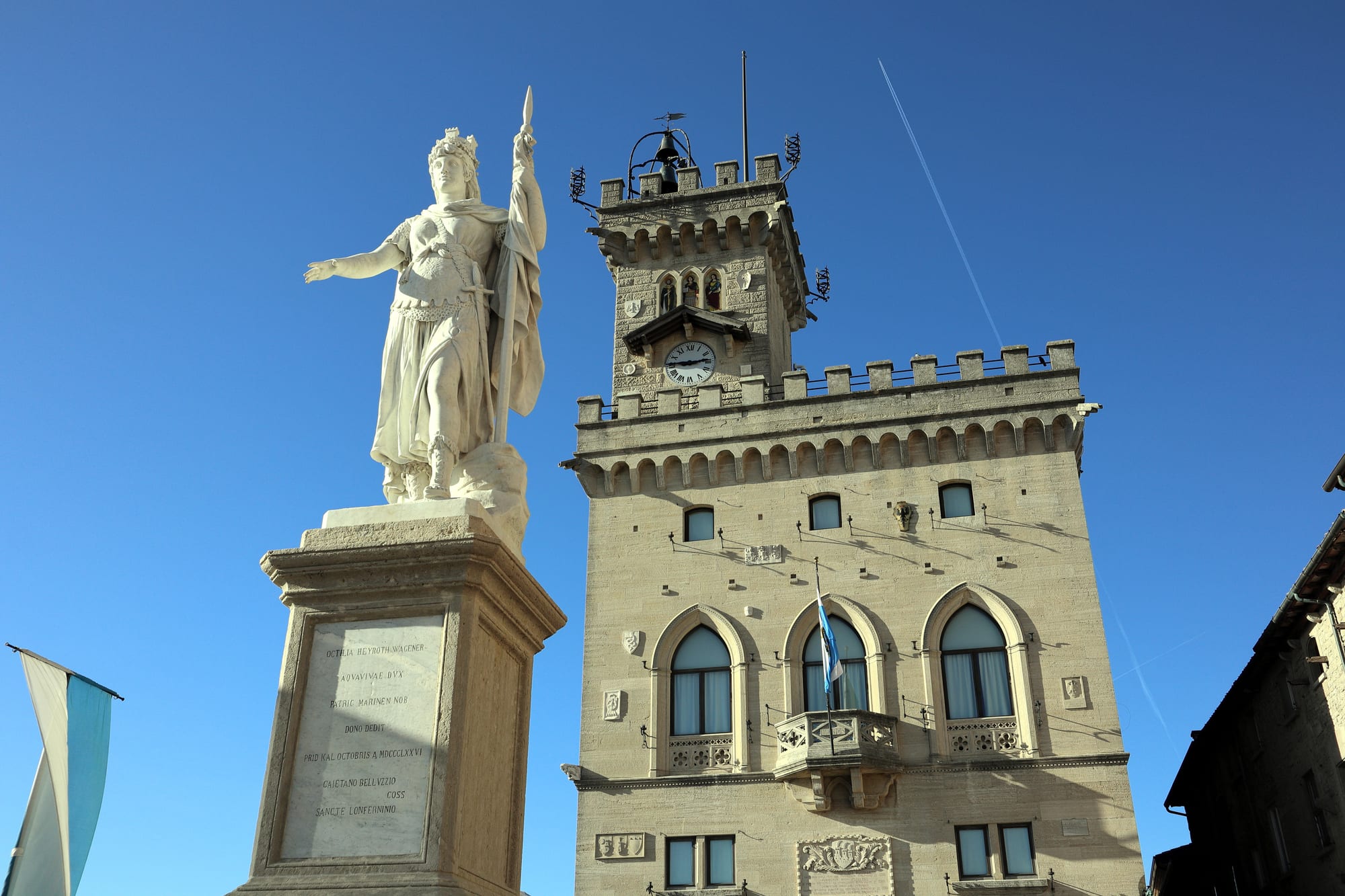
The present Palazzo Pubblico, designed by the Roman architect Francesco Azzurri, was built between 1884 and 1894 on the site of a 14th-century predecessor.
Too small to bother with, too clever to conquer
Geography helped. Monte Titano rises to 739 metres, and its isolation gave the community the seclusion it needed. The lords of Montefeltro, the Malatesta of Rimini and the lords of Urbino all tried to take the town and failed. In 1463 San Marino joined an alliance against Sigismondo Pandolfo Malatesta, and when he was defeated Pope Pius II rewarded it with the castles and towns of Fiorentino, Montegiardino and Serravalle. Faetano joined of its own accord that year, and the borders have not changed since.
The republic was not invincible. After 1625, when the Papal States absorbed the Duchy of Urbino, San Marino was completely surrounded by papal territory and in 1631 accepted the pope's formal protection, which never became real papal control. In 1739 Cardinal Giulio Alberoni, the papal governor of Ravenna, occupied it by force, but after secret appeals to Rome Pope Clement XII restored its independence on 5 February 1740.
- 301
Traditional date of Marinus's community on Monte Titano.
- 1243
The Grand and General Council elects the first two Captains Regent.
- 1463
San Marino gains the territory it still holds today.
- 1600
The Statutes of 1600 come into force.
- 1739–1740
Cardinal Alberoni occupies the republic; the pope restores it.
- 1815
The Congress of Vienna ratifies San Marino's independence.
- 1862
A Convention of Friendship with the new Kingdom of Italy.
- 1992
San Marino joins the United Nations.
Napoleon, Garibaldi and the unification of Italy
The greatest danger came when Europe's map was redrawn. In 1797 Napoleon's army reached the region, and one of the Captains Regent, Antonio Onofri, won the general's respect. Napoleon saw in it a surviving example of republican ideals, promised to protect its independence and even offered to enlarge it. San Marino politely declined the extra land. Napoleon exempted its citizens from taxes and sent wheat. Venice and Genoa, by contrast, were conquered by his armies that same year, and Lucca was turned into a principality in 1805. The Congress of Vienna ratified San Marino's independence in 1815.
When Italy was being unified, San Marino again made friends in the right places. In 1849 it covered the retreat of Giuseppe Garibaldi and 250 followers after the fall of the Roman Republic. Garibaldi promised to respect its wish to stay out of a united Italy, and in 1860 pressed King Victor Emmanuel II to call off a planned annexation. A Convention of Friendship with the new kingdom followed in 1862.
A republic that kept changing
Being old has not meant standing still. The Statutes of 1600 also let the council fill its own seats, and over time power gathered in the hands of wealthy landowners. In 1906 the Arengo was summoned again, with 805 of 1,477 heads of family present, and voted for reforms that led to the first political elections that year. A fascist party dominated the government from the 1920s into the Second World War, though the republic stayed neutral in both world wars. Women won the right to vote around 1960, San Marino joined the Council of Europe in 1988 and the United Nations in 1992, and in 2022 Paolo Rondelli became one of the Captains Regent, the world's first openly gay head of state.
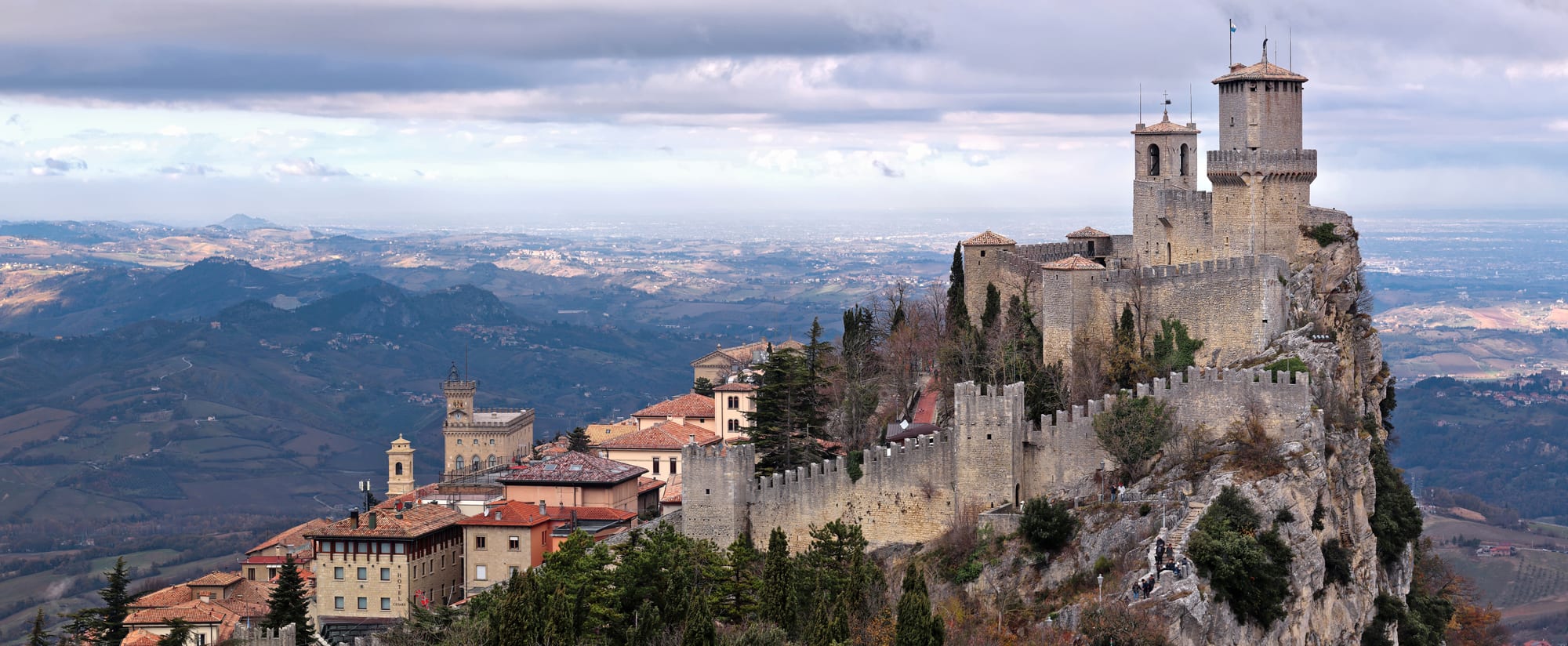
Today the ridge of Monte Titano carries the three towers that appear on the flag: the 11th-century Guaita, the 13th-century Cesta on the highest summit, and the 14th-century Montale. Together with the historic centre of the capital they have been a UNESCO World Heritage Site since 2008. Twice a year, on 1 April and 1 October, the investiture of new Captains Regent shows the republic's oldest institution still at work.